Yahoo Class Action Lawsuit 2026: Settlement Status, Data Breach Claims, and What You Need to Know
Quick Answer
- The Yahoo data breach class action settlement is real and court-approved.
- Per-person payouts have already been distributed; new claims may not be accepted.
- Check the official settlement website for any residual or late-claim options.
If you searched for “Yahoo class action lawsuit,” you probably remember the breach. Maybe you had a Yahoo account in 2013 or 2014. Maybe you got a settlement notice years ago and ignored it. Or maybe you saw a recent ad claiming Yahoo owes you money and you want to know if it is real.
The Yahoo data breach litigation is real. It is one of the largest data breach settlements in U.S. history. But the claim window has closed. If you did not file a claim before the deadline, you may not be able to collect. That is the honest answer most sites bury.
This article covers the settlement history, what was verified, who qualified, how much people actually received, what the data breach involved, and whether any Yahoo-related claims remain open in 2026.
| The Facts | |
|---|---|
| Case | In re Yahoo! Inc. Customer Data Security Breach Litigation |
| Court | U.S. District Court, Northern District of California |
| Status | Settlement approved; payments distributed |
| Settlement Fund | $117.5 million |
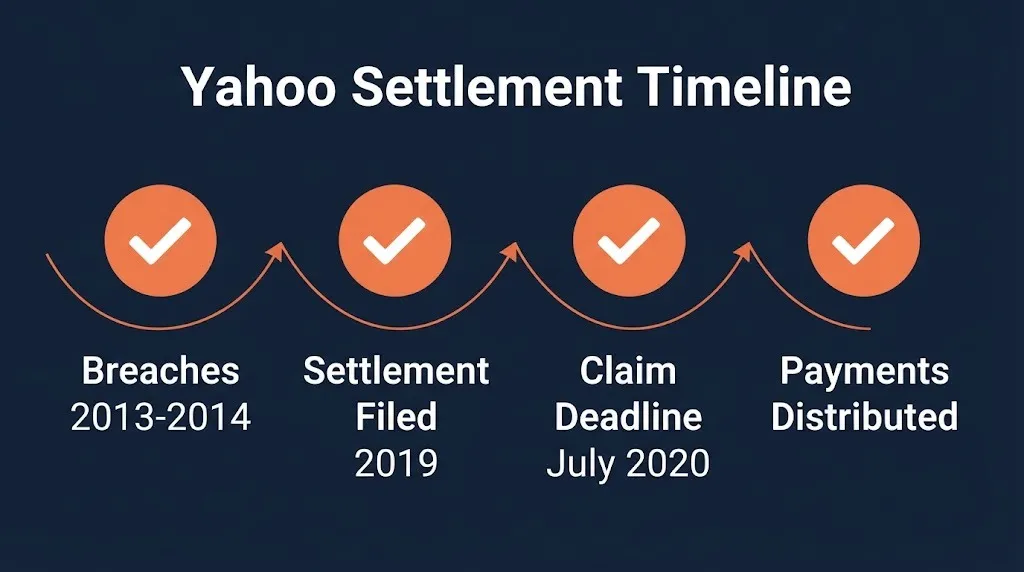
| Claim Deadline | July 20, 2020, now closed |
| Administrator | Epiq |
| Proof Needed | Yahoo account ownership or identity verification |
Is the Yahoo class action lawsuit real?
Yes, the Yahoo class action lawsuit is real. The case was called In re Yahoo! Inc. Customer Data Security Breach Litigation. It was filed in the U.S. District Court for the Northern District of California after Yahoo disclosed a series of data breaches affecting billions of user accounts.
The court approved a $117.5 million settlement. That number is verified. The settlement resolved claims that Yahoo failed to protect user data and delayed disclosing the breaches. The company did not admit wrongdoing, but it paid to end the litigation.
The settlement administrator was Epiq. The claims period closed on July 20, 2020. If you filed a valid claim, you may have received a payment. If you did not file, the settlement is now closed.
This is not an ongoing open settlement. Some articles still describe it as active. That is outdated. The case has moved from active settlement to payment distribution to closed.
What was the Yahoo data breach settlement?
The Yahoo data breach settlement was a $117.5 million class action settlement that resolved claims from multiple data breaches between 2013 and 2016. The breaches compromised names, email addresses, phone numbers, birth dates, hashed passwords, and in some cases security questions and answers.
The settlement fund covered class members in the United States and Israel who had a Yahoo account between 2012 and 2016. The fund also provided credit monitoring or a cash payment alternative.
Here is how the settlement fund was structured.
| Component | Details |
|---|---|
| Total fund | $117.5 million |
| Credit monitoring | Available as an alternative to cash |
| Identity theft reimbursement | Up to certain limits for documented losses |
| Business accounts | Separate settlement category |
| Small business claims | Reimbursement for certain documented losses |
The amount each person received depended on how many claims were filed and whether the person chose credit monitoring or cash. The average cash payment was smaller than many expected because millions of people filed claims.
How much did people get from the Yahoo settlement?
The Yahoo settlement payout per person was smaller than many claimants expected. The final amount depended on claim volume and claim type. Many class members received less than $50. Some received more if they documented identity theft losses.
The settlement did not promise a fixed per-person amount. The $117.5 million fund was divided among eligible claimants after attorney fees, administration costs, and named plaintiff service awards were deducted. Those deductions reduced the amount available for the class.
Attorney fees in the Yahoo case were substantial. The court approved fees for class counsel. The settlement administrator Epiq also received payment for processing claims. After those amounts, the remaining fund was distributed pro rata.
Here is a simplified breakdown.
| Category | Approximate Impact |
|---|---|
| Attorney fees | Approved by court, reduced fund |
| Administration costs | Paid to Epiq |
| Named plaintiff awards | Small per-person amounts |
| Class member payments | Remaining fund divided pro rata |
The pro rata distribution means everyone who filed a valid claim got a share, but the share shrank as more claims were filed.
Key Takeaway: The Yahoo settlement was real and paid out, but the per-person amount was modest for most claimants. If you expect a large windfall from a data breach settlement, adjust that expectation.
Can I still file a Yahoo settlement claim?
No, you cannot file a Yahoo settlement claim now. The claim deadline was July 20, 2020. The claims period is closed. The settlement administrator is no longer accepting new claim forms.
If you filed a claim before the deadline, you may still be able to check your claim status. The settlement administrator’s website may still have a status tool. If you did not file, you missed the window.
Courts rarely reopen claim deadlines after final approval. Exceptions exist for people who never received notice through no fault of their own, but those are rare and fact-specific. You would need to show a legal basis for late filing, not just that you forgot.
Do not pay anyone who claims they can get you a late Yahoo settlement payment. That is a scam signal. No legitimate settlement administrator charges a fee to file or check a claim.
What was the Yahoo data breach?
The Yahoo data breach was a series of cyberattacks that exposed user data from billions of accounts. The largest breach, disclosed in 2016, affected approximately 3 billion accounts. That number was revised upward after Yahoo initially said 1 billion accounts were affected.
The breaches occurred in 2013 and 2014. Attackers stole names, email addresses, phone numbers, dates of birth, hashed passwords, and in some cases security questions. Yahoo’s disclosure was delayed, which became a central issue in the litigation.
The breach was one of the largest in internet history at the time. It affected Yahoo Mail, Yahoo Fantasy Sports, Flickr, and other Yahoo services. If you had any Yahoo account during that period, you were likely in the class.
The settlement resolved claims that Yahoo did not do enough to protect user data and did not tell users fast enough after discovering the breaches.
What was the Yahoo lawsuit about?
The Yahoo lawsuit claimed that Yahoo failed to protect user data and delayed disclosing multiple data breaches. Plaintiffs said Yahoo’s security practices were inadequate and that users suffered harm from identity theft, spam, and loss of trust.
The litigation consolidated dozens of individual lawsuits into a multidistrict litigation in the Northern District of California. The plaintiffs sought damages for negligence, breach of contract, and violations of state data breach and consumer protection laws.
Yahoo argued that its security measures were reasonable and that no specific harm was proven for most users. The settlement ended the dispute without a trial. Yahoo did not admit liability.
The case is important because it set a precedent for how courts handle data breach class actions involving massive user bases and uncertain individual harm.
Who was eligible for the Yahoo settlement?
Eligibility for the Yahoo settlement generally included anyone in the United States or Israel who had a Yahoo account between January 1, 2012, and December 31, 2016. That class definition covered most people who used Yahoo Mail, Yahoo Fantasy, Flickr, or other Yahoo services during that period.
The class definition was broad. You did not need to prove your account was specifically compromised. You just needed to have had an account during the covered period. That is why millions of people were eligible.
If you had multiple Yahoo accounts, you were still one class member. The settlement did not pay per account. It paid per person.
The deadline to file was July 20, 2020. Even if you met the eligibility definition, missing the deadline meant no payment.
What proof was needed for the Yahoo settlement?
The Yahoo settlement required minimal proof for most claims. You needed to provide your name, contact information, and either your Yahoo email address or a statement that you had a Yahoo account during the covered period.
For identity theft reimbursement claims, the proof requirement was higher. You needed documentation of actual losses, like bank statements, police reports, or correspondence with creditors. The settlement allowed reimbursement up to certain limits for documented out-of-pocket losses tied to identity theft.
Here is a summary of proof requirements by claim type.
| Claim Type | Proof Required |
|---|---|
| Basic cash claim | Name, contact info, Yahoo email |
| Credit monitoring | Same as basic claim |
| Identity theft reimbursement | Documents showing actual losses |
| Small business claim | Business records and loss documentation |
Most people filed the basic claim. The reimbursement claims required more work and more proof.
Key Takeaway: The Yahoo settlement claim process was simple for basic claims but strict for loss reimbursement. Documentation mattered.
Reality Check: No one from the Yahoo settlement will text you asking for your bank password. No one will ask you to pay a fee to receive a payment. Third-party “claim helpers” are unnecessary. The settlement is closed, and any new solicitation about it should be ignored.
Where can I check my Yahoo settlement status?
You can check your Yahoo settlement status on the official settlement website if the tool is still active. The settlement administrator Epiq maintained a claim status page. You needed your claim ID or the email address you used to file.
If the status tool is no longer available, you may not have another way to check. The settlement is closed and the administrator may have archived the site.
Here is what to look for.
- Search for the official Yahoo data breach settlement website.
- Look for a claim status or FAQ page.
- Enter your claim ID if you have it.
- Check for any residual payment updates.
- Contact the administrator only through the official site.
Do not enter your information on third-party sites that promise to check your Yahoo claim. Those sites are not the administrator.
When will Yahoo settlement checks be mailed?
Yahoo settlement checks have already been mailed. The settlement reached final approval and the distribution phase was completed. If you filed a valid claim and had a confirmed mailing address, you should have received your payment already.
The distribution timeline stretched over several months. Some class members received checks. Some received electronic payments if they selected that option. Some received credit monitoring activation codes.
If you filed a claim and did not receive anything, the first step is to check your spam folder for a payment email. Then check the settlement website status tool. If you moved after filing, your check may have been returned.
There is no new mailing scheduled. The distribution is complete.
Is there a new Yahoo lawsuit in 2026?
There is no confirmed new Yahoo class action settlement in 2026 that is open for claims. Yahoo remains part of Apollo Global Management after its acquisition. The company has faced other litigation, but nothing with an open claims window as of August 20, 2026.
Some law firm marketing pages use “Yahoo lawsuit” as a keyword to attract people searching for the old settlement. Those pages may describe the old case as if it is active. That is misleading.
If you see a 2026 Yahoo lawsuit ad, check the case name and court. The old case was In re Yahoo! Inc. Customer Data Security Breach Litigation. If the ad does not name a case or court, it is not a reliable source.
The practical answer is that the main Yahoo data breach settlement is closed. New claims are not being accepted.
What happened with the Yahoo data breach settlement administrator?
The Yahoo data breach settlement administrator was Epiq. Epiq was responsible for sending notices, processing claims, calculating pro rata payments, and distributing the settlement fund.
Epiq’s role ended after distribution. The settlement website may still exist as an archive. But no new claims are being processed.
If you need to contact Epiq about the Yahoo settlement, use only the contact information on the official settlement website. Do not call numbers listed on random blogs or YouTube videos. Scammers often impersonate settlement administrators.
What did the Yahoo settlement cover?
The Yahoo settlement covered claims arising from the 2013 and 2014 data breaches that Yahoo disclosed in 2016. It included basic cash payments, credit monitoring, identity theft reimbursement, and certain small business claims.
The release was broad. Class members who did not opt out released Yahoo from all claims related to the data breaches. That release bound everyone in the class.
If you opted out of the settlement, you kept your right to sue Yahoo individually. The opt-out deadline was in 2020. Very few people opted out because individual litigation against Yahoo on these facts was expensive and uncertain.
The settlement also covered related claims against Yahoo’s successor entities and partners. The release language was specific and court-approved.
How do class action data breach settlements work?
Class action data breach settlements work by grouping millions of affected users into one case. The parties negotiate a total fund. The court approves the deal. A settlement administrator sends notice and processes claims. The fund is divided pro rata after deductions.
Here is the standard sequence.
- Data breach occurs and lawsuits follow.
- Cases consolidate into a multidistrict litigation.
- Parties negotiate a settlement fund.
- Court grants preliminary approval.
- Settlement administrator sends notice.
- Class members file claims or opt out.
- Court holds final approval hearing.
- Payments go out after any appeals.
The Yahoo case followed this pattern exactly. The $117.5 million fund, the Epiq administration, the July 20, 2020 deadline, and the pro rata distribution all fit the standard model.
Data breach settlements rarely make individual class members rich. The per-person amount is usually small because the class is enormous.
Key Takeaway: Data breach settlements pay modest amounts to many people, not large amounts to a few. The math is simple but unforgiving.
What is the Yahoo settlement pro rata payment?
The Yahoo settlement pro rata payment means each valid claim received an equal share of the remaining fund after deductions. The share was not based on the severity of your individual harm for basic claims. It was based on the number of valid claims filed.
Pro rata is Latin for “in proportion.” In the Yahoo case, the remaining fund was divided by the number of approved claims. More claims meant smaller individual payments.
Here is a simplified example. If $50 million remained for class member payments and 10 million valid claims were approved, each claim would receive $5 before considering administrative rounding and payment costs. The actual numbers differed, but the concept held.
This is why the per-person payment was small. Millions of people filed because the claim form was simple and the class was enormous.
What should I do if I had a Yahoo account during the breach?
If you had a Yahoo account during the breach and missed the claim deadline, there is little you can do now. The settlement is closed. You may still take steps to protect your identity going forward.
Here is a practical checklist.
- Change your password if you still use Yahoo.
- Enable two-factor authentication.
- Review your credit reports for unusual activity.
- Freeze your credit if you are not applying for new accounts.
- Watch for phishing emails that reference Yahoo.
Those steps do not get you settlement money. They protect you from future harm. The Yahoo breach data is still circulating online. Your email address and old passwords may still be in criminal databases.
What is the Yahoo data breach settlement status in 2026?
The Yahoo data breach settlement status in 2026 is closed and distributed. The case is no longer accepting claims. No new payments are scheduled. The settlement administrator has completed its primary work.
If you filed a claim and received payment, the case is over for you. If you filed and did not receive payment, check the official status tool or contact the administrator through the official website.
If you did not file, the case is also over for you. No late claims are being accepted. Watch for scams that claim otherwise.
Is the Yahoo settlement taxable?
The Yahoo settlement payments were generally small and treated as compensatory for data breach harm. Whether you owe tax depends on your individual tax situation and the character of the payment. Most class members received modest amounts unlikely to create significant tax liability.
The IRS generally taxes income unless an exception applies. Settlement payments for personal injury or physical sickness are excluded. Data breach payments are usually not for physical injury. But the practical amount was small for most Yahoo claimants.
Ask a tax professional if you received a large payment or if you filed a reimbursement claim for substantial losses. The basic cash payment is unlikely to trigger a reporting requirement for most people.
What is the Yahoo business account settlement?
The Yahoo business account settlement was a separate category within the $117.5 million fund. It provided reimbursement for certain documented losses tied to the data breach for small business account holders.
The business claim required documentation of lost business, fraudulent charges, or other measurable harm caused by the breach. The proof requirement was higher than the basic consumer claim.
Fewer business claims were filed than consumer claims. That may have meant larger average payments for business claimants who submitted valid documentation. But the amount depended on the specific losses shown.
If you had a Yahoo business account and missed the claim deadline, the same closure rules apply. No new business claims are being accepted.
What Happens Next
If you filed a claim: Check the official settlement website status tool for any archived updates.
If you did not file: The case is closed. Focus on protecting your identity from breach fallout.
If you see a new Yahoo lawsuit ad: Verify the case name and court before believing it.
If you get a text or email about Yahoo money: Delete it. The settlement is closed.
The single most important fact is the July 20, 2020 claim deadline. It has passed. No new Yahoo settlement claims are being accepted.