Bumped From Flight Compensation 2026: DOT Rules, Payout Amounts, and How to Claim
Quick Answer:
- Bumped flight compensation is real and required by federal law for involuntary denied boarding.
- Payouts can reach 400% of your one-way fare, capped at $1,550 per passenger.
- You must claim your compensation at the airport or in writing, with no formal filing deadline.
If an airline bumped you from a flight in 2026, you are probably wondering what they owe you and whether the offer the gate agent made was fair. The answer is not left to airline discretion. Federal rules from the Department of Transportation set minimum compensation for involuntary denied boarding when the airline oversold the flight.
The people searching this term include travelers who volunteered their seat and later realized they left money on the table, and passengers involuntarily removed from oversold flights. The single most important number is 400%, the maximum percentage of your one-way fare the airline must pay for long delays.
This article covers how the rules work, what you are owed based on your delay, how to claim, and when the airline does not have to pay. One surprising detail: if you volunteer your seat, the airline can offer you anything, including vouchers with restrictions, and the federal minimums do not apply.
| The Facts | |
|---|---|
| Governing Rule | DOT 14 CFR Part 250 |
| Applies To | Involuntary denied boarding on oversold flights |
| Maximum Cash Payout | 400% of one-way fare, capped at $1,550 |
| Delay Thresholds | 1 hour and 2 hours based on arrival time |
| Volunteer Compensation | No federal minimum, airline sets terms |
| Claim Deadline | No formal deadline, but prompt filing recommended |
| Administrator | Airline customer service, DOT complaint portal |
Is Bumped Flight Compensation Legitimate?
Yes, bumped flight compensation is a legitimate federal requirement. It is not a class action settlement, not a scam, and not an airline goodwill gesture. The Department of Transportation mandates specific compensation when an airline involuntarily denies you boarding on an oversold flight.
The rule appears in 14 CFR Part 250, the federal regulation governing oversales. It applies to flights within the United States and flights departing the United States. It does not apply to flights departing a foreign country, even on a U.S. airline.
The compensation is separate from any refund. If the airline rebooks you on a later flight, you still receive denied boarding compensation. If you choose not to travel, you receive a refund plus the compensation.
The rule has existed for decades. The DOT updates the maximum payout amounts periodically based on inflation. The current cap is $1,550 per passenger for the highest tier.
How Much Is Bumped Flight Compensation in 2026?
The amount you receive depends on two factors: the length of your arrival delay and the price of your one-way fare. The DOT formula ties compensation to a percentage of that fare, with a dollar cap.
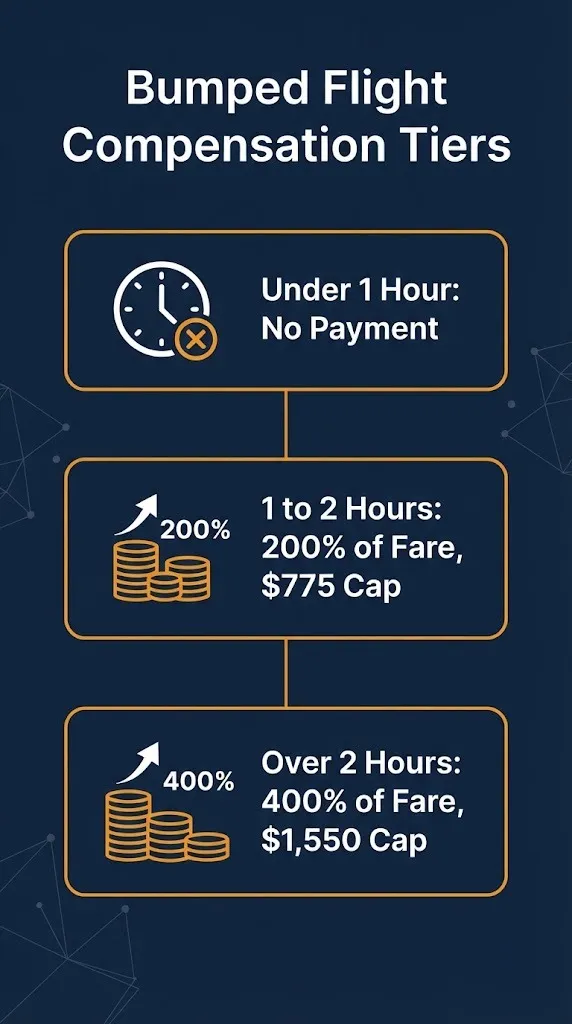
If the airline gets you to your destination within one hour of your original arrival time, you are owed 200% of your one-way fare, capped at $775. If your arrival is delayed by more than two hours, you are owed 400% of your one-way fare, capped at $1,550.
| Delay Length | Compensation Formula | 2026 Maximum Cap |
|---|---|---|
| Less than 1 hour | No compensation required | $0 |
| 1 to 2 hours | 200% of one-way fare | $775 |
| More than 2 hours | 400% of one-way fare | $1,550 |
The one-way fare is the price of the specific flight segment, not your entire round-trip ticket. If you paid $400 for a one-way segment and were delayed three hours, you are owed $1,600 under the formula, but the cap limits you to $1,550.
Airlines sometimes offer vouchers instead of cash. You are entitled to cash or check. A voucher is acceptable only if the airline tells you it can be converted to cash and explains the restrictions.
What Is the Difference Between Voluntary and Involuntary Bumping?
The difference is who made the choice. If you volunteer your seat in exchange for compensation, the airline sets the terms. If you are involuntarily denied boarding, federal minimums apply.
Voluntary bumping happens when the airline asks for volunteers and you agree. The airline can offer a $200 voucher, a free flight, or nothing at all. You negotiate. Once you accept, the federal compensation rules do not apply because you were not involuntarily denied boarding.
Involuntary bumping happens when no one volunteers or not enough volunteers come forward. The airline selects passengers to remove. Those passengers are entitled to the DOT compensation amounts.
| Bumping Type | Who Decides | Compensation Source |
|---|---|---|
| Voluntary | You agree to give up your seat | Airline offer, no federal minimum |
| Involuntary | Airline selects you | Federal DOT formula, mandatory |
The practical lesson is to understand what you are agreeing to when you volunteer. That $300 voucher may be less than the $775 you could receive if you waited to be involuntarily bumped. But waiting carries no guarantee you will be selected.
What Should You Do If You Are Bumped From a Flight?
If you are involuntarily bumped, the first step is to know your rights before accepting anything. The gate agent may offer a voucher when cash is required. You can ask for the required compensation in cash.
Here are the verified steps to take:
- Confirm whether you are being voluntarily or involuntarily denied boarding.
- Ask for a written statement explaining your rights under DOT rules.
- Calculate the one-way fare for your specific flight segment.
- Determine your expected arrival delay on the rebooked flight.
- Request the required compensation in cash or check.
- Keep your boarding pass, ticket receipt, and any written notices.
- If the airline refuses, file a complaint with the DOT.
The airline must provide a written notice explaining the compensation rules. If they do not, that is a violation you can report.
Do not accept a voucher without understanding it. Airlines sometimes offer vouchers that expire quickly or have blackout dates. Cash is always the better option if you are entitled to it.
When Does an Airline Not Have to Pay Bumped Flight Compensation?
Airlines do not have to pay compensation in every case of denied boarding. The rules contain exceptions that airlines use regularly.
The biggest exception is voluntary bumping. If you agree to give up your seat, the federal minimums do not apply. The compensation is whatever you negotiated.
Other exceptions include:
- Smaller aircraft with fewer than 30 seats
- Aircraft substitutions for safety or operational reasons
- Flights departing from a foreign country
- Passengers who fail to check in on time
- Passengers who do not meet the airline’s boarding requirements
| Exception | Applies To |
|---|---|
| Voluntary bumping | You agreed to give up your seat |
| Small aircraft | Fewer than 30 passenger seats |
| Equipment substitution | Safety or operational need |
| Late check-in | Passenger failed to meet deadlines |
| Foreign departure | Flight leaves from outside the U.S. |
The equipment substitution exception is broad. If the airline swaps a larger plane for a smaller one and the seat count drops, the denied boarding rules may not apply. The airline must still accommodate you, but the mandatory cash compensation may be off the table.
Key Takeaway: Involuntary bumping triggers mandatory federal compensation of 200% or 400% of your one-way fare, while voluntary bumping leaves you to negotiate without federal minimums.
Can You Negotiate More Than the DOT Minimum?
You can try to negotiate more than the DOT minimum, but the airline is not required to agree. The federal rule sets a floor, not a ceiling. Airlines sometimes offer more to avoid complaints or to manage angry passengers.
The negotiation is hardest at the gate. Gate agents often have limited authority. They may offer a standard package and nothing more. Asking for a supervisor can help, but the supervisor may also stick to the script.
Your leverage increases after the fact. If the airline violated the rules, a DOT complaint or a small claims lawsuit can push them to settle for more. Airlines often settle DOT complaints with additional compensation to close the file.
| Negotiation Point | Likelihood of Success |
|---|---|
| At the gate, polite request | Low to moderate |
| Ask for supervisor | Moderate |
| Written complaint to airline | Moderate |
| DOT complaint | Higher, if violation occurred |
| Small claims lawsuit | Variable, depends on facts |
The best strategy is to know the exact amount you are owed before you speak to anyone. That way you can recognize whether the airline’s offer meets the legal requirement.
What Is the DOT Rule on Overbooked Flight Compensation?
The DOT rule on overbooked flight compensation is codified at 14 CFR Part 250. The rule requires airlines to follow specific procedures before removing passengers and to pay set compensation when they do.
The rule requires airlines to first ask for volunteers. The airline must explain the compensation offered to volunteers before anyone gives up a seat. If not enough volunteers come forward, the airline can involuntarily deny boarding.
The compensation formula applies to involuntarily bumped passengers based on arrival delay. The rule also requires written notice of the passenger’s rights. The notice must explain the compensation amounts and the right to cash.
The DOT has enforced this rule for decades. Airlines face fines for violations. The rule does not create a private right of action in all cases, but passengers can file DOT complaints and sometimes sue in small claims court.
How Does International Flight Bumping Differ?
International flight bumping rules differ based on where the flight departs. Flights departing the United States are covered by the DOT rule, even on foreign airlines. Flights departing a foreign country are not covered, even on U.S. airlines.
European Union rules apply to flights departing the EU. The EU denied boarding regulation provides compensation of 250 to 600 euros depending on flight distance. The rules are separate from the U.S. system.
| Flight Route | Applicable Rules |
|---|---|
| Departing U.S., domestic or international | DOT 14 CFR Part 250 |
| Departing EU | EU Regulation 261/2004 |
| Departing other foreign country | Country-specific rules may apply |
| Arriving U.S. from foreign country | No DOT coverage |
If you were bumped from a flight departing Paris to New York, EU rules apply. If you were bumped from New York to Paris, U.S. rules apply. The difference matters because compensation formulas differ.
Reality Check: A Voucher Is Not Always the Same as Cash
Reality Check: Airlines often offer vouchers first because vouchers cost them less than cash. If you were involuntarily bumped, you are entitled to cash or check. A voucher is acceptable only if the airline tells you it can be converted to cash and explains the restrictions. If the agent pressures you into a voucher, ask for the written notice of your rights. The notice explains the cash option.
How Do You File a Complaint for Denied Boarding?
Filing a complaint for denied boarding starts with the airline. After the airline responds or fails to respond, you can escalate to the DOT. The DOT complaint process is free and can be completed online.
The airline must acknowledge your complaint and respond within a reasonable time. The DOT expects airlines to respond to consumer complaints within 30 days. If the airline does not resolve the issue, the DOT investigates.
Here is the complaint process:
- Write to the airline’s customer service department with your ticket number and flight details.
- State the facts: date, route, fare paid, delay length, and compensation offered.
- Attach copies of your ticket receipt, boarding pass, and any written notices.
- Wait for the airline’s response, which usually arrives within 30 days.
- If unsatisfied, file a DOT complaint through the online portal.
- The DOT will forward the complaint to the airline and request a response.
- The DOT may take enforcement action if a pattern of violations emerges.
The DOT does not resolve individual complaints like a court. It investigates patterns and can fine airlines. Individual passengers sometimes receive additional compensation through the complaint process, but not always.
What Is the Maximum Payout for Bumped Flight Compensation?
The maximum payout for bumped flight compensation in 2026 is $1,550 per passenger. That applies to the 400% tier for arrival delays of more than two hours. The 200% tier caps at $775.
The cap is tied to inflation and has increased over the years. The DOT reviews the caps periodically. The current amounts have been in effect since the last adjustment, and no change was announced for 2026.
| Compensation Tier | Delay | Formula | 2026 Cap |
|---|---|---|---|
| No compensation | Less than 1 hour | None | $0 |
| Standard | 1 to 2 hours | 200% of fare | $775 |
| Maximum | More than 2 hours | 400% of fare | $1,550 |
A family of four involuntarily bumped and delayed more than two hours could receive up to $6,200 under the caps, assuming each ticket qualifies. The actual amount depends on each passenger’s one-way fare.
What If the Airline Offers a Voucher Instead of Cash?
The airline may offer a voucher, but you can insist on cash. The DOT rule requires payment in cash or check unless the airline offers a voucher that can be converted to cash and clearly explains the restrictions.
A voucher that expires in 90 days, has blackout dates, or cannot be converted to cash does not satisfy the rule. You can reject it and demand cash.
| Offer Type | Meets DOT Rule |
|---|---|
| Cash or check | Yes |
| Voucher convertible to cash | Yes, with disclosures |
| Voucher with blackout dates | No |
| Expiring voucher | No |
| Travel credit | No, unless convertible |
The key word is negotiable. If the voucher can be exchanged for its cash value, it may meet the rule. If it locks you into future travel with restrictions, it does not.
Key Takeaway: The DOT caps bumped flight compensation at $1,550 per passenger for long delays, and airlines must offer cash or a convertible voucher, not restricted travel credits.
How Does Bumping Compensation Differ From Flight Delay Compensation?
Bumping compensation is different from flight delay compensation. In the United States, there is no federal requirement to compensate passengers for ordinary flight delays. The DOT rule applies only to denied boarding on oversold flights.
If your flight is delayed three hours due to weather, the airline does not owe you compensation under federal law. Some airlines offer meal vouchers or hotel accommodations voluntarily, but that is a customer service decision, not a legal requirement.
If you are involuntarily bumped and the rebooked flight arrives three hours late, you are owed compensation because the trigger was denied boarding, not the delay itself.
| Situation | Federal Compensation Required |
|---|---|
| Weather delay | No |
| Mechanical delay | No |
| Oversold, involuntarily bumped | Yes |
| Oversold, volunteered | No, airline discretion |
| Delay after bumping | Yes, baked into bumping formula |
This distinction confuses many travelers. The DOT has proposed but not enacted broader delay compensation rules. As of August 2026, the denied boarding rule remains the primary federal protection.
What Happens Next If You Were Bumped
| Expected Timing | Milestone |
|---|---|
| At the airport | Request cash compensation and written notice |
| Within days | File a written complaint with the airline |
| Within 30 days | Airline responds to your complaint |
| If unsatisfied | File a DOT complaint |
| Within weeks | DOT forwards complaint and requests response |
| Variable | DOT may take enforcement action |
The timeline is predictable. The outcome depends on whether the airline violated the rules. If you were involuntarily bumped and denied the required compensation, a DOT complaint is the strongest tool.
Keep every document. The ticket receipt, boarding pass, written notice, and any emails from the airline establish the facts. Without documentation, your complaint is harder to prove.
Frequently Asked Questions
How much do airlines pay for bumping passengers?
Airlines pay 200% or 400% of your one-way fare for involuntary bumping.
The caps are $775 and $1,550 respectively.
Volunteer compensation is set by the airline.
Can I get cash instead of a voucher for being bumped?
Yes, you can request cash or check for involuntary bumping.
A voucher is acceptable only if convertible to cash.
Ask for the written notice of your rights.
What if my rebooked flight arrives only 30 minutes late?
If your arrival delay is under one hour, no compensation is required.
The airline must still get you to your destination.
The compensation formula starts at one hour of delay.
Does the DOT rule apply to international flights?
It applies to flights departing the United States.
It does not apply to flights departing a foreign country.
EU rules apply to flights departing the EU.
Can I sue an airline for bumping me?
You may file a small claims lawsuit in some cases.
The DOT rule does not always create a private right of action.
A DOT complaint is often the faster path.
What is the difference between overbooking and bumping?
Overbooking is the airline selling more tickets than seats.
Bumping is removing a passenger due to overbooking.
Compensation applies when you are involuntarily bumped.
Do children get the same bumped flight compensation?
Yes, every involuntarily bumped passenger qualifies.
The compensation is per passenger, not per adult.
A family of four may receive four separate payments.
How long do I have to claim bumped flight compensation?
There is no formal deadline in the DOT rule.
Prompt filing is recommended.
Airlines may argue laches if you wait years.
Bumped flight compensation is one of the clearest consumer rights in air travel. The DOT formula is specific, the caps are published, and the process for claiming is straightforward. If you were involuntarily bumped, know your one-way fare, calculate your delay, and demand the required amount in cash. Do not accept a restricted voucher unless you choose to. August 25, 2026 is the date this information was verified. The date that matters most to you is the day you were bumped, and your right to compensation attached that day.