Car Crash Lawsuit in 2026: How to File, Average Settlements, and What to Expect
Quick Answer
- A car crash lawsuit is a personal injury claim against an at-fault driver or other responsible party.
- Average settlements range from $15,000 to $75,000, with serious injury cases exceeding $100,000.
- Each state has a statute of limitations, typically two to three years from the crash date.
A car crash lawsuit is how you recover money after a collision that was not your fault. It is not a class action. It is your individual claim for medical bills, lost wages, and pain and suffering.
If you were in a crash and searching for how lawsuits work, you are probably deciding whether to accept an insurance offer or fight for more. The right answer depends on your injuries, your state’s laws, and the available insurance coverage.
This guide explains the lawsuit process, average payouts, how fault works, and what to do before you sign anything. One fact that surprises people: the first insurance offer is often far below what a case is worth.
The Facts
| Item | Detail |
|---|---|
| Case | Individual personal injury claim, not a class action |
| Status | Varies by individual case |
| Fund Size | No fixed fund, paid by insurance or defendant |
| Est. Per Person | $15,000 to $75,000 average |
| Claim Deadline | State statute of limitations, often 2 to 3 years |
| Administrator | Not applicable, handled by attorneys |
| Proof Needed | Medical records, crash report, wage documentation |
Is a Car Crash Lawsuit Worth Filing?
Yes, a car crash lawsuit may be worth filing if you have real injuries and the insurance offer does not cover your losses. A lawsuit is not automatic. It is a tool you use when negotiation fails.
The value of your case depends on your injuries, the clarity of fault, and the insurance coverage available. A minor fender bender with no injuries is not worth a lawsuit. A crash with surgery, permanent impairment, or lost income is different.
You should consider a lawsuit if the insurance company denies liability, offers less than your medical bills, or pressures you to settle before you know the full extent of your injuries.
The first step is not a lawsuit. It is a demand letter. Your attorney sends the insurance company a detailed account of your damages and a settlement demand. Most cases settle before trial.
Key Takeaway: Lawsuits are for serious claims where negotiation failed. Most car crash cases settle before a judge ever sees them.
How Much Is the Average Car Crash Lawsuit Settlement?
The average car crash lawsuit settlement in the United States falls between $15,000 and $75,000. Cases with severe injuries, such as fractures, surgeries, or traumatic brain injuries, often exceed $100,000.
The average is misleading because every case is different. A rear-end collision with whiplash might settle for $10,000 to $25,000. A head-on collision with multiple surgeries might settle for $250,000 or more.
Here is a typical settlement range by injury severity:
| Injury Type | Typical Settlement Range |
|---|---|
| Minor whiplash, no fracture | $5,000 to $15,000 |
| Fracture requiring cast | $20,000 to $50,000 |
| Surgery required | $50,000 to $150,000 |
| Multiple surgeries, permanent injury | $150,000 to $500,000+ |
| Fatal injury | $250,000 to $1,000,000+ |
These ranges are not guarantees. They are based on reported settlements and insurance industry data. Your case may be higher or lower.
How Much Can I Get from a Car Crash Lawsuit?
You can get economic and non-economic damages from a car crash lawsuit. Economic damages cover medical bills, lost wages, and future care costs. Non-economic damages cover pain and suffering.
The amount depends on three factors: the severity of your injuries, the clarity of fault, and the insurance policy limits. If the at-fault driver has a $25,000 minimum policy, that may cap your recovery unless you have underinsured motorist coverage.
Your medical bills are the foundation of your claim. The insurance company multiplies your special damages by a factor based on injury severity. A common formula is two to three times your medical bills for moderate injuries.
If your medical bills total $30,000 and your case is solid, a fair settlement might be $60,000 to $90,000. That includes pain and suffering on top of the bills.
How Do I File a Car Crash Lawsuit?
You file a car crash lawsuit by having your attorney draft and file a complaint in the appropriate court. The complaint names the defendant, describes the crash, and states your damages.
The process starts long before filing. You gather evidence, complete medical treatment, and attempt to negotiate. Filing a lawsuit is a formal step that signals you are serious.
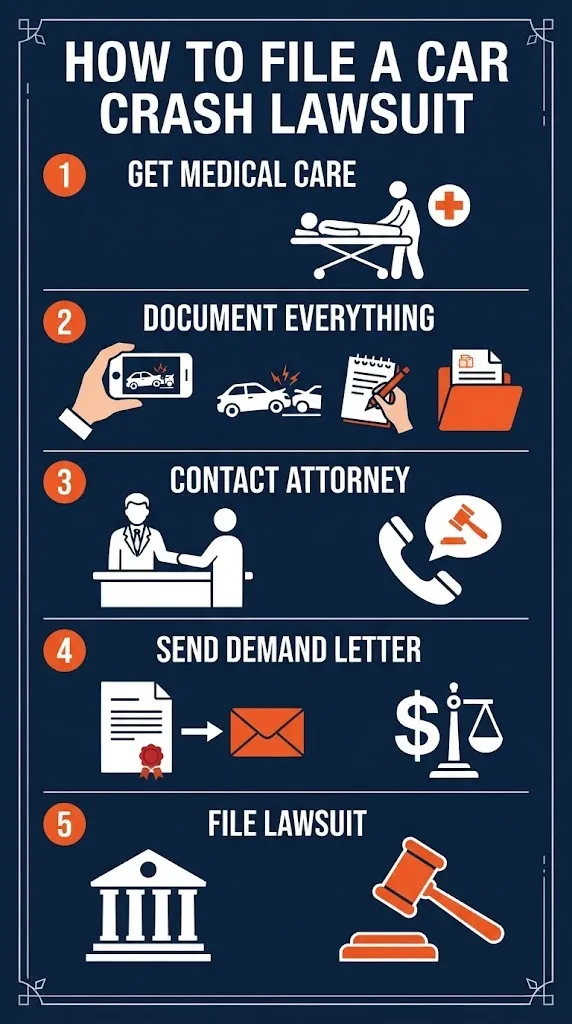
Here are the steps:
- Seek medical treatment immediately after the crash.
- Gather the police report, photos, and witness statements.
- Contact a personal injury attorney for a case evaluation.
- Complete your medical treatment and document all costs.
- Send a demand letter to the at-fault driver’s insurance company.
- Negotiate a settlement if possible.
- File a lawsuit if the insurance offer is inadequate.
Most attorneys work on contingency. You pay nothing upfront. The attorney takes a percentage of the settlement or verdict, usually 33 to 40 percent.
What Is the Deadline to File a Car Crash Lawsuit?
The deadline to file a car crash lawsuit is the statute of limitations in your state. Most states set the deadline at two to three years from the crash date. Some allow less. A few allow more.
If you miss the deadline, your case is barred. You lose the right to sue, no matter how strong your case was. That is why you should contact an attorney soon after the crash.
The deadline applies to the lawsuit filing, not the insurance claim. You can file an insurance claim sooner, but the lawsuit must be filed before the statute runs out.
Exceptions exist for minors, incapacitated adults, and cases where the defendant left the state. Those exceptions are narrow. Do not rely on them.
What Is the Car Accident Claim Process in 2026?
The car accident claim process in 2026 has not changed fundamentally. You report the crash, treat your injuries, document your damages, and negotiate with insurance. Technology has made documentation easier.
Most insurance companies now accept digital photos, electronic medical records, and app-based claims. Some insurers use artificial intelligence to evaluate claims. That can speed up simple cases but complicate serious ones.
The process still favors the prepared. Keep every receipt. Track every missed workday. Document every symptom. The more organized your file, the stronger your negotiation position.
- Report the crash to both insurance companies
- Get a copy of the police report
- Follow all medical advice
- Keep a pain journal
- Save all receipts and bills
- Track lost wages with pay stubs
What Is Comparative Fault in a Car Crash Lawsuit?
Comparative fault means your compensation can be reduced if you were partly responsible for the crash. Most states use some form of comparative fault.
In a pure comparative fault state, you can recover even if you were 90 percent at fault. Your recovery is reduced by your fault percentage. In a modified comparative fault state, you can recover only if you were 50 or 51 percent or less at fault.
A few states use contributory negligence. In those states, if you were even 1 percent at fault, you recover nothing. Those states are rare.
Fault is determined by the police report, witness statements, traffic camera footage, and accident reconstruction. Your attorney’s job is to minimize your fault percentage.
How Long Does a Car Crash Lawsuit Take?
A car crash lawsuit takes 12 to 24 months on average from filing to resolution. Simple cases settle faster. Complex cases with disputed fault or severe injuries take longer.
The timeline breaks into phases. Discovery takes 6 to 12 months. Depositions, medical expert reviews, and document exchanges happen during discovery. Settlement talks often follow.
If the case goes to trial, add another 6 to 12 months. Trials are the exception. More than 90 percent of car crash lawsuits settle before trial.
Your injury treatment timeline also matters. You should not settle until you reach maximum medical improvement. That is the point where your condition is stable and future care needs are known. Settling too early can leave money on the table.
Reality Check
No one from a legitimate car crash claim will call you first and offer money out of nowhere. Insurance companies do not text settlement offers. If a “claims agent” asks for your bank password or a processing fee to release your settlement, it is a scam. Real settlements go through your attorney or a verified insurance check.
What Should I Do After a Car Crash to Protect My Claim?
The steps you take after a crash determine the strength of your claim. What you do in the first 48 hours matters most.
First, get medical care. Even if you feel fine, some injuries appear later. A gap in treatment is the insurance company’s favorite excuse to deny or reduce a claim.
Second, document everything. Take photos of the vehicles, the scene, and your injuries. Get the other driver’s information. Get witness contact details. File a police report if the police will respond.
Third, do not give a recorded statement to the other driver’s insurance company. You are not required to. What you say can be used against you later. Let your attorney handle communication.
- Get medical care immediately
- Take photos and video of everything
- Get the police report number
- Do not admit fault at the scene
- Do not give a recorded statement
- Contact an attorney before signing anything
What Is Pain and Suffering in a Car Crash Lawsuit?
Pain and suffering is non-economic damages. It is the physical pain, emotional distress, and reduced quality of life caused by the crash. It is not a receipt you can submit. It is a value your attorney negotiates.
Insurance companies calculate pain and suffering using a multiplier. The multiplier is based on the severity of your injuries. A minor injury might get a multiplier of 1.5. A catastrophic injury might get a multiplier of 5 or more.
If your medical bills total $40,000 and your injuries are serious, a multiplier of 3 produces $120,000 in pain and suffering on top of the $40,000 in bills. The total demand would be $160,000.
The multiplier is a starting point, not a rule. Your attorney uses it as a benchmark in negotiations.
What Is Underinsured Motorist Coverage?
Underinsured motorist coverage, or UIM, protects you when the at-fault driver does not have enough insurance to cover your damages. It is part of your own auto policy.
If the at-fault driver has a $25,000 policy and your damages are $100,000, you may recover $25,000 from the driver’s insurance and the remaining $75,000 from your own UIM coverage, if you have it.
UIM coverage is optional in most states, but it is cheap relative to its value. Many attorneys recommend carrying at least $100,000 per person and $300,000 per accident in UIM coverage.
A car crash lawsuit sometimes involves suing your own insurance company for UIM benefits. That is a separate claim from the claim against the at-fault driver.
Key Takeaway: Your own insurance coverage often determines your recovery more than the at-fault driver’s policy.
What Happens Next: Timeline for a Car Crash Lawsuit in 2026
- September 2026: Injury victims continue medical treatment and gather documentation.
- October 2026: Demand letters go out in cases where treatment is complete.
- November 2026: Insurance companies respond to demands with offers or denials.
- December 2026: Cases that do not settle enter formal litigation.
- Early 2027: Discovery, depositions, and settlement talks continue.
Frequently Asked Questions
Is it worth suing after a car crash?
Yes, if your injuries are real and the insurance offer is too low.
How much can I get from a car crash lawsuit?
Typical settlements range from $15,000 to $75,000, with serious cases exceeding $100,000.
How long do I have to file a car crash lawsuit?
Most states allow two to three years from the crash date.
What if the other driver has no insurance?
You may recover from your own uninsured motorist coverage if you have it.
Do I need a lawyer for a car crash lawsuit?
Yes, especially if your injuries are serious or fault is disputed.
What is pain and suffering worth?
It is calculated as a multiple of your medical bills, usually 1.5 to 5 times.
What should I not do after a car crash?
Do not give a recorded statement to the other driver’s insurer or sign anything without review.
How much does a car crash lawyer cost?
Most work on contingency, taking 33 to 40 percent of the final settlement or verdict.
Closing
A car crash lawsuit is your path to fair compensation when insurance is not enough. The average settlement is $15,000 to $75,000, but your case depends on your injuries and the coverage available.
Act quickly. Get medical care, document everything, and contact an attorney before you accept any offer. The deadline to sue is real, and the first insurance offer is rarely the best one.