Whatnot Lawsuit 2026: Illegal Gambling Claims, Arbitration Rules, and What Buyers Can Do
Quick Answer
- Whatnot faces arbitration demands and a whistleblower suit claiming randomized card breaks are illegal gambling under California law.
- No settlement exists and no payout amount has been determined. The arbitration process is private and ongoing.
- Users who want to preserve the right to sue in court must opt out of Whatnot’s arbitration agreement within 30 days of accepting new terms.
The Whatnot lawsuit is a collection of legal challenges, not one tidy case. Attorney Paul Lesko filed 15 separate arbitration demands in California on behalf of 30 clients who say Whatnot’s randomized “box breaks” and “repack breaks” are unlawful lotteries and violations of the RICO Act .
If you bought breaks on Whatnot, you are not automatically part of any claim. Whatnot’s terms of service require individual arbitration and include a class action waiver. That means you cannot join a class. You must file your own demand, or opt out of arbitration and go to court .
This article breaks down what is confirmed, what is still unproven, and the one deadline that matters most: the 30-day opt-out window for Whatnot’s changed arbitration terms. One detail that catches many buyers off guard: Whatnot recently shifted arbitration costs onto users, making individual claims far more expensive.
The Facts
| Item | Details |
|---|---|
| Case Type | Private arbitration demands plus a qui tam whistleblower lawsuit |
| Filing Attorney | Paul Lesko, Leskow Law (St. Louis) |
| Clients Represented | 30 clients in 15 arbitration demands |
| Key Claim | Randomized breaks and repacks violate California illegal lottery laws |
| Separate Suit | California False Claims Act case against Whatnot and Fanatics Live |
| Whatnot’s Position | Denies wrongdoing; says gambling is not allowed on the platform |
| Arbitration Opt-Out Window | 30 days from accepting terms; varies by agreement version |
| Settlement Status | None. No payout determined. No liability found. |
Is the Whatnot lawsuit real or fake?
The Whatnot lawsuit is real, but it is not a class action and it has not produced a settlement. The claims live in private arbitration, where outcomes are confidential by default.
Paul Lesko filed 15 arbitration demands and represents 30 clients with claims against Whatnot . The filings argue that randomized box breaks violate California’s ban on illegal lotteries, and that randomized repack breaks constitute illegal sports trading card “grab bag” lotteries .
A separate California False Claims Act lawsuit was filed under seal and later unsealed. It names Whatnot and Fanatics Live as defendants and claims both companies operate “unlicensed box-break lotteries” and failed to pay required taxes and obtain mandatory gambling licenses .
Whatnot rejects the claims. In a March 2026 statement, the company said: “We absolutely reject the characterization in this complaint. Gambling isn’t allowed on Whatnot, and we strictly enforce this policy” .
How much is the Whatnot lawsuit settlement worth?
There is no Whatnot settlement, and no dollar figure has been determined. The arbitration demands seek restitution, compensatory damages, punitive damages, and injunctive relief, but no arbitrator has ruled .
If you see a website or social media post claiming a “Whatnot settlement payout” amount, treat it as false. No such number exists.
The only concrete figure tied to these claims is what the clients allegedly spent. Attorney Lesko said his clients have spent more than $252 million on the Whatnot platform . That is spending, not damages, and it is not a settlement offer.
Key Takeaway: There is no settlement, no claims fund, and no payout schedule in the Whatnot case. Any number you see quoted as a payout is either a guess or a scam.
Who qualifies to file a Whatnot claim?
You may qualify to pursue a claim if you bought randomized breaks or repacks on Whatnot and lost money. But you cannot join a class action. Whatnot’s terms require individual arbitration .
The arbitration demands filed by Lesko focus on buyers who paid for randomized “spots” in box breaks or repacks where the contents were determined by chance mechanisms like wheel spins, dice rolls, or card draws .
If you accepted Whatnot’s terms, you agreed to arbitrate disputes individually and waived your right to a jury trial or class action . You cannot simply “join” the existing 30 clients.
What you can do depends on whether you are still within an opt-out window. If Whatnot changed its arbitration terms and you have not opted out, you may still have time to preserve your right to go to court instead of arbitration.
How do I opt out of Whatnot’s arbitration agreement?
You can opt out of Whatnot’s arbitration agreement by sending a signed written notice within the opt-out window. The window is typically 30 days from when you accepted the relevant terms .
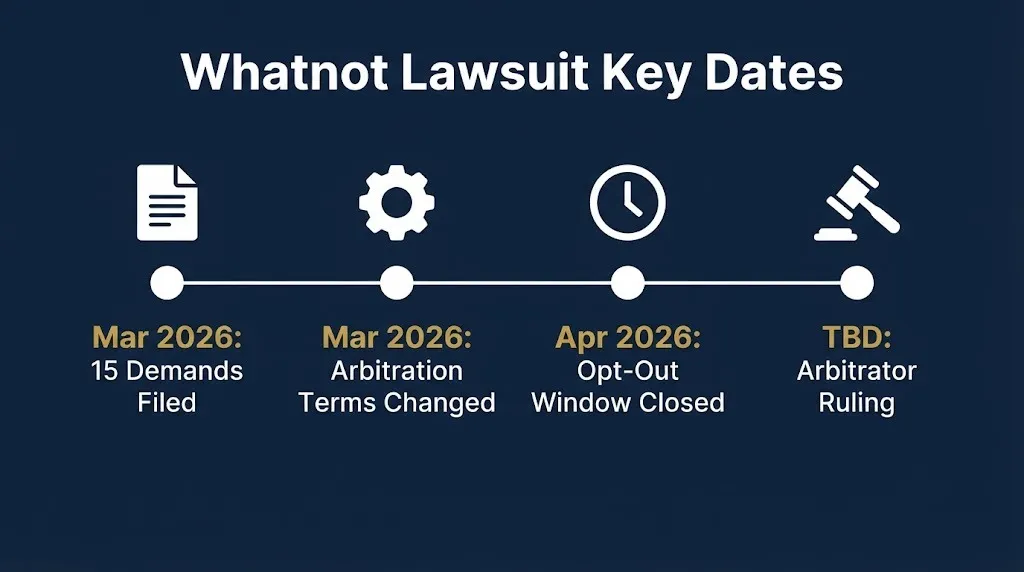
For the March 2026 terms change, the opt-out window ran from March 4, 2026, to approximately April 3, 2026 . That specific window has closed.
Whatnot’s older terms provide a 30-day opt-out window from first use of the app . If you are a new user, check your account creation date and review the current terms for the exact opt-out method.
Here are the general steps:
- Check your account creation date. The 30-day window usually starts when you first accept the terms.
- Review the current arbitration section in Whatnot’s Terms of Service.
- Write a signed notice stating you opt out of arbitration.
- Email it to [email protected] or mail it to Whatnot’s legal address.
- Keep proof of sending and delivery.
If you opted out, Whatnot cannot enforce the arbitration agreement against you for those claims . You may then pursue claims in court, subject to other legal deadlines.
What is the Whatnot lawsuit about?
The Whatnot lawsuit is about whether randomized card breaks and repacks are illegal gambling under California law. The core argument is that buyers pay for a chance at a prize, which meets the three elements of an illegal lottery: payment, chance, and prize .
The arbitration demands describe Whatnot as an “unregulated online casino” that exploits compulsive spending . They point to random mechanics like wheel spins and dice rolls that determine what each buyer receives.
For repacks, the claim is that they operate as illegal “grab bag” lotteries under California law because buyers pay for a mystery item whose value is unknown .
The demands also allege RICO violations, arguing that Whatnot’s operations constitute a pattern of racketeering activity .
Whatnot’s defense is that card breaks are a long-standing collecting format, not gambling. The company says breaks happen live and on camera, and sellers face consequences for rule violations .
What consumer protections does Whatnot lack?
The arbitration demands claim Whatnot lacks safeguards that regulated gambling operators must provide. Those missing protections include addiction warnings, self-exclusion tools, and meaningful spending limits .
Whatnot added spending limits in 2025, but the complaints call them “inadequate” because users control them and can turn them off . Attorney Lesko said there is “no ability to self-ban” .
The demands seek an order requiring Whatnot to implement warnings about addictive features, self-exclusion mechanisms, spending limits, and addiction support resources .
A documented case cited in reporting involved a child who spent $67,000 in two hours on the platform . Whatnot’s website says users must be 18 for an individual account, though 13- to 17-year-olds can use a parent’s account with permission .
What happens next in the Whatnot lawsuit?
The next stage depends on the arbitrator’s ruling on a threshold issue: whether the disputes are arbitrable at all. Whatnot moved to compel arbitration in a separate Utah case, and the court stayed that case pending the arbitrator’s decision .
Here is the expected timeline:
Expected late 2026: Arbitrator rules on threshold arbitrability questions in the filed demands.
Expected 2027: If arbitrable, the individual demands proceed to hearings. Outcomes are private unless a party files to confirm or vacate an award in court.
TBD: California Attorney General decision on whether to intervene in the False Claims Act suit. The office declined to intervene as of mid-2026 .
Expected 2027: Lesko has said he hopes to force platform changes regardless of individual payouts .
Attorney Lesko unsuccessfully approached Whatnot in October to settle outside of arbitration . No settlement talks are confirmed to be active.
Frequently Asked Questions
Is the Whatnot lawsuit a class action?
No. Whatnot’s terms include a class action waiver. Claims must be pursued individually through arbitration .
How much money can I get from the Whatnot lawsuit?
No amount has been determined. The arbitration demands seek restitution and damages, but no arbitrator has ruled .
Can I still opt out of Whatnot’s arbitration agreement?
It depends on when you accepted the terms. Each agreement version has a 30-day opt-out window. The March 2026 window closed in April 2026 .
Does Whatnot admit it is gambling?
No. Whatnot denies the claims and says gambling is not allowed on the platform .
What is the False Claims Act lawsuit against Whatnot?
It is a separate whistleblower suit alleging Whatnot and Fanatics Live failed to pay taxes and obtain gambling licenses. California declined to intervene, and plaintiffs may proceed alone .
What evidence do I need for a Whatnot claim?
Purchase records, break receipts, chat logs, and records of losses. An attorney can advise on what is needed for a specific demand.
Is there a settlement fund for Whatnot buyers?
No. No settlement exists and no fund has been established.
What is the RICO claim against Whatnot?
The arbitration demands allege Whatnot’s operations constitute a pattern of racketeering activity under the RICO Act . RICO claims are complex and no ruling has been issued.
What you should do now
If you bought breaks on Whatnot and want to explore a claim, contact an attorney who handles consumer arbitration. Do not wait. Whatnot’s terms include a shortened one-year limitation period for claims, though its enforceability varies by state .
Check whether you are still within any arbitration opt-out window. If you are, and you want to preserve your right to court, send the signed opt-out notice before the deadline.