Sony PlayStation Lawsuit: 2026 Settlement, Claim Deadlines, and Payout Updates
Quick Answer:
- The PlayStation digital game monopoly lawsuit is real, with a preliminary settlement approved in 2025.
- Estimated payouts may range from $6 to $65 per eligible consumer, depending on the number of claims filed.
- No claim deadline is set yet. The claims window is expected to open by late 2026 or early 2027.
If you bought digital PlayStation games, add-ons, or subscriptions through the PlayStation Store between 2019 and 2025, you may be part of the largest consumer class action Sony has faced in years. The case alleges Sony operated an unlawful monopoly over digital game distribution. A federal judge gave preliminary approval to a settlement in late 2025, and the claims process is expected to begin within months.
This article covers every verified fact about the PlayStation class action, including who qualifies, how much you might get, how to file, and what deadlines matter. It also addresses the separate PlayStation Network outage claims and the DualSense controller drift lawsuit, because those get confused with this case constantly. The numbers here come from court filings, not Sony press releases.
The Facts
| Detail | Value |
|---|---|
| Case | Cendejas et al. v. Sony Interactive Entertainment LLC (digital game monopoly) |
| Status | Preliminarily settled; final approval pending |
| Fund Size | Not yet confirmed; plaintiffs estimate damages exceeding $5 billion |
| Est. Per Person | $6 to $65 estimated range, depending on claim volume |
| Claim Deadline | Not yet set; claims window expected late 2026 or early 2027 |
| Administrator | Not yet appointed |
| Proof Needed | Likely PlayStation Store purchase receipts or account records |
Is the PlayStation Class Action Lawsuit Real?
Yes. The PlayStation class action lawsuit is real. It is not a scam, not a clickbait headline, and not a rumor. The case is Cendejas et al. v. Sony Interactive Entertainment LLC, filed in the U.S. District Court for the Northern District of California under case number 3:21-cv-04269.
The lawsuit accuses Sony of operating an illegal monopoly over the sale of digital PlayStation games. Plaintiffs argue that Sony blocked third-party retailers like Amazon, GameStop, and Best Buy from selling digital game download codes starting in 2019. That change forced every digital game purchase through the PlayStation Store, where Sony controls pricing and charges a commission on every sale.
Consumers claim they overpaid for digital games as a result. The court record shows the case survived Sony’s motion to dismiss and moved through discovery. In late 2025, Judge James Donato granted preliminary approval to a class action settlement. That means the court found the deal fair enough to move forward, but it is not final yet. A final approval hearing date has not been publicly posted by the court as of July 2026.
If you received an email or saw a social media ad about a PlayStation settlement, check the official case docket or the yet-to-launch settlement website. Anyone asking for a fee to help you file is running a scam. Filing is free.
How Much Money Could I Get From the PlayStation Settlement?
Payout estimates are not final. The plaintiffs’ economic expert estimated damages could reach $5 billion or more across the class period. What that means for individual consumers depends entirely on how many people file claims.
Early estimates from the plaintiffs’ filings suggest payouts could land in the range of $6 to $65 per person. That is a wide gap, and it exists because the total settlement fund size has not been confirmed. The number of eligible class members is enormous, likely tens of millions of PlayStation account holders.
Here is how the math works, based on what the filings describe:
| Scenario | Estimated Payout per Person |
|---|---|
| Low participation (under 500,000 claims) | Possibly $50 to $65 |
| Moderate participation (1 to 3 million claims) | Roughly $15 to $35 |
| High participation (over 5 million claims) | Likely $6 to $12 |
These are not guaranteed numbers. The final per-person amount depends on the settlement fund total, the claims administrator’s distribution formula, and the exact number of valid claims. A court will review the allocation plan before final approval.
You will not need to prove exactly how much you spent on digital games to qualify. Most class actions of this type use a flat per-person payment model or a tiered system based on purchase volume. But the precise claims structure has not been published yet.
Reality Check: Settlement payouts almost always take longer and arrive smaller than early headlines suggest. The $65 figure makes a good headline but assumes very few people file. In large consumer class actions, per-person payouts typically land on the lower end. The real value of this settlement is not a windfall. It is a refund of a small portion of the overcharge you may have paid on digital games.
Key Takeaway: The PlayStation settlement is real, but no payout amount is guaranteed yet. Expect something in the range of $6 to $65, and plan for the lower end if claim volume is high.
How Do I File a PlayStation Class Action Claim?
The claims process is not open yet. When it opens, you will file through the official settlement website. Here is what the process will likely involve, based on the preliminary settlement structure and how similar consumer class actions work.
- Wait for the claims website to go live. The settlement administrator will launch a site once the court finalizes the settlement terms.
- Look for a Notice ID and Confirmation Code if you receive an email or postcard from the administrator. This speeds up filing but is not required.
- Visit the official settlement website and select “File a Claim.”
- Enter your PlayStation Network account email or the Notice ID from your notification.
- Confirm your eligibility. The system may check your account history against the class period.
- Select your payment method. Most settlements offer Venmo, PayPal, Zelle, or a mailed check.
- Submit the form and save your confirmation number. Take a screenshot.
If the administrator cannot verify your purchase history automatically, you may need to upload receipts. Start gathering those now if you have them. PlayStation Store email receipts, bank statements showing PSN charges, and transaction history from your PlayStation account settings all count.
Do not pay anyone to file for you. Third-party services charging fees for claim filing are unnecessary. The process is free and designed to be completed in under 15 minutes.
Who Qualifies for the PlayStation Class Action?
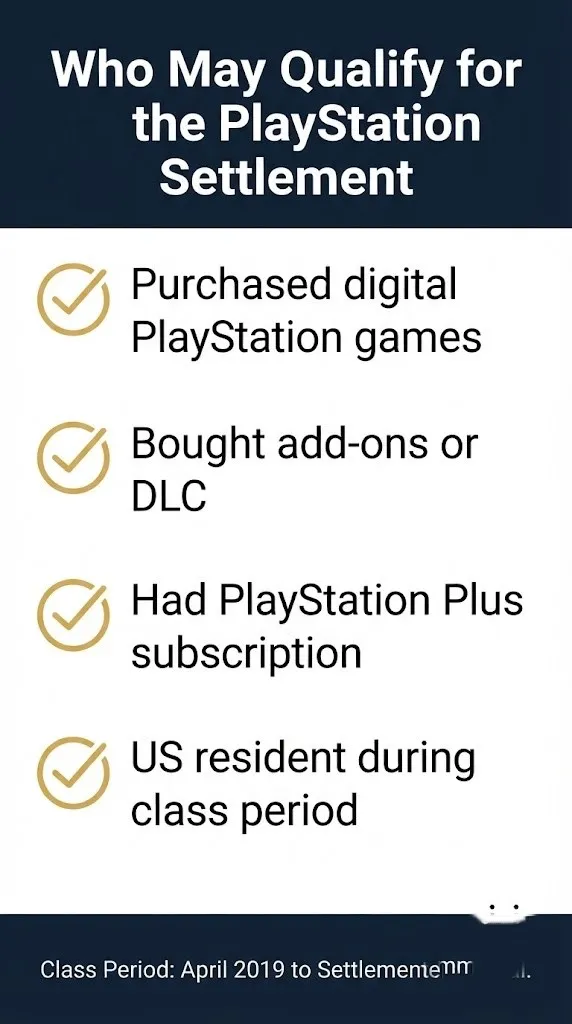
You may qualify if you bought digital games, add-ons, or subscriptions through the PlayStation Store while living in the United States during the class period. The proposed class covers all U.S. consumers who purchased digital PlayStation content between April 1, 2019, and the date the settlement receives final approval.
The class definition from court filings includes:
- Any person in the United States who purchased one or more digital PlayStation games from the PlayStation Store.
- Purchases of downloadable content (DLC), add-ons, and season passes are included.
- PlayStation Plus, PlayStation Now, or other subscription purchases made through the Store may qualify.
- The purchase must have occurred during the class period.
You do not need to have bought a specific number of games. Even one qualifying purchase may make you eligible. You do not need to still own the console or the games. The purchase record matters, not current ownership.
If you bought only physical disc games, you likely do not qualify. The case centers on digital distribution, where Sony’s alleged monopoly forced higher prices. Physical game retailers remained an option during the entire class period.
What Is the PlayStation Digital Game Monopoly Case About?
The core allegation is simple. Before April 2019, you could buy a digital PlayStation game code from Amazon, GameStop, Walmart, or Best Buy. The retailer set the price. Competition between sellers kept prices lower.
Then Sony changed the rules. The company stopped allowing third-party retailers to sell digital download codes for PlayStation games. Every digital purchase had to go through the PlayStation Store, where Sony sets the price and takes a 30 percent commission on every transaction.
The plaintiffs argue this is an illegal monopoly under federal antitrust law. By cutting off competing retailers, Sony removed price competition. Consumers had no choice but to pay Sony’s price. The lawsuit claims Sony overcharged consumers by hundreds of millions of dollars as a result.
Sony denied all wrongdoing and argued its policies were lawful business decisions. The company did not admit fault in the preliminary settlement. But the fact that the case survived dismissal and reached settlement negotiations suggests the plaintiffs’ claims had enough merit to put significant financial pressure on Sony.
This case echoes the Apple App Store antitrust battles and the Epic Games v. Apple litigation. The legal theory is similar: when a platform owner blocks all competition in digital distribution, consumers pay monopoly prices.
What Other PlayStation Lawsuits Are Active in 2026?
The Cendejas digital monopoly case grabs the most headlines, but it is not the only PlayStation-related legal action. Two other cases generate questions regularly.
The PlayStation Network outage lawsuit stems from a 2011 data breach that exposed personal information of roughly 77 million PSN users. That class action settled years ago, and payouts were distributed. If you are seeing 2026 claims about PSN outage settlements, those are likely outdated posts being reshared. The 2011 breach settlement is closed.
The DualSense controller drift lawsuit is a separate class action filed over alleged defects in PlayStation 5 controllers. Plaintiffs claim the controllers develop stick drift, where the analog stick registers movement without user input. This case is still in early litigation stages as of 2026. No settlement has been reached, and no claims window exists. Check for updates on the official court docket for that specific case if you experienced stick drift.
Do not confuse these cases. The digital monopoly case is the one with a preliminary settlement and a forthcoming claims process.
Key Takeaway: Only the digital game monopoly case has an active settlement. The PSN outage case is closed. The controller drift case has no settlement yet.
What Is the Deadline to File a PlayStation Claim?
No deadline exists yet. The claims window has not opened. The court must first grant final approval to the settlement. That hearing date has not been publicly scheduled as of July 2026.
Once final approval happens, the settlement administrator typically takes 60 to 90 days to set up the claims website and begin accepting submissions. The claims period usually runs for 90 to 180 days. Based on the pace of similar large class actions, here is a realistic timeline expectation:
- Final approval hearing: Expected late 2026 or early 2027.
- Claims window opens: 60 to 90 days after final approval.
- Likely claim deadline: Mid to late 2027.
These are estimates, not guarantees. The best move right now is to bookmark the court docket page for case 3:21-cv-04269 and check for updates every few weeks. When the settlement website goes live, it will be widely reported. You can also set a Google Alert for “PlayStation settlement claim deadline 2026” to catch news quickly.
What Happens Next in the PlayStation Class Action?
The settlement is in the preliminary stage. Several steps remain before anyone gets paid.
- Late 2026 (expected): Final approval hearing. The court reviews the settlement terms and hears any objections from class members.
- Early to mid-2027 (expected): If approved, the claims administrator launches the official settlement website and opens the claims window.
- Mid to late 2027 (expected): Claim deadline, likely 90 to 120 days after the window opens.
- Late 2027 to early 2028 (expected): Claims review and payment distribution. Direct deposit and digital payment options typically arrive first. Paper checks follow by several weeks.
- 2028 or later (expected): Any appeals are resolved. Appeals can delay payments by 12 to 24 months.
This timeline matches the pace of similarly sized consumer antitrust settlements. The process is slow by design. Courts scrutinize settlements affecting tens of millions of consumers carefully. Each stage involves notice requirements, review periods, and opportunities for objection.
Frequently Asked Questions
Is the PlayStation lawsuit settlement email a scam?
If you received an email about a PlayStation settlement in 2026, it could be legitimate if it comes from a court-authorized settlement administrator.
But no administrator has been appointed yet for the digital monopoly case.
Any email asking for payment or personal banking details right now is a scam.
How do I check my PlayStation lawsuit claim status?
You cannot check claim status yet because no claims have been filed.
When the claims window opens, the settlement administrator website will have a “Check Claim Status” tool.
You will need the confirmation number you receive when you submit your claim.
What happens if I don’t file a claim?
You get nothing.
You also give up your right to sue Sony separately over the claims covered by this settlement.
If you want to preserve your right to sue independently, you must file an exclusion or opt-out request during the opt-out period, which has not been set yet.
Can I file a claim without proof of purchase?
It depends on the final claims form, which has not been published.
Many consumer class actions allow claims without receipts if the administrator can verify your eligibility through other means.
If the administrator cannot verify your purchases, you may need to provide documentation.
How long will it take to get paid?
Do not expect payment before late 2027 at the earliest.
If appeals are filed, payments could be delayed until 2028 or later.
Digital payments like Venmo or PayPal typically arrive weeks before paper checks.
Did Sony admit wrongdoing?
No.
Sony denied all allegations and did not admit fault as part of the preliminary settlement.
The settlement resolves the litigation without a trial and without any finding of liability.
Does this affect PlayStation Plus subscribers?
Yes, if you purchased your subscription through the PlayStation Store during the class period.
The proposed class definition includes subscription purchases.
The exact treatment of subscription payments will be detailed in the final settlement agreement.
Where can I find the official PlayStation settlement website?
No official settlement website exists yet.
When one launches, it will be listed in the court docket and reported by major legal news outlets.
Avoid any website claiming to be the settlement site and asking for money.
The PlayStation digital monopoly settlement is one of the largest consumer tech class actions in years. It could affect tens of millions of gamers. But the process moves slowly, and the payout per person will likely be modest. The most important step you can take right now is to wait for the official claims website, ignore anyone asking for fees, and start locating your old PlayStation Store receipts. When the deadline drops, you will have roughly three months to act. Do not wait until the last week.