Uber Eats Class Action Lawsuit 2026: Priority Fee Claims, Settlements & Sign-Up Status
Quick Answer
- Is it legit: Yes. The priority fee lawsuit is real, filed July 27, 2026, in federal court.
- How much: Not yet determined. No settlement fund exists and no class has been certified.
- Key deadline: None set. Uber hasn’t responded and no claim form is available.
Uber Eats faces a proposed class action over its priority delivery fee, which customers say doesn’t deliver what it promises. The lawsuit, filed July 27, 2026, in the Northern District of California, alleges that paying $1 to $5 for “priority” or “direct to you” delivery doesn’t actually result in faster or more direct service .
You may be affected if you paid a priority fee on Uber Eats expecting your food to come directly to you without other stops. The lawsuit seeks to represent all U.S. customers who paid priority fees for orders advertised as “direct to you” .
This article breaks down what the lawsuit actually alleges, why no money is available yet, how the separate Seattle worker settlements played out, and what you should do if you think you’re affected. One detail stands out: Uber Eats doesn’t even tell drivers which orders are priority, meaning the company has no mechanism to ensure the promise is kept .
The Facts
| Case | Wright v. Uber Technologies, Inc. |
| Case Number | 3:26-cv-07753 |
| Court | U.S. District Court for the Northern District of California |
| Status | Filed July 27, 2026; no response from Uber yet |
| Fund Size | Not yet confirmed (no settlement) |
| Est. Per Person | Not yet determined |
| Claim Deadline | TBD, no claims process exists |
| Administrator | Not yet appointed |
| Proof Needed | Not yet determined |
Is the Uber Eats Class Action Lawsuit Legitimate?
Yes, the Uber Eats class action lawsuit is legitimate and has been filed in federal court. The case is Wright v. Uber Technologies, Inc., Case No. 3:26-cv-07753, pending in the U.S. District Court for the Northern District of California .
The lawsuit was filed on July 27, 2026, by plaintiff Hassan Wright and attorneys at Singleton Schreiber. It alleges that Uber Eats “swindled” customers into paying priority fees for a service the company has no way to guarantee .
The 43-page complaint claims Uber Eats promises “direct to you” delivery when customers pay the priority fee, but drivers are actually permitted and even encouraged to make other stops along the way. The lawsuit states Uber doesn’t notify drivers which orders are priority, making the promise impossible to enforce .
Uber has not yet responded to the complaint. No class has been certified, and no judge has reviewed the merits of the allegations.
How Much Could You Get from the Uber Eats Priority Fee Lawsuit?
Not yet determined. No settlement fund exists, no payout tiers have been proposed, and the court has not certified a class.
The lawsuit seeks damages for all U.S. customers who paid priority fees for orders advertised as “direct to you.” The complaint claims Uber has pulled in “staggering profits” from these fees, “likely totaling hundreds of millions of dollars nationwide” .
If the case settles or the plaintiffs prevail, any distribution formula would need court approval. Consumer class action settlements typically produce per-person payments ranging from a few dollars to under $50, depending on the number of valid claims and the total fund size.
Key Takeaway: There is no money available today from the Uber Eats priority fee lawsuit. Anyone promising a payout is ahead of the court record.
Who May Qualify for the Uber Eats Priority Fee Class Action?
You may qualify for the Uber Eats priority fee class action if you paid a priority fee for an Uber Eats order advertised as “direct to you” or “delivered directly to you” .
The proposed class covers all individuals in the United States who paid this fee. The lawsuit focuses on the “priority” or “direct to you” option, not standard delivery orders .
If you’re unsure whether your orders qualify, check your Uber Eats order history for any priority fees. The typical fee ranges from $1 to $5 per order .
No class has been certified yet, so no one is officially a class member at this point.
Reality Check: No one from a court or settlement administrator will text you about money from this case. Filing a claim is always free once a settlement exists. Third-party “claim helpers” charging fees for cases that haven’t settled are unnecessary.
What Are the Allegations Against Uber Eats in the Priority Fee Lawsuit?
The lawsuit alleges Uber Eats misleads customers about what the priority fee actually buys. The complaint claims the fee is “a sham surcharge for a guarantee that Uber has no means of keeping” .
Key allegations include:
- Drivers aren’t told which orders are priority. Uber Eats doesn’t notify drivers that a customer paid extra for direct delivery, making the promise impossible to fulfill .
- Drivers can multi-app. Uber Eats allows drivers to work for DoorDash, Grubhub, and other platforms simultaneously, which can delay priority deliveries .
- Batched orders prevent direct delivery. Uber may assign one driver multiple orders in a single trip, preventing priority orders from going “direct to you” .
- Uber can’t control driver routes. The company cannot compel drivers to take any particular route or prevent them from making additional stops .
The lawsuit claims industry surveys show nearly 70% of gig drivers deliver for multiple platforms at once, and roughly 38% of Uber Eats drivers multi-app with Grubhub alone .
What Is the Uber One Subscription Lawsuit About?
A separate class action targets Uber One, the company’s subscription service, over its advertised “$0 delivery fee” promise. The lawsuit alleges that Uber One’s promised benefit is effectively recovered through a separate “Service Fee and Other Fees” line at checkout .
This case is distinct from the priority fee lawsuit. It focuses on subscription terms, not per-order priority fees. No settlement has been reached in either case .
The Federal Trade Commission also filed a lawsuit against Uber in April 2025 over Uber One, accusing the company of signing up subscribers without their knowledge and making deceptive claims about the service . That regulatory action is separate from the private class actions.
What Is the Uber Class Action Lawsuit Sign-Up About?
If you’ve seen a “Uber class action lawsuit sign-up” form online, it’s likely from a law firm investigating securities fraud claims, not the priority fee case. These forms are for investors who bought Uber stock, not for customers seeking refunds .
The securities investigation stems from the FTC lawsuit announcement in April 2025. When news broke, Uber stock fell over 4%, prompting law firms to investigate potential shareholder losses .
These sign-up forms are not related to consumer claims about priority fees or Uber One subscriptions. If you’re a customer seeking a refund, there’s no sign-up form to complete yet.
What Happened with the Seattle Uber Eats Worker Settlements?
Uber Eats paid two major settlements to delivery workers in Seattle, but both are now closed. The most recent settlement, announced August 18, 2026, totaled $4,386,682.28 for 14,421 affected workers over violations of Seattle’s App-Based Worker Minimum Payment Ordinance .
Here’s the breakdown:
| Settlement | Amount | Workers | Status |
|---|---|---|---|
| August 2026 OLS Settlement | $4.39 million | 14,421 | Paying |
| 2025 OLS Settlement | $15.03 million | 16,120 | Closed November 2025 |
The 2025 settlement payments were issued on August 29, 2025, and the check-cashing deadline was November 27, 2025 . That case is finished.
These settlements were for Seattle delivery workers, not customers. They resolved wage theft and minimum payment violations, not priority fee complaints.
Step-by-Step: What to Do If You Paid Uber Eats Priority Fees
No claims process exists for the priority fee lawsuit today. But if you believe you’re affected, here’s how to prepare:
- Check your order history. Look for priority fees on Uber Eats orders advertised as “direct to you.”
- Save your receipts. Screenshot order confirmations showing the priority fee amount.
- Monitor the docket. Track Case No. 3:26-cv-07753 in the Northern District of California.
- Don’t pay for claim help. No legitimate service charges you to file a claim in a class action.
- Watch for official notice. If a settlement happens, notice comes from a court-approved administrator.
- Consider a demand letter. If you paid significant priority fees, a consumer attorney may review individual claims.
What Happens Next in the Uber Eats Class Action?
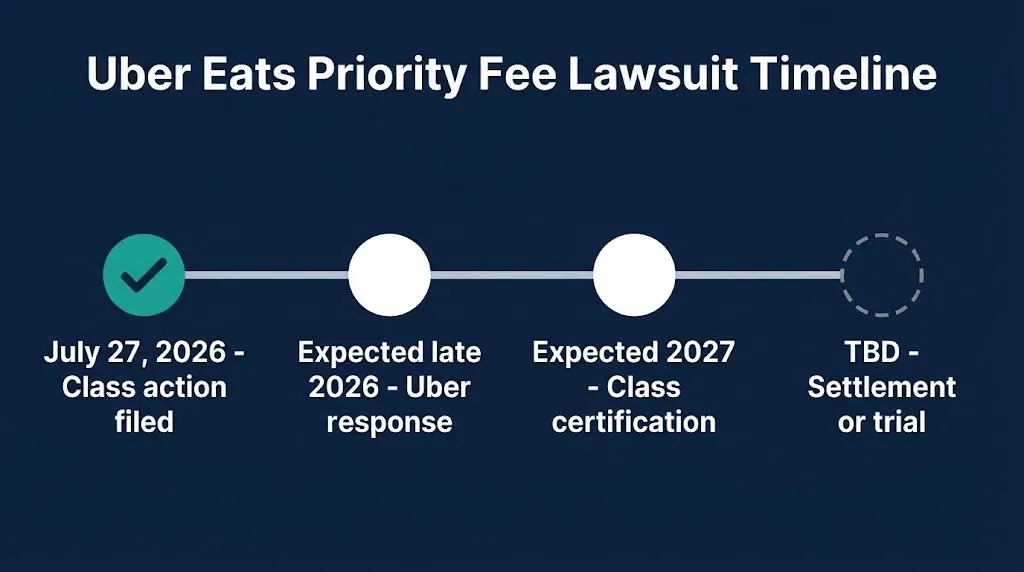
The immediate next stage is Uber’s response to the complaint. The company has not yet filed an answer or motion to dismiss.
Expected late 2026: Uber’s response to the complaint. Motion to dismiss practice is standard in consumer class actions.
Expected 2027: If the case survives dismissal, discovery begins. Class certification briefing follows.
Expected 2027-2028: Settlement discussions or trial preparation if the case proceeds.
TBD: Settlement, trial, or dismissal. No outcome is guaranteed.
Frequently Asked Questions
Is the Uber Eats class action lawsuit real?
Yes. The priority fee lawsuit was filed July 27, 2026, in the Northern District of California. No settlement exists yet.
How much will I get from the Uber Eats lawsuit?
Nothing is determined. There is no settlement fund, no payout formula, and no confirmed eligibility list.
What is the Uber Eats priority fee lawsuit about?
The lawsuit alleges Uber Eats charged $1 to $5 for “priority” delivery but doesn’t actually deliver orders directly as promised.
Can I sign up for the Uber Eats class action?
No sign-up exists. Class members are automatically included once a class is certified and a settlement is reached.
When will the Uber Eats case settle?
No timeline. The case was filed in July 2026, and class actions typically take years to resolve.
Did Uber Eats already pay a settlement in 2026?
Uber Eats paid $4.39 million to Seattle delivery workers in August 2026, but that was for wage violations, not customer priority fees.
What is the Uber One lawsuit about?
A separate case alleges Uber One’s “$0 delivery fee” promise is misleading because fees appear elsewhere at checkout.
How do I know if I paid a priority fee?
Check your Uber Eats order history for charges labeled “Priority” or “Direct to You.” Fees typically range from $1 to $5.
What Should You Do Now?
If you paid Uber Eats priority fees expecting direct delivery, save your order confirmations and screenshots. Those may help if a settlement is reached and a claims process opens.
Do not pay anyone who promises to file a claim for you. Do not share personal information with social media accounts claiming to represent this case. The official court docket is the only source of confirmed updates.
The single most important fact: no claim deadline exists, no settlement fund has been created, and no payout is available. Uber hasn’t even responded to the lawsuit yet.