Drake Lawsuit 2026: The UMG Defamation Petition, Astroworld Subpoenas, and Every Active Case
Quick Answer:
- Drake filed a petition against UMG and Spotify in 2024, not a full lawsuit, alleging streaming manipulation and defamation.
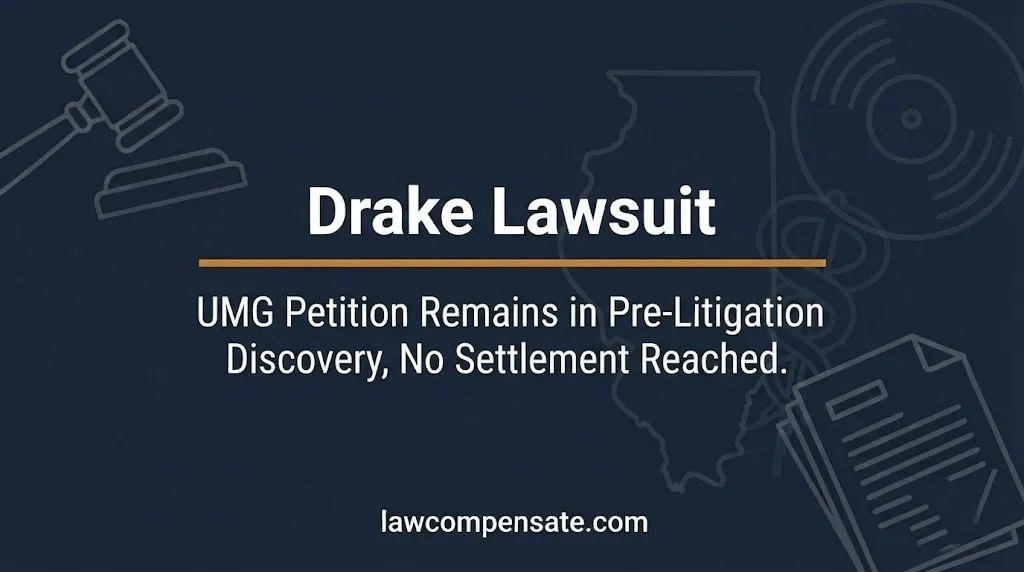
- No settlement has been reached; the petition remains in pre-litigation discovery.
- No payout, claim process, or class action for fans exists from any Drake-related litigation.
Drake is no stranger to courtrooms, but the legal action that has dominated headlines since late 2024 is not a criminal case or a contract dispute. It is a pre-litigation petition filed in a Texas state court, and later in New York, targeting the world’s largest music company over what Drake claims was an orchestrated campaign to inflate the streaming numbers of a diss track aimed at him. The feud with Kendrick Lamar has spilled from the recording booth into the judicial system, and the filings tell a story that goes far beyond two rappers trading bars.
This guide covers every verified fact about Drake’s active legal battles as of mid-2026. That includes the UGM petition, the Astroworld-related subpoenas, the legal strategy behind his filings, and what a win or loss would actually mean. One fact most coverage misses: the November 2024 filing is not a lawsuit. It is a petition for pre-suit discovery, a legal tool used to gather evidence before deciding whether to file a full complaint.
The Facts
| Detail | Value |
|---|---|
| Primary Filing | Drake v. Universal Music Group et al., Petition for Pre-Suit Deposition |
| Filed | November 25, 2024 (Texas), November 27, 2024 (New York) |
| Court (Texas) | District Court, Bexar County, Texas |
| Court (New York) | Supreme Court of the State of New York, New York County |
| New York Case Number | Not yet assigned full index at time of filing |
| Current Status | Pre-litigation discovery, no complaint filed |
| Allegations | Streaming manipulation, defamation, violation of RICO Act |
| Settlement | None |
| Damages Sought | Not specified in petition |
| Related Case | Astroworld Festival litigation (subpoenas to Drake) |
Is Drake Really Suing Universal Music Group?
Yes, but the distinction between a petition and a lawsuit matters. Drake filed a verified petition for pre-suit deposition under Texas Rule of Civil Procedure 202 in Bexar County, Texas, on November 25, 2024. Two days later, he filed a similar petition in New York County, New York. Neither filing is a complaint that initiates a full lawsuit. Both are procedural vehicles designed to force the respondents, Universal Music Group, Spotify, and iHeartMedia, to produce documents and sit for depositions before Drake decides whether to file a formal complaint.
The petition is real, stamped by the court, and signed by Drake’s attorneys. It is not a publicity stunt, though it has generated enormous publicity. The filing is a serious legal maneuver that, if granted, would give Drake access to internal communications, contracts, and streaming data that are normally shielded from public view. The music industry is watching closely because the discovery could expose practices that record labels and streaming platforms prefer to keep confidential.
Drake’s attorneys argue that UMG, the parent company of Drake’s own label Republic Records, engaged in a coordinated effort with Spotify and iHeartMedia to artificially inflate the streaming and radio play numbers of Kendrick Lamar’s track “Not Like Us,” a song that accuses Drake of serious misconduct. The petition alleges UMG used bots, pay-for-play arrangements, and reduced licensing fees in exchange for promotional placement, all to make the song appear more popular than it organically was.
Why This Matters Beyond the Drake-Kendrick Beef
The petition is not primarily about hurt feelings or rap beef. It is a business tort action dressed in the language of streaming fraud and racketeering. If Drake proceeds to a full complaint and wins, the case could reshape how streaming platforms report numbers and how labels promote competing artists. If the petition fails, it becomes a footnote in a long-running feud. Either outcome has implications for an industry where streaming counts determine chart positions, Grammy nominations, and millions in royalty payments.
Key Takeaway: The filing is real, but it is a petition, not a lawsuit. Drake has not yet sued anyone. He is asking a court for permission to gather evidence first.
What Is Drake Accusing UMG and Spotify of Doing?
The petition accuses UMG, Spotify, and iHeartMedia of engaging in a coordinated scheme to manipulate the commercial performance of “Not Like Us.” The specific allegations include the use of automated bots to generate fake streams, pay-for-play arrangements in which UMG compensated Spotify and iHeart for promotional placement, and a practice known as “negative licensing,” where UMG allegedly offered Spotify reduced royalty rates on other UMG catalog in exchange for preferential treatment of Lamar’s track.
The petition frames these actions under the Racketeer Influenced and Corrupt Organizations Act, or RICO, a federal statute designed to prosecute organized criminal enterprises. Using RICO in a music industry dispute is unusual but not unprecedented. The theory is that UMG and its partners formed an enterprise whose purpose was to harm Drake’s commercial interests by fraudulently promoting a competitor’s product.
The defamation component of the petition is tied to the content of “Not Like Us” itself. Drake argues that UMG, by distributing and promoting a song that falsely accuses him of pedophilia, engaged in defamation. This theory faces significant legal hurdles. UMG will likely argue that the song is opinion, artistic expression, and protected speech under the First Amendment. Defamation claims involving music are rare and rarely successful. But the argument gives Drake an additional legal hook.
What Is a Pre-Suit Petition and Why Did Drake File One Instead of a Lawsuit?
A pre-suit deposition petition under Texas Rule 202 is a tool that allows a potential plaintiff to investigate a potential claim before filing a lawsuit. It is used when the evidence needed to prove the claim is in the hands of the opposing party and would be difficult or impossible to obtain without court intervention. Think of it like a store security guard detaining a suspected shoplifter. The guard does not arrest the person. The guard holds them long enough to check the facts before deciding whether to call the police. The petition holds the evidence in place while Drake decides whether to sue.
Drake’s attorneys chose this route for strategic reasons. Filing a full complaint triggers immediate motions to dismiss, discovery obligations, and public scrutiny of Drake’s own business practices. A petition allows Drake to test his theories and see what evidence exists before committing to a lawsuit that could expose him to counterclaims and sanctions if the allegations prove thin.
The downside is that courts are skeptical of petitions that look like fishing expeditions. UMG and Spotify have already argued in response that Drake is using the court system to harass competitors and air personal grievances. The judge in the Texas case will decide whether Drake has shown a sufficient basis to proceed with discovery. That decision has not yet been made public as of mid-2026.
Key Takeaway: The petition is a legal reconnaissance mission. Drake wants to see UMG’s internal emails, contracts, and streaming data before deciding whether to sue for real.
Has the Drake UMG Petition Settled?
No settlement has been reached in the UMG petition as of July 28, 2026. The petition remains in the pre-litigation discovery phase, with both sides filing motions and responses. No trial date has been set because there is no complaint to try. No settlement talks have been confirmed, though both sides have incentives to resolve the matter quietly given the sensitivity of the information at stake.
Settlement of a pre-suit petition is unusual because the petition is not a claim for damages. It is a request for information. A settlement in this posture would likely involve UMG and Spotify agreeing to produce some documents voluntarily in exchange for Drake withdrawing the petition and signing a confidentiality agreement. This kind of resolution happens often in business disputes where both sides want to avoid public litigation. Whether it happens here depends on what UMG believes the documents would reveal.
What Does the Astroworld Case Have to Do With Drake?
Drake is not a defendant in the Astroworld Festival litigation, but he is a central figure in the discovery battles surrounding it. Drake performed at the 2021 Travis Scott concert in Houston where a crowd surge killed ten people and injured hundreds. Thousands of plaintiffs have sued Scott, Live Nation, and other entities in consolidated litigation pending in Harris County, Texas.
Plaintiffs’ attorneys have sought Drake’s deposition and documents related to his role at the festival. They argue that Drake’s performance during the deadly crowd surge makes him a witness, and potentially a party, to the events that unfolded. Drake has resisted those subpoenas. His attorneys have argued that he was a performer with no control over crowd management, security, or festival operations. Courts have mostly agreed, limiting the scope of discovery into Drake’s conduct.
As of 2026, the Astroworld litigation is approaching a global settlement, with reports in legal news outlets that a confidential settlement framework has been reached involving hundreds of millions of dollars. Drake’s role in that settlement, if any, remains unclear. He has not been named as a paying party in any reported settlement terms, but the final agreement may include provisions related to his testimony or document production.
Reality Check: There is no “Drake lawsuit payout” for fans, concertgoers, or the general public. The Astroworld settlement, if finalized, will compensate victims and their families. The UMG petition is an industry dispute that will not produce any consumer compensation. Any social media post promising money from a Drake settlement is a scam.
Has Drake Filed Any Other Lawsuits in 2026?
As of mid-2026, no other lawsuits initiated by Drake have been filed in state or federal court. He remains involved in several legal matters as a defendant or interested party. These include ongoing trademark disputes related to his OVO brand and various contractual matters that are typical for an artist of his commercial stature. None of these cases carry the industry-wide significance of the UMG petition.
Drake has historically been more likely to be sued than to sue. His legal history includes copyright infringement claims, sampling disputes, and breach of contract actions, most of which settle before trial. The UMG petition represents a departure from that pattern. It is Drake as the aggressor, using the courts offensively rather than defensively.
What Would a Drake Win Look Like?
If the Texas or New York court grants Drake’s petition and he proceeds to file a full complaint, a win could take several forms. A judgment finding that UMG violated RICO by conspiring with streaming platforms to manipulate chart positions would expose the label to significant damages, potentially including treble damages under RICO’s penalty provisions. It would likely trigger industry-wide reforms in how streaming numbers are reported and audited.
A defamation judgment against UMG for distributing “Not Like Us” is less likely given First Amendment protections but would be explosive if it succeeded. It would set a precedent that record labels can be liable for the lyrical content of the songs they distribute, a result that would chill artistic expression across the music industry. Most legal analysts expect the defamation claim to be dismissed early if a complaint is ever filed.
The most realistic outcome is a settlement that produces no public admission of wrongdoing. UMG and Drake share a deep commercial relationship. Drake is one of UMG’s most valuable artists. A public trial would damage that relationship and expose both sides to reputational harm. The smart money is on a quiet resolution that makes the petition disappear in exchange for commercial concessions from the label.
Potential Outcomes Table
| Outcome | Likelihood | Impact |
|---|---|---|
| Petition granted, full discovery proceeds | Moderate | Industry practices exposed, potential complaint |
| Petition denied | Moderate | Drake’s legal options narrow significantly |
| Settlement with confidentiality | High | Petition withdrawn, no public resolution |
| Full complaint filed, goes to trial | Low | Years of litigation, industry precedent |
| Defamation claim succeeds | Very low | First Amendment implications for music industry |
Key Takeaway: The most likely ending is a confidential settlement. The least likely is a public trial. The petition is a pressure tactic, and pressure tactics work best when they never need to be fully executed.
How Has the Music Industry Responded to the Drake Petition?
The music industry has responded with a mixture of alarm and opportunism. Streaming platforms, labels, and artist advocacy groups are watching the case because the discovery could expose practices that are widespread but rarely discussed publicly. If Drake’s attorneys depose Spotify executives under oath and those depositions become public, the resulting testimony could trigger regulatory scrutiny, Congressional interest, and class action lawsuits from other artists who believe their streams were suppressed.
Several artist advocacy groups, including the Music Artists Coalition and the Black Music Action Coalition, have expressed support for greater transparency in streaming data. They have not endorsed Drake specifically, but they have endorsed the principle that labels should not be able to manipulate streaming numbers to favor one artist over another. This broader industry conversation is one reason UMG may prefer to settle rather than litigate.
Spotify and iHeartMedia have denied the allegations. Spotify issued a brief statement in December 2024 calling the claims “baseless” and noting that it has no economic incentive to artificially inflate streams for any particular track. iHeartMedia similarly denied any pay-for-play arrangement. Neither company has provided the documents Drake is requesting.
What Happens Next: The Drake Legal Timeline
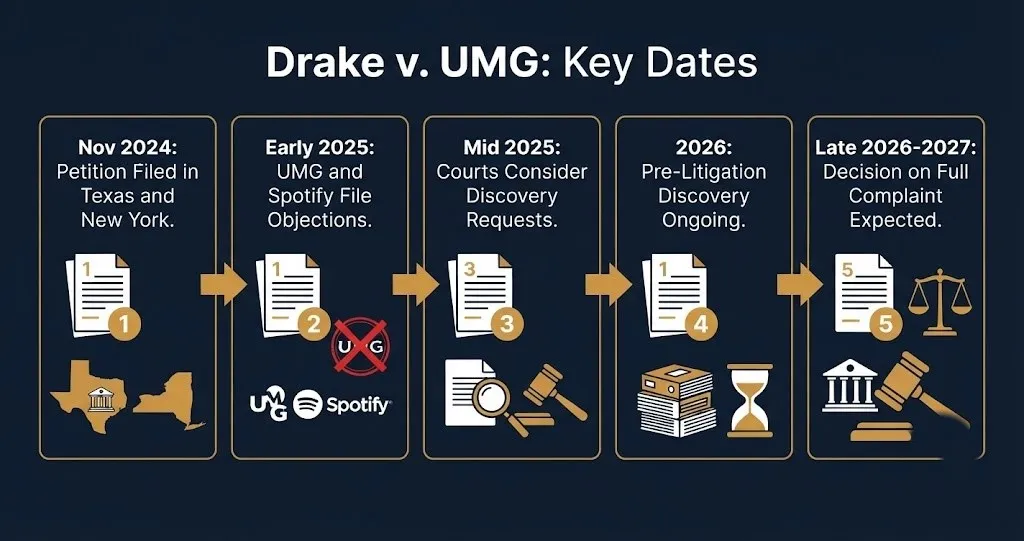
- Late 2024: Drake files petitions in Texas and New York. UMG and Spotify file responses opposing discovery.
- Early to Mid-2025: Courts hold hearings on whether to allow pre-suit discovery. Rulings are not immediately made public.
- Mid to Late 2025: If petition is granted, Drake’s attorneys begin depositions and document review.
- 2026: Pre-litigation discovery phase continues. No complaint filed. Settlement discussions possible but not confirmed.
- Late 2026 to 2027: Drake must decide whether to file a complaint based on evidence gathered, negotiate a settlement, or withdraw the petition.
- Parallel Track: Astroworld global settlement moves toward finalization. Drake’s role limited to subpoena compliance.
Frequently Asked Questions
Is Drake suing Kendrick Lamar?
No. The petition names UMG, Spotify, and iHeartMedia, not Kendrick Lamar.
Lamar is not a party to the petition.
The case is about business practices, not the lyrical content of the feud itself.
How much is the Drake lawsuit worth?
The petition does not specify a dollar amount.
If a complaint is filed and succeeds, damages could reach tens of millions under RICO.
No settlement figure has been proposed or reported.
Can I get money from the Drake lawsuit?
No. This is a business dispute between an artist and a record label.
There is no class action, no settlement fund, and no consumer payout.
Anyone offering you money from a Drake settlement is running a scam.
What did Kendrick Lamar say about the lawsuit?
Kendrick Lamar has not publicly commented on the petition.
His attorneys have not appeared in the case because he is not a party.
The song “Not Like Us” remains available on streaming platforms.
Why did Drake file in Texas and New York?
Texas allows broad pre-suit discovery under Rule 202.
New York is where UMG’s U.S. headquarters are located.
Filing in both jurisdictions increases the odds of obtaining discovery.
Is the Astroworld lawsuit settled?
A global settlement framework has been reported but not finalized.
Drake is not a defendant but has been subpoenaed as a witness.
The settlement, if completed, will compensate victims and their families.
Does this affect Drake’s music or streaming numbers?
The petition has not affected Drake’s commercial releases.
He continues to release music and tour.
The legal action has not resulted in any streaming platform removing his catalog.
What is a RICO claim and why is Drake using it?
RICO is a federal law originally designed for organized crime prosecutions.
Civil RICO allows private parties to sue for damages caused by a criminal enterprise.
Drake’s petition alleges UMG and the platforms formed an enterprise to harm his business.
Drake’s legal offensive against UMG is the most significant artist-versus-label dispute since Prince scrawled “SLAVE” on his face and fought Warner Bros. for his masters. The difference is the weapon. Drake is not using public protest. He is using the courts, and he is asking for the one thing record labels fear most: transparency.
The petition may succeed, fail, or settle. But the filing itself has already forced a conversation the music industry did not want to have. Whether that conversation leads to real change or fades into the noise of the next album cycle depends on what a Texas judge decides to do with Drake’s request.