Amazon Fire TV Stick Lawsuit 2026: Case Status, Eligibility, and What’s Confirmed
Quick Answer
- The lawsuit is real: Merewhuader v. Amazon.com Inc. accuses Amazon of “bricking” first and second-generation Fire TV Stick devices.
- No payout exists yet. The case hasn’t been certified as a class action or reached a settlement.
- There is no claim deadline right now, since there’s no claims process to file into as of mid-2026.
If you searched “Amazon Fire TV Stick lawsuit” hoping to file a claim today, here’s the direct answer: you can’t yet, because no settlement or certified class exists.
A California plaintiff, Bill Merewhuader, sued Amazon in April 2026, alleging the company deliberately let first and second-generation Fire TV Stick devices degrade after cutting software support, a practice the complaint calls “bricking.” The case affects anyone who owned those specific older devices, but it’s still working through preliminary court proceedings.
This article covers exactly what’s confirmed: which devices are named, what Amazon is accused of, and where the case actually stands as of mid-July 2026. One detail most coverage misses: this case was recently transferred out of California state court entirely, moving to federal court in Washington, Amazon’s home turf.
The Facts
| Case | Merewhuader v. Amazon.com Inc., et al. |
| Court | Originally Superior Court of California, Los Angeles County; transferred to U.S. District Court, Western District of Washington |
| Case Number | Not yet confirmed for the transferred federal filing |
| Status | Early stage, proposed class action, not yet certified |
| Fund Size | Not applicable, no settlement has been reached |
| Est. Per Person | Not yet determined |
| Claim Deadline | Not applicable, no claims process currently exists |
| Administrator | Not yet appointed |
| Proof Needed | Not applicable at this stage |
Is the Amazon Fire TV Stick lawsuit real?
Yes, the Amazon Fire TV Stick lawsuit is a real, active case, filed by plaintiff Bill Merewhuader against Amazon.com Inc. and Amazon.com Services LLC. It was originally filed in the Superior Court of California, Los Angeles County, in approximately early April 2026.
The complaint alleges Amazon marketed first and second-generation Fire TV Stick devices as offering “instant” access to streaming content, then cut off the software support needed to keep that promise, while never clearly disclosing that the devices would eventually lose core functionality.
As of July 2026, the case has been transferred to a federal court in Washington state, Amazon’s home jurisdiction. Transfers like this are a standard procedural step in many cases against a company headquartered elsewhere, not evidence the case is weak or strong.
Key Takeaway: The lawsuit is confirmed and active, but it remains a proposed class action, meaning no court has yet ruled it can proceed on behalf of a broader group.
Is the Amazon Fire TV Stick lawsuit a scam?
No, the underlying lawsuit is a legitimate legal filing, but that doesn’t mean every website discussing it is trustworthy. The case itself is verifiable through public California and federal court filings.
Watch for a specific red flag: since no settlement or claims process exists yet, any site or message asking you to “file a claim” for Fire TV Stick compensation right now is not connected to this actual case. There is nothing to file into as of mid-2026.
Reality Check: No legitimate settlement administrator contacts you first by text or email demanding personal information before a case has even reached a settlement. Filing into any future legitimate claims process will always be free, and this case hasn’t reached that stage.
How much money could I get from the Amazon Fire TV Stick lawsuit?
Not yet determined. No specific dollar figure exists for individual Fire TV Stick owners, because the case hasn’t reached a settlement or verdict, and hasn’t even been certified as a class action yet.
The complaint seeks unspecified damages on behalf of a proposed nationwide class, plus asks the court to order Amazon to provide compensation to affected consumers. Those are requests in a filed complaint, not confirmed numbers a court has approved.
| Stage | Status |
|---|---|
| Class certification | Not yet granted |
| Settlement fund | None exists |
| Per-person payout estimate | Not yet determined |
| Claims administrator | Not yet appointed |
Cases like this can take a year or more to reach a certified class, let alone a settlement. Comparing this to a delayed tax refund isn’t quite right, since a refund is already owed; this is closer to a store return dispute that hasn’t been resolved yet, where nothing is guaranteed until a decision is made.
Is there a settlement for Amazon Fire TV Stick owners right now?
No, there is no settlement or payout program open for Fire TV Stick owners as of mid-2026. The case remains in its early litigation stage, with no fund, no administrator, and no claim form.
Amazon has previously settled other, unrelated class actions, including a case over rejected refunds in January 2026, showing the company does resolve some disputes through settlements. That history doesn’t guarantee this specific Fire TV Stick case will follow the same path.
Reality Check: Filing a legitimate class action claim is always free once a real claims process opens. If you encounter a site asking for payment or sensitive banking details to “register” for this case now, that’s not a real part of this litigation.
Can I file a claim in the Amazon Fire TV Stick lawsuit?
Not yet, because there is no claims process to file into as of mid-2026. This case hasn’t reached class certification or settlement, both of which typically precede any claim form being made available to the public.
Here’s what typically happens before a claims process opens in a case like this:
- The court rules on whether the case can proceed as a class action
- If certified, the case moves through discovery and, potentially, additional motions
- The parties may reach a settlement, or the case proceeds toward trial
- If settled, the court grants preliminary approval to the settlement terms
- A claims administrator is appointed and a claim form is published
- A final approval hearing is held before payments are authorized
- Eligible class members are notified and given a specific window to file
Right now, this case is sitting at step one. Watching the docket is the only real action available to potentially affected consumers today.
Which Fire TV Stick models are covered by the lawsuit?
The lawsuit specifically covers first-generation Fire TV Stick devices, released in 2014, and second-generation Fire TV Stick devices, released in 2016. Neither model is currently sold by Amazon.
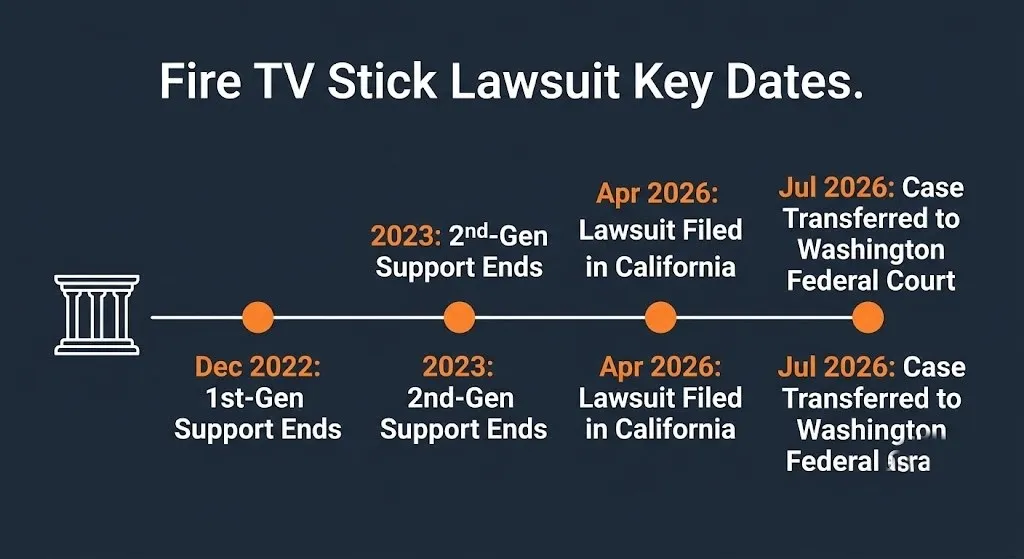
- First-generation Fire TV Stick: Released 2014, software support ended December 2022
- Second-generation Fire TV Stick: Released 2016, software support ended in 2023, shortly after the first-generation cutoff
The proposed class described in coverage of the complaint is open to consumers nationwide who owned a first-generation device as of around January 1, 2023, or a second-generation device as of around April 1, 2023, based on when support cutoffs took effect. Not yet confirmed: the court has not certified this class definition, so it remains a proposed framework from the complaint, not an approved eligibility standard.
How do I check the status of the Amazon Fire TV Stick lawsuit?
You can check this case’s status through the federal court docket in the Western District of Washington, where the case was transferred as of July 2026. Public court dockets are the most reliable source, ahead of any news aggregator site.
- U.S. District Court, Western District of Washington, public docket search
- Established legal-news outlets covering class action filings, such as Top Class Actions
- Consumer technology outlets that have tracked the case since its April 2026 filing
Avoid third-party “claim tracker” sites requesting your email or personal details before showing you basic, publicly available docket information.
Key Takeaway: This case is still too early for a settlement tracker to show meaningful movement, since no claims process exists yet.
What is the latest update in the Amazon Fire TV Stick lawsuit?
As of early July 2026, the most significant development is the case’s transfer from California state court to federal court in Washington. That move shifts the case into Amazon’s home federal jurisdiction, a common outcome in cases against large companies headquartered in a specific state.
Amazon has not issued a detailed public statement disputing the specific allegations, though outlets reporting on the case note the company denies wrongdoing generally. Not yet confirmed: any specific court ruling on class certification, motions to dismiss, or scheduling for further proceedings following the transfer.
Separately, Amazon has begun publishing clearer software update timelines for its newer Fire TV Stick models, promising “at least four years” of updates going forward, a policy change that postdates the cutoffs at issue in this lawsuit.
What court is handling the Amazon Fire TV Stick lawsuit now?
The case is now proceeding in the U.S. District Court for the Western District of Washington, after originally being filed in the Superior Court of California, Los Angeles County. The specific new federal case number had not been publicly confirmed as of this writing.
This is the same federal district that handles a number of other active cases involving Amazon, given the company’s Seattle-area headquarters. A separate, unrelated Amazon Fire TV lawsuit over alleged privacy violations, Manypenny, et al. v. Amazon.com Inc., is also proceeding in this same district under case number 2:26-cv-01534.
Key Takeaway: The bricking lawsuit and Amazon’s separate Fire TV privacy lawsuit are two different cases with different legal theories, now both in the same federal court district.
Why is Amazon being sued over the Fire TV Stick?
Amazon is being sued because the complaint alleges the company knowingly let older Fire TV Stick devices degrade in performance after ending software support, without adequately warning buyers this would happen. Plaintiff Bill Merewhuader says he bought two second-generation Fire TV Sticks in 2018 that became unusable by 2024.
The complaint frames this as “software tethering,” a practice where a company retains the ability to limit or shut down hardware functionality remotely, even after a customer has purchased and owns the physical device. The lawsuit argues Amazon used this control to push consumers toward buying newer, more expensive Fire TV models.
Legal claims raised include deceptive marketing under California consumer protection law and, according to some coverage, breach of contract. Amazon marketed the devices as providing “instant” access to hundreds of thousands of movies and shows, a claim the complaint says was central to why people bought them in the first place.
What does “bricking” mean in the Fire TV Stick lawsuit?
Bricking, in this lawsuit’s context, means a device’s core software functionality is lost or severely degraded, even though the physical hardware remains intact and undamaged. The term borrows from tech slang describing a device rendered as useless as a brick.
The complaint alleges this happened gradually rather than all at once. Merewhuader describes performance declining over “a few years” after Amazon ended software updates, eventually reaching a point where the devices became “effectively inoperable.”
This differs from a hardware failure or physical defect. The lawsuit’s core argument is that Amazon retained remote control over the device’s usability long after the sale, and used that control in a way that wasn’t clearly disclosed at purchase.
How has Amazon responded to the Fire TV Stick lawsuit?
Amazon has not issued a detailed public statement addressing the specific bricking allegations as of mid-2026, though the company is understood to deny wrongdoing, consistent with its typical posture in active litigation. Several outlets that requested comment from Amazon reported no response at the time of publication.
Amazon has, separately, begun communicating clearer update timelines for its current Fire TV Stick lineup, now promising “at least four years” of software support for newer models. The company also maintains a dedicated page detailing software update timelines across its device lineup, a resource that didn’t exist in the same form for the original first and second-generation devices.
This pattern, improved forward-looking disclosure without addressing the specific historical allegations, is common in early-stage litigation, where companies are cautious about public statements that could affect their legal position.
Is this the same as the Amazon Fire TV privacy lawsuit?
No, the Fire TV Stick bricking lawsuit and the Fire TV privacy lawsuit are two separate, unrelated cases with different legal claims. Confusing the two is a common mistake, since both involve Fire TV devices and both are proceeding in the same federal court.
| Bricking Lawsuit | Privacy Lawsuit | |
|---|---|---|
| Case Name | Merewhuader v. Amazon.com Inc. | Manypenny, et al. v. Amazon.com Inc. |
| Case Number | Not yet confirmed | 2:26-cv-01534 |
| Filed | Approximately April 2026 | May 6, 2026 |
| Core Allegation | Software support cutoffs degraded device functionality | Secret collection and sale of viewing habit data |
| Legal Theory | Deceptive marketing, planned obsolescence | Video Privacy Protection Act violation |
The privacy lawsuit alleges Amazon’s Fire TV software records and analyzes what’s played on screen, then sells that data to advertisers without consumer consent, a claim under the federal Video Privacy Protection Act. That’s an entirely different legal theory from the bricking case’s deceptive marketing and planned obsolescence claims.
What happens if the lawsuit becomes a certified class action?
What Happens Next
- Ongoing (confirmed): Case proceeds in the Western District of Washington following its transfer from California state court.
- Expected next stage: A ruling on whether the proposed class can be certified, allowing the case to proceed on behalf of a broader group of Fire TV Stick owners.
- Not yet confirmed: Any specific hearing date for class certification or a motion to dismiss.
- If certified: The case would move into discovery, where both sides gather evidence before any trial or settlement talks.
- If settled or won at trial: A claims process, administrator, and claim form would then be established, none of which exist today.
Frequently Asked Questions
Can I get money from the Amazon Fire TV Stick lawsuit right now?
No, there is no settlement or payout available as of mid-2026.
The case has not been certified as a class action, and no fund exists.
Watch official court filings for updates, since no legitimate claims process exists to file into yet.
What Fire TV Stick models does the lawsuit cover?
The lawsuit centers on first-generation Fire TV Stick devices from 2014 and second-generation devices from 2016.
Software support for these ended in 2022 and 2023, respectively.
Current Fire TV Stick models sold by Amazon are not part of this lawsuit’s core allegations.
Is the Amazon Fire TV Stick lawsuit a class action?
It’s currently a proposed class action, meaning it hasn’t yet been certified by a court to proceed on behalf of a wider group.
Only after certification would the case function as a full class action with broader participant eligibility.
As of mid-2026, that certification step has not been confirmed.
Why did Amazon stop supporting older Fire TV Sticks?
The lawsuit alleges Amazon ended support to push consumers toward newer, more expensive devices, a claim the company has not specifically confirmed or denied in public statements.
Ending software support after several years is common across the tech industry, including at Apple, Samsung, Roku, and Google.
The lawsuit’s core argument is about inadequate disclosure, not the decision to end support itself.
Has Amazon settled the Fire TV Stick bricking lawsuit?
No settlement has been reached as of mid-2026.
The case remains in early procedural stages following its transfer to federal court in Washington.
Amazon has settled other, unrelated class actions in the past, including a January 2026 case over rejected refunds.
Is this the same lawsuit as the Amazon Fire TV privacy case?
No, these are two separate lawsuits with different allegations.
The bricking lawsuit, Merewhuader v. Amazon, concerns software support cutoffs.
The privacy lawsuit, Manypenny v. Amazon, concerns alleged secret data collection from Fire TV viewing habits.
What should I do if I owned an affected Fire TV Stick?
There’s no action required right now, since no claims process exists.
Keeping a record of your purchase dates and device generation could be useful if a settlement or certified class emerges later.
Watch official court records and established legal-news sources rather than unofficial claim trackers.
Check back on official federal court records for the Western District of Washington for the next real development in this case. As of mid-July 2026, the most important fact remains simple: no settlement, fund, or claims process exists yet.