Avast Settlement 2026: Claim Deadline Passed, Payments Already Sent
Quick Answer
- The Avast settlement is real and confirmed by the FTC, but the claim window closed on June 5, 2025.
- The FTC distributed close to $15.3 million among 103,152 valid claimants starting December 2, 2025.
- There is no new deadline; the FTC states it is “no longer accepting claims” for this case.
If you’re searching “Avast settlement” in September 2026 hoping to still file, here’s the direct answer: you can’t. The Federal Trade Commission closed this claims window months ago, and payments already went out.
This affects anyone who bought Avast antivirus software between August 2014 and January 2020, the group the FTC identified as harmed by Avast’s sale of browsing data. The number that matters most now isn’t a deadline, it’s the result: 103,152 people filed valid claims and shared nearly $15.3 million.
This article walks through what the Avast settlement actually was, why some websites are currently spreading a false 2026 claim window, and what your options are if you missed it. One detail worth knowing upfront: at least one site circulating in search results right now invents a fake January to July 2026 filing period that does not exist in any FTC record.
The Facts
| Case | In the Matter of Avast Limited, FTC Matter No. 2023033 |
| Status | Closed. Claims deadline passed, payments already distributed |
| Fund Size | $16.5 million total settlement, paid by Avast |
| Est. Per Person | Average roughly $148 per claimant (calculated from $15.3M shared among 103,152 claimants; actual amounts varied) |
| Claim Deadline | June 5, 2025 (passed, no new deadline exists) |
| Administrator | Rust Consulting, Inc. |
| Proof Needed | None required; only a claim number and confirmation code from the FTC’s email notice |
Is the Avast Settlement Real or a Scam?
The Avast settlement is a real, government-confirmed case, not a scam, backed directly by Federal Trade Commission enforcement records.
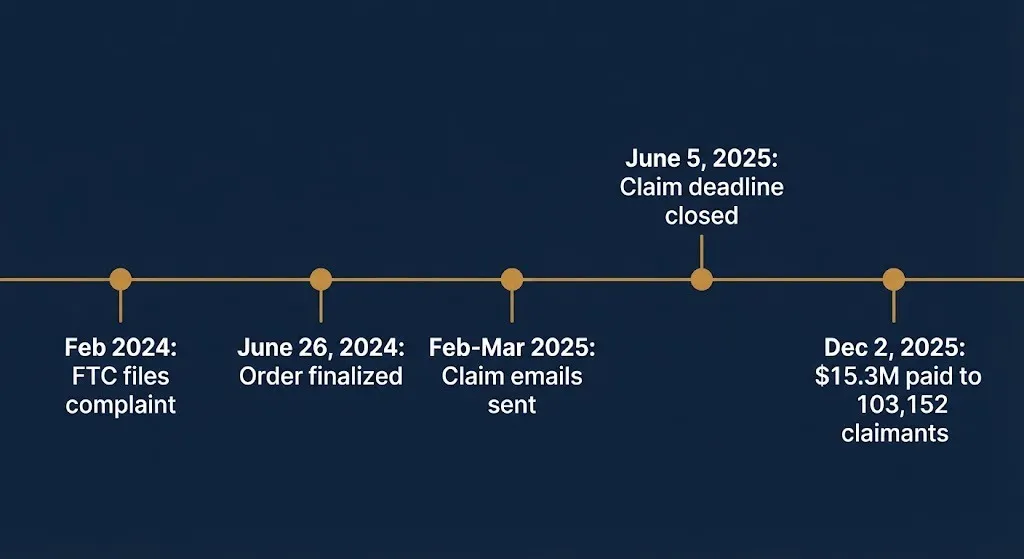
The FTC brought a complaint against Avast Limited and its subsidiaries in February 2024, alleging the company sold users’ browsing data without proper consent. Avast agreed to a $16.5 million consent order, which the FTC finalized on June 26, 2024.
Where things get confusing is a wave of 2026 content claiming a “new” filing window is open right now. That claim is false according to the FTC’s own Avast settlement page, which explicitly says the agency is “no longer accepting claims.”
What this means for you: any site telling you to file a claim for the Avast settlement in 2026 is pointing you toward a window that already closed in June 2025.
Is Avast Still Being Sued in 2026?
No. There is no active or new lawsuit against Avast Limited as of September 2026 tied to this browsing-data case.
The FTC’s action against Avast was resolved through a consent order, a type of settlement where a company agrees to pay and change its practices without admitting guilt in a contested trial. That order became final in June 2024, and the redress phase that followed is now complete.
No separate class action lawsuit tied to this same conduct was identified in current public records beyond the FTC’s own enforcement action.
Did Avast Actually Pay the $16.5 Million?
Yes. Avast paid the full $16.5 million ordered by the FTC, and the agency confirms it distributed nearly all of that amount to affected consumers.
The FTC reported that $15.3 million of the total fund reached 103,152 people who submitted valid claims before the June 5, 2025 deadline. The remaining balance covered administrative costs tied to running the claims process.
| Fund Category | Verified Amount |
|---|---|
| Total settlement ordered | $16.5 million |
| Distributed to consumers | Nearly $15.3 million |
| Valid claimants paid | 103,152 |
| Administrator | Rust Consulting, Inc. |
Key Takeaway: The Avast settlement wasn’t just announced, it was fully funded and paid out, which puts it ahead of many class actions that stall before reaching consumers.
How Much Did Individual Avast Claimants Receive?
Not a fixed amount for everyone. Payments were pro-rata, meaning your share depended on how many total people filed valid claims.
Dividing the nearly $15.3 million distributed by the 103,152 valid claimants works out to an average of roughly $148 per person, though the FTC never guaranteed a specific figure and actual payments varied by claimant. The FTC stated from the start that individual amounts would depend on the total number of people who filed.
- Checks: had to be cashed within 90 days of issue
- PayPal payments: had to be redeemed within 30 days
- Zelle payments: deposited directly, no action required
If you filed a valid claim before June 5, 2025, and haven’t checked your payment status, contact Rust Consulting directly rather than searching for a new claim form that doesn’t exist.
Is There Still an Avast Claim Deadline in 2026?
No. The confirmed claim deadline was June 5, 2025, and it has passed. There is no new or extended deadline for this settlement.
This is the most important correction this article can make. A separate website currently claims a filing window running from January 15, 2026, to July 15, 2026. That claim does not match anything on the FTC’s own settlement page and appears to be fabricated.
Reality Check: No legitimate FTC settlement reopens a closed claim window through a random blog post. If a site tells you to file a “new” Avast claim in 2026, treat it as false information, not an opportunity. The FTC will never ask you to pay a fee or provide banking passwords to receive a legitimate refund.
How Do You Check Your Avast Settlement Payment Status?
You can only check status on a claim you already filed before June 5, 2025; new claims are not being accepted.
- Locate the claim number and confirmation code from your original FTC email.
- Call the refund administrator, Rust Consulting, Inc., at 1-866-290-0165.
- Ask specifically about your payment method: check, PayPal, or Zelle.
- If you received a check, confirm it was cashed within the required 90 days.
- If you never received a payment despite filing a valid claim, raise that directly with the administrator.
- Report any suspicious follow-up messages asking for payment or account details to the FTC.
Key Takeaway: Anyone still trying to “file” for Avast in 2026 is chasing a window that closed over a year ago; anyone who already filed should be checking payment status instead.
What Happened to the People Who Missed the June 2025 Deadline?
Consumers who did not file a valid claim by June 5, 2025 did not receive a payment from this settlement fund, and no reopening has been confirmed.
The FTC’s process required eligible consumers to use a specific claim number and confirmation code sent by email between February 24 and March 7, 2025. Anyone who didn’t receive or act on that email during the filing window fell outside the paid group.
There is no confirmed appeals process or late-filing exception described anywhere in FTC records for this case.
Why Was Avast Sued by the FTC in the First Place?
Avast was sued because it marketed antivirus software as privacy protection while secretly collecting and selling detailed browsing data through its subsidiary Jumpshot.
The FTC’s complaint alleged that Avast gathered more than 8 petabytes of browsing information from users of its antivirus software and browser extensions, then routed it through Jumpshot to more than 100 third-party buyers. That data reportedly included search history, timestamps, and enough detail to be re-identified back to individual users despite claims of anonymization.
This is the kind of contradiction that draws regulator attention fast: a privacy tool operating as a data pipeline. Think of it like a locksmith who sells you a lock, then keeps a spare key for anyone who pays for it.
What Data Did Avast Collect and Sell?
Avast collected detailed, re-identifiable web browsing data, including URLs visited, search queries, timestamps, and device identifiers, according to the FTC’s complaint.
The FTC alleged this information could reveal sensitive categories of activity, including health concerns, religious beliefs, political leanings, location history, and financial status. Jumpshot then packaged this data into products with names like “All Clicks Feed” and “Cookie Feed” and sold them to major companies for advertising purposes.
Key Takeaway: The FTC’s core finding was that Avast’s own products created the exact tracking risk they were marketed to prevent.
Who Was Eligible for the Avast Settlement?
Eligibility was limited to people who purchased Avast antivirus software between August 2014 and January 2020.
The FTC identified roughly 3,690,813 potentially eligible consumers and sent them email notices with claim numbers between February 24 and March 7, 2025. Only people who both received that notice and submitted a valid claim by June 5, 2025 were paid.
- Purchased Avast antivirus software in the covered window (Aug. 2014 to Jan. 2020)
- Received an FTC email with a claim number and confirmation code
- Submitted the claim online before June 5, 2025
- No receipts or proof of purchase were required to file
What Was Avast’s Response to the FTC Case?
Avast agreed to the consent order without admitting or denying the FTC’s underlying allegations, which is standard in this type of settlement.
As part of the order, Avast agreed to delete the browsing data transferred to Jumpshot, stop selling browsing data for advertising without consent, notify affected consumers, and put a comprehensive privacy program in place going forward.
The FTC finalized this order on June 26, 2024, without further modification, meaning the terms Avast agreed to in February 2024 stood as originally negotiated.
What Is the Difference Between an FTC Settlement and a Class Action Lawsuit?
An FTC settlement is a government enforcement action, while a class action is a private lawsuit filed by consumers or their attorneys.
In the Avast case, the FTC itself brought the complaint and negotiated the consent order, so there was no lead plaintiff, no opt-out option, and no attorney’s fees taken from the fund the way there might be in a private class action. That structure is part of why a large share of the $16.5 million reached consumers directly.
This distinction matters if you’re trying to compare this case to other “settlements” you’ve seen: not every settlement follows the same rules on deadlines, opt-outs, or payout math.
What Happens Next
June 26, 2024: FTC finalizes its $16.5 million consent order against Avast.
February 24 to March 7, 2025: FTC emails claim notices to roughly 3.69 million eligible consumers.
June 5, 2025: Claim filing deadline passes; FTC stops accepting new claims.
December 2, 2025: Rust Consulting begins distributing payments to 103,152 valid claimants.
Now (2026): Case closed; no new claims, deadlines, or funds are expected unless the FTC announces otherwise on its official Avast page.
Frequently Asked Questions
Can I still file an Avast settlement claim in 2026?
No, the claim window closed on June 5, 2025.
The FTC’s official page states it is no longer accepting claims for this settlement.
Any site suggesting a new 2026 filing period is not reflecting confirmed FTC information.
How much money did Avast pay in the FTC settlement?
Avast paid $16.5 million total under the FTC’s June 2024 consent order.
Nearly $15.3 million of that was distributed directly to 103,152 verified claimants.
The rest covered the cost of administering the claims process.
Who was eligible for the Avast settlement?
People who bought Avast antivirus software between August 2014 and January 2020 were eligible.
The FTC emailed eligible consumers claim numbers between late February and early March 2025.
Only those who filed a valid claim by June 5, 2025 received a payment.
How much was my individual Avast settlement payment?
Payments were pro-rata, so amounts varied by claimant.
Dividing the total distributed by the number of claimants works out to roughly $148 on average.
Your specific amount depended on the total number of people who filed valid claims.
Is the Avast settlement legitimate or a scam?
It’s legitimate and confirmed directly on the FTC’s official website.
The agency itself brought the case and ran the claims process through administrator Rust Consulting.
The FTC never asks for payment or account passwords to issue a refund.
What should I do if I never received my Avast payment?
Contact the refund administrator, Rust Consulting, at 1-866-290-0165.
Have your original claim number and confirmation code ready.
This only applies if you filed a valid claim before the June 5, 2025 deadline.
Was there a separate class action lawsuit against Avast?
No separate class action tied to this same browsing-data conduct was found in current public records.
This case moved forward as an FTC enforcement action and consent order instead.
That structure is why there was no opt-out process or lead plaintiff involved.
The Avast settlement already ran its full course: the FTC investigated, Avast paid, and 103,152 people were compensated by December 2025. If you filed on time, follow up with Rust Consulting about your payment status rather than searching for a new claim form.