Biote Lawsuit 2026: What’s Confirmed, What’s Not, and Who Actually Qualifies
Quick Answer
- The Biote lawsuit is real: multiple individual suits and at least one proposed class action are active in state and federal courts.
- No settlement fund or per-person payout exists yet; each case is being litigated or negotiated separately.
- There is no shared claim deadline; your own state’s statute of limitations controls how long you have to file.
If you searched “Biote lawsuit,” you probably saw scary headlines and no real answer. Here’s the direct one: yes, Biote Medical is being sued, but not through one unified case you can simply join.
This affects two very different groups. Patients who received Biote’s hormone pellet implants and allege injuries like pellet extrusion, cardiovascular events, or cancer make up one track. A second, newer track began in February 2026, when a former Biote employee and his wife sued the company in Dallas County court, alleging its “Deep Sleep” supplement caused liver damage.
This article separates fact from marketing on both tracks: what’s actually confirmed in court filings, what settlement figures are still guesses, and what a surprising FDA finding from years ago still means for anyone considering pellet therapy today.
The Facts
| Case | Multiple separate lawsuits against Biote Medical LLC, no single consolidated case |
| Status | Active; individual suits and at least one proposed class action pending in 2026 |
| Settlement Fund | Not yet confirmed, no global fund exists |
| Est. Per Person | Not yet determined |
| Claim Deadline | No shared deadline; each state’s statute of limitations applies |
| Administrator | Not yet appointed |
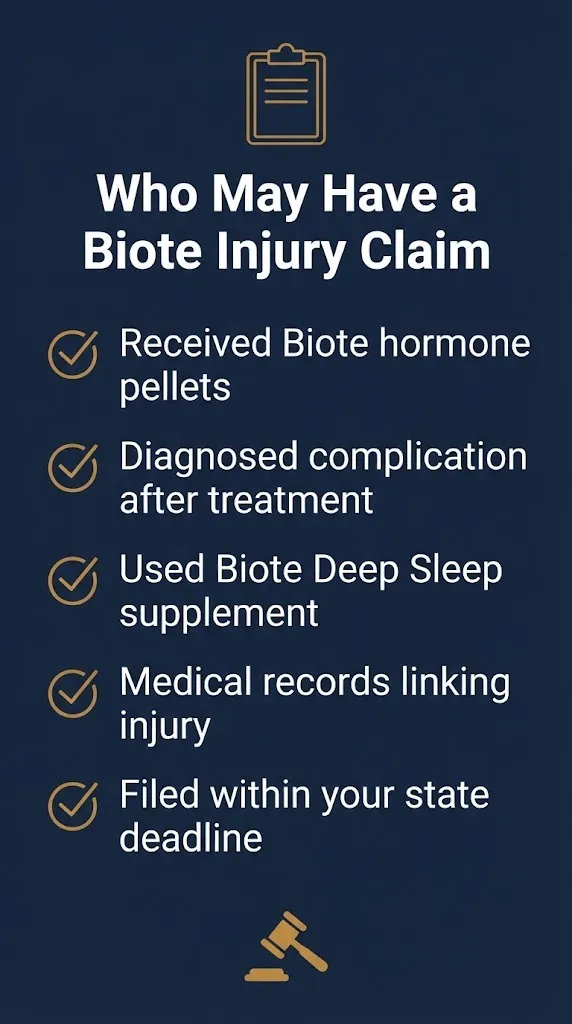
| Proof Needed | Medical records tying injury to Biote pellet therapy or supplement use, plus treatment or purchase records |
Is the Biote Lawsuit Legit?
Yes, the Biote lawsuit is legitimate. Multiple real lawsuits with named plaintiffs, real attorneys, and filed court records exist right now.
This isn’t a rumor circulating on social media. A Dallas County court filing from February 2026 names Christopher and Mary Pat Sharon as plaintiffs, represented by attorney Bill Brewer of Brewer, Attorneys & Counselors. Separately, a class action filed in West Virginia alleges hormone pellet injuries requiring multiple surgeries.
What makes this confusing for searchers:
- There isn’t one “Biote lawsuit,” there are several, with different plaintiffs and different products
- No court has consolidated these into a single multidistrict litigation (MDL) yet
- Corporate shareholder litigation involving Biote’s founder is a separate, unrelated legal track
Is Biote Hormone Pellet Therapy FDA Approved?
No. Biote hormone pellets are compounded products, not an FDA-approved finished drug.
The individual hormones used, like estradiol or testosterone, are FDA-approved ingredients, but the compounded pellet itself skips the FDA’s standard drug review process. This distinction sits at the center of the failure-to-warn claims in pending lawsuits.
Biote also received a May 22, 2017 FDA warning letter over cGMP violations and unapproved drug claims tied to certain supplement products, which the FDA closed out on May 3, 2018 after the company corrected the issues. That closeout means the specific 2017 violations were resolved, not that all safety concerns disappeared.
Key Takeaway: Biote’s pellets are legally compounded, not FDA-approved as a finished drug, and that gap is a central argument in the pending injury lawsuits.
How Much Could a Biote Lawsuit Settlement Pay?
Not yet determined. No global settlement fund exists for Biote patient injury claims as of September 2026.
Because these cases remain individual lawsuits rather than a certified class action with an approved fund, there’s no verified payout range to report. Any website listing a specific dollar figure for a “Biote settlement” is estimating, not reporting a confirmed number.
Some legal-industry sites speculate that a broader settlement announcement could arrive in the third or fourth quarter of 2026, based on how similar mass tort litigation has unfolded. That timeline is a projection from outside legal commentators, not a court-confirmed date, and should be treated as speculation until an official settlement website or court order says otherwise.
What typically determines payout size once cases do resolve:
- Severity of the alleged injury (extrusion versus cancer or cardiovascular event)
- Whether the plaintiff can show a direct medical link to Biote’s product
- Documented medical costs, lost income, and ongoing care needs
Is There a Biote Class Action Settlement Fund Yet?
No. As of September 2026, there is no certified, funded class action settlement covering Biote pellet or supplement injury claims.
A separate 2024 settlement exists, but it has nothing to do with patient injuries. That agreement resolved a corporate dispute between Biote and its founder, Dr. Gary Donovitz, over his departure and share ownership following the company’s SPAC merger. An amendment filed in early 2026 set a payment of $18,500,000 from Biote to Donovitz entities, due on or before January 2, 2026, for a share buyout.
Why this distinction matters: searchers sometimes assume that corporate settlement money is available to injured patients. It is not. That fund resolves a shareholder and founder dispute, not consumer injury claims.
How Do You File a Biote Lawsuit Claim?
You file a Biote lawsuit claim by consulting a personal injury or mass tort attorney, since no shared claim form exists yet.
Because there’s no certified class action or settlement administrator, you can’t submit a simple online claim form the way you would for an already-approved consumer settlement. Filing means starting an individual legal claim.
Steps typically involved:
- Gather medical records connecting your symptoms to Biote pellet therapy or a Biote supplement
- Collect receipts, treatment dates, and provider names
- Consult an attorney experienced in pharmaceutical or medical device mass torts
- Have your case evaluated for viability and statute of limitations
- File in the appropriate state or federal court if the attorney proceeds
- Track whether your case gets consolidated with others as litigation develops
What Proof Do You Need for a Biote Lawsuit?
You need medical documentation directly linking your injury to Biote pellet therapy or a specific Biote product.
Courts and attorneys weigh medical causation heavily in these cases. A general complaint about feeling unwell after treatment carries far less weight than records showing a diagnosed condition tied to the timing of your pellet insertion or supplement use.
Documentation that strengthens a claim:
- Records showing the specific date of pellet insertion or supplement purchase
- Diagnostic records for the alleged injury (biopsy results, imaging, lab work)
- A treating physician’s notes connecting the condition to hormone or supplement use
- Any communication with Biote or a certified provider about side effects
Who Qualifies for a Biote Pellet Injury Claim?
You may qualify if you received Biote hormone pellet therapy and later experienced a documented complication, though eligibility depends on your specific facts and an attorney’s evaluation.
Plaintiffs in pending litigation report a range of alleged complications tied to pellet therapy. Not everyone who used Biote products has a viable legal claim, and outcomes depend heavily on evidence and timing.
Complications named in current filings and FDA data:
- Pellet extrusion (implant pushing back out through the skin)
- Cardiovascular events, including strokes and heart attacks
- Hormone-related cancers, including endometrial and prostate cancer
- Deep vein thrombosis and cellulitis at the insertion site
A federal review cited in a 2019 FDA statement found more than 4,200 unreported adverse events tied to hormone pellets from a single entity, discovered during a 2018 facility inspection. Those events included possible associations with the complications listed above.
Key Takeaway: eligibility for a pellet injury claim depends on medical proof, not simply having used the product, and each case gets evaluated individually.
Reality Check
No one from a real settlement administrator will text or call you out of nowhere offering Biote lawsuit money, because no settlement fund currently exists to pay from. Filing a personal injury claim through a licensed attorney typically costs nothing upfront under a standard contingency fee arrangement. Be skeptical of any third-party “claim center” charging a fee just to submit paperwork on your behalf.
What Is the New Biote Deep Sleep Supplement Lawsuit About?
The newest Biote lawsuit, filed February 9, 2026, in Dallas County court, alleges the company’s “Deep Sleep” supplement caused liver damage.
Plaintiffs Christopher and Mary Pat Sharon say they took Deep Sleep as directed starting around 2021. The complaint states both later developed symptoms consistent with liver injury, and Mary Pat Sharon underwent a liver biopsy.
Details confirmed in reporting on the filing:
- Christopher Sharon was a former Biote employee, internally raising safety concerns in 2023
- He was terminated from the company in mid-2025; Biote attributed this to restructuring
- Biote discontinued Deep Sleep in late 2021 and introduced a reformulated product called “Best Night Sleep”
- As of the initial court record check, Biote had not filed a formal public response
This is a new, individual lawsuit, not yet a class action, and it targets a supplement rather than the hormone pellets at the center of earlier litigation.
Is the Biote Lawsuit Consolidated Into an MDL?
No. As of September 2026, Biote pellet injury cases have not been consolidated into a federal multidistrict litigation.
Cases are proceeding individually in various state and federal courts, alongside at least one proposed class action filed in West Virginia. Some legal trackers describe litigation as “developing toward” possible consolidation, similar to how mass torts against comparable hormone pellet competitors have progressed, but no consolidation order has been confirmed.
| Litigation Track | Consolidation Status |
|---|---|
| Hormone pellet injury claims | Individual suits plus at least one proposed class action, not consolidated |
| Deep Sleep supplement claim | Single individual lawsuit filed February 2026 |
| Founder/shareholder dispute | Resolved via amended 2024/2026 settlement agreement, unrelated to injury claims |
What Did the FDA Find About Biote’s Hormone Pellets?
The FDA found in a 2018 inspection that a single entity marketing hormone pellets had failed to report more than 4,200 adverse events to the agency.
This finding, published in a September 9, 2019, FDA statement, remains one of the most concrete regulatory facts tied to this case. The FDA said it could only formally attribute about 61 of those reports, covering issues like pellet extrusion and cellulitis, to testosterone pellets between 2013 and 2018, due to limited reporting requirements at the time.
The FDA also noted that patients using compounded bioidentical hormone products are using them instead of FDA-approved alternatives, and that no compounded formulation carries the agency’s safety and efficacy assurance. Biote’s earlier May 2017 warning letter over unapproved drug claims and manufacturing violations was formally closed out in May 2018, after corrective steps were taken.
What Are People Suing Biote For?
People suing Biote allege the company failed to adequately warn patients and providers about risks tied to its hormone pellet products, and, in the newest case, its sleep supplement.
Core legal theories across the pellet lawsuits include product liability, negligence, and failure to warn. Plaintiffs argue Biote marketed pellets as safe and natural while downplaying documented risks.
Recurring allegations across filings:
- Inadequate risk disclosure to patients before treatment
- Marketing that emphasized benefits while minimizing known complications
- Insufficient long-term safety data supporting pellet therapy claims
- Inconsistent training standards among certified providers who perform insertions
Who Is Biote Medical and What Does It Sell?
Biote Medical LLC is a Texas-based company that develops and markets bioidentical hormone pellet therapy, along with related supplements, through a network of trained and certified practitioners.
Headquartered in Irving, Texas, Biote itself does not perform pellet insertions. It trains and certifies outside providers who deliver the therapy directly to patients, a structure that shapes some of the liability questions raised in current lawsuits.
Think of it like a franchise model: the parent company sets the standards and sells the product, but a separate local provider carries out the actual procedure. That structure is now central to arguments over who bears responsibility when something goes wrong.
Biote became a publicly traded company after merging with Haymaker Acquisition Corp. III, a special purpose acquisition company (SPAC), a transaction that later triggered separate corporate governance litigation.
Is the Biote Founder Dispute Related to Patient Lawsuits?
No, the Biote founder dispute is a separate corporate matter, not connected to patient injury claims.
That litigation, filed in Delaware Chancery Court, involves Biote’s founder Dr. Gary Donovitz and disputes stemming from his exit and the company’s SPAC merger. A 2024 settlement agreement was amended in early 2026, setting an $18,500,000 payment from Biote to Donovitz entities for a share buyout, due by January 2, 2026.
Key Takeaway: three separate legal tracks exist here (patient pellet injury claims, the new supplement liver-damage lawsuit, and the founder’s corporate dispute), and no single settlement or deadline applies to all three.
What Happens Next
Now through late 2026: individual pellet injury and supplement lawsuits continue to be filed and litigated in multiple states.
Ongoing: courts may consider whether to consolidate pellet injury cases into a formal mass tort or MDL, though no consolidation order is confirmed yet.
Expected, unconfirmed timeline: some legal-industry commentary points to possible settlement developments in the third or fourth quarter of 2026, though this is speculation, not a court-set date.
As cases develop: watch for any official settlement website or court-appointed administrator announcement, since none exists as of this writing.
Frequently Asked Questions
Is the Biote lawsuit a class action I can join right now?
Not exactly, most cases are still individual lawsuits rather than a certified class action.
A proposed class action exists in West Virginia, but no certified, joinable class action covers all patients nationwide yet.
How much is the average Biote lawsuit settlement?
There is no confirmed average settlement amount because no global fund has been established.
Any specific dollar figure you see cited elsewhere is an estimate, not a verified payout.
What is the deadline to file a Biote lawsuit?
There is no single shared deadline; your state’s statute of limitations for personal injury or product liability applies.
These deadlines vary by state and typically run from when you discovered, or reasonably should have discovered, your injury.
Is Biote hormone pellet therapy FDA approved?
No, Biote’s hormone pellets are compounded from FDA-approved ingredients but are not themselves an FDA-approved finished drug.
This gap is central to the failure-to-warn claims in pending litigation.
What is the new 2026 Biote lawsuit about?
It’s a liver-injury lawsuit filed in February 2026 by a former employee and his wife over Biote’s “Deep Sleep” supplement.
It is separate from the hormone pellet injury lawsuits and is not a class action.
Did the FDA ever take action against Biote?
Yes, the FDA issued a warning letter in 2017 over manufacturing and labeling issues, later closed out in 2018.
A separate 2019 FDA statement also flagged thousands of unreported adverse events tied to hormone pellets from a single entity.
Do I need a lawyer to file a Biote claim?
Given the lack of a simple claim form or certified class fund, most people pursuing a claim work with a personal injury or mass tort attorney.
Many such attorneys evaluate cases on contingency, meaning no upfront legal fee.
Will Biote patients get money from the founder’s settlement?
No, that settlement resolves a shareholder and founder dispute and has no connection to patient injury compensation.
Patient claims remain a completely separate legal process.
If you believe a Biote product harmed you, the most useful step right now is gathering your medical records and treatment dates before memories or paperwork fade. There’s no shared deadline pushing you today, but your own state’s statute of limitations is quietly running. Watch for any future settlement announcement, since none has been confirmed as of September 2026.