Homeowners Insurance Lawsuit Coverage 2026: What’s Covered
Quick Answer
- Is it covered? Liability coverage may pay your defense and damages if you’re sued, up to your policy limit.
- How much? Not determined. The standard ISO form sets a basic liability limit of $100,000 per occurrence.
- Deadline? It varies. Many property policies set a one or two year limit to sue your insurer.
Homeowners insurance can cover a lawsuit against you, but only if the claim falls inside your liability coverage. The standard ISO form sets a basic limit of $100,000 per occurrence.
This affects anyone sued over an injury or damage tied to their home, and anyone fighting their own insurer over a denied claim. The deadline that matters most is your policy’s suit limitation period, often one or two years.
This guide covers both meanings of the search, plus 2026 developments. One surprising detail: one report puts homeowner suits over wind and hail claims above 900 in Oklahoma alone.
The Facts
| Item | Detail |
|---|---|
| Case | Not a single case. Guide to homeowners liability coverage and suits against insurers. 2026 matters: Hursh v. State Farm (Oklahoma Supreme Court), West v. State Farm (Comanche County, Oklahoma) |
| Status | Oklahoma discovery disputes active. A court order dated August 20, 2026 lifted blanket confidentiality designations in one case |
| Fund Size | Not applicable. Coverage pays up to your policy limit |
| Est. Per Person | Not yet determined. ISO basic liability limit is $100,000 per occurrence, with higher limits available |
| Claim Deadline | Set by your policy and state law. Suit limitation periods are often one or two years |
| Administrator | None. Your insurer’s claims department handles the claim |
| Proof Needed | Your policy, the lawsuit papers or denial letter, and claim records |
Does homeowners insurance cover a lawsuit against you?
Yes, often. The personal liability part of a homeowners policy, called Coverage E, pays your legal defense and damages awarded against you, up to your limit. The lawsuit must fall within what the policy covers.
Coverage applies to bodily injury or property damage claims, and it applies worldwide on the standard ISO form. A neighbor hurt on your steps is the classic example.

Here’s what has to line up:
- The claim alleges bodily injury or property damage
- The event happened during your policy period
- No exclusion applies
- You gave your insurer timely notice
Coverage isn’t automatic for every suit. A claim over a business dispute or a deliberate act usually isn’t covered. Read your declarations page and Section II exclusions.
Does homeowners insurance pay for your lawyer?
Often yes. If a claim could possibly fall within coverage, the insurer typically has a duty to defend you and pays the attorney it assigns.
Courts describe the trigger as a “potentiality for coverage.” One example from a Maine law firm: if a plaintiff alleges you injured her both intentionally and negligently, the insurer will likely defend, because negligence is covered by almost all homeowners policies.
The insurer usually picks the lawyer and controls settlement. FindLaw notes that liability insurers generally hold the contractual right to settle or defend as they see fit.
Think of a fire department responding to any call that might be a fire. It shows up first and sorts out the cause later. The duty to defend works the same way.
What lawsuits does homeowners insurance not cover?
Intentional acts, business activities, and some employee injuries are commonly excluded. Your exact policy controls, so read the exclusions section.
| Typical exclusion | Example |
|---|---|
| Intentional acts | Deliberately pushing someone down stairs |
| Business activity | A customer injured at a home business |
| Workers’ compensation liability | Injury to an employee who should be covered by workers’ comp |
| Expected or intended harm | An insurer arguing the harm was “willful and malicious” |
Insurers raise these in real cases. In a federal case involving State Farm and a Vermont lawsuit, the insurer argued it had no duty to defend because the complaint alleged harm that was “expected or intended.”
In a Maryland case, Nationwide argued a homeowners policy excluded liability tied to a worker’s injury. Exclusions are where most disputes happen.
Key Takeaway: Homeowners liability coverage usually defends claims that could be covered, but intentional acts, business activity, and some employee injuries are commonly excluded.
How much does homeowners liability coverage pay in a lawsuit?
Not yet determined for your policy, because your limit decides it. The ISO basic personal liability limit is $100,000 per occurrence, and higher limits are available.
| Item | Detail |
|---|---|
| ISO basic liability limit | $100,000 per occurrence |
| Higher limits | Available by endorsement or purchase |
| Medical payments to others (Coverage F) | Separate coverage, not legal expenses |
| Example | $500,000 limit, $550,000 settlement, about $50,000 out of pocket |
One consumer guide warns that the default $100,000 limit may not be enough for a serious injury claim. Anyone whose net worth exceeds their liability limit has meaningful personal exposure.
Coverage F pays small medical bills for guests regardless of fault. It isn’t a legal-defense benefit.
Check your declarations page for the exact liability figure. Don’t assume.
Do legal fees count against your liability limit?
It depends on your policy, and sources conflict. The ISO HO-3 form treats defense costs as supplementary, meaning in addition to the limit. A consumer site says defense fees come out of the same limit.
The Institutes’ coverage text says defense is supplemental to the liability limit. It adds that the insurer’s duty to defend ends once the limit is exhausted by paying a settlement or judgment.
MoneyGeek says legal defense fees come out of your liability limit, not on top. That may reflect specific insurer forms.
Don’t assume either version. Ask your insurer in writing:
- Do defense costs reduce my limit?
- What happens to the duty to defend once the limit is paid?
- Does my policy follow the ISO form?
What happens if a lawsuit exceeds your liability limit?
You may owe the difference personally, unless you have an umbrella policy. An umbrella extends liability coverage beyond your homeowners limit and pays after Coverage E is exhausted.
Example from Progressive: a $500,000 limit and a $550,000 settlement likely leaves you covering $50,000 out of pocket.
Here’s what to compare when judging whether you need more:
- Your home equity and savings
- Your future earnings
- Whether you have a pool, dog, or frequent guests
- Your current liability limit on the declarations page
Umbrella policies add their own conditions, including minimum underlying limits. Ask an agent which apply.
Reality Check: Nobody legitimate texts you “settlement money” from your own insurer first. An adjuster or “claim helper” who demands fees to speed a payout isn’t required. If a message pressures you to sign a release the same day, pause and read it first.
Key Takeaway: Your declarations page, not the average policy, sets how much your coverage pays, and an umbrella policy covers amounts above it.
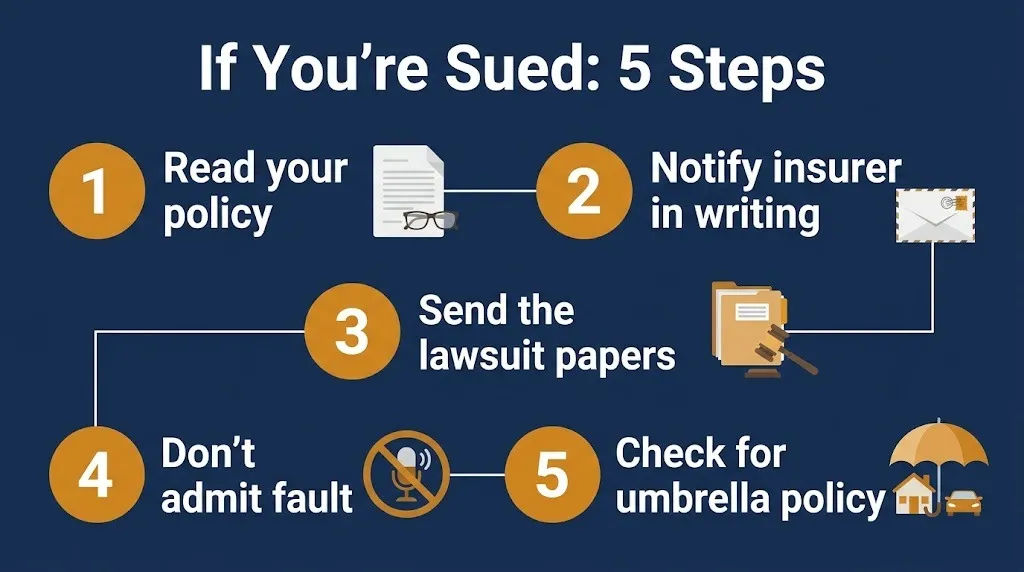
What should you do the day you’re served with a lawsuit?
Notify your insurer in writing right away and send the lawsuit papers. Delay can complicate coverage, so don’t wait to see if the suit goes away.
Follow these steps:
- Read the papers and note the response deadline.
- Notify your insurer in writing immediately.
- Send the insurer the summons and complaint.
- Don’t admit fault or settle on your own.
- Preserve photos, texts, and records.
- Ask whether the insurer will defend under a reservation of rights.
- Check for an umbrella policy and notify that insurer too.
Step 6 matters. An insurer may defend you while reserving the right to deny coverage later. That’s common when some claims in the suit are excluded.
Keep a log of every call and email with the insurer.
How do you sue your homeowners insurance company?
You usually start with the claim itself, then escalate. Lawsuits against insurers typically allege breach of contract, and some also allege bad faith.
Follow these steps:
- Get the denial or underpayment decision in writing.
- Request a certified copy of your full policy.
- Check your policy’s suit limitation clause.
- Consider demanding appraisal before that clock runs.
- Gather estimates, photos, and repair invoices.
- Ask in writing for a deadline extension if needed.
- Talk to a licensed attorney in your state.
Step 4 matters. A Florida-style property coverage firm warns that a demand for appraisal should be made before the suit limitation period runs. In one State Farm case, the insurer rejected an appraisal request as untimely.
Don’t let negotiations run out the clock.
What is the deadline to sue your homeowners insurer?
It’s set by your policy and your state, and it can be as short as one year. Most property insurance policies have a one or two year suit limitation period.
| Rule | Detail |
|---|---|
| Typical policy period | One or two years |
| Contrast | Four- or six-year general contract limits in some states |
| Colorado example | Three years for homeowners, and insurers can’t shorten it (Statute 10-4-110.8) |
| Tolling | Some states pause the clock during claim adjustment |
| Extensions | Insurers often agree if you ask in writing |
United Policyholders says state law may override a one-year clause, and insurers will usually extend if you ask in writing. It advises sending a letter before the one-year anniversary of your loss.
This is like a store’s return window. The receipt doesn’t help once the window closes.
Key Takeaway: Find your policy’s “Suit Against Us” clause today, because missing it can end a claim regardless of its merit.
Is there a homeowners insurance lawsuit update for 2026?
Yes. The biggest 2026 activity is in Oklahoma, where reports describe hundreds of homeowner suits over wind and hail claims. We verified no nationwide class settlement for homeowners claims.
| Date | Development |
|---|---|
| January 8, 2026 | A Palisades Fire homeowner sues State Farm for bad faith |
| June 23, 2026 | Oklahoma Supreme Court rules the state can’t join a policyholder’s bad-faith suit |
| June 24, 2026 | Oklahoma’s attorney general sues State Farm |
| August 20, 2026 | Oklahoma judge lifts blanket confidentiality designations in West v. State Farm |
These are allegations and procedural rulings, not final findings of wrongdoing. State Farm denies the allegations.
If a settlement notice reaches you, verify the case and administrator before filing anything.
What is happening in the Oklahoma homeowners insurance lawsuits?
Homeowners allege State Farm underpaid or denied wind and hail roof claims, and discovery disputes are exposing internal documents. State Farm strongly rejects the allegations. No verdict in these cases is confirmed.
| Case or action | Verified detail |
|---|---|
| Hursh v. State Farm | Tulsa-area policyholders allege a denied hail claim left them with about $22,000 out of pocket; before the Oklahoma Supreme Court |
| Oklahoma attorney general suit | Filed June 24, a day after the court barred the state from joining Hursh |
| West v. State Farm | Comanche County case; August 20 order cites more than 800,000 pages State Farm produced |
| Lyle v. State Farm Fire and Casualty | Cleveland County case filed February 2024 |
Plaintiffs’ lawyers say emails show State Farm denied 39% of claims in the period. That figure comes from attorneys’ characterizations of documents. State Farm says it paid more than $1 billion for Oklahoma wind and hail losses over two years.
One report counts more than 900 such suits statewide. Treat counts as approximate.
What does the Palisades Fire bad-faith lawsuit allege?
A homeowner alleges State Farm delayed environmental testing for ten months and withheld at least $319,881.12 on a Palisades Fire claim. These are allegations, and State Farm’s response isn’t confirmed here.
The filing, reported January 8, 2026, alleges contractor estimates were labeled “not warranted” and that a $3,610 flood-mitigation invoice went unpaid. It also alleges Xactimate software was used to reassess costs despite disclaimers about post-disaster pricing.
The suit claims the home remained uninhabitable nearly a year after the fire. Estimates stayed below policy limits, according to the filing.
Court filings contain claims, not findings. Check any docket before relying on a summary.
Key Takeaway: The 2026 homeowner suits are allegations in active cases, and no final ruling establishes wrongdoing by any insurer.
What is the difference between duty to defend and duty to pay?
The duty to defend is broader. An insurer must defend if a claim might be covered, but it pays damages only if coverage actually applies.
| Duty | Trigger | What it means |
|---|---|---|
| Duty to defend | Claim might fall within coverage | Insurer provides and pays for your defense |
| Duty to indemnify (pay) | Covered liability is established | Insurer pays settlement or judgment up to the limit |
A Vermont federal court applied this rule in a State Farm case. It said an insurer must defend whenever the claim might be of the type covered.
You can win the defense question and still lose the payment question. If the facts later show an excluded act, the insurer may stop paying.
What is bad faith in a homeowners insurance claim?
Bad faith means an insurer denies, delays, or underpays a claim without a reasonable basis. It can also mean failing to investigate properly.
Remedies vary by state. In some states, bad faith awards can include punitive damages beyond the claim amount.
Signs commonly cited include:
- Unexplained delays
- Failure to respond within a reasonable time
- Denials without investigation
- Lowball estimates not tied to actual repair costs
Not every denial is bad faith. A coverage dispute can be reasonable even if you disagree.
Do you need a lawyer to fight a homeowners insurance denial?
Many sources advise consulting one before your suit deadline arrives. Property coverage lawyers say to see counsel before the one-year potential deadline.
Ask any attorney:
- Have you handled homeowners claims in my state?
- How do you handle suit limitation deadlines?
- How are fees structured, and who pays costs?
- Is appraisal or a regulator complaint a better first step?
LawCompensate doesn’t recommend firms. You can also file a complaint with your state’s insurance department.
Keep copies of everything you send.
Key Takeaway: Check your suit deadline and talk to a licensed attorney before a denial turns into a missed filing window.
What happens next in homeowners insurance lawsuits?
Several Oklahoma matters are still moving. None has a guaranteed date.
Today (October 25, 2026): Oklahoma discovery disputes continue, with no verdicts confirmed.
Expected next: State Farm must review its confidentiality designations within 30 days of the August 20 order in West.
Expected after that: Courts decide whether additional documents become public.
Expected over coming months: The Oklahoma Supreme Court proceedings in Hursh continue.
Expected eventually: Settlements, verdicts, or appeals determine whether any claims succeed.
Frequently Asked Questions
Does homeowners insurance cover lawsuits?
Yes, if the claim falls within liability coverage.
It typically pays defense and damages up to your limit.
Does homeowners insurance pay for a lawyer if I’m sued?
Usually, if the claim might be covered.
The insurer typically assigns the attorney.
What is the standard homeowners liability limit?
The ISO basic limit is $100,000 per occurrence.
Higher limits are available.
What if the lawsuit is bigger than my coverage?
You may owe the difference.
An umbrella policy pays after your homeowners limit is exhausted.
How long do I have to sue my homeowners insurer?
It depends on your policy and state.
Many policies set a one or two year limit.
Is State Farm being sued over homeowners claims in 2026?
Yes, in Oklahoma and elsewhere.
State Farm denies the allegations.
Are intentional acts covered by homeowners insurance?
Usually not.
Insurers commonly exclude intentional harm.
Open your declarations page and write down your liability limit. Then find the “Suit Against Us” clause in your policy.
Calendar the one-year anniversary of any loss. Many property policies set a one or two year limit to sue.