Lopez vs Apple Settlement Email: Is That “Lopez Voice Assistant” Message Real in 2026?
Quick Answer
- Is it legit? Yes. The “Lopez Voice Assistant” email and payment label came from the official Lopez v. Apple Siri settlement, not a scam.
- How much? Payments were capped at $20 per device, up to 5 devices, but averaged around $8 per device in reality.
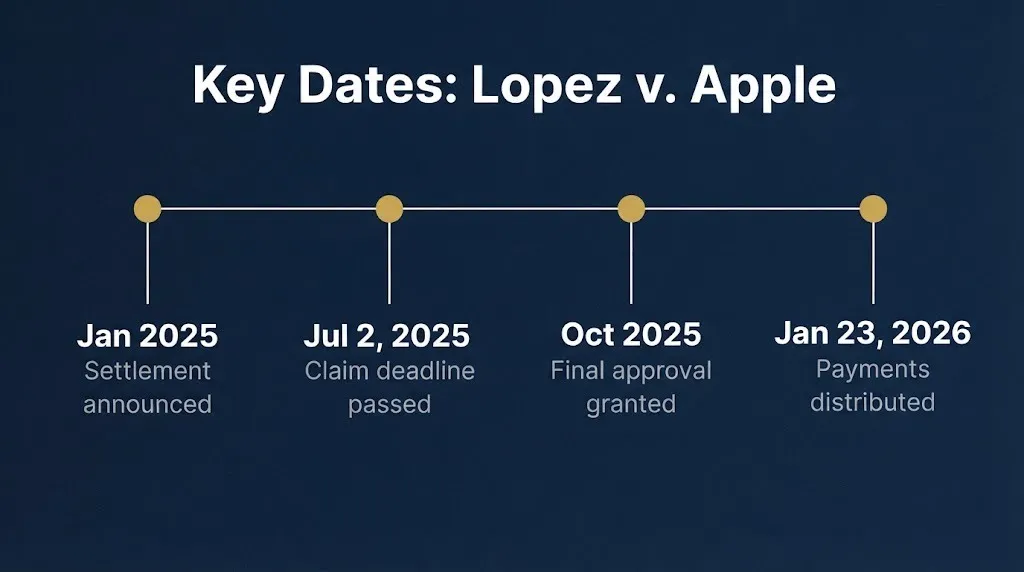
- Key deadline? The claim deadline was July 2, 2025. It has passed and no new claims are being accepted.
The “Lopez Voice Assistant” email you’re worried about is real. It’s tied to a $95 million class action that accused Apple’s Siri of recording private conversations without consent. The settlement administrator sent those emails to people who qualified for a cut of the money.
If you filed a claim before July 2, 2025, you may have already received a deposit labeled “Lopez Voice Assistant” or “Lopez Voice Asst Payouts”. If you didn’t file, the window is closed. No amount of email checking will change that.
This article breaks down exactly what the settlement email means, who got paid, how much, and what to do if your payment never showed up.
The Facts
| Case | Lopez v. Apple Inc., No. 4:19-cv-04577-JSW (N.D. Cal.) |
| Status | Settlement finalized, payments distributed |
| Fund Size | $95 million |
| Est. Per Person | ~$8 per device on average; $20 max per device |
| Claim Deadline | July 2, 2025 (passed) |
| Administrator | Angeion Group |
| Proof Needed | Claim form filed before deadline; device serial number or purchase proof |
Is the Lopez vs Apple Settlement Email Legit or a Scam?
The Lopez vs Apple settlement email is legitimate, sent by the court-appointed administrator Angeion Group, from the address [email protected]. It is not a phishing attempt, though the subject line has confused plenty of people.
The confusion makes sense. The email arrives with the subject “Lopez Voice Assistant Class Action Settlement,” a name almost nobody recognizes. Most people know the case as “the Apple Siri settlement,” not by the lead plaintiff’s last name. The email also asks you to click a link and enter codes, which looks exactly like the kind of message you’re told to delete.
Here’s the verification method that actually works. The official settlement website was lopezvoiceassistantsettlement.com. If your email came from that domain, it’s real. If it came from anywhere else, delete it. And critically: the settlement administrator will never ask you to pay a fee to receive your money. Filing was always free.
Reality Check: No legitimate settlement ever requires you to pay upfront to receive a payout. The Lopez v. Apple settlement was free to claim. Anyone who asked you for payment to “release” your funds is running a scam.
How Much Money Did People Actually Get From the Apple Siri Settlement?
People received around $8 per device on average, not the full $20 cap, because so many claims were filed that the money had to be spread thinner. The settlement website said payments were capped at $20 per device, with a maximum of five devices per person, so $100 was the theoretical ceiling.
The math worked against claimants. When more people file valid claims than the fund anticipated, each payout shrinks proportionally. That’s standard for class actions.
Here’s what the payout structure looked like:
| Scenario | Devices Claimed | Theoretical Max | Actual Average Reported |
|---|---|---|---|
| Single device | 1 | $20 | ~$8 |
| Two devices | 2 | $40 | ~$16 |
| Five devices | 5 | $100 | ~$40 |
Multiple claimants confirmed receiving exactly $40.10 for five devices. That’s the $8 per device reality applied to the maximum claim.
Key Takeaway: The Lopez vs Apple settlement paid real money, but it was roughly $8 per device, not the $20 headline number, because claim volume diluted the fund.
How Do You Check If You Received a Lopez vs Apple Settlement Payment?
You check for the Lopez vs Apple settlement payment by searching your bank statement for the label “Lopez Voice Assistant” or “Lopez Voice Asst Payouts”. That’s how the deposits appeared. Some people got physical checks. Others received digital checks via email.
The payment methods varied based on what you selected when you filed your claim. Options included direct deposit (ACH), Venmo, PayPal, or paper check. If you chose a digital check, the payment arrived as an email from the administrator, and it could easily land in your spam folder.
If you filed a claim and haven’t seen anything, here’s what to do:
- Search your email inbox and spam folder for “Lopez Voice Assistant”
- Check every bank account you may have linked during the claim process
- Look through physical mail, including forwarded mail if you’ve moved
- Contact the settlement administrator directly if you believe you were missed
The administrator’s website noted that payments were fully distributed by January 26, 2026. If you filed on time and received nothing by February 2026, you were likely excluded for a specific reason, such as submitting both a claim and an exclusion request.
Who Qualified for the Lopez vs Apple Settlement?
You qualified for the Lopez vs Apple settlement if you owned or purchased a Siri-enabled Apple device and experienced an unintended Siri activation during a private conversation between September 17, 2014 and December 31, 2024. You also had to live in the United States or a U.S. territory.
The device list was broad. It included:
- iPhone
- iPad
- Apple Watch
- MacBook
- iMac
- Apple TV
- HomePod
- iPod touch
The key phrase in the eligibility rules was “unintended Siri activation during a confidential or private communication.” You didn’t need a receipt, though proof of purchase helped. You could claim a device using its serial number if you didn’t have the original paperwork.
Apple denied all wrongdoing as part of the settlement, and the court did not rule on whether the company actually violated any laws. The settlement was a business decision to end litigation, not an admission of fault.
Can You Still File a Claim in the Lopez vs Apple Settlement in 2026?
No, you cannot file a claim in the Lopez vs Apple settlement in 2026. The deadline to submit a claim was July 2, 2025, and it has passed. The settlement fund has been fully distributed, and the case is closed.
There is no late claim process, no hardship exception, and no waiting list. Class action deadlines are firm. If you missed July 2, 2025, you permanently forfeited your right to any payment from this settlement.
Some websites may suggest you can still “check eligibility” or “submit a late claim.” Those sites are either collecting your information for other purposes or trying to generate ad revenue. The official settlement website is no longer accepting submissions.
Key Takeaway: The Lopez vs Apple claim deadline was July 2, 2025. It passed. No new claims are being accepted in 2026, regardless of what any website tells you.
What Should You Do If You Got an Email About Lopez vs Apple But Never Filed?
If you got an email about Lopez vs Apple but never filed a claim, you’re not getting paid. The email was a notice, not a payment. Many people received it and assumed the money was automatic. It wasn’t.
Class action settlements require you to take action. The notice email included a Claim Identification Code and Confirmation Code for people who were identified as potential class members. You had to use those codes to file. If you ignored the email or deleted it thinking it was spam, you missed the window.
This is different from some settlements where payment is automatic for identified class members. In the Apple Siri case, you had to file a claim form. The notice was an invitation, not a check.
If you’re unsure whether you filed, search your email for a confirmation from lopezvoiceassistantsettlement.com. The administrator sent confirmation emails after successful submissions. If you can’t find one, you almost certainly didn’t complete the process.
Why Did Some People Get Confused About the Apple Siri Settlement Email?
People got confused about the Apple Siri settlement email because the sender name, “Lopez Voice Assistant Settlement Administrator,” didn’t mention Apple at all. The case name comes from the lead plaintiff, Fumiko Lopez, whose 2019 lawsuit started everything. Most people only knew the case as “the Apple Siri lawsuit” from headlines.
The timing made it worse. The emails went out in waves, and some people received them months before payments were distributed. That gap between “you might be eligible” and “here’s your money” created suspicion. Scammers exploit exactly that kind of uncertainty.
The bank statement labels caused the same confusion. A deposit showing “Lopez Voice Assistant” looks random if you don’t remember signing up for anything. Some people contacted their banks to report fraudulent transactions before realizing the money was legitimate.
That’s the catch with class action settlements: the legal names on the paperwork rarely match the brand names in the news.
How Does the Lopez vs Apple Settlement Compare to Other Tech Privacy Settlements?
The Lopez vs Apple settlement compares to other tech privacy settlements as a mid-sized payout with unusually broad eligibility. The $95 million fund is substantial, but the per-person amount was small because millions of people qualified.
The scope of the class was massive. The settlement website received over 7.9 million visits from 5.3 million unique users. That’s a signal of how many people believed they might qualify. The actual number of valid claims determined the final payout per device.
Other tech privacy settlements have followed a similar pattern. Big headline fund, broad eligibility, small individual payouts. The attorneys typically request a percentage of the fund, and in this case, there was an objection filed arguing the fee request should be capped at $19 million rather than the roughly $28.5 million requested. The court ultimately approved the settlement and the distribution moved forward.
For consumers, the takeaway is consistent: if you get a settlement notice and you might qualify, file. The money is real, even if it’s modest. Ignoring the email guarantees you get nothing.
What Happens Next With the Lopez vs Apple Settlement?
Nothing happens next with the Lopez vs Apple settlement. The case is over. Payments were distributed. The fund is depleted. There are no further hearings, appeals, or payment rounds scheduled.
The final approval came in late 2025, payments began January 23, 2026, and distribution concluded January 26, 2026. Some payments took slightly longer to clear depending on the method chosen, but the administrator’s work is done.
If you received a payment and haven’t deposited it yet, do that. Digital checks and physical checks typically have expiration windows. The settlement website noted that payment must be accepted within 120 days or the funds will be forfeited. If you’re past that window, the money may already be gone.
For anyone who missed this settlement entirely, the best move is to stay alert for future class action notices. They arrive by email, postcard, and sometimes social media ads. The Lopez case won’t come back, but similar ones will.
Key Takeaway: The Lopez vs Apple settlement is fully closed. If you got paid, deposit the check. If you didn’t file, there’s no recourse. Watch for the next notice instead.
Frequently Asked Questions
Is the Lopez vs Apple settlement email a scam?
No, the Lopez vs Apple settlement email is legitimate. It was sent by the court-appointed administrator Angeion Group from the official settlement domain. The confusion comes from the case name, which doesn’t mention Apple.
How much was the Lopez vs Apple settlement payout?
The Lopez vs Apple settlement payout was around $8 per device on average. The cap was $20 per device, with a maximum of five devices, but high claim volume reduced actual payments. Some people received $40.10 for five devices.
Can I still claim the Apple Siri settlement in 2026?
No, you cannot claim the Apple Siri settlement in 2026. The deadline to file was July 2, 2025. The settlement is closed and all payments have been distributed.
What does “Lopez Voice Assistant” mean on my bank statement?
“Lopez Voice Assistant” on your bank statement means you received a payment from the Lopez v. Apple class action settlement. The label comes from the lead plaintiff’s name. It is not a scam.
Who was eligible for the Apple Siri settlement?
Anyone who owned a Siri-enabled Apple device and experienced an unintended Siri activation during a private conversation between September 17, 2014 and December 31, 2024, and lived in the U.S., was eligible.
Did Apple admit wrongdoing in the Siri settlement?
No, Apple admitted no wrongdoing. The company denied all allegations and settled to avoid the cost and risk of trial. The court did not rule on whether Apple violated any laws.
What if I filed a claim but never got paid?
If you filed a claim but never got paid, first check your spam folder and all bank accounts. If you still can’t find the payment and filed before July 2, 2025, contact the settlement administrator. Some payments may have been invalidated for filing errors.
What happens if I didn’t file a claim before the deadline?
If you didn’t file a claim before the deadline, you get nothing. The July 2, 2025 deadline was firm. No late claims, no exceptions, no waiting list. You forfeited your right to any payment from this settlement.
What You Should Do Now
The Lopez vs Apple settlement is closed. If you received a “Lopez Voice Assistant” email or bank deposit, it was real. If you filed a claim, your payment has already been sent or was forfeited for non-acceptance.
The single most important date in this entire case was July 2, 2025. That was the deadline to file. Everything after that was just processing.
If you missed it, mark your calendar for the next class action notice that lands in your inbox. Read it. Verify the sender. File before the deadline. The money is usually small, but it’s yours if you act.