Paraquat Lawsuit 2026: Settlement Status, Payout Amounts, and What Comes Next
Quick Answer
- The paraquat lawsuit is real. It’s an active federal mass tort (MDL No. 3004) plus thousands of state court cases in Philadelphia.
- Settlement amounts are not officially confirmed. Industry estimates put individual payouts between roughly $20,000 and $1.5 million, unverified and case-dependent.
- There is no public claim deadline. Existing plaintiffs are working through opt-in and opt-out decisions with their own lawyers and the court-appointed Special Master.
If you’re searching this because you or a family member developed Parkinson’s disease after working with paraquat, you’re not chasing a rumor. This litigation has been building since 2017, and it hit a major turning point when the parties signed a confidential settlement agreement in August 2025.
More than 6,600 people are currently part of the federal case alone, with thousands more in Philadelphia state court. The single most important fact right now: no official per-person payout numbers have been released, and anyone quoting you a guaranteed dollar figure is getting ahead of the actual court record.
This article breaks down what’s confirmed, what’s still confidential, and what “settled” actually means in a mass tort like this one, which works differently than a class action with a claim form. One detail that trips people up: Syngenta announced in March 2026 that it will stop making paraquat entirely, but that decision is separate from the lawsuit payouts.
The Facts
| Case | In re: Paraquat Products Liability Litigation, MDL No. 3004 |
| Court | U.S. District Court, Southern District of Illinois, Chief Judge Nancy J. Rosenstengel |
| Status | Confidential master settlement signed August 4, 2025; Qualified Settlement Fund approved March 2026; payouts still rolling out |
| Fund Size | Not publicly disclosed |
| Est. Per Person | Not officially confirmed; industry estimates range $20,000 to $1.5 million, unverified |
| Claim Deadline | Not applicable, no public claim form; existing MDL plaintiffs work through their own attorneys |
| Special Master / Administrator | Randi S. Ellis, court-appointed Special Master |
| Proof Needed | Plaintiff Assessment Questionnaire (PAQ), Parkinson’s diagnosis records, documented paraquat exposure history |
Is the Paraquat Lawsuit Real, and Is It Legit?
Yes, the paraquat lawsuit is a legitimate, active mass tort, not a scam or internet rumor.
It exists as a federal multidistrict litigation, MDL No. 3004, formed by the Judicial Panel on Multidistrict Litigation and consolidated before Chief Judge Nancy J. Rosenstengel in the U.S. District Court for the Southern District of Illinois. Thousands of additional cases also sit in Philadelphia’s Court of Common Pleas, a separate but related state court track.
The claims allege that Syngenta and Chevron, paraquat’s manufacturers and distributors, failed to warn users that routine exposure to the herbicide could raise the risk of Parkinson’s disease. Both companies have denied liability while continuing to settle individual cases before they reach a jury.
Key detail: as of court filings reviewed in 2026, the case count sits above 6,600 in the federal MDL, with sources reporting figures between roughly 6,400 and 6,665 depending on the exact filing date, since the docket changes weekly as cases settle or get dismissed.
What Is a Paraquat Settlement?
A paraquat settlement is a negotiated agreement where Syngenta and Chevron pay compensation to individual plaintiffs without those cases going to a jury verdict.
This is not a class action in the traditional sense. Each plaintiff’s case is evaluated individually based on their diagnosis, exposure history, and medical documentation, then plaintiffs choose whether to accept an offer or opt out and keep litigating.
The master settlement agreement covering most MDL cases was signed on August 4, 2025, according to a court filing requesting the Qualified Settlement Fund. Its financial terms remain confidential.
Not yet determined: the total dollar value of that master agreement. Courts allow this kind of confidentiality in mass torts, but it also means no outlet, including this one, can report a verified total fund size right now.
Paraquat Lawsuit Settlement Amounts: How Much Could You Get?
Confirmed individual payout amounts have not been made public, so any specific number you see should be treated as an estimate, not a guarantee.
Legal industry trackers have published estimated ranges based on similar mass torts and case severity, but these figures come from outside analysis, not court records.
| Estimate Type | Reported Range | Verification Status |
|---|---|---|
| Industry-estimated individual payout | $20,000 to $1.5 million | Unconfirmed, sourced to legal-marketing trackers |
| Prior 2021 settlement (smaller case group) | Approximately $187.5 million total, covering multiple plaintiffs | Reported by multiple legal news outlets |
| 2026 master settlement fund value | Not disclosed | Confidential, unconfirmed |
Your actual amount, if you have a pending case, depends on your diagnosis severity, how long and how directly you were exposed, your age at diagnosis, and the strength of your medical documentation. A stronger paper trail functions a lot like a warranty claim: the better your records, the smoother the process moves.
Key Takeaway: no verified per-person dollar figure exists yet for the 2026 master settlement, and estimates you’ll see online are industry projections, not confirmed court numbers.
Paraquat Settlement Fund: What’s Actually Been Approved So Far
The court has approved the creation of a Qualified Settlement Fund (QSF), a structure used to hold and later distribute settlement money, but that’s a process step, not a payout announcement.
In March 2026, attorneys for both plaintiffs and defendants jointly asked the court to establish the Paraquat Products QSF under federal tax code Section 468B. Judge Rosenstengel authorized it and canceled an upcoming trial “in light of the pending settlement.”
The QSF will eventually receive settlement funds from Syngenta and Chevron and distribute money to claimants who accept individual offers, overseen by a court-appointed administrator and Special Master Randi S. Ellis.
Here’s what that means in plain terms:
- The fund exists as a legal mechanism now.
- Money has not been confirmed as deposited or distributed publicly.
- Individual plaintiffs go through their own attorneys to accept or decline offers.
- The court, not the companies, supervises the process.
Reality Check: no one from a real paraquat settlement fund is going to text, email, or call you out of the blue offering a payout. Filing or joining this litigation is handled through licensed attorneys, and legitimate law firms don’t charge upfront fees to evaluate your case. If someone asks for payment before you’ve even signed a retainer agreement, treat that as a red flag.
How to File a Paraquat Lawsuit
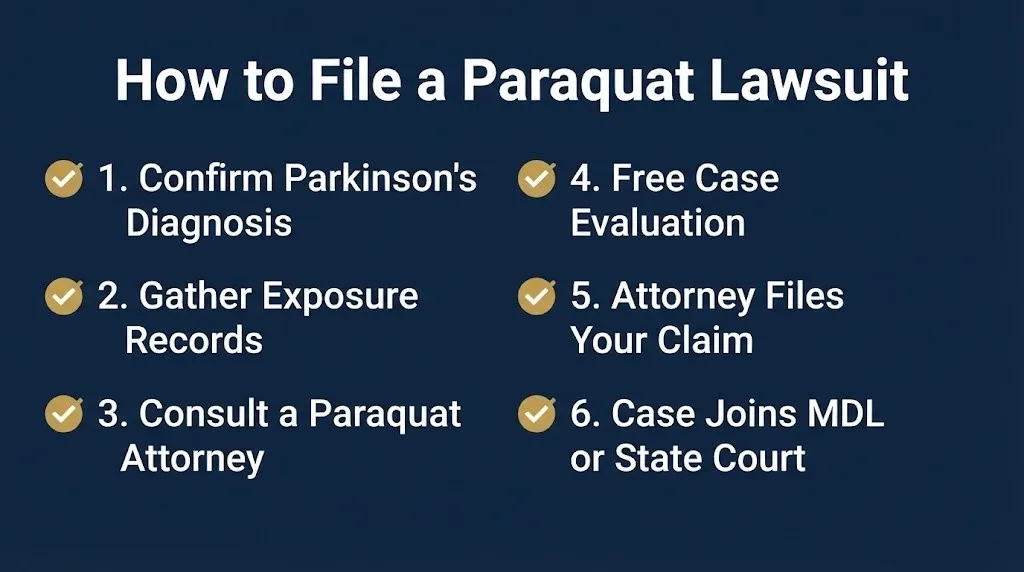
You file a paraquat lawsuit by working with an attorney who can document your Parkinson’s diagnosis and your paraquat exposure history, then pursuing a claim in the appropriate court.
New potential plaintiffs are still being accepted into related litigation, even though the master settlement covers thousands of existing cases. Here’s the general process:
- Confirm a documented Parkinson’s disease diagnosis from a treating physician.
- Gather records showing paraquat exposure, such as employment history, farm records, or purchase receipts.
- Consult an attorney who specifically handles mass tort or paraquat litigation.
- Complete a case evaluation, which reputable firms typically offer at no upfront cost.
- If you have a viable claim, your attorney files it in the appropriate federal or state court.
- Your case may be transferred into MDL No. 3004 or filed directly in a state court track like Philadelphia’s.
- You’ll complete a Plaintiff Assessment Questionnaire (PAQ) once your case is active.
- You and your attorney later decide whether to accept a settlement offer or continue litigating.
How to Find a Paraquat Lawsuit Attorney
You find a paraquat lawsuit attorney by looking for a law firm with direct experience in the federal MDL or Philadelphia’s paraquat docket, not a general personal injury generalist.
Several firms currently listed as active in this litigation include Motley Rice, TorHoerman Law, Miller & Zois, Sokolove Law, and Robert King Law Firm, based on their public case-tracking pages and court filings reviewed for this article.
Questions worth asking before you sign anything:
- Have you filed or handled cases specifically in MDL No. 3004 or Philadelphia’s paraquat docket?
- What documentation will you need from me to evaluate my case?
- Do you charge anything upfront, or is this strictly contingency-based?
- How will you communicate updates as the settlement fund rolls out?
Key Takeaway: legitimate paraquat attorneys work on contingency, meaning they only get paid if your case results in a settlement or verdict, so any upfront fee request is a warning sign.
When Will the Paraquat Lawsuit Be Settled?
There is no confirmed final date for when all paraquat cases will be resolved, since this is a rolling settlement process rather than a single payout event.
The federal MDL has been under a litigation stay for much of 2025 and 2026 while the settlement framework gets finalized. That stay has been extended multiple times, most recently pushing pretrial proceedings past early March 2026 as the Qualified Settlement Fund process moved forward.
Individual cases are resolving faster than the overall docket. Syngenta settled a Philadelphia bellwether case involving landscaper Bill Merten on January 27, 2026, the night before that trial was set to begin, avoiding a jury verdict entirely.
Not yet confirmed: an end date for the full settlement rollout. Mass torts of this size, involving thousands of individually evaluated claims, commonly take one to several years to fully distribute funds after a master agreement is signed.
Paraquat Lawsuit Update: What Changed in 2026
2026 has been the most active year yet for this litigation, moving from stalled negotiations toward an actual distribution framework.
Here’s what’s confirmed so far this year:
- January 2026: Syngenta settled a federal bellwether case just before trial, and the federal stay was extended into March.
- March 2026: The parties jointly moved to establish the Qualified Settlement Fund, Judge Rosenstengel approved it, and Syngenta announced it will discontinue global paraquat production.
- April 2026: The U.S. Supreme Court heard oral arguments in Monsanto v. Durnell, a related pesticide case that could affect failure-to-warn claims across herbicide litigation, including paraquat.
- May 2026: Vermont’s State Senate voted toward becoming the first U.S. state to ban paraquat sale and use.
- July 2026: Philadelphia’s Court of Common Pleas reported 1,952 pending paraquat cases, while federal MDL trackers cite figures in the 6,400 to 6,665 range.
Key Takeaway: the biggest 2026 shift is procedural, moving from “settlement announced” to “settlement fund actually being built,” which is the step that comes right before real payouts.
Is the Paraquat Lawsuit a Class Action?
No, the paraquat lawsuit is not a traditional class action. It’s structured as a multidistrict litigation, or MDL, which is a related but different legal process.
In a class action, one lawsuit represents an entire group and any settlement typically covers everyone in the defined class automatically. In an MDL, each plaintiff files an individual lawsuit, and those cases get consolidated for shared pretrial proceedings, but each person’s claim, and eventual settlement amount, is evaluated separately.
That distinction matters here because it means there’s no single class-wide claim form to fill out. If you want to be part of this litigation, you need your own attorney and your own filed case, not a shared submission.
The Judicial Panel on Multidistrict Litigation originally created MDL No. 3004 from 14 paraquat lawsuits filed across six federal districts, consolidating them in the Southern District of Illinois. It’s since grown into one of the largest active MDLs in the country.
Paraquat Parkinson’s Lawsuit: Who Is Filing and Why
People filing paraquat Parkinson’s lawsuits are typically individuals who worked with or near the herbicide, most often in agricultural, landscaping, or groundskeeping jobs, and later received a Parkinson’s disease diagnosis.
Plaintiffs allege that Syngenta and Chevron knew or should have known about a link between paraquat exposure and Parkinson’s risk, and failed to adequately warn users through product labeling.
Common exposure scenarios described in these cases include:
- Regular application of paraquat as part of farm or landscaping work
- Living or working near fields where paraquat was regularly sprayed
- Handling paraquat without protective equipment before safety standards changed
- Occupational exposure over multiple years, sometimes decades before diagnosis
Paraquat is already banned in more than 70 countries, a fact plaintiffs’ attorneys have repeatedly cited in court filings and public advocacy as evidence the U.S. regulatory approach lagged behind other nations.
What Is Paraquat, and Why Is It Linked to Parkinson’s Disease?
Paraquat is a fast-acting herbicide used to kill weeds and grasses, sold commercially under brand names tied to Syngenta and previously Chevron’s distribution network.
Scientific studies cited in litigation and by advocacy groups have linked long-term paraquat exposure to an elevated risk of developing Parkinson’s disease, a progressive neurological condition affecting movement and coordination. The EPA announced in January 2026 that it would review paraquat’s safety profile amid the ongoing litigation and mounting research.
Defendants continue to dispute causation. Court filings show ongoing disputes over whether existing scientific evidence sufficiently establishes that paraquat exposure causes Parkinson’s disease, with plaintiffs pointing to EPA assessments and published research, and defendants arguing the data falls short of proving causation.
One plain comparison: think of this dispute the way you’d think of a delayed tax refund stuck in review. The underlying claim (or refund) may be legitimate, but until the reviewing body signs off, nothing moves, and that’s largely where the causation debate sits within the broader settlement talks.
Paraquat Lawsuit Settlements: Individual Cases That Have Already Resolved
Several individual paraquat cases have already settled outside the broader master agreement, each avoiding trial through negotiated deals.
The clearest confirmed example is the Bill Merten case in Philadelphia, a landscaper whose Parkinson’s claim was set for trial in late January 2026. Syngenta settled that case on January 27, 2026, the night before jury selection was scheduled to begin.
A separate, earlier settlement from 2021 covered a smaller group of paraquat plaintiffs and reportedly totaled around $187.5 million, according to legal industry reporting, though this predates the 2025 master settlement agreement and involved a different, smaller set of claims.
Key Takeaway: every individual paraquat case that has reached the eve of trial so far has settled rather than gone to a jury, a pattern plaintiffs’ attorneys have pointed to as leverage in ongoing negotiations.
Parkinson’s Class Action and State Ban Efforts Tied to the Litigation
Separate from the lawsuit itself, several states are moving to restrict or ban paraquat entirely, adding regulatory pressure alongside the litigation.
Vermont’s State Senate voted in May 2026 to move toward becoming the first U.S. state to ban both the sale and use of paraquat. Minnesota and New York lawmakers have introduced similar bills, citing the ongoing litigation and international bans as supporting evidence.
At the federal level, the Supreme Court’s April 27, 2026 oral arguments in Monsanto v. Durnell centered on a different pesticide but could reshape how failure-to-warn claims work across all herbicide litigation, including paraquat, depending on the ruling’s scope.
Advocacy groups have also amplified pressure. More than 350 Parkinson’s advocates from 49 states gathered in Washington for the 2026 Parkinson’s Policy Forum, part of a broader public push connecting the litigation to state and federal regulatory change.
What Happens Next in the Paraquat Lawsuit
Ongoing, 2026: The Qualified Settlement Fund continues to be built out under Special Master Randi S. Ellis’s oversight, with existing plaintiffs choosing to opt in or opt out.
Expected, mid-to-late 2026: A ruling in Monsanto v. Durnell from the Supreme Court could clarify failure-to-warn standards affecting remaining paraquat claims.
Expected, later 2026: Syngenta’s announced production shutdown for paraquat is expected to move forward, though this affects future product availability, not existing settlement payouts.
Not yet confirmed: a specific date for when broad payout distributions from the QSF will begin reaching individual plaintiffs.
Frequently Asked Questions
Is the paraquat lawsuit real or a scam?
It’s a real, active federal mass tort, MDL No. 3004, plus thousands of related state court cases in Philadelphia.
Court filings confirm a signed settlement agreement from August 2025 and an approved settlement fund structure from March 2026.
How much is the average paraquat settlement?
No official average payout has been confirmed by the court.
Industry estimates suggest a range of roughly $20,000 to $1.5 million depending on case severity, but treat these as unverified projections, not guarantees.
Is there a deadline to file a paraquat claim?
No public claim-form deadline exists, since this isn’t a traditional class action with a filing cutoff.
New potential plaintiffs can still consult an attorney about joining related litigation, and existing plaintiffs work through opt-in or opt-out decisions with their own legal counsel.
Who is eligible for a paraquat lawsuit?
People with a documented Parkinson’s disease diagnosis and a history of paraquat exposure, often through agricultural or landscaping work, may have grounds to consult an attorney.
Eligibility ultimately depends on medical records and exposure documentation reviewed case by case.
Is the paraquat lawsuit a class action?
No, it’s structured as a multidistrict litigation (MDL), not a class action.
Each plaintiff files an individual case, and settlements are evaluated and paid out separately, not through one shared class-wide claim.
Who are the defendants in the paraquat lawsuit?
Syngenta and Chevron are the primary named defendants, as the manufacturer and a distributor connected to paraquat products.
Both companies have denied wrongdoing while continuing to settle individual cases before trial.
When will paraquat settlement checks be mailed?
An exact payment timeline has not been publicly confirmed.
The Qualified Settlement Fund was only approved in March 2026, and mass tort funds of this size typically take additional time after approval before individual payments go out.
Do I need a lawyer to join the paraquat lawsuit?
Yes, since this is an MDL rather than a class action, you need your own attorney to file and pursue a claim.
Reputable firms handling this litigation typically offer free case evaluations and work on contingency.
If you or a family member are dealing with a Parkinson’s diagnosis and past paraquat exposure, the most useful next step is a documented case evaluation with an attorney experienced in this specific litigation. Keep your medical records and any exposure history organized now, since that documentation drives your case value later.
The one date worth watching closest going forward is any ruling tied to the Qualified Settlement Fund’s actual payout rollout, since that will be the first real signal of when money starts reaching plaintiffs.