Candace Owens Lawsuit: Status, Claims, and What It Means in 2026
Quick Answer
- Candace Owens is involved in several active lawsuits, both as a plaintiff and a defendant, with no single case called “the Candace Owens lawsuit.”
- No settlement fund exists and no per-person payouts are available; these are individual defamation and employment disputes, not class actions.
- The most prominent case is Owens v. FactCheck.org et al., filed in 2025, which remains in pre-trial litigation as of mid-2026.
If you saw a headline or social media post about a “Candace Owens lawsuit settlement” or a “Candace Owens class action payout,” you are likely looking at misinformation. There is no class action against or involving Candace Owens that offers compensation to the general public. The legal matters bearing her name are individual civil lawsuits, mostly centered on defamation claims, and none have reached a settlement that involves consumer payouts.
This article breaks down every major legal case tied to Candace Owens as of 2026. You will find verified case names, court jurisdictions, current statuses, and what each case could mean for the parties involved. One surprising detail: Owens has been both the person suing and the person being sued in defamation actions within the same federal court system, a legal position that creates unusual procedural overlap.
The Facts
| Detail | Verified Information |
|---|---|
| Case 1 (Plaintiff) | Owens v. FactCheck.org et al. |
| Case 2 (Defendant) | Cardillo v. Owens |
| Court | U.S. District Court, District of Delaware (Owens v. FactCheck.org); New York State Supreme Court (Cardillo v. Owens) |
| Status | Both active in pre-trial litigation as of mid-2026 |
| Fund Size | Not applicable (individual civil suits, no settlement fund) |
| Per Person Payout | Not applicable (no class action, no consumer compensation) |
| Claim Deadline | No claim deadlines (private lawsuits, not class actions) |
| Administrator | Not applicable (no claims administrator appointed) |
| Proof Needed | Not applicable (no public claims process) |
Is the Candace Owens Lawsuit Real or a Scam?
The phrase “Candace Owens lawsuit” is real but misleading when used as a single term. Owens is connected to multiple real court cases. Some she initiated as the plaintiff. Others name her as the defendant. None are scams in the sense of fake lawsuits filed without her knowledge. However, scam actors online have used her name to promote fake settlement websites and phishing schemes.
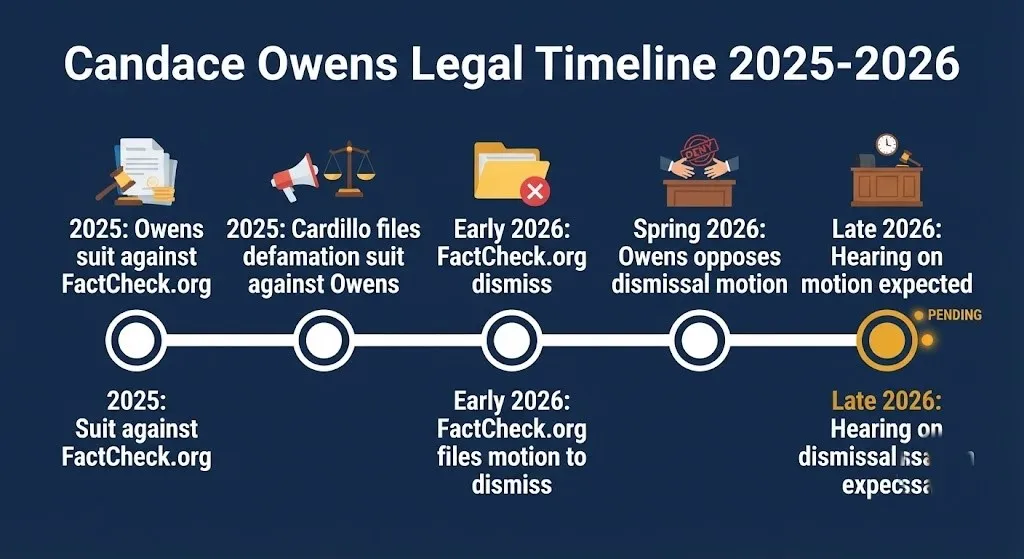
The most significant active case Owens filed herself is Owens v. FactCheck.org, Science Feedback, and Logically Facts. She filed this lawsuit in 2025 in the U.S. District Court for the District of Delaware. She alleges the three fact-checking organizations colluded to censor her speech by labeling her content as false or misleading. She claims this amounted to defamation and a violation of antitrust laws.
No court has ruled on the merits of her claims yet. The defendants have filed motions to dismiss. As of mid-2026, those motions remain pending.
The case that names Owens as a defendant, Cardillo v. Owens, was filed in New York State Supreme Court. The plaintiff, Anthony Cardillo, alleges Owens defamed him in social media posts. That case is also in pre-trial stages. Discovery is ongoing.
Both cases are real. Both appear in public court dockets. Neither involves a settlement fund, a claims process, or any money available to the public.
Key Takeaway: Legitimate lawsuits involving Candace Owens exist, but no class action or consumer settlement is attached to her name. Any website promising a payout is a scam.
How Much Money Could Someone Get From a Candace Owens Lawsuit?
Zero dollars from any public settlement, as of July 30, 2026. There is no settlement fund. There is no class action. There are no per-person payouts. The lawsuits involving Candace Owens are private civil actions between specific parties. They seek damages for the individuals directly involved, not for a class of consumers or the general public.
In Owens v. FactCheck.org, Owens seeks monetary damages for alleged harm to her reputation and business. The complaint does not specify a dollar amount in publicly available filings, but her legal team has referenced significant reputational harm in court documents. Any damages awarded would go to Owens herself, not to a class.
In Cardillo v. Owens, the plaintiff seeks damages for defamation. The amount is not publicly specified in the initial complaint. New York law allows plaintiffs to request damages determined at trial.
If either case settles, the settlement terms would almost certainly remain confidential. Private settlements in defamation cases rarely result in public payout structures. They are negotiated between the parties and paid in lump sums or structured payments, not through claims administrators.
Scam websites often promise “$5,000 per claimant” or similar figures tied to celebrity lawsuits. These numbers are fabricated. They use celebrity names to collect personal information from visitors. Do not enter your name, email, or any financial details on sites promising a “Candace Owens settlement check.”
Key Takeaway: No settlement money is available to the public. Any site claiming otherwise is harvesting data under false pretenses.
How to File a Claim in the Candace Owens Lawsuit
There is no claim to file. No class has been certified. No settlement has been reached. No claims administrator has been appointed. Filing a claim is not possible because the legal actions are individual civil suits, not class actions or mass torts.
If a legitimate class action involving Candace Owens ever emerges, the process would follow standard steps. But as of 2026, that scenario does not exist. Here is what a real class action claim process looks like, for reference, should one ever materialize:
- A court certifies the class and appoints class counsel.
- The parties reach a settlement or a verdict is issued.
- A settlement administrator is appointed by the court.
- The administrator builds a website with the official case name and docket number.
- A notice program begins, typically by email or mail to known class members.
- Eligible individuals submit a claim form with required proof.
- The deadline passes and the administrator reviews all claims.
- Payments issue after final approval and any appeals are resolved.
None of these steps have occurred for any case involving Candace Owens. If you receive an email or text saying you qualify for a payout from a Candace Owens lawsuit, delete it. It is a phishing attempt.
Real settlement notices never ask for payment to file a claim. Real notices never request your Social Security number upfront. Real notices always reference a specific court, case number, and claims administrator you can verify independently.
What Is the Latest Update on the Candace Owens Lawsuit in 2026?
The most recent significant development came in Owens v. FactCheck.org. The defendants filed a joint motion to dismiss in early 2026. They argue that Owens failed to state a valid claim under federal defamation and antitrust law. They also argue that fact-checking is protected speech under the First Amendment.
Owens opposed the motion. Her legal team filed a response brief in spring 2026. They argue that coordinated fact-checking efforts amount to state action because the organizations worked with government entities during the COVID-19 pandemic. This is a novel legal theory. Most First Amendment scholars have expressed skepticism in public commentary, but the court has not ruled yet.
A hearing on the motion to dismiss is expected in late 2026. No specific date has been set on the public docket as of this writing.
In Cardillo v. Owens, the parties are in discovery. Depositions are scheduled through fall 2026. No trial date has been set. Settlement discussions have not been reported in court filings.
The status of both cases remains unchanged in the most critical respect: no settlements, no payouts, no public claims process.
Key Takeaway: Both cases are stuck in procedural motion practice, with no resolution expected before 2027 at the earliest.
Why Is Candace Owens Being Sued?
Candace Owens is being sued because Anthony Cardillo alleges she defamed him. The case, Cardillo v. Owens, centers on social media posts Owens made. Cardillo claims the posts falsely portrayed him in a damaging light and caused harm to his reputation and livelihood.
Defamation claims require a plaintiff to prove several elements. The statement must be false. It must be published to a third party. It must cause harm. And, in cases involving public figures, the plaintiff must prove actual malice, meaning the defendant knew the statement was false or acted with reckless disregard for the truth.
Cardillo’s complaint alleges all these elements. Owens denies the allegations. Her legal team has filed an answer disputing the factual claims and raising affirmative defenses.
This case is separate from the lawsuit Owens filed herself. The two cases are not consolidated. They proceed in different courts under different judges. The only common thread is Owens herself.
The Cardillo case has received less media attention than Owens v. FactCheck.org, but it carries similar legal stakes. A defamation judgment can result in significant monetary damages. It can also create precedent that affects how public figures use social media.
Reality Check: No one is sending you settlement money from a Candace Owens defamation case. If you see an ad or post claiming otherwise, it is a scam designed to collect your information. Real defamation settlements are private and never involve mass payouts to strangers.
What Did Candace Owens Do to Trigger These Lawsuits?
Owens did not trigger all the lawsuits. She filed one herself. The second was filed against her. The circumstances differ for each.
In Owens v. FactCheck.org, Owens claims she was the victim of a coordinated censorship campaign. She alleges that three fact-checking organizations worked together to label her content as false, which caused social media platforms to reduce her reach and advertising partners to withdraw. She filed the lawsuit to seek damages for what she describes as defamation and an illegal conspiracy to restrain her speech.
In Cardillo v. Owens, the plaintiff claims Owens made false statements about him on social media. The specific statements are detailed in the complaint but remain under seal in parts. The case is a traditional defamation action: one person claims another person lied about them publicly and caused harm.
Owens has not been criminally charged in either matter. These are civil disputes. Civil lawsuits resolve through money damages or settlements, not jail time.
The broader context matters. Owens is a polarizing political commentator. Her statements often generate strong reactions. Lawsuits like these are not uncommon for public figures with large platforms. What makes Owens unusual is that she is simultaneously a plaintiff and a defendant in defamation actions, a position that requires her to argue both for and against broad speech protections depending on the case.
Who Is Affected by the Candace Owens Lawsuits?
The direct parties are the only people legally affected. In Owens v. FactCheck.org, the affected parties are Candace Owens as plaintiff and FactCheck.org, Science Feedback, and Logically Facts as defendants.
In Cardillo v. Owens, the affected parties are Anthony Cardillo as plaintiff and Candace Owens as defendant.
No class of consumers is affected. No group of users, subscribers, or followers has standing to claim damages. The general public is not a party to either case.
Indirect effects are possible. If Owens v. FactCheck.org succeeds, it could change how fact-checking organizations operate. It could affect how social media platforms handle disputed content. But those are policy outcomes, not direct legal entitlements for individuals.
If you are not Candace Owens, Anthony Cardillo, or one of the named fact-checking organizations, you are not a party. You have no claim to file. You will receive no payout.
This point cannot be overstated because scam sites rely on confusion. They hope you will see a headline about a lawsuit, assume it is a class action, and hand over your information. Do not fall for it.
Key Takeaway: Only the named parties have legal standing. No consumer class exists. No public compensation is available.
What Court Is Handling the Candace Owens Cases?
Two courts are handling the two main cases. Owens v. FactCheck.org is in the U.S. District Court for the District of Delaware. Federal district courts handle cases involving federal law, and Owens raised antitrust claims under federal statutes, which gives the court jurisdiction.
Cardillo v. Owens is in New York State Supreme Court. Despite the name, the New York Supreme Court is a trial-level court, not the highest court in the state. The highest court in New York is the Court of Appeals. Defamation cases often land in state court because defamation is primarily a state law claim.
The different court systems matter. Federal courts have different procedural rules. They have different standards for motions to dismiss. They have different discovery timelines. A case in Delaware federal court will move at a different pace than a case in New York state court.
Both courts provide public access to dockets. You can look up case numbers and read filings through PACER for the federal case and through the New York State Unified Court System for the state case. This is how you verify any claim you see online. Real cases leave a public paper trail.
If someone tells you a settlement has been reached, ask for the case number and court. Then check the docket. If no docket entry confirms the settlement, the claim is false.
Has Candace Owens Won Any Lawsuit?
No final judgment has been entered in any of the active cases. Owens has not won or lost a verdict. All cases remain in pre-trial litigation.
Owens has been involved in legal disputes before the current cases. She settled a defamation lawsuit in 2021 related to statements she made about a political activist. The terms of that settlement were not disclosed. Settlements are not admissions of liability. They are negotiated resolutions that avoid trial.
The 2021 settlement is not open for claims. It was a private resolution between private parties. No settlement fund was created. No class received compensation.
The current cases could end in several ways. The court could grant the motion to dismiss in Owens v. FactCheck.org, ending the case before trial. The court could deny the motion and allow discovery to proceed. The parties could settle at any point. A jury could eventually render a verdict.
None of those outcomes have happened yet. Anyone claiming Owens won or lost a major lawsuit in 2026 is guessing or misrepresenting the procedural posture of the cases.
Key Takeaway: No final rulings have been issued. All cases remain active and unresolved as of mid-2026.
What Happens Next
The timeline for both cases extends into 2027. Here are the expected next stages based on current docket activity:
- Late 2026: Hearing on the motion to dismiss in Owens v. FactCheck.org expected. The court will hear oral arguments and issue a ruling, which could take several months after the hearing.
- Fall 2026: Discovery continues in Cardillo v. Owens. Depositions scheduled. No summary judgment motions filed yet.
- Early 2027: If Owens v. FactCheck.org survives dismissal, discovery begins. This phase typically lasts 12 to 18 months in federal court.
- Mid to Late 2027: Summary judgment motions likely in both cases if no settlement is reached. These motions ask the court to rule on the law without a trial.
- 2028 or Later: Trial dates, if cases survive all pre-trial motions. Most civil cases settle before trial.
No settlement conferences have been ordered by either court as of mid-2026. That could change quickly. Settlement discussions can begin at any time and often do after key motions are decided.
Frequently Asked Questions
Is there a class action lawsuit against Candace Owens?
No. No class action has been filed against Candace Owens.
Both active cases are individual civil lawsuits, not class actions.
No class has been certified and no settlement exists for the public.
Can I get money from a Candace Owens lawsuit?
No. There is no settlement fund and no claims process for the public.
Any website promising a payout is a scam.
Delete any message that claims you qualify for compensation.
Is Candace Owens suing someone in 2026?
Yes. She filed Owens v. FactCheck.org in 2025.
The case remains active in U.S. District Court in Delaware.
A motion to dismiss is pending as of mid-2026.
Who is suing Candace Owens?
Anthony Cardillo filed a defamation lawsuit against Owens.
The case is in New York State Supreme Court.
It remains in the discovery phase with no trial date set.
Did Candace Owens settle a lawsuit?
She settled a defamation case in 2021, but terms were not disclosed.
No current cases have been settled as of July 2026.
No public settlement funds exist.
How do I check if a Candace Owens settlement is real?
Search the case name and court docket directly.
Use PACER for federal cases and state court websites for state cases.
If no docket entry confirms a settlement, the claim is false.
What court is hearing the Candace Owens cases?
Owens v. FactCheck.org is in U.S. District Court for the District of Delaware.
Cardillo v. Owens is in New York State Supreme Court.
Both courts provide public docket access.
Are there scam sites using Candace Owens to collect data?
Yes. Numerous sites falsely claim settlements and request personal information.
These sites use celebrity lawsuit headlines to bait visitors.
Never enter your information on such sites.
If you see a headline about a Candace Owens lawsuit settlement, verify it through the court docket before believing anything. The cases are real. The settlements are not. The only people who stand to gain money from these lawsuits are the named parties. Check the official court records. Calendar the hearing dates if you want to follow the legal arguments. But do not hand your personal information to a scam site promising a payout that does not exist.