Debt Settlement Attorney 2026: What They Do, What They Cost, and When You Actually Need One
Quick Answer
- A debt settlement attorney is a licensed lawyer who negotiates directly with creditors to reduce what you legally owe.
- Attorney fees typically range from 15 to 25 percent of the enrolled debt or the settled amount, depending on the firm and state.
- There is no universal claim deadline, but the statute of limitations on debt collection varies by state and debt type, making timing critical.
A debt settlement attorney is a licensed legal professional who negotiates with creditors on your behalf to reduce the total amount you owe. This is different from a debt settlement company, which is not staffed by lawyers and operates under a separate regulatory framework. The distinction matters because attorneys carry professional liability and are bound by state bar rules.
If you are carrying significant unsecured debt, such as credit card balances, personal loans, or medical bills, a debt settlement attorney may be one of several options available to you. The right path depends on how much you owe, your income, your state’s laws, and how far along the collection process has gone. Timing matters more than most people realize.
This article covers what a debt settlement attorney actually does, how much it costs, how the process works step by step, and when it makes sense versus bankruptcy or other alternatives. One fact that surprises many people: the FTC’s Telemarketing Sales Rule prohibits debt relief companies from collecting upfront fees, but attorneys operating under a retainer agreement may be exempt from that specific rule under certain conditions.
The Facts
| Topic | Detail |
|---|---|
| Service Type | Legal debt negotiation (not a lawsuit or settlement claim) |
| Governing Rules | FTC Telemarketing Sales Rule, state bar regulations, CFPB oversight |
| Typical Attorney Fee | 15 to 25 percent of enrolled or settled debt amount |
| Debt Types Covered | Unsecured debt: credit cards, medical bills, personal loans |
| Debt Types Excluded | Student loans (federal), mortgages, auto loans (generally) |
| Timeframe | 2 to 4 years for full program completion (typical) |
| Credit Score Impact | Significant negative impact during the process |
| Tax Consideration | Forgiven debt over 600 dollars may be taxable as income (IRS Form 1099-C) |
What does a debt settlement attorney do?
A debt settlement attorney is a licensed lawyer who negotiates directly with creditors to reduce the principal balance you owe on unsecured debts. Their core job is to contact each creditor, present a lump-sum offer that is less than the full balance, and secure a written agreement accepting that reduced amount as payment in full.
Attorneys in this role do more than non-lawyer debt settlement companies can legally do. They can represent you in court if a creditor sues you for the debt. They can send legal correspondence that carries the weight of attorney-client privilege. They can also advise you on whether debt settlement is legally appropriate given your full financial picture, including whether bankruptcy might produce a better outcome.

The process typically starts with a free consultation. The attorney reviews your total debt load, your income, your assets, and your state’s statutes. From there, they either recommend debt settlement or redirect you to a bankruptcy attorney or credit counseling service.
- Negotiates directly with creditors on your behalf
- Drafts and reviews all settlement agreements before you sign
- Represents you if any creditor files a lawsuit during the process
- Advises you on tax consequences of forgiven debt
- Monitors the statute of limitations on each account
Is hiring a debt settlement attorney legitimate?
Yes, hiring a debt settlement attorney is a legitimate legal service regulated by state bar associations and, in certain contexts, by the FTC and CFPB. Unlike unaccredited debt relief companies, attorneys must hold a valid law license in your state and are subject to professional conduct rules.
The legitimacy concern most consumers have stems from the broader debt relief industry, which has a documented history of fraud and abuse. The FTC has taken enforcement action against dozens of non-attorney debt settlement companies for charging upfront fees and failing to deliver results. Attorneys operating under a proper retainer structure are held to a different standard.
You can verify any attorney’s license and disciplinary history through your state bar association’s public directory. This is a free lookup that takes about two minutes. A licensed debt settlement attorney who has never faced disciplinary action is a very different professional from a call-center debt relief company with an unlicensed “account manager.”
- Check license status: State bar association public directory
- Check complaints: CFPB complaint database
- Check firm history: Better Business Bureau and state attorney general records
- Red flag: Any firm demanding large upfront fees before doing any work
How much does a debt settlement attorney cost?
Debt settlement attorney fees typically fall between 15 and 25 percent of either the total enrolled debt amount or the settled amount, depending on the firm’s fee structure and your state’s regulations. Some attorneys charge a flat fee per account settled instead of a percentage.
The FTC’s Telemarketing Sales Rule prohibits for-profit debt relief companies from charging fees before settling at least one account. However, licensed attorneys operating under a direct retainer, rather than through telemarketing, may have more flexibility in their fee timing. This distinction is important and should be confirmed with any attorney you speak to before signing anything.
Understanding the fee structure before you commit is essential. A 25 percent fee on 30,000 dollars of enrolled debt is 7,500 dollars. That fee is often spread across your monthly program payments, so you do not pay it all at once. Still, you need to factor that cost into your overall savings calculation.
| Fee Structure | Example | Total Cost on 30,000 Dollars Enrolled |
|---|---|---|
| 15% of enrolled debt | Standard lower range | 4,500 dollars |
| 20% of enrolled debt | Mid-range common | 6,000 dollars |
| 25% of enrolled debt | Higher range | 7,500 dollars |
| 25% of settled amount | Incentive based | Varies by negotiation outcome |
| Flat fee per account | Less common | Depends on number of accounts |
Key Takeaway: A debt settlement attorney’s legitimacy is verifiable through your state bar association in minutes, and that check should be your first step before signing any agreement.
How does debt settlement with an attorney work, step by step?
Debt settlement with an attorney works through a structured program where you stop paying creditors, build a reserve fund, and the attorney negotiates lump-sum settlements once funds accumulate. This process typically takes two to four years to complete.
The mechanics are straightforward but require discipline. You stop making payments to enrolled creditors. This is intentional. Creditors rarely negotiate meaningful reductions on current accounts. The delinquency creates the leverage needed for a settlement offer to be attractive to the creditor.
Each month, instead of paying creditors, you deposit money into a dedicated savings account that you control. When that account reaches a threshold sufficient to make a settlement offer on one account, your attorney begins negotiations. The process repeats account by account until all enrolled debts are resolved or the program ends.
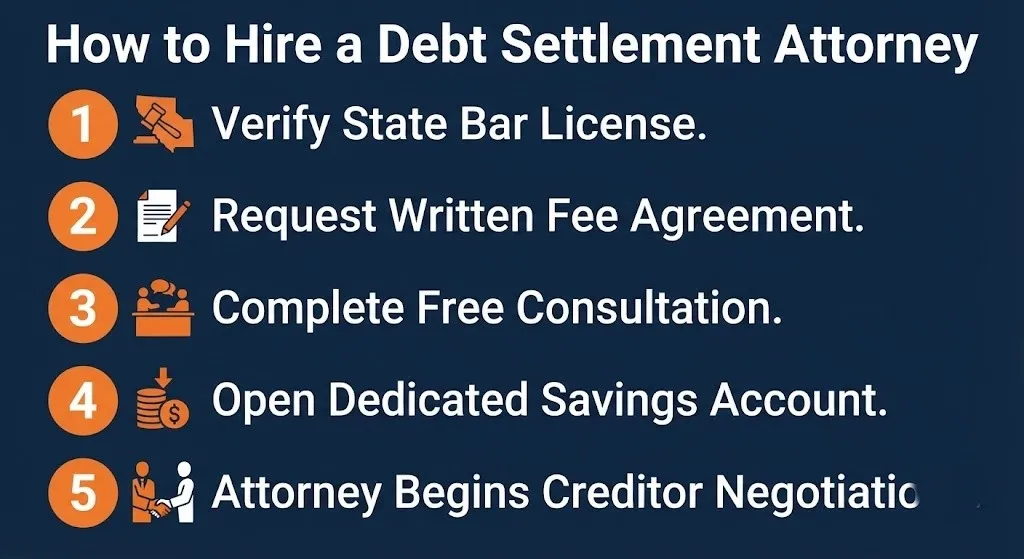
- Free consultation with the attorney to review your total debt load.
- Sign a retainer agreement and review the fee structure carefully.
- Stop making payments to enrolled creditors as directed by your attorney.
- Open a dedicated savings account and make monthly deposits.
- Attorney sends cease communication letters to enrolled creditors on your behalf.
- Attorney negotiates a lump-sum settlement when your reserve fund is sufficient.
- You review and approve each settlement offer before any money is paid.
- Attorney obtains a written settlement agreement from the creditor.
- Funds are disbursed from your savings account per the agreement.
- You receive a paid-in-full or settled letter, and the account is closed.
What debts can a debt settlement attorney help with?
A debt settlement attorney can help with unsecured debts, meaning debts that are not backed by collateral. Credit card balances, personal loans, medical bills, private student loans, and certain business debts fall into this category. Secured debts like mortgages and auto loans are generally not eligible for traditional debt settlement.
Federal student loans operate under a separate set of rules governed by the Department of Education. Debt settlement attorneys do not typically handle federal student loan negotiation, as that process involves income-driven repayment plans, Public Service Loan Forgiveness, and other administrative programs. A few specialized attorneys focus exclusively on student loan law, and that is a separate engagement.
Medical debt is one area where settlement is often highly effective. Hospitals and medical providers frequently accept significant reductions, especially when the account has already been sold to a collection agency. Many consumers do not realize that medical debt purchased by a third-party collector was often bought for pennies on the dollar, creating significant room for negotiation.
- Eligible: Credit card debt, personal loans, medical bills, private student loans, old collection accounts
- Not eligible: Federal student loans, mortgages, car loans, tax debt (IRS), child support
- Best candidates: Accounts already in collections or severely delinquent
- Challenging: Accounts less than 90 days past due (creditors rarely settle current accounts)
How does debt settlement affect your credit score?
Debt settlement causes significant damage to your credit score, particularly during the program period when you are intentionally not paying enrolled accounts. A FICO score can drop by 100 points or more once accounts become delinquent. This is a documented, expected consequence of the process and any attorney who tells you otherwise is not being straight with you.
Settled accounts remain on your credit report for seven years from the date of first delinquency. They are reported as “settled” or “settled for less than the full amount,” which is a negative notation. Future lenders can see this and may use it to decline credit or charge higher interest rates.
The credit damage, however, is often temporary relative to the financial relief achieved. Consumers who complete a debt settlement program and then begin rebuilding credit through secured cards and on-time payments can see meaningful score recovery within two to three years. The trade-off is real, and you should evaluate it against your specific goals.
Reality Check
No legitimate debt settlement attorney will promise to remove negative items from your credit report as part of the settlement. Credit reporting and debt settlement are separate legal processes. Any firm guaranteeing credit repair as part of a settlement package is misrepresenting what they can deliver, and that guarantee should be a firm reason to walk away.
Debt settlement attorney vs. bankruptcy: which is better?
Whether a debt settlement attorney or bankruptcy is the better option depends on your total debt load, your income, your assets, and your state’s exemption laws. Neither option is universally superior, and the right answer requires a factual analysis of your specific financial situation.
Chapter 7 bankruptcy can discharge most unsecured debt within three to six months. It is faster than debt settlement and, in many cases, cheaper. The income threshold for Chapter 7 eligibility is set by the means test, which compares your income to your state’s median income. If you qualify for Chapter 7, it may produce a faster and more complete resolution than a two to four year settlement program.
Chapter 13 bankruptcy involves a three to five year repayment plan supervised by a court. It allows you to keep assets like a home while restructuring payments. Debt settlement, by contrast, keeps the process out of court entirely, which some people prefer for privacy and flexibility reasons.
| Factor | Debt Settlement Attorney | Chapter 7 Bankruptcy | Chapter 13 Bankruptcy |
|---|---|---|---|
| Timeframe | 2 to 4 years | 3 to 6 months | 3 to 5 years |
| Credit impact | Severe during program | Severe, stays 10 years | Severe, stays 7 years |
| Court involvement | None | Yes | Yes |
| Cost | 15 to 25% of debt | Filing fee plus attorney | Filing fee plus attorney |
| Asset protection | No court protection | Exemptions apply | Stronger protection |
| Tax on forgiven debt | Yes, generally | No (bankruptcy exclusion) | No (bankruptcy exclusion) |
Key Takeaway: Debt settlement keeps you out of court, but bankruptcy may discharge debt faster and at lower total cost for consumers who meet the eligibility requirements.
What are the tax consequences of settling debt?
The IRS treats forgiven debt as taxable income under most circumstances. When a creditor agrees to accept less than the full balance, the difference, called cancellation of debt income, is generally reportable on your federal tax return. The creditor is required to send you IRS Form 1099-C for any forgiven amount of 600 dollars or more.
For example: if you owe 10,000 dollars on a credit card and your attorney settles it for 4,000 dollars, the remaining 6,000 dollars is taxable income. At a 22 percent effective federal tax rate, that translates to roughly 1,320 dollars in additional taxes owed for that year. You need to factor this into your financial projections before starting a settlement program.
There is an important exception. If you are legally insolvent at the time of the settlement, meaning your total liabilities exceed your total assets, you may be able to exclude the cancelled debt from taxable income using IRS Form 982. Your debt settlement attorney should explain this, but tax advice on that form should come from a CPA or tax professional, not the settlement attorney alone.
- IRS Form 1099-C: Issued by creditors for cancelled debt of 600 dollars or more
- Taxable income: The forgiven amount is added to your gross income for that year
- Insolvency exclusion: Available if your liabilities exceed assets at time of settlement
- IRS Form 982: Used to claim the insolvency exclusion on your tax return
- Recommendation: Consult a CPA alongside your debt settlement attorney
How to choose a debt settlement attorney in 2026
Choosing a debt settlement attorney in 2026 means verifying three things before you sign anything: their state bar license, their fee structure, and their track record with consumer debt cases. These three checks separate legitimate attorneys from firms that use attorney branding but operate more like call centers.
Start with your state bar association’s online directory. Every licensed attorney in the United States is listed there. You can check whether the license is active, see what year they were admitted to the bar, and review any public disciplinary history. This check is free and takes less than five minutes. It is the single most important step you can take.
Next, ask directly about the fee structure in writing before the consultation ends. A trustworthy attorney will give you a written fee agreement to review before you are asked to sign anything. If a firm rushes you to sign on the first call, slow down. This process takes two to four years and a rushed enrollment is a red flag.
- Search your state bar association’s attorney directory for an active license.
- Check the CFPB complaint database for the firm’s name.
- Review the Better Business Bureau rating and any closed complaints.
- Ask for a written fee agreement before the consultation ends.
- Request references from past clients or ask about the firm’s average settlement percentage.
- Confirm the attorney will personally represent you, not a paralegal or account manager.
- Get a clear explanation of what happens if a creditor sues you during the program.
- Ask about the tax consequences of settled debt before enrolling.
What happens when a creditor sues you during debt settlement?
When a creditor sues you during debt settlement, your attorney can appear in court and defend the action, which is a key advantage over non-attorney debt settlement companies. This is the moment the legal credential matters most. A debt settlement company’s “representative” cannot appear in court. A licensed attorney can.
Creditor lawsuits during settlement programs are common, especially for larger balances. Creditors have a limited window to sue before the statute of limitations expires, and they use it aggressively on accounts over a certain dollar threshold. Being served with a lawsuit does not necessarily mean the settlement process has failed, but it does require immediate legal attention.
Your attorney should respond to the complaint within the required timeframe, which varies by state but is often 20 to 30 days. Missing that deadline can result in a default judgment against you, which gives the creditor the ability to garnish wages or levy bank accounts. This is why having a licensed attorney rather than a debt settlement company is such a meaningful distinction.
- Lawsuit response deadlines: Generally 20 to 30 days from service, varies by state
- Consequences of missing deadline: Default judgment, potential wage garnishment
- What your attorney can do: File an answer, negotiate a settlement, request a hearing
- What a non-attorney company cannot do: Appear in court or file legal documents
Key Takeaway: The ability to defend you in court when a creditor sues is the most concrete legal advantage a debt settlement attorney holds over non-attorney debt relief companies.
How long does debt settlement take with an attorney?
Debt settlement with an attorney typically takes two to four years from the start of the program to the resolution of the last enrolled account. The timeline depends on the number of accounts, the total debt amount, your monthly savings contribution, and how aggressively each creditor pursues the account.
Accounts with smaller balances are often settled first, as the reserve fund threshold is reached sooner. Larger accounts may take a year or more of saving before a meaningful settlement offer is possible. Some creditors settle faster than others, and some accounts may get sold to collection agencies mid-program, which can reset negotiations.
The process is similar to waiting for a layered warranty claim to clear: each component resolves on its own schedule rather than all at once. Patience is part of the program. Clients who expect a quick resolution and then drop out early often end up in a worse position than when they started, with damaged credit and partial settlements that leave balances still outstanding.
- Short programs (under 2 years): Typically for smaller debt loads under 15,000 dollars
- Average programs (2 to 3 years): Most common, covers moderate debt loads
- Longer programs (3 to 4 years): Large debt loads or many creditor accounts
- Factors that speed things up: Higher monthly contributions, fewer accounts
- Factors that slow things down: Creditor lawsuits, accounts sold to collectors
Debt settlement attorney fees vs. debt settlement company fees: the real comparison
Debt settlement attorney fees and debt settlement company fees are often similar in percentage terms, but the legal protection you receive is materially different. Both typically charge 15 to 25 percent of enrolled or settled debt. What you get for that fee is where the comparison matters.
Non-attorney debt settlement companies cannot represent you in court. Their “advisors” are not licensed professionals and carry no malpractice liability. If the company gives you bad advice and a creditor obtains a judgment against you, you have limited legal recourse against that company. An attorney, by contrast, carries professional liability and is governed by ethics rules enforced by the state bar.
The FTC has taken action against many large non-attorney debt settlement companies for deceptive practices. Some of those companies collected fees for years without settling a single account. Attorney-based programs are not immune to bad actors, but the oversight mechanisms are significantly stronger.
| Factor | Debt Settlement Attorney | Non-Attorney Debt Settlement Company |
|---|---|---|
| License required | Yes, state bar | No license required |
| Can appear in court | Yes | No |
| Professional liability | Malpractice coverage | Generally none |
| FTC TSR exemption | Sometimes, if direct retainer | No exemption |
| Regulatory oversight | State bar plus FTC and CFPB | FTC and CFPB only |
| Typical fee range | 15 to 25% | 15 to 25% |
What Happens Next (if you are considering a debt settlement attorney)
- Now (November 2026): Review your total unsecured debt balance and determine if it exceeds 7,500 to 10,000 dollars, which is the general threshold where debt settlement becomes cost-effective.
- Expected within 30 days: Verify at least two to three attorneys through your state bar directory and request written fee agreements from each.
- Expected within 60 days: Complete a free consultation and receive a written program estimate showing projected settlements and total fees.
- Expected within 90 days: If you proceed, open a dedicated savings account and begin monthly deposits as directed by your attorney.
- Expected 6 to 12 months in: First settlement offers may begin on smaller accounts as your reserve fund reaches a workable threshold.
Frequently Asked Questions
What is a debt settlement attorney?
A debt settlement attorney is a licensed lawyer who negotiates with creditors to reduce the total amount you owe on unsecured debts.
They can represent you in court if a creditor sues, which non-attorney debt companies cannot do.
Their fees typically range from 15 to 25 percent of enrolled debt.
Is debt settlement better than bankruptcy?
Debt settlement and bankruptcy are different tools, and the better option depends on your income, assets, and total debt load.
Chapter 7 bankruptcy resolves debt faster and eliminates the tax liability on forgiven amounts that debt settlement creates.
You should consult both a debt settlement attorney and a bankruptcy attorney before deciding.
How much debt do you need to qualify for debt settlement?
Most debt settlement attorneys require a minimum of 7,500 to 10,000 dollars in unsecured debt to make the program cost-effective.
Below that threshold, the attorney fees and credit damage may outweigh the savings from negotiation.
There is no formal legal minimum, but economics determine whether it makes practical sense.
Will debt settlement ruin my credit score?
Yes, debt settlement will significantly damage your credit score during the program period.
Accounts become delinquent intentionally, which creates negative marks that remain for seven years.
Credit recovery is possible after the program ends, but it requires consistent on-time payments and disciplined rebuilding.
Do I have to pay taxes on settled debt?
Yes, in most cases forgiven debt of 600 dollars or more is treated as taxable income by the IRS.
The creditor must issue IRS Form 1099-C reporting the cancelled amount.
If you were legally insolvent at the time of settlement, you may qualify for an exclusion using IRS Form 982.
Can a debt settlement attorney stop creditor calls?
Yes, once an attorney formally represents you, most creditors are required to communicate through the attorney rather than calling you directly.
This protection comes from the Fair Debt Collection Practices Act for third-party collectors.
Original creditors have slightly different rules, but attorneys routinely send cease communication letters to all enrolled creditors.
What happens if a creditor won’t settle?
If a creditor refuses to settle, your attorney may continue negotiations, wait for the account to be sold to a collector, or advise you on other options.
Some creditors are more willing to settle after an account changes hands to a collection agency.
In the worst case, the creditor may sue, at which point your attorney defends the action in court.
How do I verify a debt settlement attorney is licensed?
You can verify any attorney’s license through your state bar association’s free public directory, which lists license status and any disciplinary history.
Search by the attorney’s full name and state to confirm the license is active and in good standing.
Always verify before signing any retainer agreement or providing financial information.
Your most important next action is to verify any attorney’s license through your state bar association before committing to any fee agreement. That one check protects you from the most common risks in this space.
Once you have a verified attorney and a written fee agreement you understand, the timeline becomes predictable. Most programs resolve within two to four years. The statute of limitations on your oldest debts makes starting sooner rather than later the strategically sound move.