Debt Settlement Lawyers in 2026: When to Hire One and What It Costs
Quick Answer
- What is it? A lawyer who negotiates with creditors to reduce what you owe, and defends you if you’re sued.
- How much does it cost? Fees vary. Most settlement companies charge 15% to 25% of enrolled debt. Attorneys may charge differently.
- Key deadline: No federal deadline, but if you’re sued, you must respond quickly or risk a default judgment.
Debt settlement lawyers occupy a strange space in consumer finance. They’re attorneys, but many operate debt relief programs that look and sound like the settlement companies the FTC has spent years policing. The difference matters for your wallet and your legal protection.
If you’re drowning in credit card debt, the question isn’t whether debt settlement works. It’s whether hiring a lawyer gets you a better outcome than negotiating yourself or using a nonprofit counselor. The answer depends on your situation, the type of debt, and whether you’re already facing a lawsuit.
This article breaks down what debt settlement lawyers actually do, how their fees compare to settlement companies, the tax consequences you’ll face on forgiven debt, and the red flags that separate legitimate attorneys from debt relief operations wearing a law firm’s name.
The Facts
| Item | Detail |
|---|---|
| What It Is | Legal representation for negotiating reduced debt payoff, plus defense in collection lawsuits |
| Typical Fee Range | Settlement companies charge 15% to 25% of enrolled debt; attorney fees vary |
| Federal Rule | TSR bans advance fees for telemarketed debt relief services |
| Tax on Forgiven Debt | Forgiven amounts over $600 generally taxable unless insolvent or bankrupt |
| Key Risk | Credit damage, potential lawsuits, tax liability |
| Best For | Consumers facing lawsuits, complex debt portfolios, or creditor harassment |
Is hiring a debt settlement lawyer worth it?
Hiring a debt settlement lawyer is worth it when you’re facing a collection lawsuit, need legal defense, or have a complex situation that requires court representation.
The core value of a lawyer in debt settlement isn’t just negotiation. It’s legal protection. A settlement company can call creditors. An attorney can appear in court for you .
Here’s what a lawyer can do that a settlement company cannot:
- Defend you in a collection lawsuit: If a creditor sues you, only a licensed attorney can represent you in court. A settlement company cannot appear on your behalf.
- Send cease-and-desist letters: Under the Fair Debt Collection Practices Act, an attorney’s letter often carries more weight in stopping harassment.
- Negotiate with legal credibility: Creditors and their attorneys respond differently when a lawyer is involved, which can produce better settlement terms .
- Review settlement agreements: A lawyer can spot terms that hurt you long-term, like agreements that waive your rights or fail to prevent the debt from being resold.
- Address tax implications: Forgiven debt can create tax liability. A lawyer can flag insolvency exclusions or timing strategies .
The trade-off is cost. Attorney fees in debt settlement vary widely. Some charge hourly, some charge a percentage of savings, and some work through arrangements with debt relief companies. You need to ask upfront.
Key Takeaway: A lawyer’s biggest advantage is court representation and legal leverage. If you’re not being sued and your debts are straightforward, the value is lower.
How much do debt settlement lawyers cost?
Debt settlement fees typically range from 15% to 25% of the enrolled debt amount, but attorney fees vary and may be structured differently.
Settlement companies base their fee on the total debt you enroll. If you enroll $25,000, a 25% fee means $6,250 . The fee is charged after a debt is settled, not upfront, under the FTC’s Telemarketing Sales Rule .
Attorney fee structures differ. Some charge hourly. Some take a percentage of savings achieved. Some work through law firms affiliated with debt relief companies, where the attorney’s role may be limited.
| Fee Type | Typical Range | Notes |
|---|---|---|
| Percentage of enrolled debt | 15% to 25% | Common for settlement companies |
| Percentage of savings | Varies by state | Some states cap this at 10% to 15% of savings |
| Hourly attorney fees | $150 to $500+ per hour | Depends on market and complexity |
| Flat fee for defense | Case-specific | Common for lawsuit defense |
State fee caps matter. Connecticut caps fees at 10% of savings. Illinois caps at 15% of savings. Louisiana limits fees to 12% of enrolled debt . Your state’s rules apply based on where you live, not where the debt originated .
Watch for account maintenance fees. Some companies charge $5 to $10 monthly for the dedicated savings account. Others charge setup fees of $10 to $50 .
Key Takeaway: Fees are regulated but vary by state and provider. Ask for the fee structure in writing before enrolling.
How do you file a debt settlement claim or negotiate with creditors?
You don’t “file a claim” in debt settlement. You negotiate. The process involves stopping payments, accumulating funds, and making lump-sum offers to creditors.
Debt settlement is not a court process with a claim form. It’s a negotiation strategy. Here’s how it works :
- Assess your debts: List all unsecured debts (credit cards, personal loans, medical bills) and determine what you can realistically pay.
- Stop making payments: This is controversial but necessary. Creditors won’t settle if you’re current. Missed payments damage your credit.
- Accumulate funds: Make monthly deposits into a dedicated savings account. The money is used for settlement offers and fees.
- Negotiate settlements: Either you or your lawyer contacts creditors and offers a lump sum, often 40% to 60% of the balance.
- Get the agreement in writing: Never pay based on a phone promise. Get the settlement terms documented.
- Pay the settlement: Once the agreement is signed, pay the agreed amount. The creditor forgives the rest.
- Handle the tax consequences: Forgiven debt over $600 may be taxable. You’ll receive a Form 1099-C.
A lawyer can handle steps 4 through 6 for you. But you still need to fund the settlement account.
Key Takeaway: Debt settlement is negotiation, not a legal filing. The process takes years and damages your credit before it improves your finances.
What happens to your credit during debt settlement?
Your credit score will drop significantly during debt settlement, and settled accounts remain on your report for up to seven years.
This is the part debt relief marketing downplays. To settle a debt, you typically have to stop paying it first. Those missed payments get reported to credit bureaus. Your score falls .
A settled account shows as “settled for less than full balance.” That’s better than an unpaid collection, but it’s still negative. It tells future lenders you didn’t pay what you agreed to.
The damage timeline:
| Event | Credit Impact |
|---|---|
| Missed payments begin | Score drops immediately |
| Accounts charged off | Major negative mark |
| Settlements negotiated | Accounts show “settled” status |
| 7 years after missed payments | Negative marks age off |
One Reddit user described the reality: they enrolled in a debt settlement program, paid $700 monthly for a year, and watched their credit score drop to 498. They couldn’t rent a car. They missed a wedding .
For many consumers, the net financial benefit of settlement after fees and credit damage is questionable. The Woodstock Institute found that substantial numbers of New Yorkers experienced net financial harm from debt settlement enrollment .
Key Takeaway: Debt settlement damages your credit before it helps your finances. The negative marks last seven years.
Will you owe taxes on settled debt?
Yes. Forgiven debt over $600 is generally taxable as ordinary income unless you qualify for an exclusion like insolvency or bankruptcy.
When a creditor forgives $10,000 of debt, the IRS treats that $10,000 as income. You’ll receive a Form 1099-C from the creditor .
The math works like this: if you owed $20,000 and settled for $10,000, the $10,000 forgiven is added to your taxable income for that year .
There are exceptions:
- Bankruptcy: Debt discharged in Chapter 7 or Chapter 13 is excluded from income .
- Insolvency: If your total debts exceeded the fair market value of your assets immediately before the cancellation, you can exclude forgiven debt up to the amount you were insolvent .
- Public Service Loan Forgiveness: Federal student loans forgiven through PSLF remain tax-free .
The insolvency exclusion requires math. You calculate your total liabilities minus your total assets. If liabilities are higher, you’re insolvent by that difference. You can exclude forgiven debt up to that amount.
You claim the exclusion by filing IRS Form 982 with your tax return .
The American Rescue Plan Act made federal student loan forgiveness tax-free through 2025. That provision expired. Starting in 2026, balances forgiven through income-driven repayment plans are again taxable .
Key Takeaway: Forgiven debt is taxable income unless you’re insolvent or bankrupt. Plan for a tax bill after settlement.
What are the warning signs of a debt settlement scam?
Red flags include upfront fees, guaranteed results, attorney-backed claims without real legal representation, and pressure to act immediately.
Debt relief is a scam magnet. The FTC has brought repeated enforcement actions against operations that charged advance fees, made deceptive claims, and impersonated government agencies .
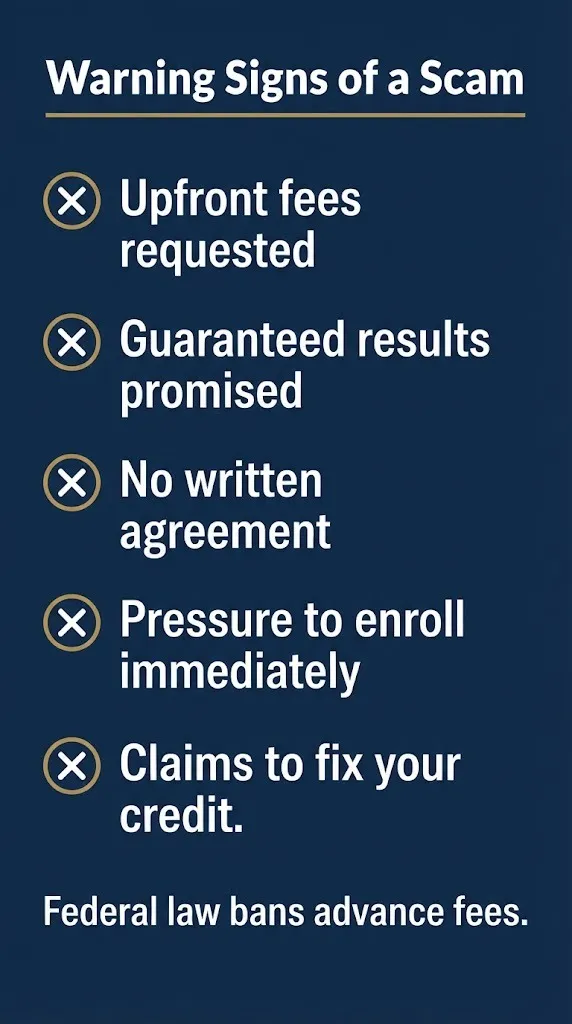
Watch for these signs:
- Upfront fees: Federal law bans advance fees for telemarketed debt relief. If they want money before settling a debt, walk away .
- Guaranteed results: No one can guarantee a creditor will settle. If they promise specific savings, they’re lying.
- “Attorney-backed” without attorneys: Some companies claim lawyer involvement but consumers never meet an attorney. The New York City Bar Association flagged this tactic years ago .
- Pressure to enroll immediately: Legitimate help doesn’t require a same-day decision.
- No written agreement: You should get everything in writing before paying anything.
- Claims they can “fix” your credit: Only accurate negative information can be removed, and only by time or dispute.
A 2026 lawsuit against a debt settlement company alleged TCPA violations for calls to numbers on the Do Not Call Registry . Another case described a consumer who paid $4,368 to a settlement program, only to be sued by Capital One because no settlement was ever negotiated .
Key Takeaway: Upfront fees, guarantees, and pressure tactics are the clearest signs of a debt relief scam.
What are the alternatives to debt settlement?
Credit counseling, debt management plans, and bankruptcy are often better options than debt settlement for consumers who qualify.
Debt settlement is a last resort. It damages your credit, creates tax liability, and doesn’t always work. Before you enroll, consider alternatives .
| Alternative | How It Works | Best For |
|---|---|---|
| Credit Counseling | Nonprofit counselors review your finances and suggest options | Understanding your situation |
| Debt Management Plan | Counselor negotiates lower interest rates and one monthly payment | Consumers who can pay but need structure |
| Debt Consolidation Loan | New loan pays off old debts at lower rate | Good credit, manageable debt |
| Chapter 7 Bankruptcy | Discharges most unsecured debt | Severe financial hardship, low income |
| Chapter 13 Bankruptcy | Reorganization plan, 3 to 5 years | Regular income, need to protect assets |
Nonprofit credit counseling is free or low-cost. Debt management plans through nonprofits don’t carry the same fee structures as for-profit settlement. Bankruptcy provides a legal discharge and stops collection activity immediately.
The Woodstock Institute found that most New Yorkers would be better served by free or low-cost nonprofit options than by for-profit debt settlement .
Key Takeaway: Debt settlement is not your only option. Nonprofit counseling and bankruptcy may cost less and work better.
Reality Check
Debt settlement lawyers are not a magic solution. No one can promise your creditors will settle. No one can erase your debt without consequences. If you’re being sued, you need a lawyer. If you’re not, a nonprofit credit counselor may give you better advice for free. And if anyone asks for an upfront fee to settle your debt, that’s not how federal law works.
What happens next in the debt settlement process?
Month 1: You stop paying creditors. Missed payments start reporting to credit bureaus.
Months 2 to 6: Debt settlement account accumulates funds. Creditors may begin collection calls or lawsuits.
Months 6 to 24: Settlement negotiations begin. Creditors may accept 40% to 60% of the balance.
After settlement: You receive Form 1099-C for forgiven debt. The forgiven amount may be taxable.
7 years after missed payments: Negative marks age off your credit report.
Frequently Asked Questions
Do I need a lawyer for debt settlement?
You may need a lawyer if you’re being sued or facing aggressive collection. For simple negotiation, a nonprofit credit counselor may be a better first step.
How much do debt settlement lawyers charge?
Fees vary. Settlement companies charge 15% to 25% of enrolled debt. Attorney fees depend on the arrangement and your state’s rules.
Can a debt settlement lawyer stop a lawsuit?
Yes. An attorney can represent you in court and negotiate with the creditor’s lawyer. A settlement company cannot appear in court for you.
Will I owe taxes on settled debt?
Yes, forgiven debt over $600 is generally taxable. You can exclude it if you were insolvent or filed bankruptcy. File Form 982 to claim the exclusion.
What happens if I stop paying my creditors?
Your credit score drops, creditors may charge off the debt, and you may be sued. Debt settlement requires missed payments, but the consequences are real.
Is debt settlement a scam?
Not always. Legitimate attorneys and companies exist. But the industry has a history of deceptive practices. Watch for upfront fees, guarantees, and pressure tactics.
How long does debt settlement take?
Most programs take 24 to 48 months. You accumulate funds, negotiate settlements, and pay them off over time.
What is the best alternative to debt settlement?
Nonprofit credit counseling, debt management plans, and bankruptcy are often better options. Speak with a nonprofit counselor before enrolling in a for-profit program.
If you’re considering debt settlement, start with a free consultation from a nonprofit credit counselor. If you’re already being sued, talk to a consumer law attorney immediately. The single most important fact: forgiven debt is taxable income unless you’re insolvent or bankrupt, and no one can promise your creditors will settle.