New York Workers’ Compensation Lawyer 2026: Benefits, Fees, and How to Choose One
Quick Answer
- What is it? A lawyer who helps injured workers file claims, appeal denials, and secure benefits under New York’s no-fault workers’ comp system.
- How much do they cost? Fees are set by law and must be approved by the Board. Most claimants pay nothing upfront.
- Key deadline: You must report a work injury to your employer within 30 days and file Form C-3 within two years.
If you were hurt on the job in New York, you have a legal right to workers’ compensation benefits. The system is no-fault, meaning you don’t have to prove your employer did anything wrong. But getting benefits isn’t automatic, and insurance carriers dispute claims every day.
A New York workers’ compensation lawyer can help you file correctly, appeal a denial, or fight a reduction in benefits. The fee structure is regulated by state law, which means attorneys can’t charge whatever they want. That’s good news for injured workers.
This article breaks down how the New York workers’ comp system works in 2026, what a lawyer actually does, how much they cost, and what deadlines you can’t afford to miss. You’ll also learn when it makes sense to hire an attorney and when you can handle the claim on your own.
The Facts
| Item | Detail |
|---|---|
| System Type | No-fault. You don’t need to prove employer negligence. |
| Max Weekly Benefit (2026-27) | $1,281.50 for injuries occurring July 1, 2026 through June 30, 2027 |
| Min Weekly Benefit (2026-27) | $384.45 |
| Reporting Deadline | 30 days to notify employer in writing |
| Filing Deadline | 2 years from injury to file Form C-3 |
| Attorney Fee Rules | Set by WCL § 24 and approved by the Board |
| Key Agency | NYS Workers’ Compensation Board |
Is it worth hiring a New York workers’ compensation lawyer?
Hiring a lawyer is worth it if your claim is disputed, denied, or involves complex injuries that affect your long-term earning capacity.
The system is designed to work without an attorney. If your injury is straightforward, your employer doesn’t dispute it, and you’re back to work quickly, you may not need one. But that’s the easy path.
The harder reality: insurance carriers controvert claims regularly. A controverted claim means no benefits until a judge resolves the dispute . That process involves hearings, deadlines, and legal standards most workers don’t know.
Here’s what a lawyer typically handles:
- Filing the claim correctly: Errors on Form C-3 can delay or sink a claim.
- Appealing a denial: You have 30 days to file an application for review after a judge’s decision .
- Protecting your average weekly wage: Your benefit is based on gross earnings, not take-home pay. Insurers sometimes miscalculate.
- Schedule loss of use awards: If your injury causes permanent impairment, a lawyer ensures the award reflects the full extent.
- Waiver agreements (WCL § 32): Settling a case involves giving up future rights. A lawyer reviews whether that’s in your interest.
The cost structure actually reduces the risk of hiring someone. Fees come out of your award, not your pocket upfront.
Key Takeaway: If your claim is contested or your injury is serious, a lawyer’s fee is regulated and often paid from the award, not upfront.
How much does a New York workers’ compensation lawyer cost?
Attorney fees in New York workers’ compensation are set by statute and must be approved by the Workers’ Compensation Board. You don’t pay hourly rates or upfront retainers.
New York Workers’ Compensation Law Section 24 lays out a schedule for fees. The Board approves the amount based on the work done and the compensation awarded .
The fee structure depends on the type of award:
| Award Type | Attorney Fee |
|---|---|
| Continued weekly benefits (temp. total/partial) | One-third of one week’s compensation |
| Increase in prior temporary benefits | 15% of the increased compensation |
| Schedule loss of use or facial disfigurement | 15% of compensation above prior payments |
| Permanent total or permanent partial disability | 15% of excess compensation plus 15 weeks of compensation |
| Death benefits | 15% of excess compensation plus 15 weeks of compensation |
| Waiver agreements (WCL § 32) | 15% of benefits paid, excluding future medical |
For fees over $1,000, a written application on a Board form is required. The application must show the calculation used and certify it’s correct . The Board then approves an amount “commensurate with the services rendered and the amount of compensation awarded” .
In practice, this means your lawyer gets paid when you get paid. If you recover nothing, there’s no fee. That’s similar to how a contingency fee works in personal injury, but with tighter controls.
Key Takeaway: Fees are capped by law and deducted from your award. You won’t get a bill for hourly work.
How do you file a New York workers’ compensation claim?
You file a workers’ compensation claim by reporting the injury to your employer within 30 days and submitting Form C-3 to the Workers’ Compensation Board within two years.
The process has specific steps and deadlines. Miss one and you risk losing benefits .
Here’s the sequence:
- Seek medical treatment immediately. Your health comes first. Tell the provider it’s a work injury.
- Report to your employer in writing. Do this within 30 days of the accident. Written notice creates a record .
- File Form C-3 with the Board. This is the Employee Claim form. You can file online at wcb.ny.gov or by mail .
- Your employer notifies its insurer. They must do this within 10 days if you need treatment beyond first aid or miss work .
- The insurer investigates. It can accept the claim, deny it, or request more information.
- If accepted, benefits begin. For lost time beyond seven days, payments start within 18 days of your employer notifying the insurer .
- If denied, request a hearing. A Workers’ Compensation Law Judge will decide the dispute .
The two-year filing deadline is strict. For occupational illnesses, the clock may start when you knew or should have known the condition was work-related .
Key Takeaway: Report in 30 days, file Form C-3 within two years. Missing either deadline can cost you benefits.
What benefits can you get from New York workers’ compensation?
New York workers’ compensation covers medical care, lost wage benefits, permanent disability awards, and death benefits for survivors.
The system provides several types of benefits :
| Benefit Type | What It Covers |
|---|---|
| Medical | Doctor visits, hospital care, surgery, physical therapy, prescriptions, equipment |
| Lost Wage (Indemnity) | Two-thirds of your average weekly wage, adjusted by disability percentage |
| Schedule Loss of Use | Permanent impairment to specific body parts (arms, legs, hands, etc.) |
| Permanent Disability | Long-term or lifelong loss of earning capacity |
| Death Benefits | Support for surviving dependents in fatal injury cases |
Lost wage benefits are tax-free . They’re based on your average weekly wage (AWW) for the 52 weeks before the injury, using gross earnings including overtime .
The calculation: two-thirds of your AWW multiplied by your degree of disability. If you’re 100% disabled and your AWW was $900, your weekly benefit is $600 .
There are waiting periods for lost wages. You don’t get paid for the first seven days unless you miss more than 14 days. If you miss 15 days or more, you can receive benefits from the first day out .
Medical care is covered regardless of time lost from work .
Key Takeaway: Benefits cover medical care and two-thirds of lost wages, capped at the state maximum and paid tax-free.
What is the maximum weekly benefit in New York in 2026?
The maximum weekly benefit for workers’ compensation claims with injuries from July 1, 2026 through June 30, 2027 is $1,281.50. The minimum is $384.45.
These figures come from the New York State Average Weekly Wage (NYSAWW) for calendar year 2025, which the Department of Labor set at $1,922.25 .
The formula: the maximum is two-thirds of the NYSAWW. The minimum is one-fifth of the NYSAWW or your actual wages, whichever is less .
| Period | Maximum | Minimum |
|---|---|---|
| July 1, 2026 – June 30, 2027 | $1,281.50 | $384.45 |
| July 1, 2025 – June 30, 2026 | $1,222.42 | $325.00 |
Your benefit rate depends on your date of injury, not the current date. If you were injured in 2025, your rate is based on the 2025-26 schedule, even if you’re still receiving benefits in 2027 .
This matters for long-term claims. You don’t get a raise when the maximum increases. Your rate is locked to your injury date.
Key Takeaway: The current maximum is $1,281.50 per week, but your rate is set by your injury date, not the payment date.
When should you hire a New York workers’ compensation lawyer?
You should hire a lawyer when your claim is denied, your benefits are reduced, you face a permanent disability, or your employer retaliates against you for filing.
The Board’s own materials list scenarios where an attorney helps . Here are the clearest triggers:
- Claim denied: The insurer files a notice of controversy. You need someone who knows the hearing process.
- Benefits suspended or modified: If the carrier tries to cut you off without a judge’s order, a lawyer can challenge it.
- Permanent disability: Schedule loss of use and permanent partial disability awards are where large sums are at stake. The fee schedule reflects that complexity.
- Waiver agreement offered: Settling your case means giving up future rights. You need independent review.
- Retaliation: It’s illegal for an employer to fire or punish you for filing a claim. A lawyer can address that separately.
The system is no-fault, but it’s not simple. A controverted claim can take months to resolve through hearings and appeals. Having someone who navigates that process regularly changes the outcome.
Key Takeaway: Denials, reductions, permanent injuries, and settlement offers are the four situations where a lawyer’s help matters most.
Reality Check
No one can promise you a specific settlement amount before a claim is evaluated. Workers’ compensation benefits are calculated by formula, not negotiated like a personal injury lawsuit. If a lawyer guarantees a dollar figure upfront, walk away. Fees are regulated and paid from awards, not upfront. And you never have to pay a fee just to file a claim.
What happens next in your New York workers’ comp case?
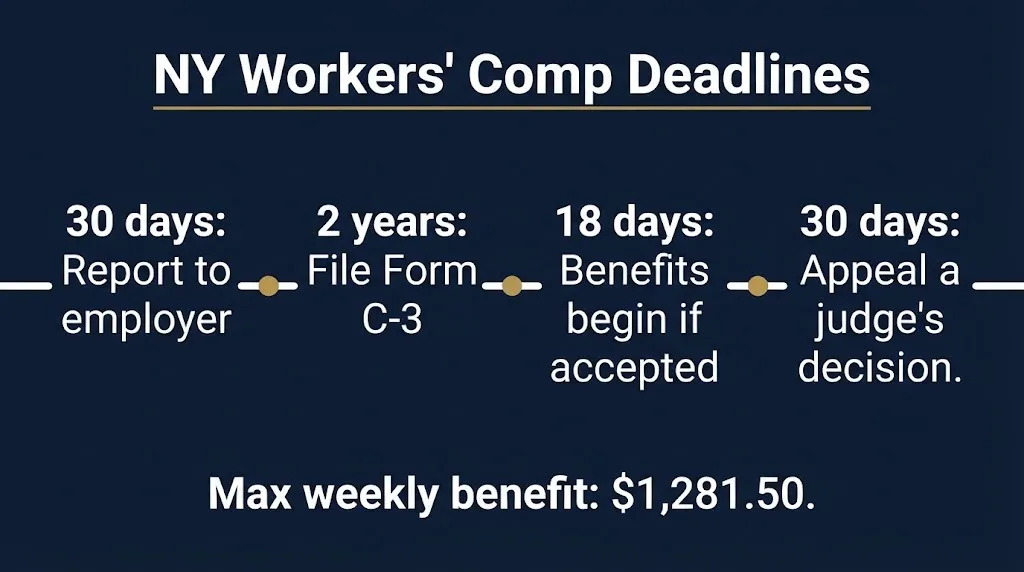
Day 1: Report the injury to your employer in writing. Get medical treatment.
Within 30 days: Written notice must reach your employer .
Within 2 years: File Form C-3 with the Workers’ Compensation Board .
Within 18 days of notice: If claim is accepted and lost time exceeds seven days, benefits should begin .
If denied: File for a hearing. The Board schedules a pre-hearing conference or hearing before a Law Judge.
If you disagree with the judge: File an application for review within 30 days .
Frequently Asked Questions
Do I need a lawyer for a workers’ comp claim in New York?
Not always. Simple claims with cooperative employers may not require one. But if your claim is denied, disputed, or involves permanent injury, a lawyer helps protect your benefits.
How much does a workers’ comp lawyer charge in New York?
Fees are set by Workers’ Compensation Law Section 24 and approved by the Board. They come out of your award, not your pocket upfront. Fee amounts vary by award type.
What is the maximum weekly benefit in 2026?
For injuries occurring July 1, 2026 through June 30, 2027, the maximum is $1,281.50 per week. The minimum is $384.45.
How long do I have to file a workers’ comp claim in New York?
You must report the injury to your employer within 30 days and file Form C-3 with the Board within two years of the injury.
Can I sue my employer for a work injury in New York?
Generally no. Workers’ compensation is the exclusive remedy for most workplace injuries. Exceptions exist for intentional acts or situations where the employer lacked coverage.
What happens if my workers’ comp claim is denied?
You can request a hearing before a Workers’ Compensation Law Judge. If you disagree with the judge’s decision, you have 30 days to file an application for review.
Are workers’ comp benefits taxable in New York?
No. Workers’ compensation lost wage benefits are tax-free.
What if my employer doesn’t have workers’ comp insurance?
You should still file a claim. The Board has a process to ensure you receive benefits even if your employer was uninsured .
If you were injured at work, the clock is already running. Report the injury in writing within 30 days and file Form C-3 within two years. If your claim gets denied or the insurer disputes it, a lawyer who handles New York workers’ comp cases can walk you through the hearing process. The system is there to protect you, but it won’t work if you miss the deadlines. The single most important fact: your filing deadline is two years, and the current maximum weekly benefit is $1,281.50.