Roundup Litigation 2026: The $7.25 Billion Settlement, Supreme Court Ruling, and Who Qualifies
Quick Answer
- Bayer agreed to a $7.25 billion settlement covering current and future Roundup cancer claims .
- Payouts range from $10,000 to $165,000 for non-Hodgkin lymphoma claimants .
- The Supreme Court’s June 2026 ruling preempts failure-to-warn claims, limiting future lawsuits .
The Roundup litigation is the largest product liability case in agricultural history, and 2026 has been its most consequential year. Bayer’s Monsanto unit agreed to a $7.25 billion class settlement in February, the Supreme Court handed Monsanto a major victory in June, and a Missouri judge is now weighing whether to grant final approval of the deal that would resolve roughly 65,000 claims .
For anyone who used Roundup and developed non-Hodgkin lymphoma, this is the moment that matters. The settlement creates a claims program that pays between $10,000 and $165,000 depending on cancer severity, age at diagnosis, and whether exposure was residential or occupational .
This article breaks down the settlement terms, who qualifies, how the Supreme Court ruling changes the legal landscape, and what happens next as the Missouri court considers final approval.
The Facts
| Detail | Status |
|---|---|
| Case Name | Monsanto Roundup Class Settlement (Missouri Circuit Court, St. Louis) |
| Court | Circuit Court of the City of St. Louis, Missouri |
| Status | Preliminary approval granted March 2026; final approval pending |
| Settlement Fund | Up to $7.25 billion |
| Per-Person Payout | $10,000 to $165,000 |
| Eligibility | Exposure before Feb. 17, 2026, with NHL diagnosis within 16 years |
| Opt-Out Deadline | June 4, 2026 (passed) |
| Fairness Hearing | July 9, 2026 |
| Payment Period | Up to 21 years of declining capped annual payments |
| Supreme Court Case | Monsanto v. Durnell, decided June 2026 in Monsanto’s favor |
How much money will eligible claimants get from the Roundup settlement?
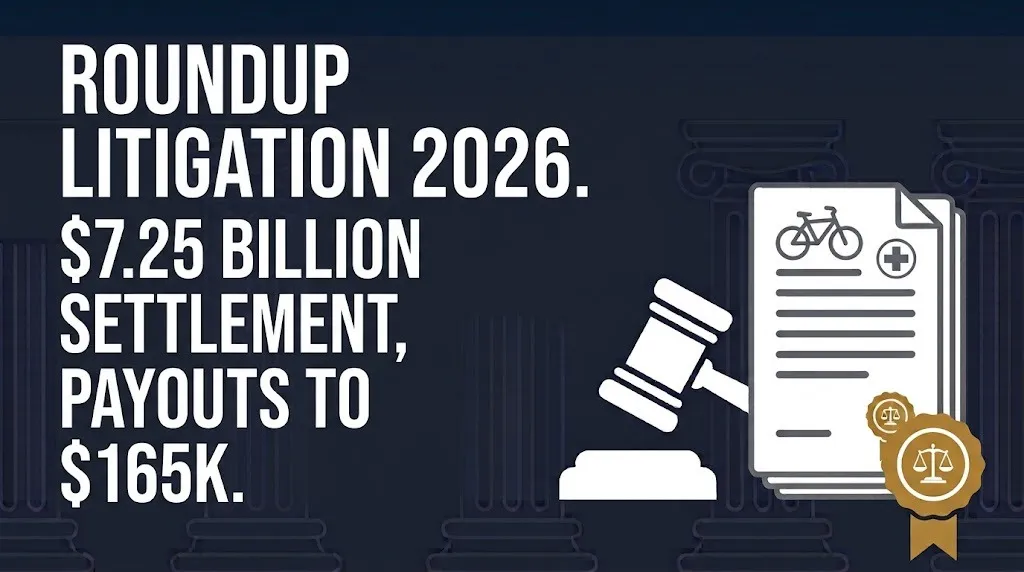
The Roundup settlement pays between $10,000 and $165,000 per eligible claimant, with the exact amount depending on several factors . The $7.25 billion fund is designed to cover both current claims and future diagnoses over a 16-year period .
The settlement uses a tiered structure based on:
- Cancer severity: More advanced NHL diagnoses receive higher payouts
- Age at diagnosis: Younger claimants may receive more due to longer expected impact
- Exposure type: Occupational exposure (farming, landscaping) typically pays more than residential use
- Diagnosis timing: Claims filed earlier in the program may receive different treatment than future claims
The payouts are funded through declining capped annual payments over up to 21 years, giving Bayer financial predictability while ensuring the fund has resources for future claimants .
| Factor | Impact on Payout |
|---|---|
| Cancer severity | Higher stage = higher payout |
| Age at diagnosis | Younger age may increase award |
| Occupational exposure | Workplace use pays more than home use |
| Diagnosis timing | Current vs. future claims may differ |
Not yet determined: The exact payout schedule and final amounts won’t be confirmed until the Missouri court grants final approval and the claims process begins.
Key Takeaway: Eligible claimants can expect $10,000 to $165,000, with the fund structured to pay over 21 years to cover both current and future non-Hodgkin lymphoma diagnoses.
Who qualifies for the Roundup settlement?
You may qualify for the Roundup settlement if you used Roundup before February 17, 2026, and have been diagnosed with non-Hodgkin lymphoma (or receive a diagnosis within 16 years after final approval) .
The settlement class covers:
- Current claimants: People who already filed Roundup lawsuits alleging NHL
- Future claimants: People exposed to Roundup before February 17, 2026, who haven’t yet been diagnosed but may be within 16 years
- Residential users: Homeowners and gardeners who used Roundup
- Occupational users: Farmers, landscapers, groundskeepers, and agricultural workers
The class does not cover:
- People who used Roundup after February 17, 2026
- Claims for cancers other than non-Hodgkin lymphoma
- Design defect or negligence claims not tied to NHL
The settlement is designed to resolve claims “regardless of legal theory,” meaning it covers failure-to-warn, design defect, and negligence claims tied to NHL .
Reality Check
The Roundup settlement is real, but no one is sending you money right now. The claim process hasn’t opened. The opt-out deadline passed on June 4, 2026, and the fairness hearing was held July 9, 2026 . If you see a website, text, or social post telling you to “file a Roundup claim” or pay a fee to “register,” that’s a scam. Legitimate settlement notices come from court-appointed administrators, not unsolicited messages. Don’t share personal information or pay anything to claim money from this settlement.
What did the Supreme Court rule in Monsanto v. Durnell?
The Supreme Court ruled 8-1 in Monsanto’s favor on June 25, 2026, holding that the Federal Insecticide, Fungicide, and Rodenticide Act (FIFRA) preempts state-law failure-to-warn claims .
Justice Kavanaugh’s majority opinion found that because the EPA has repeatedly concluded glyphosate is not likely to cause cancer and has not required a cancer warning on Roundup’s label, states cannot impose their own labeling requirements .
The ruling reverses a $1.25 million Missouri verdict for John Durnell, who claimed Roundup caused his non-Hodgkin lymphoma. The Court ordered Monsanto to recover $8,113.15 in costs from Durnell .
The practical impact: failure-to-warn claims are dead in state courts. Plaintiffs can still pursue design defect and negligence claims, but Bayer is arguing in federal court that the ruling should dismantle the entire consolidated federal litigation .
| Claim Type | Post-Durnell Status |
|---|---|
| Failure-to-warn | Preempted by FIFRA |
| Design defect | Still viable, but Bayer challenging |
| Negligence | Still viable, but Bayer challenging |
| Fraud | Depends on specific allegations |
What is the status of the Roundup settlement approval?
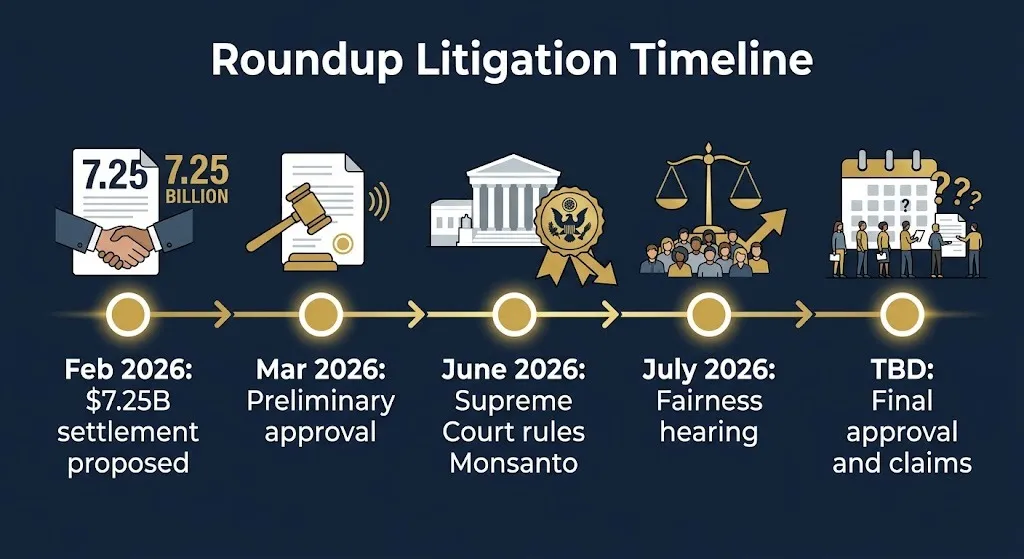
The $7.25 billion settlement received preliminary approval in March 2026 from the St. Louis Circuit Court . Judge Timothy Boyer held a fairness hearing on July 9, 2026, and heard objections from plaintiffs’ attorneys who argued the deal doesn’t offer enough money .
The settlement requires final court approval, which is subject to potential appeals. Bayer has the right to terminate the deal if too many class members opt out .
Some plaintiffs’ law firms representing nearly 20,000 people urged the court to delay reviewing the settlement, arguing that rushing would violate the rights of cancer patients and their families . Other firms, including Motley Rice and Seeger Weiss, support the settlement and say it ensures compensation before the Supreme Court ruling further weakens claims .
How do you file a claim in the Roundup settlement?
The claim process hasn’t opened yet. The settlement is still awaiting final approval, and no claims administrator has been appointed.
If the settlement is finalized, here’s how the process will likely work:
- Court grants final approval and the settlement becomes effective after appeals.
- A claims administrator is appointed and a settlement website goes live.
- Class members receive notice by mail or email.
- You submit a claim form with medical records proving NHL diagnosis and proof of Roundup exposure.
- The administrator reviews claims and calculates payouts based on the tier structure.
- Payments are distributed over the 21-year funding period.
None of those steps have started. The opt-out deadline passed on June 4, 2026, so if you’re in the class and didn’t opt out, you’re bound by the settlement terms if it’s approved .
What happens if you opted out of the Roundup settlement?
If you opted out by the June 4, 2026 deadline, you’re not bound by the settlement and can pursue your own lawsuit against Monsanto . But the Supreme Court’s Durnell ruling makes that path much harder.
Failure-to-warn claims are now preempted, so you’d need to prove your case on design defect or negligence grounds. Bayer is actively fighting those claims in federal court, arguing the Durnell ruling should eliminate them too .
If you didn’t opt out, you’re in the class and will be bound by the settlement if it’s approved. You’ll receive whatever payout the claims program determines based on your injury and exposure history.
What happens next
July 9, 2026: Fairness hearing held in St. Louis Circuit Court .
TBD: Judge Boyer’s final approval ruling, subject to appeals.
TBD: Claims administrator appointed and claim process opens.
Ongoing: Bayer seeks to dismiss consolidated federal litigation based on Durnell .
Ongoing: EPA working on updated glyphosate risk assessment expected late 2026 .
Frequently Asked Questions
Is the Roundup settlement real?
Yes. Bayer announced a $7.25 billion class settlement in February 2026, and a Missouri judge granted preliminary approval in March .
How much will I get from the Roundup settlement?
Payouts range from $10,000 to $165,000, depending on cancer severity, age at diagnosis, and exposure type .
Can I still file a Roundup claim in 2026?
The claim process hasn’t opened. The opt-out deadline passed on June 4, 2026, and final approval is pending .
What did the Supreme Court rule in Monsanto v. Durnell?
The Court ruled 8-1 that FIFRA preempts state failure-to-warn claims, blocking a major category of Roundup lawsuits .
Who qualifies for the Roundup settlement?
People exposed to Roundup before February 17, 2026, who have non-Hodgkin lymphoma or receive a diagnosis within 16 years .
What happens if I opted out of the settlement?
You can pursue your own lawsuit, but failure-to-warn claims are now preempted. Design defect and negligence claims face challenges .
How long will the Roundup settlement take to pay out?
Bayer will make declining capped annual payments for up to 21 years .
What if I get a text about a Roundup settlement?
That’s likely a scam. No claim process exists yet. Legitimate notices come from court-appointed administrators.
The Roundup litigation has reached a turning point. Bayer’s $7.25 billion settlement offers payouts of $10,000 to $165,000 to eligible non-Hodgkin lymphoma claimants, while the Supreme Court’s Durnell ruling has closed off failure-to-warn claims for those who opted out. The Missouri court’s final approval decision will determine whether the settlement moves forward. If you’re in the class and didn’t opt out, watch for official notice from the claims administrator once final approval is granted.