How Much Does Morgan and Morgan Take From a Settlement: 2026 Fee Guide
Quick Answer:
- Morgan & Morgan takes a contingency fee, typically one-third to 40 percent of your settlement.
- The fee percentage depends on when your case resolves, not on a flat rate for all cases.
- You pay nothing upfront. The fee comes out of the recovery only if you win.
Morgan & Morgan, the largest personal injury firm in the United States, takes a percentage of your settlement as its fee. The exact percentage depends on the case type, when it settles, and the terms of your written fee agreement.
For most personal injury cases, the fee is around 33.33 percent if the case settles before a lawsuit is filed. It often rises to 40 percent once litigation begins or if the case goes to trial. These percentages are common across the personal injury industry, not unique to Morgan & Morgan.
This article breaks down how the fee works, what costs you may owe, how the math plays out on a real settlement, and what questions to ask before signing. One verified detail matters most: the percentage is only part of the story. Case costs can take thousands more from your check.
The Facts
| Item | Detail |
|---|---|
| Firm | Morgan & Morgan |
| Fee Structure | Contingency fee, percentage of recovery |
| Typical Fee Range | 33.33% to 40% depending on case stage |
| Upfront Cost | None for attorney fees |
| Case Costs | Deducted separately from your share |
| Written Agreement | Required, review before signing |
| Negotiable | Yes, within reason |
Is Morgan and Morgan’s Fee Structure Legit?
Yes, the Morgan & Morgan contingency fee structure is legal and standard for personal injury law. It is not a scam.
Contingency fees are the norm in personal injury cases. You pay nothing upfront. The firm takes a percentage of whatever it recovers. If there is no recovery, there is no attorney fee.
The percentages Morgan & Morgan charges are in line with what most personal injury firms charge. The key is understanding the exact terms in your written fee agreement.
Key Takeaway: The fee is standard. What varies is whether your specific agreement includes terms that cost you more than you expected.
What Percentage Does Morgan and Morgan Take From a Settlement?
Morgan & Morgan typically takes between 33.33 percent and 40 percent of your settlement. The exact percentage depends on when your case resolves.
Most personal injury firms, including Morgan & Morgan, use a tiered structure. If the case settles before a lawsuit is filed, the fee is usually one-third. If a lawsuit is filed or the case goes to trial, the fee often rises to 40 percent.
Some case types, like medical malpractice or complex litigation, may have different percentages. Your written fee agreement controls.
| Case Stage | Typical Fee Percentage |
|---|---|
| Pre-lawsuit settlement | 33.33% |
| After lawsuit filed | 40% |
| After trial begins | 40% |
| Appeal | 40% or higher |
Reality Check: The percentage is not the only deduction from your settlement. Case costs come out separately, and those can add up fast.
How Does the Morgan and Morgan Contingency Fee Work?
A contingency fee means the firm only gets paid if you get paid. The fee is a percentage of your recovery, not an hourly rate.
If your case settles for $100,000 and the fee is 33.33 percent, the attorney fee is $33,333. You receive the remaining $66,667, minus any case costs and other deductions.
If you lose, you owe no attorney fee. That is the risk the firm takes. It is also why the percentage is higher than an hourly rate would be for a smaller case.
What Are Case Costs and Are They Deducted Separately?
Case costs are expenses the firm pays to pursue your case. They include filing fees, medical record fees, expert witness fees, deposition costs, and postage.
These costs are deducted from your share of the settlement after the attorney fee is calculated. That means your net recovery is the settlement minus the attorney fee minus case costs.
Costs can range from a few hundred dollars for a simple case to tens of thousands for a complex case with multiple experts and a trial.
- Filing fees paid to the court.
- Medical record retrieval fees.
- Expert witness fees.
- Deposition and court reporter fees.
- Investigation and accident reconstruction costs.
- Copying and postage.
How Much Would I Take Home From a $100,000 Morgan and Morgan Settlement?
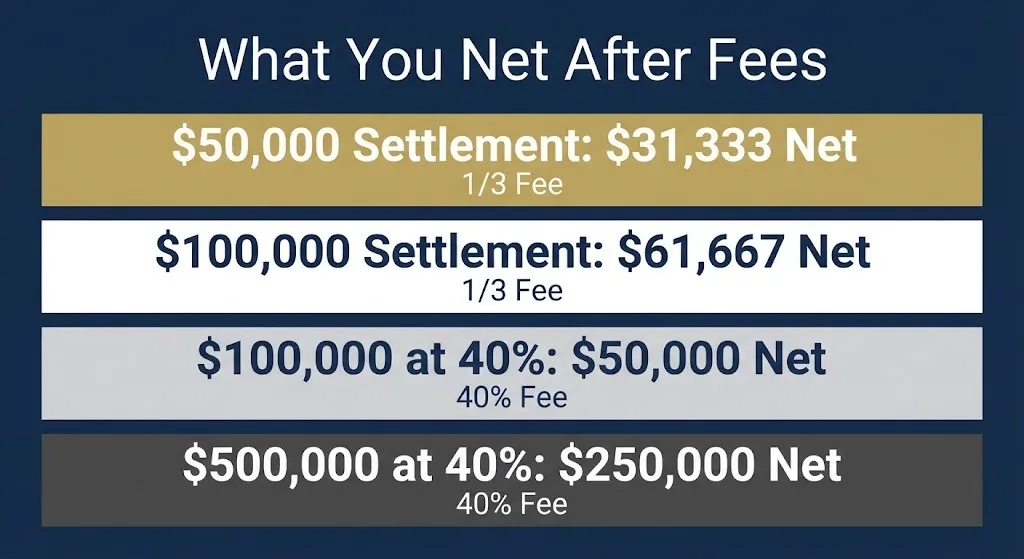
On a $100,000 settlement with a 33.33 percent fee and $5,000 in costs, you would take home approximately $61,667.
The math works like this. The attorney fee is $33,333. The costs are $5,000. That leaves $61,667 for you.
If the fee is 40 percent and costs are $10,000, your take-home drops to $50,000. The difference between 33 percent and 40 percent is significant on larger settlements.
| Settlement | Fee % | Costs | Your Net |
|---|---|---|---|
| $50,000 | 33.33% | $2,000 | $31,333 |
| $100,000 | 33.33% | $5,000 | $61,667 |
| $100,000 | 40% | $10,000 | $50,000 |
| $500,000 | 40% | $50,000 | $250,000 |
Key Takeaway: The percentage is only part of the math. Always ask about projected costs before signing.
Does Morgan and Morgan Charge a Higher Fee Than Other Firms?
Morgan & Morgan’s fee percentages are similar to other large personal injury firms. Most firms charge 33.33 percent pre-lawsuit and 40 percent after litigation begins.
Smaller firms may charge less, sometimes 25 percent to 33 percent, especially on simpler cases. Larger firms with heavy advertising budgets often charge the higher end of the range.
The difference between firms is often in the details: how costs are handled, whether the fee drops if a settlement is reached quickly, and how the firm communicates about fees.
Can You Negotiate the Morgan and Morgan Fee Percentage?
Yes, you can negotiate the contingency fee percentage. It is not fixed by law.
Some firms will reduce the fee on very large cases, where even a lower percentage is substantial. Others may offer a lower percentage if the case is simple and likely to settle quickly.
The key is to negotiate before signing the fee agreement. Once the agreement is signed, changing the terms is much harder.
- Ask for a written fee agreement before signing.
- Ask what percentage applies at each case stage.
- Ask how case costs are handled.
- Negotiate the percentage if the case is large or simple.
- Get any changes in writing.
What Should You Look for in a Morgan and Morgan Fee Agreement?
The fee agreement should state the percentage, explain when it changes, and describe how costs are handled. Read it before signing.
Look for the exact percentage at each stage. Look for whether costs are deducted before or after the fee is calculated. Some firms calculate the fee on the gross recovery, then deduct costs from your share. Others do it differently.
If anything is unclear, ask for a plain-language explanation. You are signing a contract. You have the right to understand it.
What If Morgan and Morgan Loses Your Case?
If the firm loses your case, you owe no attorney fee under a contingency arrangement. That is the risk the firm takes.
You may still owe case costs. Some firms waive costs if the case loses. Others require reimbursement. Your fee agreement should state which applies.
Before signing, ask the direct question: if we lose, do I owe anything? Get the answer in writing.
What Are the Typical Case Costs in a Personal Injury Lawsuit?
Case costs vary by case type. A simple car accident claim with no lawsuit may cost under $1,000. A complex medical malpractice case with multiple experts can cost $50,000 or more.
Common costs include court filing fees, medical records, expert witnesses, depositions, and trial exhibits. The more contested the case, the higher the costs.
These costs are your responsibility from your settlement share. The firm advances them during the case and recovers them from the settlement.
| Cost Type | Typical Range |
|---|---|
| Court filing fees | $100 to $500 |
| Medical records | $100 to $1,000 |
| Expert witnesses | $2,000 to $20,000+ |
| Depositions | $500 to $5,000 each |
| Trial exhibits | $1,000 to $10,000 |
Reality Check: A firm that quotes you a low percentage but high costs may not save you money. Compare the total package, not just the headline number.
How Do Morgan and Morgan Fees Compare by Case Type?
The fee percentage can vary by case type. Standard personal injury cases, like car accidents and slip and falls, usually fall in the 33.33 to 40 percent range.
Medical malpractice cases may carry a different percentage because they are riskier and more expensive to pursue. Some firms charge 40 percent or more for these cases.
Workers compensation cases may have statutory fee caps in some states, limiting the percentage to 20 or 25 percent.
| Case Type | Typical Fee Range |
|---|---|
| Car accident | 33.33% to 40% |
| Slip and fall | 33.33% to 40% |
| Medical malpractice | 40% |
| Workers compensation | 20% to 25% (state caps) |
| Wrongful death | 33.33% to 40% |
What Should You Do Before Signing With Morgan and Morgan?
Read the fee agreement, ask about costs, and compare with one or two other firms. Do not sign under pressure.
You have the right to shop around. Personal injury firms compete for your case. Use that leverage to understand your options and negotiate terms.
The consultation is free. Use it to ask every question on this page.
- Ask for a written fee agreement.
- Read it fully before signing.
- Ask what percentage applies at each stage.
- Ask how costs are handled and what they estimate.
- Ask what happens if you lose.
- Compare with at least one other firm.
- Negotiate if you can.
- Keep a copy of everything you sign.
What Happens Next With Your Personal Injury Case?
First week: Sign the fee agreement and begin the case.
First 30 to 90 days: Investigation, medical records, demand letter.
Next 3 to 12 months: Negotiation with the insurance company.
If no settlement: Lawsuit filed, fee percentage may increase.
Settlement: Fee and costs deducted, you receive the net.
These timelines are typical. Your case may move faster or slower.
Frequently Asked Questions
What percentage does Morgan and Morgan take?
Morgan & Morgan typically takes 33.33 percent to 40 percent depending on case stage.
Does Morgan and Morgan charge if they lose?
No attorney fee if they lose. You may still owe case costs depending on the agreement.
Are case costs deducted from my settlement?
Yes, case costs are deducted from your share after the attorney fee.
Can I negotiate the contingency fee?
Yes, especially on large or simple cases. Negotiate before signing.
What is the average settlement after fees?
It depends on the settlement amount, the fee percentage, and the costs. A $100,000 settlement may net you $50,000 to $61,667.
How are workers compensation fees different?
Some states cap workers compensation fees at 20 to 25 percent.
What should I ask before signing a fee agreement?
Ask about the percentage, costs, what happens if you lose, and whether the fee changes at different stages.
Is Morgan and Morgan worth the fee?
The firm’s size and resources matter for complex cases. For simple cases, a smaller firm may charge less.
Morgan & Morgan charges a standard contingency fee that matches the personal injury industry. The percentage is not the whole story. Costs matter, and the stage of your case changes the math.
The most important step is reading your fee agreement before signing. Ask the direct questions, get the answers in writing, and know your net before you agree.