Tariff Lawsuit 2026: IEEPA Refund Case and Consumer Overcharge Claims Explained
Quick Answer
- The tariff lawsuit is real: the Supreme Court ruled 6-3 on February 20, 2026 that IEEPA tariffs were unlawful, and refund litigation is active in federal court.
- Payout amounts are not yet determined for consumers; businesses have received an estimated $132 billion or more through CBP’s CAPE refund system as of late August 2026.
- There is no single consumer claim deadline yet, but businesses that skip filing a lawsuit or protest risk losing refunds on already-liquidated entries.
Yes, the tariff lawsuit is real, and it is actually several lawsuits happening at once. In February 2026, the Supreme Court ruled that President Trump’s IEEPA tariffs were never legal in the first place. That single ruling opened two separate legal fights that are both still playing out right now.
The first fight is between the federal government and the businesses that paid the tariffs, worth an estimated $133 billion to $166 billion depending on the cutoff date used. The second fight is newer: more than 80 proposed class action lawsuits against retailers like Costco, Walmart, Amazon, and Fabletics, accusing them of keeping price hikes they charged customers instead of passing along any refund.
This article breaks down both fights in plain language: what is confirmed, what is still pending, and what you can actually do right now if you paid a tariff surcharge or run a business that imported goods. One detail that surprises most readers: the government’s own refund system has already processed more IEEPA duty refunds in six weeks than CBP processed in the entire prior fiscal year.
The Facts
| Case | V.O.S. Selections, Inc. v. United States (lead refund case) and Learning Resources, Inc. v. Trump (Supreme Court ruling), plus 80+ related consumer class actions |
| Status | Business refunds underway through CBP’s CAPE system; consumer class actions still in early motion practice, no settlement reached |
| Fund Size | Approximately $165 billion in IEEPA duties collected government-wide (business refund pool); no consumer settlement fund exists yet |
| Est. Per Person | Not yet determined for consumers; businesses recover based on duties actually paid per entry |
| Claim Deadline | No consumer claim deadline yet; businesses generally had a 180-day window to file a protective protest per entry |
| Administrator | U.S. Customs and Border Protection, through the CAPE refund system, for business refunds; no consumer settlement administrator appointed |
| Proof Needed | Businesses need import entry and duty payment records; consumers should keep receipts showing a tariff line item, though no claim process is open yet |
Is the tariff lawsuit real, and what is it actually about
Yes, this is a real and active set of federal lawsuits, not a rumor or a scam text you can ignore. It started with a Supreme Court ruling, not a settlement announcement, which is why it looks different from a typical class action headline.
On February 20, 2026, the Supreme Court decided Learning Resources, Inc. v. Trump in a landmark 6 to 3 decision, holding that the President lacks authority to impose tariffs under the International Emergency Economic Powers Act. That ruling covered the reciprocal tariffs imposed on most countries in April 2025 and the fentanyl-related tariffs on Chinese, Canadian, and Mexican goods.
The ruling did not hand out checks. It settled the legal question of whether the tariffs were allowed. It left the “who gets paid back, and how” question to lower courts, which is exactly where the current lawsuits come in.
Key Takeaway: The Supreme Court confirmed the tariffs were illegal, but it left the refund mechanics to be fought out separately in the Court of International Trade.
Who is actually being sued in the tariff lawsuit
There is no single defendant here. Two different kinds of lawsuits are running side by side, and mixing them up is the most common source of confusion.
The first track is business versus government. Companies like Costco, Goodyear Tire, Dole Fresh Fruit, and Kohl’s filed lawsuits to recoup tariff costs directly from U.S. Customs and Border Protection. FedEx also sued the federal government to obtain a refund of tariff money it paid, citing an expected $1 billion hit in 2026.
The second track is consumer versus retailer. Here, shoppers are suing companies for keeping money, not the government. More than 80 putative class actions have been filed against businesses from a wide range of industries, with plaintiffs alleging companies passed tariff costs to consumers and are now seeking refunds from the federal government without sharing them.
Key Takeaway: If you are a consumer, your legal fight (if any) is with the retailer you bought from, not with the federal government directly.
How much money is involved in the government tariff refund case
The dollar figures reported vary because different agencies measured the total at different points in time. All of them are large.
CBP had collected $133 billion in IEEPA tariffs as of mid-December 2025, before the ruling. Later filings put the government-wide total higher: the Court of International Trade ordered CBP to refund approximately $165 billion in unlawfully collected IEEPA duties, affecting over 330,000 importers across more than 53 million entries.
By late August 2026, CBP reported to the court that over $132 billion in potential and certified refunds had been accepted for processing through CAPE, with 272,029 CAPE declarations submitted.
| Metric | Reported Figure |
|---|---|
| IEEPA duties collected (mid-Dec 2025 estimate) | $133 billion |
| Total IEEPA duties ordered refunded (CIT estimate) | $165 billion |
| Importers affected | Over 330,000 |
| Entries affected | Over 53 million |
| Refunds accepted for processing (as of Aug. 2026) | Over $132 billion |
This is business money, not a consumer settlement fund. None of it is earmarked to be paid directly to individual shoppers.
Could consumers actually get money back from Costco, Walmart, or Amazon
Not yet determined. No consumer tariff overcharge case has reached a settlement, and no claim form exists as of this writing.
The legal theory behind these consumer suits is straightforward. Plaintiffs argue that if a retailer passed tariff costs to consumers through higher prices, fees, or surcharges, the company should not get to keep both the customer’s tariff-inflated payment and a later government refund. The claims typically allege unjust enrichment, money had and received, breach of contract, and violations of state consumer-protection laws.
Specific active cases include:
- Walmart: A class action filed April 27, 2026 alleges Walmart passed IEEPA tariff costs to consumers through higher prices while positioning to retain approximately $10.2 billion in government refunds.
- Costco: Consumers allege overcharging tied to tariffs. Costco has moved to dismiss, arguing the claims are speculative, that customers voluntarily paid posted prices, and that Costco has not yet received any refund or decided how to handle one.
- Amazon: Consumers allege Amazon passed tariff-related costs to customers in violation of Washington state consumer-protection law.
- Fabletics: A suit captioned Flaherty v. Fabletics, LLC, filed March 6, 2026 in Cook County, Illinois, alleges a named plaintiff paid $14.58 in tariff surcharges across three transactions.
Reality Check: No one is going to text, email, or call you out of the blue offering a tariff refund check right now, because no consumer settlement exists yet. Filing a legitimate claim is always free. If someone asks for payment upfront to “process” a tariff refund on your behalf, that is a red flag, not a shortcut.
What is the estimated payout if a consumer settlement happens
There is no confirmed per-person payout figure for consumers, and any number you see quoted right now is a guess, not a court-approved figure.
Some early cases give a sense of scale for individual claims. The Fabletics plaintiff’s own alleged overcharge was $14.58 across three separate orders, which suggests individual surcharges in these disputes tend to be small. Walmart’s case involves a company-wide figure of roughly $10.2 billion in refunds the company allegedly stands to retain, but that total has not been divided into a per-shopper amount, and may never be, since no class has been certified and no liability has been found.
Compare this to a store return without a receipt. You know you paid something extra, but until the store’s system confirms it and processes it, there is no dollar figure to bank on.
Key Takeaway: Any “estimated payout” article naming a specific consumer dollar figure right now is speculating; the honest answer today is that it has not been determined.
How to protect your right to a tariff refund if you run a business
If your business paid IEEPA tariffs on imported goods, the courts have already drawn a hard line between businesses that took legal action and those that did not.
A July 2026 court order made clear that importers who did not file a lawsuit or protest risk losing refunds on entries that are already finally liquidated. The CIT’s order confirmed that only importers who have sued will get full IEEPA tariff refunds on those entries.
Steps a business should take:
- Pull your import entry records and identify every entry that paid IEEPA duties.
- Check whether each entry has been “finally liquidated” or is still open.
- If your 180-day protest window is still open, file a protective protest at CBP.
- Consider filing or joining a lawsuit at the Court of International Trade to preserve full refund rights.
- Track CBP’s CAPE portal status for your entries once a claim is filed.
- Consult a customs attorney before assuming a “wait and see” approach is safe.
Key Takeaway: Waiting for the government to automatically send a refund is risky. Court orders so far favor importers who filed a protest or lawsuit over those who did not.
How to join or watch a consumer tariff lawsuit
There is no unified “sign up here” claim form for consumers today. What you can do is position yourself in case one opens.
- Identify which retailers charged you a separate tariff line item or surcharge.
- Save receipts, order confirmations, and credit card statements from 2025 and early 2026.
- Check the specific retailer’s case status before assuming you can join.
- Watch for a class certification ruling, since no class has money to distribute until a class is certified.
- Avoid paying any third party to “register” you for a case that has no settlement.
- Bookmark the official court docket or a reputable legal-news source for updates, not a random text link.
At the Court of International Trade, class certification motions are pending in Freestyle World, Inc. v. United States of America and V.O.S. Selections, Inc. v. United States, which could open the door to broader refund orders if granted. That is a business-side case, but its outcome may shape how consumer cases argue their own claims.
What documents do you need to keep for a tariff claim
Whether you are a business or a consumer, documentation is what turns an allegation into a paid claim later.
For businesses, the necessary records include entry summaries, duty payment records, and importer of record numbers, since CAPE Phase 3 requires importer of record numbers to ensure refunds reach the correct party.
For consumers, keep:
- Order confirmations showing a separate tariff or import surcharge line item
- Credit card or bank statements matching those charges
- Any customer service emails referencing a tariff-related fee
- Screenshots of checkout pages if the surcharge is no longer itemized on your receipt
A missing receipt does not necessarily disqualify you if a settlement eventually opens with a self-certification option, but having documentation gives you a stronger position from the start.
What is the tariff lawsuit claim deadline
There is no single deadline that applies to everyone, because there are two different legal tracks with two different clocks.
For businesses, the relevant deadline is the 180-day window to protest a specific customs entry, which runs separately for each entry rather than for the case as a whole. Importers typically have 314 days to make corrections to their imports before an entry is “liquidated” and no refunds are allowed, and that window has already closed for many early-2025 entries.
For consumers, there is no deadline yet, because no claim process exists. A deadline only gets set once a settlement is reached or a class is certified and a court approves a claims process.
Key Takeaway: Businesses face real, entry-specific deadlines right now. Consumers are not yet racing a clock, but that could change quickly once a settlement is reached.
What is the latest news on the CAPE refund system
CBP’s CAPE system (Consolidated Administration and Processing of Entries) is the main pipeline moving refund money right now, and its rollout has been uneven.
| CAPE Phase | Covers | Status |
|---|---|---|
| Phase 1 | Unliquidated and recently liquidated entries | Became operational April 20, 2026 |
| Phase 2 | Reconciliation-flagged entries | Launched June 29, 2026 |
| Phase 3 | Finally liquidated entries, litigating importers only | Originally targeted for late July, then August 20, 2026; delayed until further notice as of late August 2026 |
As of the most recent court filing, over $132 billion in potential and certified refunds has been accepted for processing, with 272,029 CAPE declarations submitted. Earlier in the summer, CBP reported that Phase 1 alone had accepted claims covering roughly $90 billion of the $166 billion total, with about $23 billion approved and sent to Treasury, after processing nearly 8.5 million entries in the first six weeks, compared to only 338,000 entries with refunds of any type in the entire prior fiscal year.
What is happening with the government’s appeal
The government is not simply paying out refunds quietly. It is actively fighting the scope of who has to be repaid.
On June 2, 2026, the Department of Justice filed a Notice of Appeal to the U.S. Court of Appeals for the Federal Circuit, challenging the Court of International Trade’s authority to require refunds on entries that are both liquidated and past the 80-day reprocessing window. The government’s core argument is that the judge’s refund order functions as an impermissible nationwide injunction, and that the government need only refund importers who actually filed suit.
That fight escalated further in August. On August 10, 2026, the Department of Justice filed its opening brief in the consolidated Federal Circuit appeal, arguing CBP has no authority to reliquidate finally liquidated entries on its own initiative. If the Federal Circuit sides with the government, importers with finally liquidated entries who never filed suit would have no administrative path to a refund.
Reality Check: This appeal is exactly why businesses are being told to file a lawsuit or protest now rather than wait. A win for the government at the Federal Circuit could permanently cut off refunds for anyone who sat it out.
Which companies are facing tariff overcharge lawsuits
The consumer wave has spread well beyond retail into shipping and logistics.
Named defendants and related cases reported so far include Costco, Walmart, Amazon, Fabletics, and, per aggregated case trackers, an IKEA tariff refund class action, a Nike tariff refund class action, a Walmart tariff refund class action, and Puma and Ralph Lauren tariff refund class actions. Shipping carriers are named too: Anastopoulo v. FedEx Corp. and separate Anastopoulo suits against United Parcel Service allege these companies unjustly enriched themselves by collecting tariff-related surcharge charges that have since been invalidated.
The complaints generally fall into two buckets: explicit line-item tariff surcharges added at checkout, and general price increases companies attributed to tariff costs. None of these cases has reached a settlement. Several, including Costco’s, are still fighting motions to dismiss.
What caused the tariff lawsuit: the Supreme Court ruling explained
To understand why so many lawsuits appeared within days of each other, you need to know what the Court actually decided.
The Supreme Court held that the President lacks authority to impose any tariffs under the International Emergency Economic Powers Act, effectively ruling that all IEEPA tariffs are, and have been since inception, invalid. That covered both the reciprocal tariffs imposed in April 2025 on most countries and the fentanyl-related tariffs on Chinese, Canadian, and Mexican goods. Separately, Section 122 balance-of-payments tariffs remain in legal limbo after the Federal Circuit granted the government a temporary stay in May 2026, allowing continued collection while that piece of the case is reviewed.
This is not a normal consumer protection case where a company is accused of lying about a product. It is a structural constitutional ruling: a federal law that Congress passed does not give a president the power the executive branch used. That distinction is why the remedy is so complicated. Courts are used to ordering a company to pay damages. They are far less used to unwinding a year of federal tax collection.
What happens if the Federal Circuit sides with the government
This is the single biggest open question hanging over every business and consumer case tied to this dispute.
If the Federal Circuit agrees with the Court of International Trade, refund orders would likely apply broadly, and CAPE Phase 3 would move forward for finally liquidated entries even for some importers who did not sue individually. If the Federal Circuit sides with the Department of Justice, importers with finally liquidated entries who have not filed suit will have no administrative path to a refund at all.
For consumers, an outcome favoring the government would likely make it harder to argue that retailers “will definitely” receive a refund windfall, since some refunds could simply not happen. An outcome favoring importers strengthens the consumer theory that companies are sitting on money that should flow back down the chain.
What Happens Next
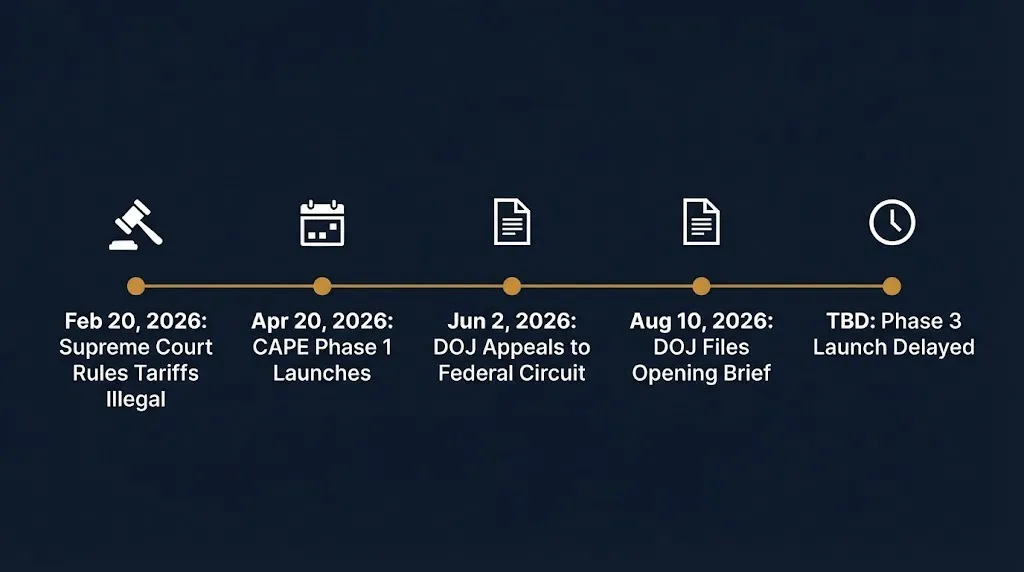
February 20, 2026: Supreme Court rules IEEPA tariffs unlawful in Learning Resources v. Trump.
April 20 to June 29, 2026: CAPE Phases 1 and 2 go live, processing business refunds.
June 2 to August 10, 2026: DOJ appeals to the Federal Circuit and files its opening brief challenging refund orders on finally liquidated entries.
August 6 and August 19, 2026: Class certification hearing and related oral argument held at the Court of International Trade.
Expected fall/winter 2026: Federal Circuit briefing continues; CAPE Phase 3 launch remains delayed with no new date confirmed; consumer class actions continue fighting motions to dismiss with no settlement yet reached.
Frequently Asked Questions
Is the tariff lawsuit a scam?
No, the underlying case is a real, documented federal legal fight tied to a genuine Supreme Court ruling.
Scam risk comes from third parties falsely claiming they can get you a payout today, since no consumer settlement or claim process currently exists.
How much is the tariff lawsuit settlement worth?
There is no single settlement. The business-side government refund pool is estimated near $165 billion, while consumer cases have no settlement fund or confirmed payout yet.
Any specific consumer dollar amount you see online right now is an estimate, not a confirmed figure.
Can I file a claim for a tariff refund as an individual consumer?
Not yet. No consumer class action against a retailer has reached a settlement or opened a claims process as of late August 2026.
Save your receipts and surcharge documentation so you are ready if one opens.
Will I get money back if I bought from Costco, Walmart, or Amazon during the tariff period?
Not yet determined, and not guaranteed even if a case eventually settles.
Costco has moved to dismiss its case, and no retailer has confirmed a plan to reimburse customers directly.
What is CAPE and does it apply to me?
CAPE is CBP’s Consolidated Administration and Processing of Entries system, built to process business tariff refunds, not consumer refunds.
It applies to importers of record who paid IEEPA duties directly, not to individual shoppers.
Is there a deadline to file a tariff refund claim?
Businesses face entry-specific deadlines, generally a 180-day protest window per customs entry, and many early entries are already past that window.
Consumers face no deadline yet because no claims process is open.
What should I do if a company or website contacts me about a tariff refund?
Verify any claim independently through official court records or a reputable legal-news source before responding.
Filing a real claim is always free, and no legitimate process currently asks consumers to pay upfront.
Why does the government still have to pay after the Supreme Court ruled the tariffs illegal?
The ruling settled the legal authority question but not the refund mechanics, leaving that fight to the Court of International Trade.
The Department of Justice is currently appealing how broadly refunds must apply, which is why the process remains contested rather than automatic.
If you paid a tariff-related surcharge or run a business that imported goods during this period, the single most useful thing you can do today is save your documentation and check the official court dockets rather than wait for a text message. The next major marker to watch is the outcome of the Federal Circuit appeal, which could decide whether refunds reach every affected importer or only those who already sued.