How Much Is a Wrongful Arrest Lawsuit Worth in 2026? Real Verdicts, Settlement Ranges, and What Your Claim Could Be
Quick Answer
- A wrongful arrest lawsuit can be worth anywhere from $15,000 to over $24 million, depending on your injuries and lost income.
- Recent settlements include $550,000 in Rhode Island, $750,000 in Colorado, and $3 million in Cook County, Illinois.
- The average wrongful arrest victim loses more than $25,000 in medical bills and lost wages before filing.
No two wrongful arrest cases are worth the same. The dollar figure depends on what happened to you, how long you were detained, whether you lost your job, and what evidence you can produce.
That’s not a lawyer dodge. It’s the actual legal reality. A false arrest case where you spent two hours in a holding cell and were released without charges is a very different claim from one where you spent 31 days in prison and lost your career .
The settlements and verdicts reported in 2026 show the full spectrum. Some cases resolve for five figures. Others produce eight-figure jury awards. This guide breaks down what drives case value, what recent payouts actually look like, and the deadlines you can’t miss.
The Facts
| Item | Detail |
|---|---|
| Typical Settlement Range | $15,000 to $550,000 |
| Large Verdict Range | $750,000 to $24 million |
| Largest 2026 Verdict | $24 million (Colorado, May 2026) |
| Largest 2026 Settlement | $30.5 million combined (Connecticut, August 2026) |
| Average Victim Loss Before Filing | $25,000+ in medical bills and lost wages |
| Federal Claim Deadline | Varies by state (often 2 to 4 years) |
| State Claim Notice Deadline | Often 6 months to 1 year |
What Determines How Much a Wrongful Arrest Lawsuit Is Worth?
A wrongful arrest lawsuit’s value depends on six primary factors: the length of your detention, whether you were physically injured, your lost income, the strength of the probable cause evidence, the jurisdiction, and whether the officer’s conduct was clearly unconstitutional.
Length of detention is the biggest driver. A 31-day incarceration for a crime you didn’t commit supports a much larger claim than a two-hour detention that ended with no charges . Every additional day behind bars increases the damages calculation.
Lost income matters enormously. In the Colorado case that produced a $24 million verdict, jurors factored in the plaintiff’s lost earnings as an investment manager to reach that number . If your arrest cost you a high-paying job, that’s compensable.
Physical injuries, emotional distress, and reputational damage all contribute. The stigma of an arrest can destroy relationships and career opportunities even if charges are dropped .
Here’s what typically drives value:
- Duration of detention: Hours vs. days vs. months
- Criminal charges filed: Misdemeanor vs. felony
- Prosecution outcome: Dropped, acquitted, or dismissed
- Lost wages: Current and future earning capacity
- Medical treatment: Physical and psychological
- Evidence quality: Bodycam, witness testimony, exculpatory records
- Jurisdiction: Some courts and juries are more plaintiff-friendly
How Much Do Wrongful Arrest Settlements Pay?
Wrongful arrest settlements typically range from $15,000 to $550,000, with cases involving significant injuries or lost income settling for more. Recent 2026 settlements illustrate the range.
The City of Mount Vernon, New York approved a $15,000 settlement for Dennis Smith in April 2026. His claims included false arrest, false imprisonment, excessive force, and malicious prosecution arising from an August 2023 incident .
A Rhode Island case settled for $550,000. Mack Blackie was arrested twice, criminally charged, and incarcerated for 31 days for crimes he didn’t commit. The case was brought with ACLU of Rhode Island involvement .
The City of Colorado Springs approved a $750,000 settlement in April 2026 for a claim arising from an April 2022 arrest. The claim alleged violations of Colorado constitutional law by two police officers .
In Jacksonville, Florida, David Washington received $180,000 after his arrest and termination from Jacksonville Fire and Rescue. The city agreed to revise his employment records to show resignation rather than termination .
| Case | Settlement Amount | Key Facts |
|---|---|---|
| Mount Vernon, NY | $15,000 | Short detention, no major injuries |
| Jacksonville, FL | $180,000 | Arrest led to job loss |
| Rhode Island | $550,000 | 31 days incarcerated, charges dropped |
| Colorado Springs, CO | $750,000 | Colorado constitutional violation claim |
| Cook County, IL | $3,000,000 | Reversed conviction, wrongful incarceration |
Key Takeaway: Most wrongful arrest settlements fall between $15,000 and $550,000, but cases involving prolonged detention or significant lost income can reach into the millions.
What Are the Largest Wrongful Arrest Verdicts in 2026?
The largest wrongful arrest verdict in 2026 was a $24 million jury award in Douglas County, Colorado. Robert Dial, 62, won $22 million in economic damages and $2 million for pain and suffering after suing a former Parker police detective.
Dial was arrested in 2022 on felony charges of tampering with evidence. The charges were dismissed five months later, but not before he lost his job and reputation. The jury found the detective liable for false arrest and malicious prosecution .
Connecticut saw its largest wrongful conviction settlement in August 2026. Vernon Horn and Marquis Jackson each received $15.25 million after spending 17 and 19 years in prison for a robbery they didn’t commit. The total settlement exceeded $30.5 million. The city of New Haven will pay $12.75 million per man, with the rest covered by insurance .
In Michigan, Roderic Pippen received $275,000 for ten years of wrongful imprisonment. The state’s Wrongful Imprisonment Compensation Act provides $50,000 for each year of wrongful incarceration .
The Cook County Board of Commissioners considered a $3 million settlement for Reginald Henderson in September 2026. His case involved a reversed conviction, wrongful incarceration, and civil rights violations .
These numbers show that wrongful conviction cases, where someone spends years in prison, produce far larger awards than simple false arrest cases.
Do You Have to Be Found Innocent to Sue for Wrongful Arrest?
No. You do not need to be found innocent to sue for wrongful arrest. A dismissed case, an acquittal, or a prosecutor dropping charges all satisfy the favorable termination requirement for a malicious prosecution claim.
The Supreme Court clarified this in Thompson v. Clark (2022). The Court held that a plaintiff needs only to show the prosecution ended without a conviction. No affirmative indication of innocence is required .
This matters because many wrongful arrest victims worry they can’t sue if they weren’t formally exonerated. That’s not the law. If your case was dismissed, you likely meet the threshold.
However, the type of claim changes based on how your case ended. A false arrest claim challenges the initial detention without legal process. A malicious prosecution claim challenges the continued prosecution after charges were filed .
If you were arrested pursuant to a warrant, courts treat your claim as malicious prosecution rather than false arrest. The legal elements differ, and your attorney needs to know which applies to your situation .
What Defenses Can Police Use Against a Wrongful Arrest Claim?
Police officers can raise three primary defenses: probable cause, qualified immunity, and statutory immunity. Probable cause is the strongest defense.
If the officer had probable cause to arrest you, your false arrest claim fails. Probable cause exists when the officer has reasonably trustworthy information that would lead a person of reasonable caution to believe an offense was committed .
Qualified immunity protects officers from liability unless they violated a clearly established constitutional right. Even without actual probable cause, an officer may be protected if there was “arguable probable cause” .
This is a high bar for plaintiffs. In one 2026 case, the Eighth Circuit reversed a denial of qualified immunity for an officer who arrested a man for DWI. The court found the officer had at least an objectively reasonable basis for the arrest .
Statutory immunity varies by state. Some states provide additional protections for officers acting within the scope of their duties.
The practical reality is that these defenses make wrongful arrest cases hard to win. That’s why settlements are common. Both sides recognize the risk of trial.
Reality Check: No one is going to call you offering money for a wrongful arrest. Police departments and cities don’t proactively pay claims. You have to file a notice of claim and pursue litigation. If someone contacts you claiming you’re owed a settlement from a wrongful arrest case you never filed, that’s a scam. And remember, filing a lawsuit is free. Any third party charging you a fee to “process” a wrongful arrest claim is unnecessary.
How Do You File a Wrongful Arrest Lawsuit?
Filing a wrongful arrest lawsuit requires meeting strict deadlines, gathering evidence, and often filing a notice of claim before you can sue. Missing a deadline can bar your claim entirely.
Here’s the process:
- File a notice of claim with the city, county, or state agency. Many jurisdictions require this within 6 months to 1 year.
- Gather evidence: Police reports, bodycam footage, witness statements, medical records, and employment records.
- Document your damages: Lost wages, medical bills, psychological treatment, and any other losses.
- Consult a civil rights attorney. These cases are complex and immunity defenses are strong.
- File your federal claim under 42 U.S.C. § 1983 for constitutional violations.
- Consider state law claims for false arrest, false imprisonment, and malicious prosecution.
- Prepare for litigation. Most cases settle, but some go to trial.
The notice of claim deadline is the most dangerous trap. In Utah, for example, state law claims against a government entity require written notice within one year. Missing that deadline can bar your state claims entirely, even if your federal claim survives .
Federal claims under Section 1983 borrow the state’s personal injury statute of limitations. That ranges from 2 to 6 years depending on the state . But don’t wait. Evidence disappears, memories fade, and officers leave departments.
What Is the Difference Between Wrongful Arrest and Malicious Prosecution?
Wrongful arrest and malicious prosecution are related but distinct claims. Wrongful arrest challenges the initial detention. Malicious prosecution challenges the continued use of legal process after charges are filed.
A false arrest occurs without legal process. The officer takes you into custody without a warrant or probable cause. The claim focuses on the moment of seizure .
A malicious prosecution occurs pursuant to legal process. Charges are filed, and you’re prosecuted. The claim focuses on whether the prosecution was initiated or continued without probable cause and with malice .
The distinction matters for several reasons. Different elements must be proven. Different immunities may apply. And the timing of when the claim accrues can differ.
In practice, many cases involve both claims. You were arrested without probable cause, and then the prosecution continued even after evidence of your innocence emerged. An experienced civil rights attorney will evaluate both.
What Happens Next: Wrongful Arrest Lawsuit Timeline
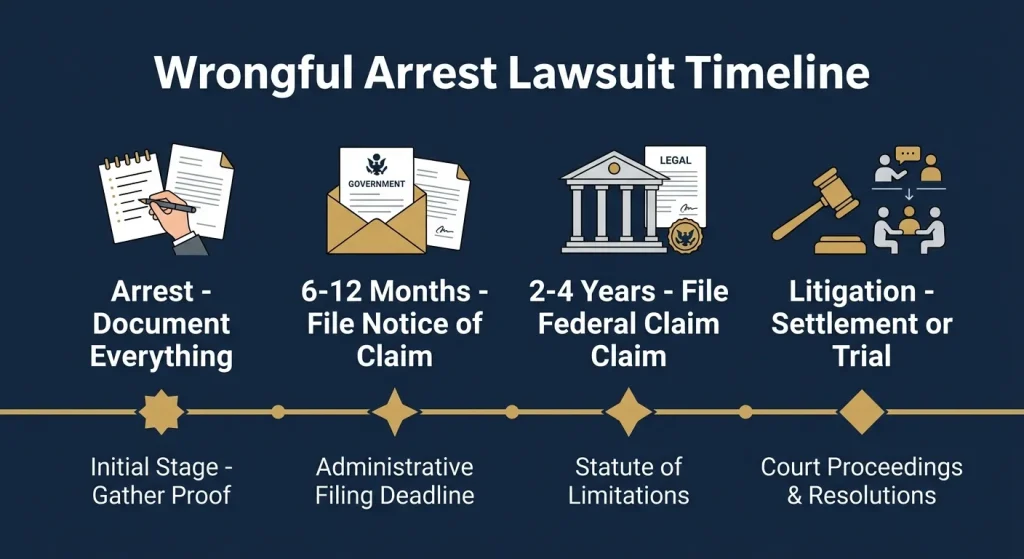
Immediately: Document everything. Get medical treatment. Preserve evidence including bodycam footage requests.
Within 6 months to 1 year: File your notice of claim with the government entity. This is often a strict deadline.
Within 2 to 4 years: File your federal Section 1983 claim. The exact deadline depends on your state’s personal injury statute of limitations.
During litigation: Discovery, depositions, and motions. Most cases settle during this phase.
If no settlement: Trial. Jury verdicts can be appealed.
Frequently Asked Questions
How much is a wrongful arrest lawsuit worth?
Wrongful arrest lawsuits range from $15,000 to over $24 million. Most settle between $100,000 and $550,000 depending on detention length, injuries, and lost income.
What is the average settlement for false arrest?
There is no single average. Recent settlements include $15,000 for short detentions and $550,000 for cases involving weeks of incarceration and dropped charges.
Do I need to be found innocent to sue for wrongful arrest?
No. The Supreme Court ruled in Thompson v. Clark that you only need to show the prosecution ended without a conviction, such as a dismissal or acquittal.
What is the deadline to file a wrongful arrest lawsuit?
Federal claims typically have 2 to 4 years, depending on your state. State law claims against government entities often require a notice of claim within 6 months to 1 year.
Can police be sued for wrongful arrest?
Yes. You can sue individual officers and the municipality under 42 U.S.C. § 1983 for Fourth Amendment violations. Qualified immunity is a common defense.
What is the difference between false arrest and malicious prosecution?
False arrest challenges the initial detention without legal process. Malicious prosecution challenges the continued prosecution after charges are filed.
How do I prove a wrongful arrest claim?
You must show the officer lacked probable cause to arrest you. Evidence includes bodycam footage, witness testimony, and the absence of facts supporting the arrest.
What damages can I recover in a wrongful arrest lawsuit?
Compensatory damages for lost wages, medical bills, pain and suffering, and emotional distress. Punitive damages may be available against individual officers.
The Bottom Line
A wrongful arrest lawsuit can be worth anywhere from $15,000 to eight figures. The difference comes down to how long you were detained, what you lost, and how strong the evidence is.
The most important step is the first one. Many jurisdictions require a notice of claim within months of the incident. Miss it and your case may be over before it starts.
If you were arrested without probable cause, document everything. Get medical treatment. Request the police reports and bodycam footage. Then talk to a civil rights attorney before the deadline runs out.