Berkey Water Filter Lawsuit 2026: EPA Action, Product Restrictions, and Consumer Claims Status
Quick Answer:
- The Berkey water filter lawsuit is not a class action, but an EPA enforcement action over pesticide claims.
- No consumer settlement fund exists, and no per-person payouts are available as of March 2026.
- Consumers may seek refunds through retailers, credit card chargebacks, or individual small claims actions.
If you own a Berkey water filter and searched for a lawsuit, you are likely wondering whether you can get your money back. The answer is complicated.
The legal problem for Berkey is not a consumer class action. It is a federal enforcement action brought by the Environmental Protection Agency. The EPA says Berkey made unregistered pesticide claims about its filters.
This article explains what happened, why Berkey filters are hard to buy in the United States, whether you can get a refund, and what legal options exist. One verified fact: the EPA ordered Berkey to stop selling most of its filter systems in the United States, and that order remains in effect.
The Facts
| Case | EPA enforcement action against New Millennium Concepts, the maker of Berkey |
|---|---|
| Status | Final order issued, sales restricted |
| Fund Size | No consumer settlement fund |
| Est. Per Person | No payout available |
| Claim Deadline | None, no class action claim process |
| Administrator | None |
| Proof Needed | Purchase receipts for refund or chargeback claims |
Is there a Berkey water filter class action lawsuit?
There is no Berkey water filter class action lawsuit as of March 2026. The legal action against Berkey is a federal enforcement case brought by the Environmental Protection Agency, not a consumer class action.
The EPA case is different from a class action in important ways. A class action is brought by private plaintiffs on behalf of a group of consumers. The EPA case is brought by the government to enforce federal pesticide law.
The EPA filed its action against New Millennium Concepts, the company that makes Berkey filters, under the Federal Insecticide, Fungicide, and Rodenticide Act. That law requires products that claim to kill or remove bacteria, viruses, or other pests to be registered with the EPA.
Berkey marketed its filters as removing bacteria, viruses, and other harmful organisms from water. Those are pesticide claims under federal law. Berkey did not register its filters as pesticides.
The result is an enforcement order that restricts Berkey from selling most of its products in the United States. That is not the same as a settlement that pays consumers. No consumer money is on the table.
Key Takeaway: The Berkey legal situation is an EPA enforcement action, not a class action, and no consumer settlement exists.
Why did the EPA stop Berkey water filter sales?
The EPA stopped Berkey water filter sales because the company made pesticide claims without registering its products under federal pesticide law. The filters themselves were never proven unsafe for their intended use.
The Federal Insecticide, Fungicide, and Rodenticide Act requires any product that claims to kill, repel, or remove bacteria, viruses, or other microbial pests to be registered with the EPA. Registration requires scientific data proving the product works and is safe.
Berkey advertised its filters as removing bacteria, viruses, parasites, and other harmful microorganisms. Those are exactly the kinds of claims that trigger pesticide registration requirements. Berkey did not register its filters.
The EPA issued a stop sale order under the statute. The order prevents Berkey and its retailers from selling most Berkey filter systems in the United States. Berkey has challenged the EPA’s authority in court, but the sales restriction remains in effect.
This is a regulatory action, not a product safety recall. The EPA did not say Berkey filters are dangerous to use. It said Berkey cannot make the claims it makes without going through the registration process.
Key Takeaway: The EPA stopped Berkey sales over unregistered pesticide claims, not because the filters were proven unsafe.
Can I get a refund for my Berkey water filter?
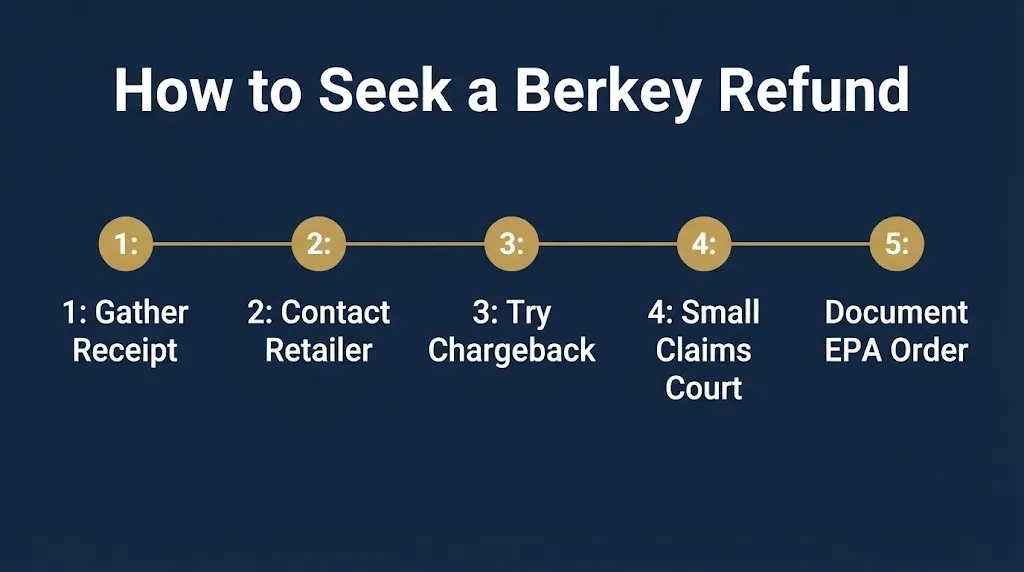
You can try to get a refund for your Berkey water filter through the retailer, a credit card chargeback, or a small claims action. There is no government or company refund program.
The lack of a class action settlement means there is no automatic refund process. No settlement administrator is mailing checks. No claim form exists.
Here are the practical options:
| Method | Likelihood of Success | Time Frame |
|---|---|---|
| Retailer refund request | Low to moderate, depends on policy | Immediate |
| Credit card chargeback | Moderate, if within time limits | 30 to 90 days |
| Small claims court | Moderate to high, if you prove misleading claims | 1 to 3 months |
| Class action, if filed later | Unknown, no case pending | Years |
Credit card chargebacks have time limits. Most card networks allow chargebacks within 60 to 120 days of the transaction. If you bought your Berkey years ago, that window is closed.
Small claims court is an option if you believe Berkey misrepresented the product. You would need to prove the filter did not perform as advertised. That is a high bar for an individual consumer.
Some consumers report success getting refunds from retailers after explaining the EPA action. Others report being denied. It depends on the retailer’s return policy and how long ago you bought the filter.
What does the Berkey lawsuit mean for current Berkey owners?
The Berkey EPA order means current Berkey owners may have trouble buying replacement filters, but it does not require you to stop using the filter you already own.
The stop sale order applies to sellers, not to consumers. You are not breaking any law by continuing to use a Berkey filter. The EPA action does not say the filters are dangerous to use.
The practical problem is replacement filters. Many Berkey filter models are no longer available from U.S. retailers. Some replacement filters are still sold, but availability is spotty.
Berkey has disputed the EPA order and continues to sell some products through its website. The company argues its filters are not pesticides and should not be regulated under pesticide law. That argument is being litigated.
If you rely on a Berkey filter for daily water treatment, you should consider a backup plan. Replacement filters may become harder to find. Compatible third party filters exist, but their performance has not been independently verified.
The legal fight between Berkey and the EPA is ongoing. A court could reverse the EPA order or uphold it. The outcome will determine whether Berkey products return to normal retail availability.
What is the current status of the Berkey EPA lawsuit in 2026?
The Berkey EPA lawsuit remains in litigation as of March 2026. The stop sale order is in effect while the company challenges it in federal court.
Berkey, through its parent company New Millennium Concepts, has argued that its water filters are not pesticides and should not be subject to EPA registration. The company says its filters remove contaminants through mechanical filtration, not through killing organisms.
The EPA maintains that any product claiming to remove bacteria and viruses makes a pesticide claim under the law. The agency says Berkey’s own marketing materials are the best evidence of those claims.
The case raises a broader regulatory question: can a water filter be regulated as a pesticide? The answer could affect other water filtration companies that make similar claims.
No court ruling has resolved that question as of March 2026. The case continues through the federal court system. A decision could come at any time, but appeals could extend the timeline for years.
For consumers, the practical outcome is unchanged. Berkey products remain restricted in the U.S. market. That could change if Berkey wins its legal challenge.
Key Takeaway: The Berkey EPA case is still in litigation, and the sales restriction stays in effect until a court says otherwise.
What did Berkey claim its water filters could do?
Berkey claimed its water filters could remove bacteria, viruses, parasites, and other harmful microorganisms from drinking water. Those claims triggered the EPA action.
The company marketed its filters as capable of removing “99.9 percent of bacteria” and “99.9 percent of viruses.” Those specific numbers appeared in Berkey advertising and on product packaging.
Berkey also claimed the filters could remove heavy metals, chemicals, and sediment. Those types of claims do not trigger pesticide regulation. The bacteria and virus claims do.
The distinction matters legally. A mechanical water filter can claim to reduce chlorine taste or sediment without EPA registration. But claiming to remove bacteria and viruses crosses into pesticide territory because bacteria and viruses are considered pests under federal law.
The EPA did not test Berkey filters or conclude they fail to remove bacteria and viruses. The agency’s action is based on the claims themselves, not on the product’s performance.
That nuance is important. The EPA action is about regulatory compliance, not about whether the filters work. Berkey’s legal fight is over whether the pesticide registration requirement should apply to water filters at all.
Are Berkey water filters dangerous or unsafe?
No evidence from the EPA action suggests Berkey water filters are dangerous or unsafe to use. The stop sale order is about unregistered pesticide claims, not about product safety.
The EPA has not issued a product safety recall for Berkey filters. The agency has not said the filters contaminate water or harm consumers. The action is regulatory, not safety based.
The practical risk for Berkey owners is different. If the EPA’s position is correct that Berkey made unverified claims, then consumers may not be getting the bacterial and viral protection they believed they purchased. That is a performance issue, not a safety issue.
Independent testing of Berkey filters has produced mixed results. Some tests show significant removal of bacteria and viruses. Others show less complete removal than advertised. No single authoritative test has settled the question.
If you rely on Berkey for water in a setting where microbial contamination is a real risk, you should verify that the filter is performing as you expect. Independent water testing is available and would give you actual data about your specific filter.
For most homeowners using Berkey as an aesthetic filter on municipal water, the risk is minimal. Municipal water is already treated for microbial contamination.
Key Takeaway: The Berkey EPA action is not a safety recall, and no evidence shows the filters are dangerous to use.
How do I check if my Berkey filter is affected by the EPA order?
Your Berkey filter is affected by the EPA order if it was marketed with claims about removing bacteria, viruses, or other microorganisms. Most Berkey filtration systems made those claims.
The stop sale order applies broadly to Berkey water purification systems sold in the United States. That includes the popular Berkey Light, Big Berkey, Travel Berkey, and Royal Berkey models.
The order also affects replacement filters, including the Black Berkey filter elements. Those elements were the primary product making microbial removal claims.
Some Berkey accessories and non-filter products remain available. Water bottles, replacement parts, and products that do not make pesticide claims are not covered by the order.
The practical test is simple. If your Berkey product was marketed as removing bacteria or viruses, it falls under the EPA action. If it was sold only for improving taste or removing sediment, it may not be affected.
Check the original product packaging or the Berkey website at the time of purchase. The claims will tell you whether your product is part of the EPA action.
Can I file a claim against Berkey without a class action?
You can file a claim against Berkey without a class action by pursuing a small claims court case or a chargeback through your credit card company. Neither requires a class action to exist.
Small claims court is the most direct option. Each state sets its own small claims limit, typically between five thousand and ten thousand dollars. Your damages, the cost of the filter system, likely fall within that range.
To win in small claims court, you would need to show that Berkey misrepresented its product or that the product did not perform as advertised. The EPA order is evidence that Berkey made unregistered pesticide claims, but it is not proof that the filter failed to work.
A chargeback is simpler but time limited. If you bought your Berkey recently, contact your credit card issuer and explain that the product was subject to a federal stop sale order. The issuer may reverse the charge.
Keep in mind that chargebacks have limits. If you bought the filter years ago, the chargeback window is closed. Small claims court has a longer statute of limitations, typically two to four years depending on your state.
Reality Check: No third party service can get you a Berkey refund faster than the options above. Anyone charging a fee to “file your Berkey claim” is selling a service you can do yourself for free.
What happens next in the Berkey legal situation?
The Berkey legal situation will develop through the court system in 2026 and beyond. Here is the expected timeline.
- Ongoing 2026: Federal court considers Berkey’s challenge to the EPA stop sale order.
- Expected late 2026: A ruling on the pesticide registration question, possibly in Berkey’s favor or the EPA’s favor.
- Possible 2027: Appeals from whichever side loses at the trial court level.
- Ongoing: Berkey continues limited sales through its own website while the case proceeds.
- Uncertain: A consumer class action could still be filed separately, but none exists now.
These dates are estimates. Litigation timelines are inherently uncertain. The case involves novel regulatory questions that could take years to resolve.
For consumers, the key point is that no refund process exists and none is imminent. If you want your money back, you must pursue individual remedies now.
The legal outcome will determine whether Berkey products return to normal retail availability. A Berkey win would lift the stop sale order. An EPA win would keep restrictions in place permanently.
Frequently Asked Questions
Is there a Berkey water filter class action lawsuit?
No, there is no Berkey class action lawsuit as of March 2026.
The legal action is an EPA enforcement case, not a consumer class action.
Can I get a refund for my Berkey filter?
You can try a retailer refund, credit card chargeback, or small claims case.
There is no automatic refund program and no settlement fund.
Why did the EPA stop Berkey sales?
The EPA stopped Berkey sales over unregistered pesticide claims.
Berkey claimed its filters remove bacteria and viruses without EPA registration.
Are Berkey filters safe to use?
No evidence shows Berkey filters are dangerous.
The EPA action is about regulatory compliance, not product safety.
Can I still buy Berkey replacement filters?
Some replacement filters remain available, but availability is limited.
Many U.S. retailers no longer carry Berkey products due to the stop sale order.
What should I do if I own a Berkey filter?
You can continue using your filter.
Consider independent water testing if you rely on it for microbial safety.
How long will the Berkey lawsuit take?
The case could take years to resolve.
A ruling could come in late 2026, but appeals could extend the timeline.
Should I hire a lawyer for a Berkey refund?
For most consumers, small claims court does not require a lawyer.
A chargeback or retailer return is simpler and faster.
The Berkey water filter situation is unusual. There is no class action. There is no settlement fund. There is no claim form. What exists is a federal regulatory action that has restricted Berkey sales and raised questions about the company’s marketing claims.
If you want a refund, your options are individual: contact the retailer, file a chargeback, or go to small claims court. The strongest evidence you have is the EPA stop sale order itself. Use it when you make your case.