Ford Class Action Lawsuit 2026: EcoBoost Engine Defect Claims, Settlement Status, and What Owners Need to Know
Quick Answer:
- Ford class action lawsuits over EcoBoost engine defects are real, active cases in federal courts.
- No settlement fund or per-person payout has been approved as of March 2026.
- The most important date for owners is the claim deadline, which has not been set yet.
If you own a Ford with an EcoBoost engine and searched for a class action lawsuit, the answer is yes. Multiple proposed class actions are pending against Ford Motor Company over alleged engine defects.
The cases center on coolant leaks, cylinder head cracking, and coolant intrusion into engine cylinders. Owners report repair bills from three thousand to over ten thousand dollars for engine replacements.
This article covers which vehicles are affected, what the lawsuits claim, how much owners could recover, and what to do now while the cases move through court. One verified fact: the National Highway Traffic Safety Administration has received over one thousand complaints related to EcoBoost engine failure in affected model years.
The Facts
| Case | Multiple consolidated Ford EcoBoost class actions |
|---|---|
| Status | Active litigation, no settlement approved |
| Fund Size | Not yet confirmed |
| Est. Per Person | Not yet determined |
| Claim Deadline | TBD, no claim form available yet |
| Administrator | Not yet appointed |
| Proof Needed | Expected: repair records, ownership documents |
Is the Ford EcoBoost class action lawsuit real?
The Ford EcoBoost class action lawsuit is real. Multiple cases have been consolidated in federal court, and the litigation is moving forward with active discovery.
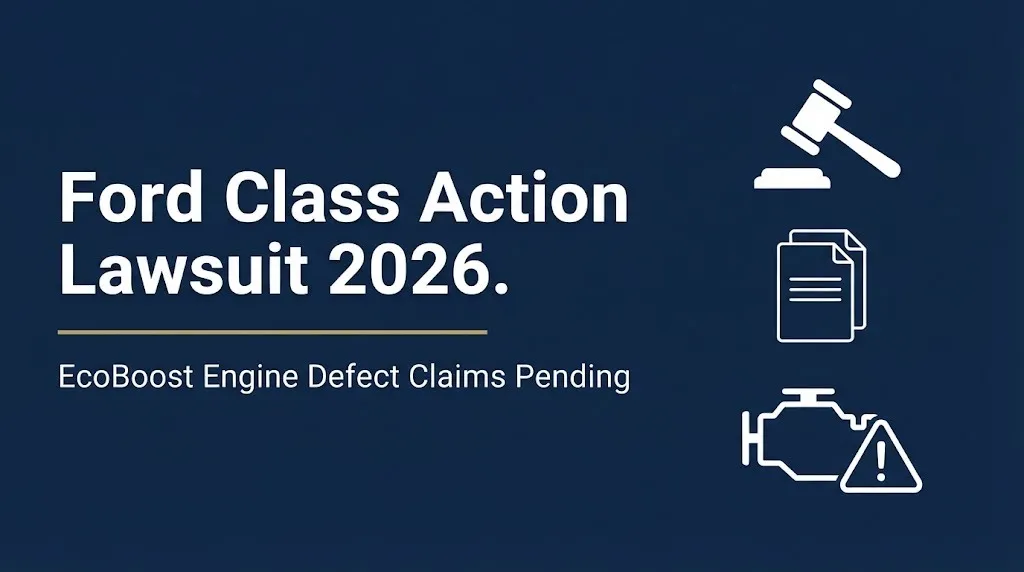
The primary consolidated case involves Ford vehicles equipped with 1.5 liter, 1.6 liter, and 2.0 liter EcoBoost four cylinder engines. Plaintiffs allege these engines have a design defect that allows coolant to leak into the cylinders.
When coolant enters a cylinder, it causes hydrolock, engine misfires, and eventually catastrophic engine failure. The repair is often a full engine replacement.
Ford has not admitted liability. The company has argued in court filings that the engines perform as designed and that any failures are isolated incidents. That position is now being tested through document discovery and expert witness reports.
Court records confirm the cases are proceeding. The Judicial Panel on Multidistrict Litigation centralized the federal cases to streamline pretrial proceedings. That consolidation does not mean Ford lost. It means the cases are being managed efficiently.
If you see social media posts claiming a settlement has been reached, check the official court docket. As of March 2026, no settlement has been approved.
Key Takeaway: The Ford EcoBoost class action is a real, active federal lawsuit, but it has not settled and no payouts are imminent.
Which Ford vehicles are affected by the EcoBoost engine lawsuit?
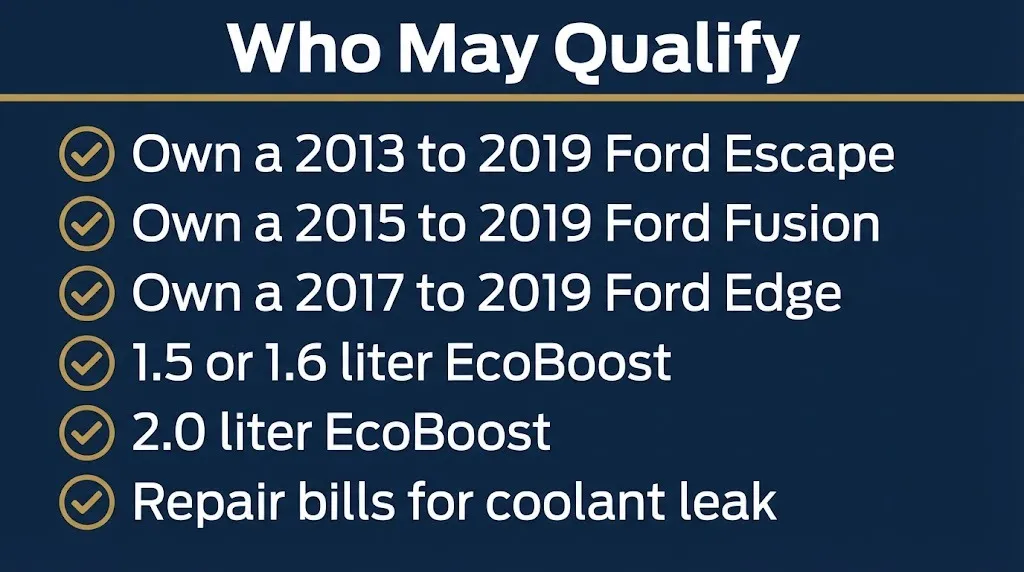
The proposed class includes several Ford and Lincoln vehicles equipped with specific EcoBoost four cylinder engines. The exact class definition remains subject to court approval.
Based on court filings, the vehicles at issue include:
| Model Years | Vehicle | Engine |
|---|---|---|
| 2013 to 2019 | Ford Escape | 1.5L and 1.6L EcoBoost |
| 2015 to 2019 | Ford Fusion | 1.5L and 2.0L EcoBoost |
| 2017 to 2019 | Ford Edge | 2.0L EcoBoost |
| 2015 to 2019 | Lincoln MKC | 2.0L EcoBoost |
| 2015 to 2019 | Lincoln MKZ | 2.0L EcoBoost |
| 2013 to 2019 | Ford Focus ST | 2.0L EcoBoost |
This list is not final. The class definition will be set by the court at the class certification stage. Some vehicles may be added or removed depending on how the evidence develops.
What matters for you is whether your vehicle matches the engine type, not just the model. A Ford Escape with the base naturally aspirated engine is not part of this case. Only the EcoBoost four cylinder engines are at issue.
The 2.7 liter and 3.5 liter EcoBoost V6 engines used in F-150 trucks are the subject of separate lawsuits and are not part of this consolidated case.
Key Takeaway: The lawsuit targets specific Ford and Lincoln vehicles with 1.5, 1.6, and 2.0 liter EcoBoost four cylinder engines, not every EcoBoost vehicle.
How much could Ford EcoBoost owners get from the class action?
Ford EcoBoost owners could recover a range of amounts if a settlement is reached, but no dollar figure exists yet. Any number you see online is speculation.
In similar automotive defect class actions, settlements have ranged from a few hundred dollars for a warranty extension to full reimbursement of repair costs for owners who paid out of pocket. The Ford case could follow either path.
Here is how a typical automotive class action settlement might break down, based on comparable cases:
| Category | Potential Recovery Range |
|---|---|
| Full engine replacement paid out of pocket | Up to 100 percent of repair cost, capped |
| Partial repair or diagnostic costs | 25 to 75 percent of documented costs |
| No repair needed yet | Warranty extension or small reimbursement |
| Vehicle sold at a loss due to defect | Diminished value payment, variable |
These ranges are illustrative, not confirmed for the Ford case. The actual recovery structure, if a settlement happens, depends on the negotiated terms, the total fund size, and how many owners file claims.
Class action math works like a group refund. The fund is fixed. The more people who file valid claims, the smaller each share. Some automotive settlements have paid thousands of dollars to owners with documented engine replacements. Others have paid a few hundred dollars plus a warranty extension.
Reality Check: No one can guarantee you a specific Ford EcoBoost settlement amount right now. Any service claiming to lock in your payment for a fee is misleading you. Filing a claim, once available, costs nothing.
What is the Ford EcoBoost engine defect lawsuit about?
The Ford EcoBoost engine defect lawsuit alleges that a design flaw allows coolant to leak into the engine cylinders. That leak causes premature engine failure and expensive repairs.
Plaintiffs describe a specific failure pattern. The engine block or cylinder head develops a crack, or a gasket fails, allowing coolant to seep into the combustion chamber. The coolant contaminates the engine oil and causes overheating.
Drivers first notice white smoke from the exhaust. Then a low coolant warning appears. The engine begins to misfire. Eventually, the engine seizes or throws a rod. At that point, the vehicle needs a new engine.
The National Highway Traffic Safety Administration has documented the pattern through consumer complaints. The complaints describe the same symptoms across the affected model years.
Ford issued technical service bulletins acknowledging coolant consumption issues in some EcoBoost engines. The plaintiffs argue those bulletins prove Ford knew about the problem but did not recall the vehicles or reimburse owners.
Ford’s defense is that coolant loss can have many causes, including normal wear and improper maintenance. The company says the failure rate does not support a defect finding. The court will have to weigh expert testimony on both sides.
Key Takeaway: The core allegation is a coolant leak design defect causing engine failure, with Ford accused of knowing about the problem and failing to act.
What should Ford EcoBoost owners do right now in 2026?
Ford EcoBoost owners should document everything and prepare for a possible claim, even though no claim form exists yet. The steps you take now will determine whether you can recover later.
- Locate your vehicle purchase documents, including the bill of sale and window sticker.
- Gather all repair records, especially any work related to coolant leaks, engine misfires, or engine replacement.
- Save receipts for out of pocket repairs, including diagnostic fees.
- Note the vehicle identification number, mileage at failure, and current mileage.
- Record the date you first noticed symptoms like white smoke or low coolant.
- Check the National Highway Traffic Safety Administration complaint database and file a complaint if you have not already.
- Keep records of any communications with Ford customer service or dealerships.
- Monitor the official court docket and the eventual settlement website for claim deadlines.
Think of this like a warranty claim. The more documentation you have, the smoother the process. If you throw away the receipt for a seven thousand dollar engine replacement, you lose the ability to prove that loss.
Do not wait for a settlement notice to start organizing. Settlement windows in class actions often run sixty to ninety days. That is enough time to file if your records are ready. It is not enough time to reconstruct years of vehicle history from scratch.
Is there a Ford EcoBoost recall related to the lawsuit?
There is no recall for the coolant intrusion issue described in the EcoBoost class action. Ford has issued technical service bulletins, but those are not recalls.
A recall is a formal safety action coordinated with the National Highway Traffic Safety Administration. Recalls require notice to owners and free repairs. The EcoBoost coolant intrusion issue has not triggered a recall as of March 2026.
Technical service bulletins are internal documents that tell dealerships how to diagnose and repair known problems. They are not sent to owners and do not provide free repairs outside warranty.
This distinction matters. Some owners assume that because a technical service bulletin exists, Ford has admitted a defect. That is not legally accurate. A bulletin shows awareness of a possible issue. It does not trigger reimbursement.
Separately, Ford has issued recalls for other EcoBoost issues, including a coolant sensor failure on some 1.6 liter engines that could cause fires. That recall is real but different from the class action defect.
If your vehicle has an open recall, you should get it fixed. But do not confuse recall completion with class action eligibility. They are separate processes.
Has Ford settled any EcoBoost class action lawsuits?
Ford has not settled the main EcoBoost coolant intrusion class action as of March 2026. The consolidated federal case remains in pretrial litigation.
Ford has settled other engine related lawsuits in the past. Some of those settlements involved different engines, different defects, and different vehicle populations. Those settlements do not apply to the current EcoBoost four cylinder case.
It is easy to get confused online. Older Ford settlement notices still circulate on consumer forums. A settlement for one case does not mean a settlement for all cases.
The current consolidated EcoBoost case has not reached the settlement stage. The parties are still arguing over class certification, expert testimony, and the scope of discovery. A settlement could come at any time, but none has been announced.
If a settlement is reached, the court will issue a preliminary approval order. After that, a settlement website will launch, and notices will go out to potential class members. That is the moment when a claim form becomes available.
Until then, the only verified status is active litigation. No checks are being mailed. No claim deadline has been set.
Key Takeaway: No Ford EcoBoost settlement exists as of March 2026, and any claim that one has been approved is false.
How do I join the Ford class action lawsuit?
You do not need to join the Ford class action lawsuit right now. If a class is certified and a settlement is reached, you will automatically be included unless you opt out.
Class actions in federal court follow a specific procedure. The court first decides whether the case can proceed as a class action. That decision is called class certification. If the class is certified, everyone who fits the class definition is automatically a member.
You do not sign up in advance. You do not pay a fee to join. You do not need a lawyer to be included. The class action mechanism includes you by operation of law.
What you may need to do later is file a claim. If a settlement is reached, you will need to submit a claim form with proof of ownership and any repair costs. That is when your documentation matters.
The opt out process is different. If the class is certified, you will receive a notice giving you the option to exclude yourself. Opting out preserves your right to sue Ford individually. Most owners will not want to opt out because individual lawsuits are expensive and slow.
For now, the only action is preparation. Gather your records. Check the court docket periodically. Watch for official notices.
What is the current status of the Ford engine lawsuit in 2026?
The Ford engine lawsuit is in the discovery and class certification phase as of March 2026. No trial date has been set, and no settlement has been reached.
The consolidated case is moving through the standard pretrial process. Both sides are exchanging documents. Experts are being deposed. The plaintiffs have filed a motion for class certification, and the court will rule on that motion in the coming months.
Class certification is the pivotal moment. If the court certifies the class, the case gains enormous leverage. Ford faces the prospect of a single trial covering thousands of owners. That often drives settlement negotiations.
If the court denies certification, the case weakens significantly. The plaintiffs would then have to pursue individual claims, which are less efficient and less threatening to Ford.
The timing is uncertain. Class certification decisions can take months. Even after certification, a trial date might be a year or more away. Settlements often come after certification but before trial.
For owners, the practical implication is patience. This case will not resolve in weeks. It may not resolve in 2026 at all.
Key Takeaway: The Ford engine lawsuit is at the class certification stage, the most important procedural moment, and the outcome will shape everything that follows.
What are the symptoms of the Ford EcoBoost coolant leak defect?
The Ford EcoBoost coolant leak defect produces a predictable set of symptoms. Owners report the same warning signs across the affected model years.
The most common symptoms include:
- White smoke from the exhaust, especially on startup
- Persistent low coolant warning light
- Engine misfire or rough idle
- Overheating, even after coolant top off
- Sweet smell from the exhaust or engine bay
- Engine knock or tapping noise before failure
- Check engine light with misfire codes
These symptoms appear gradually at first. The white smoke may only happen on cold starts. The coolant level drops slowly. Then the symptoms accelerate.
By the time the engine fails, the damage is usually severe. Coolant in the cylinders causes hydrolock, which can bend connecting rods. The engine may seize entirely. Most owners need a full replacement.
If you drive an affected vehicle and notice these symptoms, do not ignore them. Continuing to drive with coolant intrusion makes the damage worse. Have the vehicle inspected by a mechanic, and document everything.
The symptoms are also useful if you file a claim later. A clear record of when symptoms started and what repairs were attempted strengthens your position.
How much does it cost to repair an EcoBoost engine coolant leak?
Repairing an EcoBoost engine coolant leak can cost anywhere from one thousand five hundred dollars for early diagnosis and minor repairs to over ten thousand dollars for a full engine replacement.
The cost depends on when the problem is caught. If the coolant leak is caught early, a new head gasket or cylinder head might fix the issue. That repair typically runs two thousand to five thousand dollars at a dealership.
If the engine has already sustained damage from coolant intrusion, the only fix is a new engine. Ford dealerships commonly quote six thousand to ten thousand dollars for an EcoBoost engine replacement, including labor. Some owners report paying even more at independent shops when the engine is out of warranty.
These costs are the core damages in the class action. Plaintiffs argue that Ford should bear these costs because the defect, not the owner, caused the failure.
Many affected owners are out of warranty when the failure occurs. The factory powertrain warranty is five years or sixty thousand miles. Failures often happen after that period, leaving owners with the full bill.
If you paid for repairs, keep every receipt. If you have not repaired the vehicle yet, get a written estimate. Both documents will be essential if a settlement claim process opens.
Key Takeaway: EcoBoost coolant leak repairs range from a few thousand dollars to over ten thousand, and these out of pocket costs are the core damages in the lawsuit.
What happens next in the Ford EcoBoost class action?
The Ford EcoBoost class action will move through several stages before any money reaches owners. Here is the expected path.
- Mid 2026: Court rules on class certification motion.
- Late 2026: If certified, settlement negotiations intensify or trial scheduling begins.
- Early 2027: Potential preliminary settlement approval if the parties reach agreement.
- Mid 2027: Claim filing window opens, if a settlement is approved.
- Late 2027: Payments distributed, if no appeals delay the process.
These dates are estimates based on typical automotive class action pacing. None are confirmed. The court could move faster or slower.
The single most important event is the class certification ruling. Everything depends on that decision. If certification is granted, settlement pressure builds quickly. If denied, the case may fragment into individual claims and take much longer.
For owners, the action item remains the same. Gather your records now. Check for official notices periodically. Do not rely on social media for case updates. Use the court docket and the eventual settlement website.
Frequently Asked Questions
Is the Ford EcoBoost class action lawsuit real?
Yes, multiple real class actions have been consolidated in federal court.
No settlement has been approved as of March 2026.
What Ford vehicles are included in the class action?
The proposed class includes Ford Escape, Fusion, Edge, Focus ST, and Lincoln MKC and MKZ vehicles with 1.5, 1.6, or 2.0 liter EcoBoost engines.
The final class definition is pending court approval.
How much will Ford EcoBoost owners get?
No settlement amount has been determined.
Potential recovery could range from a warranty extension to reimbursement of repair costs, depending on the negotiated terms.
Is there a claim form for the Ford class action?
No claim form exists yet.
A claim form will become available only if a settlement is reached and approved.
Do I need a lawyer to join the Ford class action?
No, you are automatically included if the class is certified and you fit the definition.
You do not need to sign up or pay a fee.
Has Ford recalled the affected EcoBoost engines?
No recall covers the coolant intrusion defect described in the class action.
Ford has issued technical service bulletins, but those are not recalls.
What should I do while waiting for the lawsuit to resolve?
Gather your purchase and repair records, document any symptoms, and check the court docket periodically.
Preparation now makes filing a claim easier later.
How long will the Ford class action take?
The case could take another one to two years or more, depending on the class certification ruling and whether a settlement is reached.
Automotive class actions typically take several years.
The Ford EcoBoost class action is real and moving forward. But no money is available yet. No claim form exists. No deadline has been set.
What you can do now is prepare. Gather your records. Document your repair costs. Check the court docket and watch for official notices. The owners who recover are the ones who can prove their losses when the claim window finally opens.