Average Settlement for Car Accident 2026: Real Numbers, Key Factors, and What to Expect
Quick Answer
- The average car accident settlement is not a meaningful number because cases vary too widely.
- Minor injury cases may settle for $3,000 to $15,000; serious injury cases reach six or seven figures.
- Your settlement depends on damages, insurance limits, and proving the other driver was at fault.
You want a number. You want to know what your car accident case is worth before you talk to an insurance adjuster.
Here is the honest answer: anyone who gives you a single average settlement number is misleading you. Car accident settlements range from a few thousand dollars for minor injuries to millions for permanent disability or death.
This article breaks down the real factors that determine your payout, the rough ranges by injury type, and the mistakes that shrink settlements.
| The Facts | |
|---|---|
| Claim Type | Car accident personal injury |
| Fault System | Varies by state, at-fault vs no-fault |
| Insurance Minimums | Vary by state, often $25,000 to $50,000 |
| Settlement Drivers | Injury severity, insurance limits, liability |
| Statute of Limitations | Varies by state, often 1 to 3 years |
| Attorney Fee | Typically 33% of settlement |
| No National Average | Published figures are estimates only |
Is There a Reliable Average Settlement for Car Accidents?
No, there is no reliable average settlement for car accidents. The data is too fragmented and the cases too varied to produce a meaningful single number.
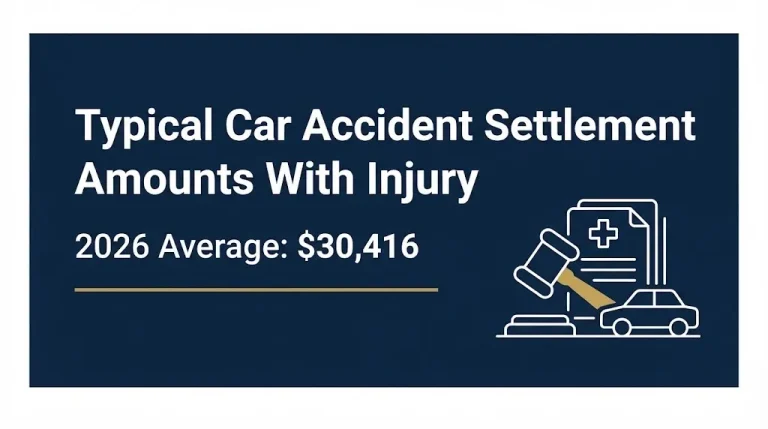
Some sources cite figures like $20,000 or $30,000 as an average. Those numbers usually come from surveys of attorney-reported settlements, not comprehensive data.

The problem is selection bias. Small cases settle quietly and are rarely reported. Large verdicts make headlines. The middle gets lost.
You should treat any “average settlement” figure as a rough reference point, not a predictor of your case.
How Much Is the Average Settlement for a Car Accident?
The average settlement for a car accident depends entirely on injury severity and case specifics.
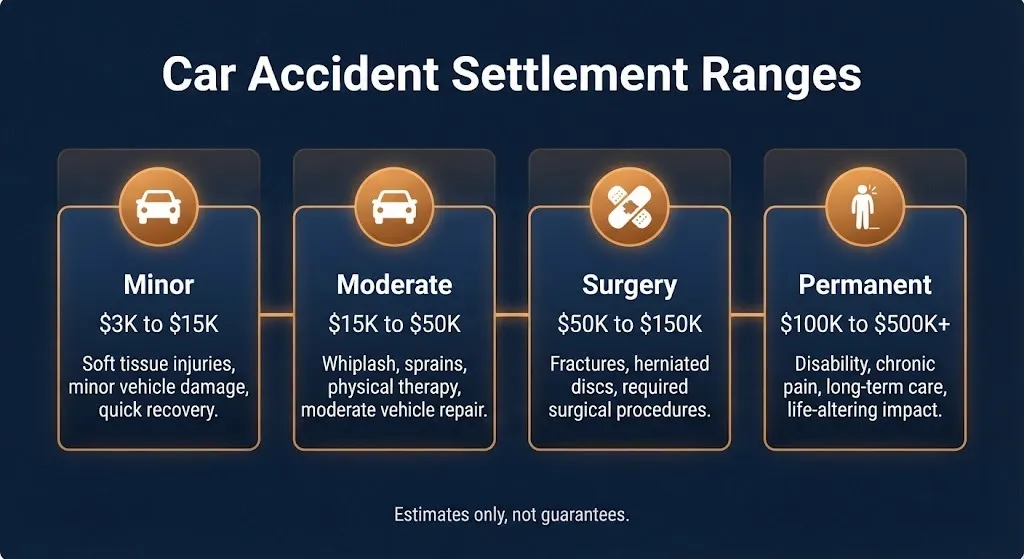
For minor injuries with full recovery, settlements often range from $3,000 to $15,000. For moderate injuries requiring surgery or extended treatment, the range shifts to $25,000 to $100,000.
| Injury Type | Typical Settlement Range |
|---|---|
| Minor soft tissue, no ongoing care | $3,000 to $15,000 |
| Moderate, physical therapy, no surgery | $15,000 to $50,000 |
| Surgery required, full or partial recovery | $50,000 to $150,000 |
| Permanent injury, disability | $100,000 to $500,000+ |
| Wrongful death | $250,000 to $1,000,000+ |
These ranges are estimates based on case patterns, not guarantees. Your case may fall outside them.
Key Takeaway: Car accident settlements track injury severity, not a national average. A minor case and a catastrophic case have nothing in common.
What Factors Determine a Car Accident Settlement?
The main factors are liability, damages, insurance limits, and the quality of your evidence.
Liability is who caused the crash. If the other driver was clearly at fault, your settlement leverage rises. If fault is disputed, your case value drops.
Damages are your actual losses: medical bills, lost wages, pain and suffering, and future care costs.
Insurance limits cap most settlements. If the at-fault driver carries $25,000 in bodily injury coverage, your settlement may be limited to that amount unless other coverage applies.
| Factor | How It Affects Value |
|---|---|
| Clear liability | Higher settlement |
| Serious injury | Higher settlement |
| Low insurance limits | Caps the payout |
| Strong medical records | Higher settlement |
| Delayed treatment | Lower settlement |
These factors interact. A serious injury with low policy limits may settle for the policy maximum.
What Is the Average Settlement for a Minor Car Accident?
A minor car accident with soft tissue injuries often settles for $3,000 to $15,000.
Minor cases typically involve whiplash, strains, and bruises with full recovery within weeks or months. Medical treatment is limited to an emergency visit and some physical therapy.
| Minor Case Component | Typical Value |
|---|---|
| Emergency room visit | $1,000 to $3,000 |
| Physical therapy | $2,000 to $5,000 |
| Lost wages, brief | $500 to $2,000 |
| Pain and suffering | $2,000 to $7,000 |
The total settlement reflects medical costs plus a pain multiplier, often two to three times the medical bills.
What Is the Average Settlement for a Serious Car Accident?
Serious car accidents involving surgery, permanent injury, or disability often settle for $100,000 to $500,000 or more.
These cases involve high medical costs, extended lost income, and long-term care needs. Pain and suffering damages rise accordingly.
| Serious Case Component | Typical Value |
|---|---|
| Surgery costs | $20,000 to $100,000+ |
| Lost income, long-term | $30,000 to $200,000+ |
| Future medical care | $50,000 to $500,000+ |
| Pain and suffering | $50,000 to $300,000+ |
When injuries are catastrophic, the limiting factor is often insurance coverage, not case value.
Key Takeaway: Serious injury cases are worth what the damages prove, but insurance limits frequently cap the actual payout.
How Do Insurance Limits Affect Car Accident Settlements?
Insurance limits cap most car accident settlements at the at-fault driver’s bodily injury coverage amount.
State minimums vary widely. Some states require only $25,000 per person in bodily injury coverage. Others require $50,000 or more.
| State Minimum Example | Bodily Injury Per Person |
|---|---|
| California | $15,000 |
| Florida | $10,000 |
| Texas | $30,000 |
| New York | $25,000 |
If your damages are $100,000 and the at-fault driver carries $25,000 in coverage, the insurer will not pay more than $25,000 unless you have underinsured motorist coverage.
What Is the Role of Fault in a Car Accident Settlement?
Fault determines who pays and how much. Most states use comparative negligence, which reduces your recovery by your percentage of fault.
In an at-fault state, you collect from the at-fault driver’s insurer. In a no-fault state, you collect from your own insurer first regardless of fault.
| Fault Rule | What It Means |
|---|---|
| Pure comparative fault | Recovery reduced by your fault percentage |
| Modified comparative fault | No recovery if you are 50% or 51% at fault |
| No-fault | Your insurer pays your medical bills first |
Your state’s fault system shapes the entire settlement negotiation.
How Is Pain and Suffering Calculated in a Car Accident Settlement?
Pain and suffering is calculated using a multiplier applied to your economic damages, typically 1.5 to 5 times your medical bills.
The multiplier reflects injury severity, recovery time, and impact on daily life. Minor injuries get lower multipliers. Permanent injuries get higher ones.
| Medical Bills | Typical Multiplier | Pain and Suffering Range |
|---|---|---|
| $5,000 | 1.5 to 2 | $7,500 to $10,000 |
| $25,000 | 2 to 3 | $50,000 to $75,000 |
| $100,000 | 3 to 5 | $300,000 to $500,000 |
This is a negotiation tool, not a legal rule. Insurers use their own formulas, often lower.
Reality Check: Insurance adjusters are trained to pay you as little as possible. Your first settlement offer is usually far below what your case is worth. Do not accept it without understanding your full damages.
How Long Does a Car Accident Settlement Take?
A car accident settlement takes months for simple cases and one to three years for complex ones.
The timeline depends on treatment duration, liability disputes, and whether litigation is necessary. You should not settle until you reach maximum medical improvement, meaning your condition has stabilized.
| Case Type | Typical Timeline |
|---|---|
| Minor, clear fault | 3 to 6 months |
| Moderate injury | 6 to 12 months |
| Serious injury | 12 to 24 months |
| Litigated case | 2 to 3 years |
Settling too early locks in a lower payout because future medical needs are unknown.
Should You Accept the First Settlement Offer?
No, you should rarely accept the first settlement offer from an insurance company.
First offers are intentionally low. The adjuster tests whether you understand your case value and whether you are desperate for cash.
| Offer Stage | Typical Pattern |
|---|---|
| First offer | 20% to 40% of case value |
| Counteroffer | Higher, but still low |
| Final pre-suit offer | Closer to policy limits |
| Post-suit settlement | Often significantly higher |
An attorney can negotiate from a position of strength and often recovers multiples of the initial offer, even after fees.
Key Takeaway: The first offer is an opening bid, not a fair valuation. Patience and legal representation consistently produce higher settlements.
What Should You Do After a Car Accident to Protect Your Settlement?
Protecting your settlement starts at the accident scene and continues through every medical appointment.
Follow these steps:
- Call the police and get a report.
- Seek medical attention immediately, even if you feel fine.
- Photograph the scene, vehicle damage, and injuries.
- Get the other driver’s insurance and contact information.
- Follow every medical recommendation without gaps.
- Do not post about the accident on social media.
- Do not give a recorded statement to the other insurer.
- Consult an attorney before accepting any offer.
Every step preserves evidence and prevents the insurer from devaluing your claim.
What Is the Statute of Limitations for a Car Accident Claim?
The statute of limitations for a car accident claim varies by state, often one to three years from the accident date.
Some states allow two years. Others allow three. A few allow only one year. The deadline applies to filing a lawsuit, not to settling a claim.
| State Example | Time Limit |
|---|---|
| California | 2 years |
| Texas | 2 years |
| Florida | 2 years |
| New York | 3 years |
Missing the deadline means losing your right to recover anything, no matter how strong your case.
What Happens Next With Your Car Accident Claim
Your car accident claim moves through predictable stages once you file.
- Week 1 to 2: Insurer investigates and requests records
- Month 1 to 3: Treatment continues, records accumulate
- Month 3 to 6: Settlement demand sent to insurer
- Month 6 to 12: Negotiations or lawsuit filing
- Year 1 to 2: Settlement or trial
These timeframes are estimates. Your case may move faster or slower.
Frequently Asked Questions
What is the average car accident settlement amount?
No meaningful average exists.
Settlements range from a few thousand to millions depending on injury severity.
How much should I settle for after a car accident?
You should settle for your full documented damages plus pain and suffering.
An attorney can calculate a realistic range for your case.
Do I need a lawyer for a car accident claim?
You need one for any injury beyond minor soft tissue.
Attorneys recover more, even after their fee, in most cases.
How long do I have to file a car accident claim?
Your state’s statute of limitations controls.
Most states allow one to three years from the accident date.
What if the other driver has no insurance?
Your uninsured motorist coverage may pay.
You can also pursue the driver personally, though collection may be difficult.
Can I still settle if I was partly at fault?
Yes, in most states.
Your recovery is reduced by your percentage of fault.
The Bottom Line
There is no average car accident settlement that predicts your case. Your payout depends on injury severity, insurance limits, fault, and how well you document your damages.
Get medical care now. Follow every treatment recommendation. Do not accept the first offer. And if your injuries are anything beyond minor, talk to a car accident attorney before you sign anything.
The single most important deadline is your state’s statute of limitations. It is shorter than you think, and it does not wait for you to feel better.