Motorcycle Accident Compensation 2026: How Claims Work, What You May Recover, and How to File
Quick Answer
- Motorcycle accident compensation is money you may recover for injuries, lost wages, and damages.
- Payouts vary widely based on injury severity, insurance limits, and who caused the crash.
- Filing deadlines depend on your state’s statute of limitations, usually one to three years.
You searched for “motorcycle accident compensation” because you were in a crash, or someone you care about was, and you need to know what the claim is worth and how to get it.
A motorcycle accident claim is not a class action. There is no settlement administrator, no national fund, and no form to fill out online to collect a check.
This article explains how motorcycle accident compensation actually works in 2026, what factors control the amount, and the steps you need to take to protect your claim.
| The Facts | |
|---|---|
| Case Type | Personal injury and insurance claims |
| Status | Private claims, no national process |
| Fund Size | No fund, compensation from insurance or defendant |
| Est. Per Person | Case-specific, no standard amount |
| Claim Deadline | State statute of limitations applies |
| Administrator | None, private negotiations or lawsuit |
| Proof Needed | Accident report, medical records, wage loss |
Is Motorcycle Accident Compensation Legitimate?
Motorcycle accident compensation is a legitimate legal right, not a scam, but the process is private, not a government program.
When a crash happens, the at-fault party’s insurance is usually the first source of compensation. If insurance is not enough, a personal injury lawsuit may follow.
Compensation covers real losses: medical bills, lost wages, pain and suffering, and property damage.
The legitimacy of your claim depends on proving fault, documenting damages, and filing before your deadline.
No one sends you a check automatically. You must file a claim with the insurer or a lawsuit in court.
How Much Is the Average Motorcycle Accident Settlement?
No single average settlement amount exists for motorcycle accidents because each crash produces different injuries and damages.
Insurance data shows motorcycle crashes often result in more severe injuries than car crashes. Riders lack the protection of a vehicle frame, airbags, and seatbelts.
Here is how compensation generally breaks down:
| Damage Type | What It Covers |
|---|---|
| Medical expenses | Hospital, surgery, rehabilitation, future care |
| Lost wages | Time off work, reduced earning capacity |
| Pain and suffering | Physical pain, emotional distress |
| Property damage | Motorcycle repair or replacement |
| Wrongful death | Loss of financial support, funeral costs |
A minor crash with soft tissue injuries may settle for a few thousand dollars. A catastrophic injury case can reach six or seven figures.
The most important number is the at-fault party’s insurance limit. If the driver carries only minimum coverage, your recovery may be capped there unless you have underinsured motorist coverage.
What Factors Affect Motorcycle Accident Compensation?
Compensation depends on liability, injury severity, insurance coverage, and the long-term impact on your life.
Here are the factors that move the number up or down:
| Factor | Impact |
|---|---|
| Clear liability | Stronger case, higher settlement |
| Severe injuries | Higher medical costs, more pain and suffering |
| Permanent disability | Larger payout for future losses |
| Insurance limits | May cap recovery |
| Comparative fault | Your share of fault reduces payout |
| Pre-existing conditions | May complicate causation |
If you were partially at fault, some states reduce your compensation by your percentage of fault. A few states bar recovery entirely if you are more than 50 percent at fault.
How Do You File a Motorcycle Accident Compensation Claim?
You file a motorcycle accident compensation claim by notifying the insurer, gathering evidence, and negotiating or filing a lawsuit.
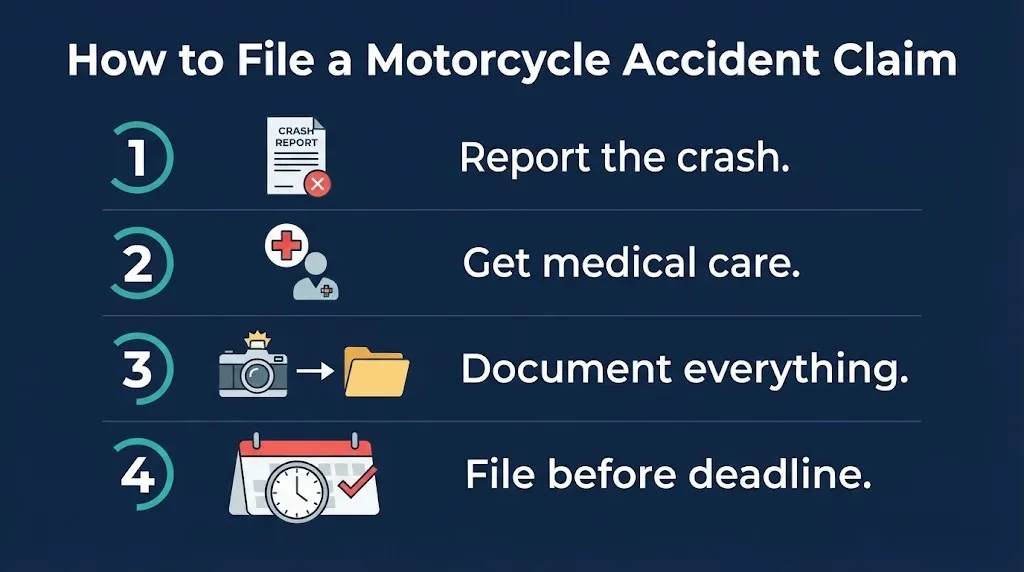
Here are the steps:
- Report the accident to police and your insurance company.
- Seek medical attention immediately, even if you feel fine.
- Document the scene with photos and witness contact information.
- Keep every medical bill, receipt, and pay stub.
- Do not give a recorded statement to the other insurer without legal advice.
- Send a demand letter with your evidence and a settlement amount.
- File a lawsuit before your state’s deadline if negotiations fail.
The insurance company is not on your side. Their job is to pay as little as possible.
Key Takeaway: Compensation depends on proving fault, documenting damages, and respecting your filing deadline.
What Is the Deadline to File a Motorcycle Accident Claim?
The deadline to file a motorcycle accident lawsuit is set by your state’s statute of limitations, usually one to three years from the crash date.
Here is a general guide, not legal advice:
| State Category | Typical Deadline |
|---|---|
| One-year states | Tennessee, Kentucky, Louisiana |
| Two-year states | California, Texas, Georgia |
| Three-year states | New York, Florida, Illinois |
Insurance claims have shorter practical deadlines. Most policies require prompt notice, often within days.
The deadline for a lawsuit is the hard one. Miss it and your claim is gone, no matter how badly you were hurt.
How Do Insurance Companies Calculate Motorcycle Accident Compensation?
Insurance companies calculate compensation by adding your economic damages and applying a multiplier for pain and suffering.
The formula is not public, but here is how it generally works:
| Step | What Happens |
|---|---|
| Add economic damages | Medical bills plus lost wages |
| Apply multiplier | 1.5x to 5x depending on severity |
| Add future damages | Future medical care, lost earning capacity |
| Subtract comparative fault | Reduce by your percentage of fault |
A $50,000 medical bill with a 3x multiplier becomes a $150,000 demand, plus future losses.
Insurers start lower than this. Negotiation is expected.
Key Takeaway: Insurance is the first source of payment, but their initial offer is rarely their best offer.
Reality Check: No one from a “motorcycle accident settlement fund” will call you with free money. Real compensation comes from an insurance claim or a lawsuit you initiate. Anyone charging upfront fees to “process” your accident claim is likely a scam.
What Is the Difference Between an Insurance Claim and a Motorcycle Accident Lawsuit?
An insurance claim is a request for payment from a policy. A lawsuit is a court action against the at-fault party.
Most cases settle through insurance without a lawsuit. Lawsuits happen when insurance is not enough or liability is disputed.
Here is the comparison:
| Factor | Insurance Claim | Lawsuit |
|---|---|---|
| Time | Weeks to months | Months to years |
| Cost | No filing fee | Court costs, attorney fees |
| Outcome | Settlement offer | Judgment or verdict |
| Public record | Usually private | Public court file |
Your lawyer will usually try the insurance route first. Litigation is the backup.
What If the At-Fault Driver Has No Insurance?
If the at-fault driver has no insurance, your own uninsured motorist coverage may pay your claim.
Uninsured motorist coverage, or UM, is required in some states and optional in others. It steps in when the at-fault driver cannot pay.
Here is how coverage works:
| Coverage Type | What It Pays |
|---|---|
| Uninsured motorist | Your damages from an uninsured driver |
| Underinsured motorist | The gap when the other driver’s limits are too low |
| Personal injury protection | Your medical bills regardless of fault, in no-fault states |
| Medical payments | Smaller medical bill coverage, regardless of fault |
Check your own policy after a motorcycle crash. Your coverage may matter more than the other driver’s.
Can You Still Get Compensation If You Were Partially at Fault?
You may still get compensation if you were partially at fault, depending on your state’s comparative fault rules.
Most states use comparative negligence. Your recovery is reduced by your percentage of fault.
Here is the breakdown:
| Rule | States | Effect |
|---|---|---|
| Pure comparative fault | About 13 states | Recover even at 99 percent fault, reduced by your share |
| Modified comparative fault, 50 percent | About 12 states | No recovery if 50 percent or more at fault |
| Modified comparative fault, 51 percent | About 23 states | No recovery if 51 percent or more at fault |
| Contributory negligence | A few states | No recovery if you are even 1 percent at fault |
Insurance adjusters often overstate your fault to reduce the payout. Do not accept their version without checking.
Key Takeaway: Your own insurance coverage and your state’s fault rules can change everything about your claim.
What Are the Most Common Motorcycle Accident Injuries That Affect Compensation?
The most common serious injuries are head trauma, spinal cord damage, fractures, and road rash, all of which increase compensation.
Motorcyclists lack structural protection. A low-speed crash can still cause serious harm.
Here is how injuries affect claim value:
| Injury | Why It Increases Value |
|---|---|
| Traumatic brain injury | Lifetime care, lost earning capacity |
| Spinal cord injury | Permanent disability, wheelchair costs |
| Fractures | Surgery, long recovery, lost work |
| Amputation | Permanent loss, prosthetics, retraining |
| Road rash | Scarring, infection, skin grafts |
The more permanent the injury, the higher the claim value. Document everything with medical records.
How Long Does Motorcycle Accident Compensation Take?
Motorcycle accident compensation takes a few months for simple insurance claims and one to three years for lawsuits.
Here is a general timeline:
| Stage | Timing |
|---|---|
| Insurance claim filed | Within days of crash |
| Medical treatment | Weeks to months |
| Settlement negotiation | 1 to 6 months |
| Lawsuit, if needed | 6 to 18 months |
| Trial and appeal | 1 to 3 years or more |
Settlements usually happen faster than trials. Your patience is part of the process.
What Should You Not Do After a Motorcycle Accident?
Do not apologize, do not sign anything from an insurer, and do not post about the crash on social media.
Here are the mistakes that hurt claims:
| Mistake | Why It Hurts |
|---|---|
| Apologizing at the scene | Can be used as an admission of fault |
| Giving a recorded statement | Used against you later |
| Signing a quick settlement | May waive future claims |
| Posting on social media | Photos and posts can contradict your injury claims |
| Delaying medical care | Creates a gap the insurer will exploit |
Treat your claim like a business matter. Evidence matters more than emotion.
Key Takeaway: What you do in the first 48 hours after a motorcycle crash affects your compensation more than anything later.
What Is the Role of a Motorcycle Accident Lawyer?
A motorcycle accident lawyer investigates the crash, negotiates with insurers, and files a lawsuit if needed.
Most work on contingency, meaning they take a percentage of your recovery, usually 33 to 40 percent.
Here is what a lawyer does:
| Task | Why It Matters |
|---|---|
| Investigate liability | Proves who caused the crash |
| Gather medical evidence | Documents your injuries |
| Calculate damages | Builds the full claim value |
| Negotiate with insurer | Counters lowball offers |
| File and litigate | Takes the case to court if needed |
You are not required to hire a lawyer. But severe injury cases rarely settle fairly without one.
What Happens Next in a Motorcycle Accident Compensation Claim?
- Day 1 to 7: Medical care, accident report, insurance notice.
- Month 1 to 3: Medical treatment, evidence gathering, demand letter.
- Month 3 to 6: Negotiation with insurer, possible settlement.
- Month 6 to 18: Lawsuit if no settlement, discovery, mediation.
- Final: Settlement check or trial verdict, minus attorney fees.
Each case moves at its own pace. Some settle fast. Others take years.
Frequently Asked Questions
What is motorcycle accident compensation?
Motorcycle accident compensation is money you may recover for injuries, lost wages, and pain after a crash.
It comes from insurance or a lawsuit, not a government fund.
How much can I get from a motorcycle accident?
Your compensation depends on injury severity, insurance limits, and fault.
Some cases settle for thousands. Catastrophic injuries can reach millions.
How long do I have to file a motorcycle accident claim?
You generally have one to three years from the crash date, depending on your state.
Insurance notice deadlines are often much shorter.
Can I get compensation if I was not wearing a helmet?
You may still get compensation, but your recovery may be reduced in some states.
Helmet use can affect comparative fault and pain and suffering.
What if the other driver has no insurance?
Your uninsured motorist coverage may pay your claim.
Check your own policy before assuming there is no recovery.
Do I need a lawyer for a motorcycle accident claim?
You are not required to have a lawyer, but severe cases benefit from one.
Most lawyers work on contingency, so you pay only if you win.
How is pain and suffering calculated?
Pain and suffering is often calculated using a multiplier on your economic damages.
The multiplier ranges from 1.5x to 5x depending on severity.
Can I still recover if I was partially at fault?
You may recover in most states under comparative fault rules.
Your recovery is reduced by your percentage of fault.
The single most important thing about motorcycle accident compensation is that it is a private claim, not a public fund.
Report the crash, get medical care, document everything, and know your state’s deadline.
The insurance company is not waiting to pay you. You have to prove your claim and push for what it is worth.