How to Get More Money From a Car Accident Settlement in 2026: The Moves That Actually Move the Number
Quick Answer
- The single biggest documented lever is representation: represented claimants averaged $77,600 versus $17,600 unrepresented, per Insurance Research Council data.
- Never accept the first offer, because 73% of unrepresented claimants take it, and insurers count on that.
- The national average car accident settlement sits around $30,416 in 2026, but injury severity and state swing that number wildly.
Getting more money from a car accident settlement is not about a magic phrase or a clever trick you saw in a video. It is about controlling three things the insurance adjuster cannot control: the completeness of your medical record, the timing of your demand, and whether you have someone across the table who can credibly threaten trial. The adjuster has a computer program and a settlement authority range. You have the facts of your injury. The side that documents better usually wins.
Most people only file an accident claim once every 18 years . That means the adjuster negotiates these claims every single day, and you negotiate one. The information gap is the whole game.
This guide covers the verified strategies that move settlement numbers, the exact mistakes that shrink them, and the timeline you need to follow so you do not settle before you know what your injury is actually worth.
The Facts
| Item | Detail |
|---|---|
| National Average Settlement (2026) | $30,416 |
| Median Settlement (4,188 cases analyzed) | $27,271 |
| Average With Attorney (IRC) | $77,600 |
| Average Without Attorney (IRC) | $17,600 |
| Share of Unrepresented Claimants Who Take First Offer | 73% |
| Typical Contingency Fee | Roughly one-third of recovery |
| Key Timing Rule | Do not settle before Maximum Medical Improvement |
| Biggest Value Driver | Injury severity, documented with objective medical evidence |
Is it really possible to get more money from a car accident settlement?
Yes, and the data proves it. Represented claimants receive an average of $77,600, while unrepresented claimants receive $17,600, according to the Insurance Research Council . That is roughly 340% more before fees and about 226% more after a standard contingency fee. Even after the lawyer takes a cut, you are still looking at more than double the money.
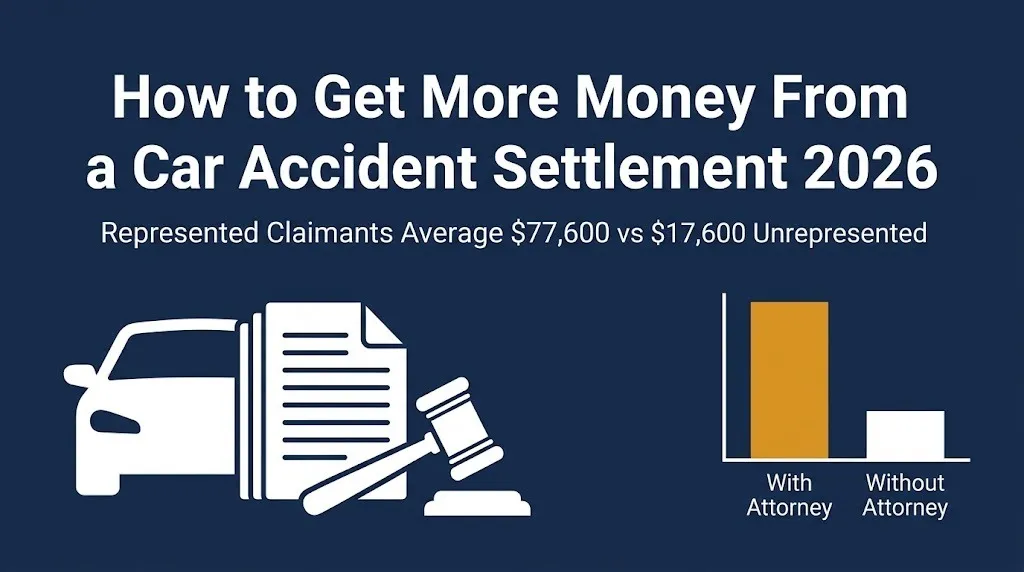
The reason is not that lawyers have secret formulas. It is that lawyers change the adjuster’s incentive. An unrepresented claimant can only ask. A represented claimant can file a lawsuit, request discovery, and put the case in front of a jury. Adjusters reserve their top settlement authority for cases that might actually cost the insurer more in litigation.
The other reason is documentation. A lawyer knows how to package medical records, lost wage proof, and pain-and-suffering evidence into a demand the adjuster has to take seriously. A claimant handling it alone often submits a stack of bills with no narrative, and the adjuster prices that as a low-value file.
Key Takeaway: The documented difference between represented and unrepresented outcomes is roughly $60,000 on average, which is the clearest verified signal that how you handle the claim matters as much as the injury itself.
How much is a car accident settlement actually worth in 2026?
The honest answer is that no single average applies to your case. The national average settlement is $30,416 in 2026 . A separate analysis of 4,188 real cases found a median of $27,271, with the middle 50% of cases falling between $9,327 and $133,125 . That spread is the real story: the average tells you almost nothing about your claim.
Injury severity is the biggest driver. The table below shows verified 2026 ranges by injury type.
| Injury Type | Typical 2026 Range |
|---|---|
| Soft tissue | $2,500 to $50,000 |
| Whiplash | $7,500 to $50,000 |
| Concussion | $20,000 to $150,000 |
| Broken bone or fracture | $30,000 to $300,000 |
| Herniated or bulging disc | $30,000 to $200,000 |
| Traumatic brain injury | $20,000 to $5,000,000+ |
| Spinal cord injury | $500,000 to $20,000,000+ |
| Wrongful death | $500,000 to $15,000,000+ |
Those ranges come from injury-specific analysis of verdicts and settlement data . Location matters nearly as much. The same injury in New York averaged $287,000 while the national average sat at $30,416, a difference of more than nine times .
One more verified multiplier: if you suffered multiple injuries, such as whiplash plus a herniated disc, your settlement typically runs 30% to 50% higher than the average for either injury alone .
Reality Check: No one texts you settlement money, and no legitimate company charges you a fee to “unlock” a higher offer. The only parties who control the number are the adjuster and, if you file suit, the court. Any service promising a specific payout before it sees your medical records is guessing or lying.
How do you negotiate a higher car accident settlement step by step?
You negotiate higher by building a record the adjuster cannot lowball, then presenting it at the right moment with a number that is justified line by line. The sequence below is the standard approach that personal injury attorneys use, and you can follow it whether you hire counsel or not.
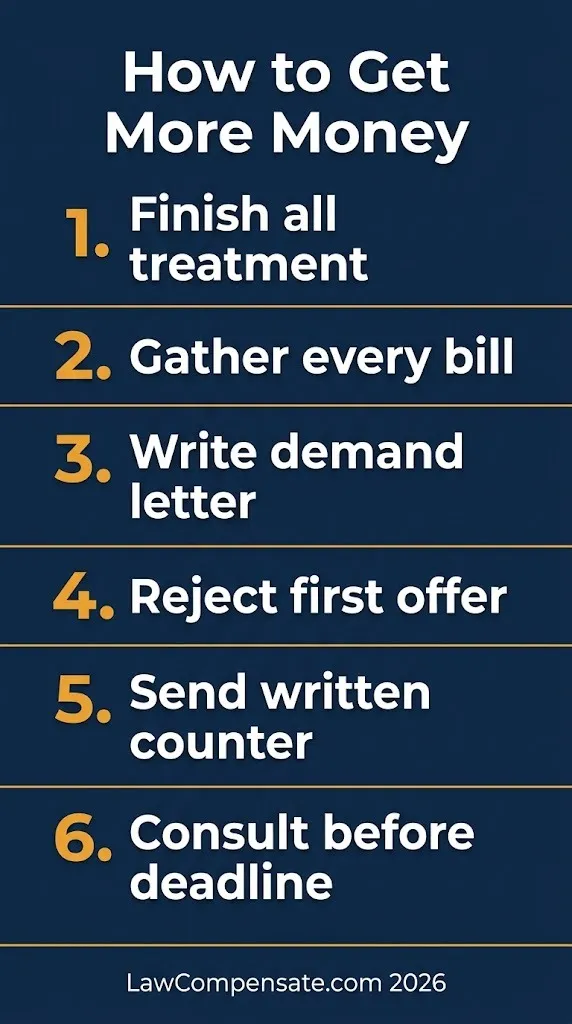
- Get all medical treatment finished before you send a demand. Settling before Maximum Medical Improvement, the point where your doctor says you are as good as you will get, locks in a number before you know your final costs .
- Gather every bill, wage record, and repair estimate. Missing records are the adjuster’s favorite excuse for a low offer .
- Write a demand letter that tells the story and totals the damages. It should include the accident facts, the injuries, the treatment, the lost wages, and a specific dollar demand .
- Ask for more than your target number. A common approach is to start at roughly double your estimated case value to leave room to negotiate .
- Refuse the first offer. Insurers open low by design, and 73% of unrepresented claimants accept that first number .
- Force the adjuster to explain the offer. If they cannot justify the math, the number was arbitrary .
- Send a written counteroffer with evidence attached. New medical records or a doctor’s letter can move the number when words alone will not .
Key Takeaway: The demand letter is not a formality. It is the document that sets the ceiling for the negotiation, and sending it before your treatment is finished caps your recovery before you know what you owe.
Why should you never accept the first settlement offer?
The first offer is a starting point, not a verdict on your case. Insurers open low because they know most unrepresented claimants are stressed about bills and will take quick cash. The Insurance Research Council found that 73% of unrepresented claimants accept the first offer . That statistic is the business model.
Adjusters also work from computer software that prices claims based on inputs like medical bill totals and injury codes. Those programs often miss the personal impact: the lost promotion, the inability to pick up your kids, the sleep you have not gotten since the crash . Your job is to put those facts in front of the adjuster in a form the software cannot ignore.
A low first offer is also useful information. It tells you the adjuster sees weaknesses in your file, whether that is a gap in treatment, a pre-existing condition, or a liability dispute. Ask for the breakdown, find the weakness, and fix it with records before you counter.
What evidence increases a car accident settlement the most?
Objective medical evidence moves the number more than anything you can say. Soft tissue claims rely on your descriptions of pain, and adjusters discount those heavily. Claims with MRI findings, surgical recommendations, or a specialist’s diagnosis carry multipliers toward the higher end of the scale, often 2.5 to 3.5 and up to 4 to 5 for permanent injuries .
| Evidence Type | Why It Moves the Number |
|---|---|
| MRI or CT scan findings | Turns “my back hurts” into a documented condition |
| Specialist treatment records | Shows the injury required more than a general practitioner |
| Surgery or injection records | Signals severity and future medical needs |
| Doctor’s letter on permanence | Supports future pain and suffering and lost earning capacity |
| Wage records and tax returns | Proves lost income instead of estimating it |
| Photos of injuries over time | Documents the recovery course and visible harm |
Lost wage proof is the most commonly underbuilt part of a claim. Pay stubs, tax returns, and a letter from your employer showing missed days turn a vague income claim into a number the adjuster has to include .
How much does hiring a lawyer actually increase your settlement?
Hiring a lawyer increases your average settlement by roughly $60,000 before fees, based on the Insurance Research Council comparison of $77,600 represented versus $17,600 unrepresented . After a standard contingency fee of about one-third, the represented claimant still nets more than double.
The tradeoff is control and time. A lawyer takes a percentage, and the case may take longer because the lawyer will not rush a settlement before treatment finishes. For small claims with minor soft tissue injuries and clear liability, the math can be closer than the averages suggest. For any claim involving surgery, permanent injury, or disputed fault, the representation gap is large enough that going alone is a financial risk.
Contingency means you pay nothing up front. The fee comes out of the recovery, which aligns the lawyer’s incentive with yours: they get paid more if you get paid more. That is not charity, but it is a structure that works in your favor compared to an hourly fee.
What mistakes shrink a car accident settlement?
The most expensive mistake is settling too early, before you know the full extent of your injuries. Once you sign a release, the case is closed forever, even if you need another surgery later . That is like cashing a final paycheck before you know how many hours you worked.
Other verified mistakes that cost money:
- Giving a recorded statement to the other insurer. They are trained to get you to minimize your injuries or admit partial fault.
- Posting about the accident on social media. Adjusters look, and a photo of you at a birthday party can undercut a pain claim.
- Missing the statute of limitations. Most states give you a limited window, often two to three years, to file suit. Miss it and you lose the claim entirely.
- Skipping medical treatment. Gaps in treatment are read as evidence the injury was not serious.
- Accepting a “quick cash” offer before all bills arrive. Medical providers can bill you later, and the settlement may not cover them.
How long does it take to get a higher settlement?
A higher settlement usually takes longer than a fast one. The timeline below reflects the typical sequence, not a promise.
Month 0 to 3: Treatment and documentation. You are building the record the adjuster will price.
Month 3 to 6: Demand letter sent, adjuster responds, negotiation begins.
Month 6 to 12: Counteroffers and evidence exchange. Many cases settle in this window.
Month 12 to 24: If negotiation stalls, a lawsuit is filed and discovery begins.
Beyond 24 months: Trial or a settlement on the courthouse steps. About 95% of cases settle before trial .
The fastest path to more money is almost never the fastest path to any money. Patience while your treatment finishes is the cheapest investment you can make in your own claim.
What happens next in your settlement negotiation
The timeline below covers the stages ahead, based on standard claim practice and verified data.
Now: Finish treatment and gather every bill, wage record, and repair estimate.
Within 30 days of Maximum Medical Improvement: Send the demand letter with a justified number.
Within 30 to 60 days after demand: Expect a low counter. Do not accept it. Ask for the breakdown.
Within 60 to 90 days after demand: Send a written counter with any new evidence attached.
If no agreement: Consult a personal injury attorney before the statute of limitations runs. The consultation is typically free.
Frequently Asked Questions
How much more money can I get from a car accident settlement with a lawyer?
Represented claimants averaged $77,600 versus $17,600 for unrepresented claimants, per Insurance Research Council data. That is roughly $60,000 more before fees, and still more than double after a standard contingency fee.
What is the average car accident settlement in 2026?
The national average is around $30,416 in 2026. The median from a separate analysis of 4,188 cases is $27,271, with the middle 50% of cases ranging from about $9,327 to $133,125.
Should I accept the first settlement offer from the insurance company?
No. Insurers open with low offers by design, and 73% of unrepresented claimants take the first number. Ask for a breakdown, gather more evidence, and make a justified counteroffer.
How do I calculate what my car accident claim is worth?
Start with your economic damages: medical bills, lost wages, and property damage. Then apply a multiplier of roughly 1.5 to 5 based on injury severity for pain and suffering. Severe and permanent injuries justify the higher end of that range.
When should I send a demand letter to the insurance company?
Send it after you reach Maximum Medical Improvement, the point where your doctor says your condition is as good as it will get. Sending too early risks undervaluing the claim because future costs are not yet known.
What evidence increases a car accident settlement the most?
Objective medical evidence: MRI findings, specialist records, surgery records, and a doctor’s letter on permanence. Lost wage proof and photos of injuries over time also move the number.
How long does it take to get a car accident settlement?
Most cases that settle do so within 6 to 12 months, with about 95% resolving before trial. Cases that go to litigation can take 18 to 24 months or longer.
What is the biggest mistake people make in car accident settlements?
Settling before treatment is finished. Once you sign a release, you cannot reopen the claim, even if you discover you need more medical care later.
Your next move
Pull together every medical bill, pay stub, and repair estimate you have, and do not sign anything until your doctor says your treatment is finished. The single most important number to remember is the $77,600 versus $17,600 gap, because it tells you that how you handle the claim changes the outcome as much as the injury itself.