How Long Does a Car Accident Settlement Take in 2026? A Realistic Timeline
Quick Answer
- A simple car accident settlement can take 2 to 4 months if liability is clear and injuries are minor.
- Most injury cases take 6 to 18 months because you must finish medical treatment before settling.
- Cases with disputed fault, severe injuries, or lawsuits can take 2 to 3 years or longer.
You were in a crash. You are hurting. Your car is damaged. The insurance adjuster is calling. And the only question that matters right now is: when will this be over, and when will I get paid.
The honest answer is that car accident settlements take longer than most people expect. The insurance company wants to close fast. That is not the same as closing fairly. The process that protects your payout is the same process that slows it down.
This article explains the verified timeline, what speeds things up, what slows them down, and the one mistake that delays more settlements than any other. The goal is to give you a realistic calendar, not a sales pitch.
The Facts
| Fact | Verified Value |
|---|---|
| Case Type | Car accident personal injury claim |
| Typical Timeline | 6 to 18 months for most injury cases |
| Fastest Settlements | 2 to 4 months for minor, clear-liability claims |
| Lawsuit Timeline | 18 to 36 months or longer if filed |
| Statute of Limitations | 1 to 6 years depending on state law |
| Payment After Signing | 2 to 6 weeks in most cases |
Is a car accident settlement quick?
No. It is rarely quick. The insurance company may offer a fast check, but that check comes with a release. Sign it, and you give up every future claim. That is not speed. That is a trade.
A quick settlement only makes sense if your injuries are minor, your treatment is done, and you know your total losses. If you are still treating, still hurting, or unsure about future medical needs, settling now is a mistake.
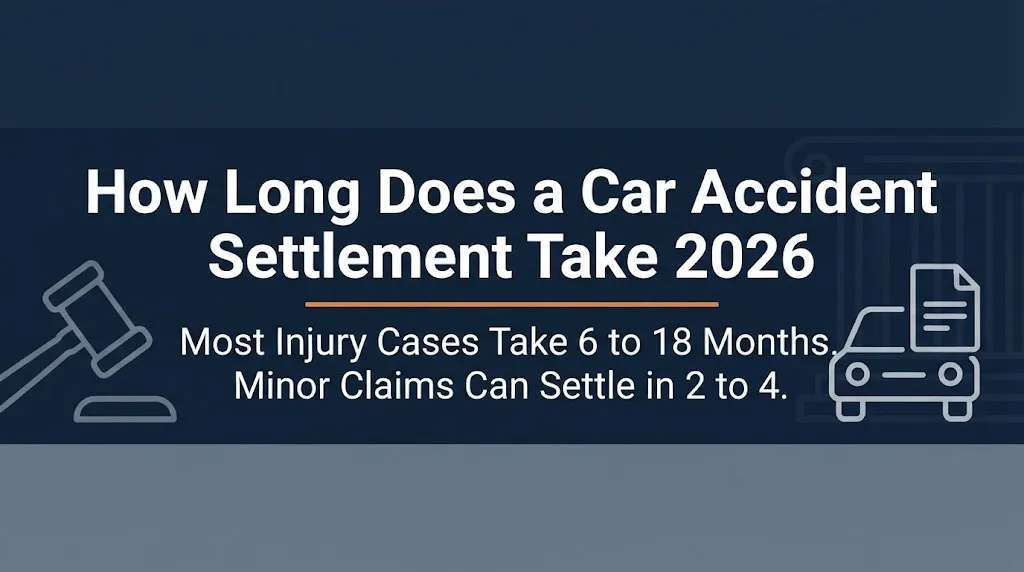
The fastest legitimate settlements happen in cases with clear liability, minor property damage, and soft-tissue injuries that resolve in a few weeks. Those can close in 2 to 4 months. Everything else takes longer.
Think of it like a store return without a receipt. You can rush the process and get store credit, or you can take the time to document everything and get your money back. The slow path pays better.
How long does the average car accident settlement take?
Most injury claims take 6 to 18 months from crash to payment. The timeline depends on three things: how fast you finish medical care, how quickly the insurer accepts liability, and whether a lawsuit is required.
Here is a verified breakdown by case type:
| Case Type | Typical Timeline |
|---|---|
| Minor injury, clear fault | 2 to 4 months |
| Moderate injury, some dispute | 6 to 12 months |
| Serious injury, contested fault | 12 to 24 months |
| Lawsuit filed, trial possible | 18 to 36 months or longer |
The biggest variable is your medical treatment. You should not settle until you reach maximum medical improvement, often called MMI. That is the point where your condition has stabilized and your future needs are known. Settling before MMI leaves money on the table.
How long does it take to get a settlement check after signing?
Once you sign a settlement agreement, the money usually arrives in 2 to 6 weeks. That is the fastest part of the entire process.
The sequence after agreement is mechanical. Your lawyer sends the signed release to the insurance company. The insurer processes the release. The check is issued. Your lawyer deposits it into a trust account. Medical liens and legal fees are paid. You receive the balance.
The delay is usually in the release processing, not the payment itself. Some insurers take 30 days to issue a check after receiving the signed release. Your lawyer can tell you the expected turnaround for your specific insurer.
You will not get the full settlement amount. Your lawyer takes a fee, usually 33% to 40%. Medical providers with liens get paid. The rest is yours.
Key Takeaway: The wait is mostly before the agreement, not after. Once you sign, payment is weeks away.
What slows down a car accident settlement?
The most common delay is incomplete medical treatment. If you are still seeing doctors, the insurer will not have a full picture of your damages. The adjuster cannot value a claim that is still growing.
Disputed liability is the second major delay. If the other driver says you caused the crash, or the insurer says you share fault, the case stalls. The insurance company will not pay until fault is resolved. That may require an investigation, witness statements, or even a lawsuit.
The third delay is a slow insurance company. Some carriers intentionally delay claims. They know financial pressure pushes people to accept less. A delayed claim is a negotiation tactic, not an accident.
Here are the verified delay factors:
- Ongoing medical treatment.
- Disputed liability or shared fault.
- Serious injuries with uncertain future costs.
- Multiple parties or insurance policies involved.
- An unresponsive or slow insurer.
- A lawsuit being filed.
What speeds up a car accident settlement?
The fastest settlements come from strong evidence, clear liability, and finished treatment. When the other driver admits fault and the police report supports it, the insurer has little reason to fight.
Having all your documents ready also helps. Medical records, bills, proof of lost wages, and repair estimates should be organized. The adjuster processes complete claims faster than messy ones.
Here is what moves the timeline:
- Clear liability with the other driver at fault.
- A police report that supports your version.
- Photographs from the scene and your injuries.
- Completed medical treatment with a final report.
- Complete documentation of all lost income.
- A lawyer who negotiates without unnecessary delay.
How long do I have to file a car accident claim?
The legal deadline is your state’s statute of limitations. Most states allow 1 to 6 years to file a personal injury lawsuit. That is not the same as an insurance claim deadline, which is usually much shorter.
You must notify the insurer promptly. Most policies require notice within a reasonable time, often defined as days or weeks, not months. Failing to report the crash can jeopardize your coverage.
The lawsuit deadline varies by state:
| State | Personal Injury Deadline |
|---|---|
| California | 2 years |
| Texas | 2 years |
| New York | 3 years |
| Florida | 2 years |
| Illinois | 2 years |
Do not confuse the lawsuit deadline with the settlement timeline. You can settle within the deadline. You must file before it expires if no settlement is reached.
Key Takeaway: You have years to file a lawsuit but only days to report the crash to your insurer.
When should I settle my car accident case?
Settle when you know your total losses. That means medical treatment is complete or you have reached maximum medical improvement. It means you know whether you need future surgery, physical therapy, or time off work. It means the full cost of the crash is knowable.
Settling before that point is like leaving a store before the total rings up. You do not know the price yet, and the insurer knows it. That is why early offers are low.
A good lawyer will tell you to wait. The insurance company will push you to settle now. The tension is real, but the math is simple. The longer the insurer wants you to settle, the less your case is worth.
Should I accept the first settlement offer?
Almost never. The first offer is a starting point, not a final number. Insurance adjusters are trained to open low. They expect a negotiation.
The first offer usually reflects the insurer’s best-case scenario for its own bottom line. It does not reflect the value of your pain, your future medical needs, or your lost earning capacity.
You can counter. Your lawyer will send a demand letter with evidence of your damages. The insurer will respond. The process may go through several rounds. That negotiation is normal and expected.
Accepting the first offer closes your claim forever. Make sure the number covers everything before you sign.
What if the insurance company denies my claim?
A denial is not the end. It is a shift in strategy. If the insurer denies liability or disputes your injuries, you may need to file a lawsuit. That starts a longer timeline but may be the only path to fair compensation.
Many cases settle after a lawsuit is filed. The insurer sees you are serious, the evidence becomes formal, and the cost of defense rises. Settlement often happens during discovery or mediation, before trial.
A denial can also be based on a policy exclusion or a coverage issue. Your lawyer can determine whether the denial is legitimate or a negotiation tactic. Not every denial means you lose.
Key Takeaway: A denial slows the case down. It does not necessarily end it.
How does a lawsuit change the car accident timeline?
Filing a lawsuit adds 12 to 24 months to the process. The litigation phase includes discovery, depositions, expert reports, and possibly trial. It is slower, more expensive, and more formal.
Here is the lawsuit timeline:
| Stage | Typical Duration |
|---|---|
| Filing the complaint | 1 to 2 months |
| Discovery and depositions | 6 to 12 months |
| Mediation or settlement talks | 3 to 6 months |
| Trial preparation | 3 to 6 months |
| Trial and verdict | 1 to 3 weeks |
Most cases do not go to trial. Roughly 95% of personal injury cases settle before a jury verdict. But the filing itself changes the timeline and often changes the settlement value.
Reality Check
No insurance company will text you a settlement offer out of the blue. No legitimate adjuster asks you to pay a fee to release your money. Settlement checks do not require gift cards, wire transfers, or “processing payments.” If someone asks for money to get your settlement, it is a scam. The real process involves a signed release, an insurer-issued check, and a lawyer who handles the paperwork.
What Happens Next
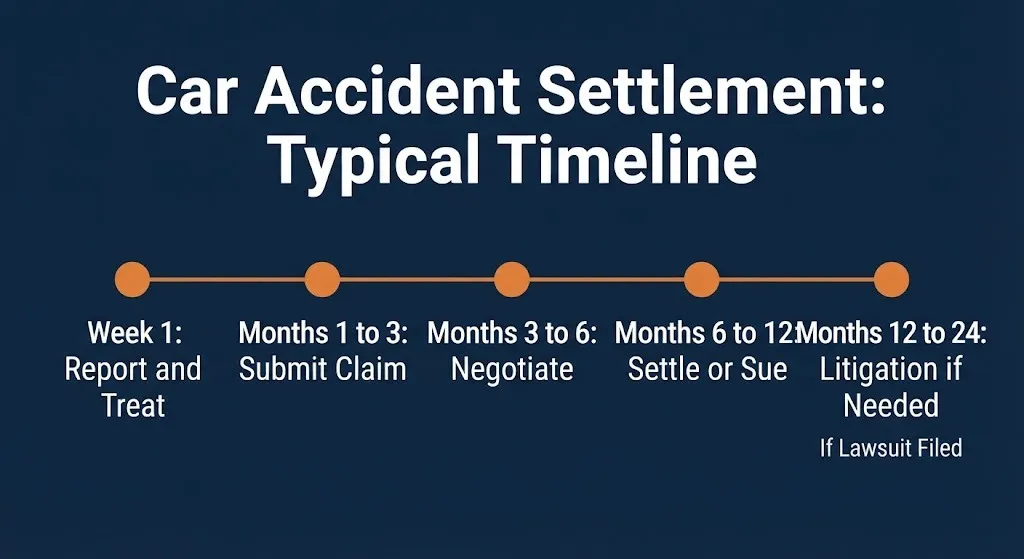
| Timeline | Expected Stage |
|---|---|
| Week 1 | Report the crash, start medical care, document everything |
| Month 1 to 3 | Finish initial treatment, submit claim, receive first offer |
| Month 3 to 6 | Negotiate, counter, and evaluate final medical status |
| Month 6 to 12 | Settlement reached or lawsuit considered |
| Month 12 to 24 | Litigation if no settlement, then likely resolution |
These dates are estimates. Your case moves at the pace of your treatment and the insurer’s cooperation.
Frequently Asked Questions
How long does a car accident settlement take?
Most injury cases take 6 to 18 months from the crash to payment.
Can I get a settlement faster?
Yes, if your injuries are minor, treatment is done, and the other driver accepts fault.
How long after signing do I get paid?
You usually receive your money 2 to 6 weeks after signing the release.
What if the other driver has no insurance?
Your uninsured motorist coverage may respond, or you may need to sue the driver directly.
Do I need a lawyer for a car accident settlement?
Not for minor cases, but any injury claim benefits from legal advice.
What is the average car accident settlement amount?
There is no reliable average. Amounts depend on injuries, fault, and insurance limits.
Can I settle while still treating?
You can, but you should not. Settling before maximum medical improvement undervalues your claim.
What happens if I miss the lawsuit deadline?
Your case is barred. The statute of limitations is strict and rarely extended.
The Only Timeline That Matters Is Yours
You cannot control the insurance company. You cannot control the other driver. You can control when you finish treatment, how you document your losses, and whether you accept a low offer too soon.
The settlement will come. The question is whether it comes fast or fair. In most cases, those two goals are on opposite ends of the calendar.