Rear-End Collision Settlement Examples 2026: Real Payouts and What Drives Them
Quick Answer
- Real 2026 examples: $25,000 for back injuries, $182,500 for a case with $145,913 in medical bills.
- Most settlements land between $10,000 and $100,000 depending on injury severity and documentation.
- The rear driver is presumed at fault in most states, but that presumption can be rebutted.
Rear-end collision settlement examples in 2026 show a wide range. A St. Louis case settled for $25,000 without filing a lawsuit . A Clark County case settled for $182,500 with medical treatment totaling $145,913 .
These numbers aren’t averages. They’re real outcomes from real cases. Your settlement value depends on injury severity, medical documentation, insurance limits, and fault rules in your state.
This guide breaks down actual 2026 settlement examples, explains what drives the numbers, and shows you what to expect if you’re navigating a rear-end claim.
The Facts
| Item | What to Know |
|---|---|
| Typical range | $10,000 to $100,000+ for most cases |
| Soft tissue settlements | $10,000 to $25,000 |
| Disc injury settlements | $80,000 to $150,000 median |
| Permanent harm | $200,000 to $400,000+ |
| Real 2026 example #1 | $25,000 for back injuries, $7,110 special damages |
| Real 2026 example #2 | $182,500 for injuries with $145,913 medical treatment |
| Key factor | Objective medical documentation (MRI, CT) |
What Is the Average Rear-End Collision Settlement in 2026?
There is no published national median for rear-end collision settlements. Confidentiality clauses keep most settlement amounts private.
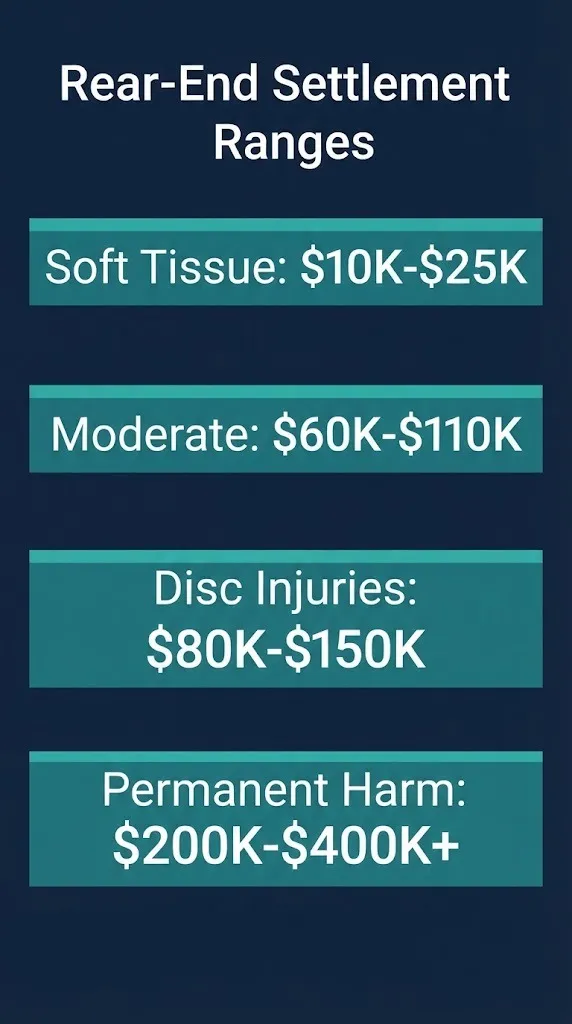
Attorney-reported ranges give the closest picture. FairSettlement.org reports rear-end settlements typically track injury severity :
| Injury Type | Settlement Range |
|---|---|
| Soft tissue / whiplash | $10,000 to $25,000 |
| Moderate injuries | $60,000 to $110,000 |
| Disc injuries (median) | $80,000 to $150,000 |
| Permanent harm | $200,000 to $400,000+ |
The insurance industry’s own benchmark, the average paid bodily injury liability claim across all crash types, was $28,278 in 2024, according to Insurance Information Institute data cited by FairSettlement.org .
One litigation finance estimate puts typical rear-end injury settlements at $15,000 to $30,000 for common cases . The spread is enormous because the facts drive everything.
What Are Real Rear-End Collision Settlement Examples from 2026?
Real 2026 settlement examples show the range clearly. Two cases illustrate how injury documentation and medical bills shape the outcome.
Example 1: $25,000 settlement for back and head injuries
A 35-year-old Arkansas man was rear-ended while stopped in traffic on Manchester Road in St. Louis County in November 2024 . He sought treatment at urgent care and with his primary physician, plus physical therapy. His special damages totaled $7,110.35. His attorney initially demanded $100,000 but settled for $25,000 with State Farm in April 2026, without filing a lawsuit .
Example 2: $182,500 settlement for injuries with substantial medical treatment
A Clark County, Nevada case involved a January 9, 2026 collision where a county driver rear-ended the claimant on Tenaya at Alexander . The claimant’s total medical treatment reached $145,913.48. The settlement was $182,500, approved by the Clark County Board of Commissioners .
Example 3: $250,000 settlement involving underinsured motorist coverage
A 60-year-old St. Louis County woman was rear-ended on Interstate 170 in December 2023 . She received more than 30 chiropractic treatments over four months, with future surgery a possibility. The settlement totaled $250,000: $50,000 from the at-fault driver’s Allstate policy and $200,000 from her own American Family underinsured motorist coverage . The settlement finalized in March 2026.
Key Takeaway: Real 2026 rear-end settlements range from $25,000 for soft-tissue cases to $182,500 and above when medical bills are substantial. The number that matters most is your documented medical treatment.
What Damages Can I Recover in a Rear-End Settlement?
You may recover economic and non-economic damages if the other driver was at fault. The specific categories depend on your losses.
Economic damages cover tangible costs :
- Medical bills (emergency care, surgery, physical therapy)
- Lost wages and lost earning capacity
- Property damage (vehicle repair or replacement)
- Rental car costs
Non-economic damages compensate for intangible losses :
- Pain and suffering
- Emotional distress
- Loss of enjoyment of life
- Anxiety or fear related to driving
Pain and suffering damages have no fixed standard. Jurors are told to use their judgment based on evidence and common sense . That’s why medical documentation matters so much. A clear record of treatment gives the jury something concrete to anchor to.
Property damage and bodily injury claims are often negotiated separately . Your vehicle repair might settle quickly while your injury claim takes months.
Who Is At Fault in a Rear-End Collision?
The rear driver is presumed at fault in most rear-end collisions. That’s the default rule in most states because drivers must maintain a safe following distance.
A rear-end collision with a stopped or stopping vehicle establishes a prima facie case of negligence against the rear driver . The rear driver must then come forward with a nonnegligent explanation to rebut that presumption.
Valid rebuttals may include :
- Mechanical failure (brake failure)
- Sudden, unexplained stop by the vehicle ahead
- Unavoidable skidding on wet pavement
- Other reasonable causes
If the rear driver claims brake failure, they must show the failure was unanticipated and that they exercised reasonable care to keep brakes in working order .
In some cases, the front driver may share fault. If the front driver stopped suddenly without warning, failed to signal, or had defective brake lights, a comparative negligence rule may reduce the rear driver’s liability .
How Does Comparative Negligence Affect My Settlement?
Comparative negligence reduces your recovery by your percentage of fault. If you’re found 20% at fault in a $100,000 claim, you receive $80,000 .
States use different rules:
- Pure comparative fault: You recover damages minus your fault percentage, even if you’re mostly at fault
- Modified comparative fault: You recover only if you’re less at fault than the other driver
- Contributory negligence: You recover nothing if you’re even slightly at fault (few states still use this)
The fault rule in your state directly affects your bottom line. A case worth $100,000 in a pure comparative state might be worth $0 in a contributory negligence state if you share any fault.
What Evidence Do I Need to Prove a Rear-End Collision Claim?
You need evidence that documents the crash, your injuries, and the connection between them. Objective medical evidence carries the most weight.
Essential evidence includes:
- Police report documenting the collision and statements at the scene
- Medical records showing diagnosis, treatment, and prognosis
- Imaging studies (MRI, CT scans) that show objective injury
- Medical bills totaling your treatment costs
- Wage loss documentation from your employer
- Photographs of vehicle damage and the accident scene
The quality of your medical documentation is one of the biggest factors in settlement value . Objective imaging like MRI carries far more weight than subjective pain reports.
A gap in medical treatment gives insurers ammunition to argue your injuries aren’t serious . Consistent, documented care strengthens your claim.
How Long Does a Rear-End Collision Settlement Take?
Minor injury claims typically settle in 3 to 6 months. Moderate injuries requiring ongoing treatment take 6 to 12 months. Serious injuries with surgery may take 12 to 24 months .
Cases that go to litigation can take 1 to 3 years to resolve .
The timeline depends on:
- How long your medical treatment continues
- Whether liability is disputed
- How quickly the insurance company responds
- Whether a lawsuit becomes necessary
You generally shouldn’t settle until you’ve reached maximum medical improvement. Settling too early means giving up the right to pursue more money if symptoms worsen later .
Reality Check: A quick offer right after a crash is often a lowball designed to close your claim before you know the full extent of your injuries. Signing a release ends your right to pursue more money. Get medical care first, then evaluate any offer.
What Happens Next?
Immediately: Get medical attention and document all symptoms, even if you feel fine at first.
Within days: Report the accident to your insurer and gather the police report.
Within weeks: Begin or continue consistent medical treatment to establish a clear record.
3 to 6 months: If treatment is complete, you and your attorney can evaluate a settlement demand.
6 to 24 months: Negotiation or litigation, depending on whether liability and damages are disputed.
Frequently Asked Questions
How much is the average rear-end collision settlement?
There is no national average because settlements are confidential. Typical ranges run from $10,000 to $25,000 for soft tissue injuries and $80,000 to $150,000 for disc injuries.
What is a typical settlement for whiplash from a rear-end collision?
Whiplash settlements typically run $12,000 to $30,000, with a national median near $7,500 according to attorney-reported data.
Can I get a settlement if I didn’t feel hurt at the scene?
Yes. Adrenaline can mask pain for hours or days. Insurance companies may use early statements against you, but medical evidence and expert testimony can overcome that.
Who pays the settlement in a rear-end collision?
The at-fault driver’s liability insurance pays first. If their policy limits are insufficient, your own underinsured motorist coverage may pay the difference.
What if the other driver’s insurance denies my claim?
Denials are common. You can negotiate directly, hire an attorney, or file a lawsuit. An attorney can apply legal pressure the insurance company may respond to.
How long do I have to file a rear-end collision claim?
The statute of limitations varies by state, typically 2 to 3 years from the accident date. Missing the deadline usually bars your claim permanently.
Can I settle a rear-end collision without a lawyer?
Yes, you can negotiate directly with the insurance company. But insurers know unrepresented claimants often accept less than their case is worth.
What if the at-fault driver has no insurance?
Your own uninsured motorist coverage may pay your claim, if you purchased it. Without it, recovery may be difficult unless the driver has personal assets.
Gather your medical records and police report now. If you’re still treating, don’t settle until your doctor says you’ve reached maximum improvement. The most important number in any rear-end case isn’t an average. It’s your documented medical bills plus a fair value for what you’ve been through.