Realistic Settlement Calculator 2026: What Car Accident Claims Actually Pay and Why Online Tools Miss the Mark
Quick Answer:
- Online settlement calculators are real tools, but they provide rough estimates, not guaranteed payout amounts.
- Actual car accident settlements depend on medical costs, lost wages, liability, and insurance limits.
- The most important deadline is your state’s statute of limitations, typically two to three years from the accident date.
If you searched for a realistic settlement calculator after a car accident, you want a number. That is understandable. You have bills, missed work, and an insurance adjuster who is not returning calls.
Here is the honest truth: no online calculator can tell you what your case is worth. The tools that promise precision are guessing. The ones that admit their limits are more useful.
This article explains how settlement calculators work, why their numbers are often wrong, what actually determines a car accident settlement, and how to get a realistic estimate. One verified fact: most car accident settlements fall between ten thousand and fifty thousand dollars, but individual cases vary enormously based on injury severity and insurance coverage.
The Facts
| Tool Type | Online Settlement Calculator |
|---|---|
| Accuracy | Rough estimate only, not a guarantee |
| Key Variables | Medical costs, lost wages, liability, insurance limits |
| Typical Settlement Range | 10,000 to 50,000 dollars for moderate injuries |
| Statute of Limitations | 2 to 3 years, varies by state |
| Best Use | General education, not case valuation |
| Replacement | Personal injury lawyer review, demand letter |
Are online settlement calculators accurate?
Online settlement calculators are not accurate for individual cases. They use generic formulas that cannot account for the specific facts of your accident, your injuries, or your insurance situation.
The typical calculator asks for a few inputs: medical bills, lost wages, pain level, and maybe the state where the accident happened. Then it applies a multiplier to estimate pain and suffering and spits out a number.

That number is based on averages, not on your case. It does not know whether the other driver was clearly at fault or whether fault is disputed. It does not know your insurance policy limits or whether the other driver has any insurance at all.
Insurance companies do not use these calculators. Neither do personal injury lawyers. The actual settlement value of a case is determined through negotiation, medical evidence, and the specific facts of liability and damages.
A calculator might tell you your case is worth thirty thousand dollars. The insurance company might offer five thousand. A jury might award fifty thousand. The calculator did not predict any of that.
Think of a settlement calculator like a home value estimator. It gives you a ballpark based on averages. But no one buys a house based on the estimator. They get an appraisal. Your injury claim deserves the same seriousness.
Key Takeaway: Settlement calculators provide rough averages, not case specific valuations, and neither insurers nor lawyers rely on them.
What factors actually determine a car accident settlement?
A car accident settlement is determined by liability, damages, and insurance coverage. Those three factors matter more than any formula a calculator can apply.
Liability is the question of who caused the accident. If the other driver was clearly at fault, your settlement value is higher. If fault is disputed or you share blame, your value drops. States with comparative fault rules reduce your recovery by your percentage of fault.
Damages include your economic losses and your non economic losses. Economic damages are medical bills, lost wages, and out of pocket costs. Non economic damages are pain, suffering, and reduced quality of life.
Insurance coverage sets the ceiling. You can only recover from the other driver’s policy limits, unless you have underinsured motorist coverage or the other driver has personal assets. A one million dollar injury with a twenty five thousand dollar policy usually settles for policy limits.
Here is the hierarchy of importance:
| Factor | Impact on Settlement |
|---|---|
| Clear liability | High, drives everything |
| Medical documentation | High, proves damages |
| Insurance limits | High, sets the ceiling |
| Injury severity | Medium to high |
| Lost wages | Medium |
| Pain and suffering | Medium, hardest to quantify |
| Property damage | Low to medium |
No calculator can weigh these factors accurately because they require judgment, not arithmetic.
Key Takeaway: Liability, damages, and insurance limits determine your settlement, not a multiplier formula.
How much is the average car accident settlement?
The average car accident settlement in the United States falls between ten thousand and fifty thousand dollars for moderate injury claims. Severe injury cases settle for far more, and minor cases for less.
This range is an industry observation, not a legal standard. No law sets average settlement amounts. The figure comes from insurance industry data and legal profession surveys.
Here is how settlements typically break down by severity:
| Injury Severity | Typical Settlement Range |
|---|---|
| Minor soft tissue | 3,000 to 15,000 dollars |
| Moderate injury | 15,000 to 50,000 dollars |
| Serious injury | 50,000 to 250,000 dollars |
| Severe or permanent injury | 250,000 dollars and up |
| Wrongful death | 500,000 dollars and up |
These ranges assume clear liability and adequate insurance coverage. If liability is disputed or coverage is low, the actual payout can be much lower than the injury severity suggests.
The multiplier method used by many calculators assumes pain and suffering is worth one to five times your economic damages. A case with ten thousand dollars in medical bills might be valued at thirty thousand using a three times multiplier.
That method has no legal basis. Insurance adjusters use it as a starting point, not an ending point. The final number depends on negotiation, not formula.
Key Takeaway: Average settlements range widely by severity, and the multiplier method is a negotiation tool, not a rule.
Can I calculate my own car accident settlement?
You can calculate a rough estimate of your car accident settlement, but you cannot calculate an accurate one. The information you would need is not fully available to you.
A rough estimate starts with your hard numbers. Add up your medical bills. Add your lost wages. Add your out of pocket costs. That is your economic damage total.
Then estimate your pain and suffering. Most people use a multiplier between one and five times economic damages. The multiplier depends on injury severity, recovery time, and permanent effects.
Here is a basic formula:
- Economic damages + pain and suffering estimate = rough settlement range
- Example: 10,000 in medical bills + 20,000 in pain and suffering = 30,000 estimate
That estimate is useful for understanding the ballpark. It is not useful for negotiating with an insurance company.
The missing variables matter. You do not know the other driver’s policy limits. You do not know how the insurance company values your injury. You do not know whether liability is truly clear.
Professional case valuation involves reading medical records, understanding insurance policy language, and knowing what similar cases have settled for in your jurisdiction. That knowledge comes from experience, not from a formula.
Key Takeaway: You can estimate a rough range, but accurate valuation requires information and experience most people do not have.
What do free settlement calculators get wrong?
Free settlement calculators get three big things wrong: they ignore insurance limits, they assume clear liability, and they overstate pain and suffering multipliers.
Insurance limits are the most common oversight. A calculator might tell you your case is worth one hundred thousand dollars. But if the other driver has a twenty five thousand dollar policy and no personal assets, your realistic recovery is twenty five thousand dollars. The calculator never asked about policy limits.
Liability is assumed but rarely simple. The calculator assumes the other driver was one hundred percent at fault. In reality, insurance companies dispute liability constantly. They argue you were speeding, you were distracted, you failed to avoid the accident. Comparative fault can cut your recovery by your percentage of blame.
Pain and suffering multipliers are treated as fixed rules. Many calculators apply a three times multiplier without asking whether your injury is a sprained neck or a spinal fusion. The right multiplier depends on severity, and it is negotiated, not assigned.
Reality Check: A settlement calculator will never ask about insurance policy limits, and policy limits are often the single most important number in your case. Any estimate that ignores them is fiction, not guidance.
What is the most accurate way to estimate a car accident settlement?
The most accurate way to estimate a car accident settlement is to consult a personal injury lawyer who reviews your medical records, insurance coverage, and liability facts. No online tool matches that analysis.
A lawyer’s valuation starts with your actual damages. Medical bills, both paid and outstanding. Lost wages, documented by pay stubs. Future medical care, estimated by doctors. Future lost earnings, if your injury affects your ability to work.
Then the lawyer evaluates liability. Police reports, witness statements, traffic camera footage. Clear liability increases value. Disputed liability decreases it.
Then the lawyer checks insurance coverage. The other driver’s policy limits. Your underinsured motorist coverage. Any umbrella policies. The available coverage often determines the settlement ceiling.
Finally, the lawyer applies judgment based on experience. What have similar cases settled for in your county? What are the local jury tendencies? What is the insurance company’s reputation?
This process takes time and produces a range, not a single number. That range is more realistic than any calculator output.
Key Takeaway: Lawyer review of medical records, liability evidence, and insurance coverage produces the most realistic settlement estimate available.
How do insurance companies calculate settlement offers?
Insurance companies calculate settlement offers using their own internal formulas, but those formulas are designed to minimize payouts, not to match your calculator estimate.
The adjuster starts with a figure called the reserve, an internal estimate of what the claim could cost. The reserve is based on the adjuster’s assessment of liability and damages. Adjusters are trained to set reserves low and adjust upward only when forced.
The first settlement offer is almost always below the reserve. The adjuster expects negotiation. A typical first offer might be twenty five to forty percent below what the company would ultimately pay.
Insurance companies use software that analyzes claims data. The software compares your claim to thousands of similar claims and produces a recommended settlement range. That range is proprietary and not shared with you.
The adjuster also considers the cost of litigation. If your lawyer has a reputation for going to trial, the settlement value increases. If your lawyer never tries cases, the insurance company knows it can lowball.
The negotiation process is not a formula. It is a strategic exchange of information and leverage. The side with better evidence and credible trial threat usually wins.
Key Takeaway: Insurance settlement offers start low and reflect internal reserves, litigation risk, and negotiation strategy, not any public formula.
What should I do instead of relying on a settlement calculator?
Instead of relying on a settlement calculator, you should gather evidence, document damages, and consult a personal injury lawyer. Those steps produce real value, not false precision.
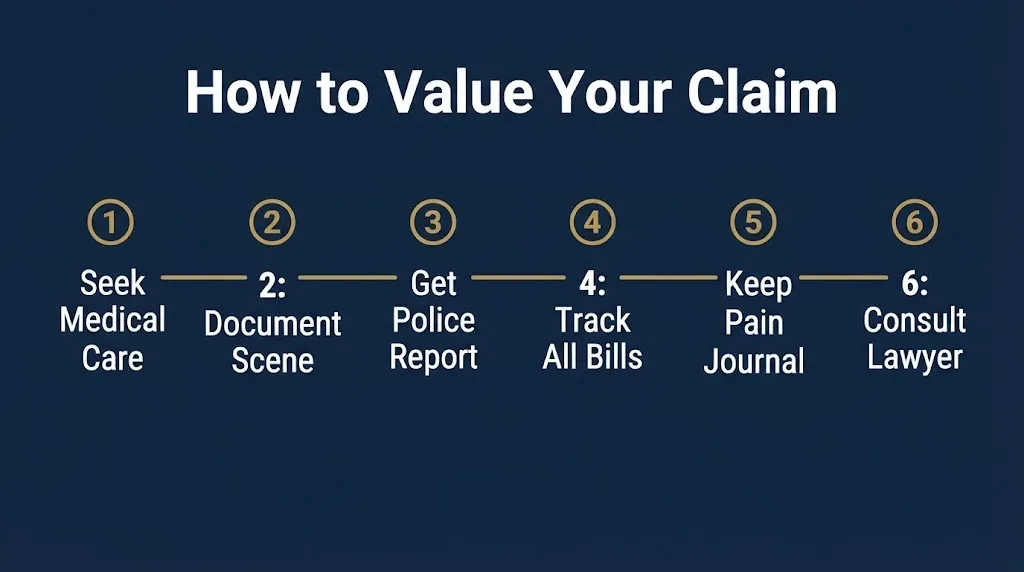
Here is the sequence that works:
- Seek medical treatment immediately and follow your doctor’s instructions.
- Document the accident scene with photos and witness contact information.
- Get a copy of the police report.
- Track all medical bills, receipts, and insurance statements.
- Keep a daily pain journal noting symptoms and limitations.
- Request your medical records after treatment stabilizes.
- Consult a personal injury lawyer for a case evaluation.
- Decide whether to negotiate yourself or retain counsel.
Personal injury lawyers offer free consultations in most cases. The consultation gives you a realistic range based on the lawyer’s experience. You are not obligated to hire the lawyer after the consultation.
If your injuries are minor and liability is clear, you may negotiate successfully without a lawyer. But you will negotiate better if you know the realistic range before you start.
Key Takeaway: Gathering evidence, documenting damages, and consulting a lawyer replaces calculator guesswork with real case evaluation.
How long do I have to file a car accident claim?
You generally have two to three years to file a car accident lawsuit, depending on your state’s statute of limitations. The deadline starts on the accident date.
The statute of limitations is not the same as the insurance claim deadline. Insurance companies expect prompt notice, often within days or weeks of the accident. The lawsuit deadline is the legal backstop if you cannot settle.
Here are the deadlines for several large states:
| State | Statute of Limitations |
|---|---|
| California | 2 years |
| Texas | 2 years |
| Florida | 2 years |
| New York | 3 years |
| Illinois | 2 years |
| Pennsylvania | 2 years |
These are general personal injury deadlines. Specific circumstances can change the deadline. Minors may have extended deadlines. Claims against government entities often have much shorter notice requirements, sometimes as little as six months.
Missing the statute of limitations bars your claim entirely. The insurance company will not pay voluntarily once the deadline passes. The court will dismiss your lawsuit.
Do not wait until the deadline approaches. Evidence disappears, witnesses forget, and insurance companies use delay as a tactic. Acting early preserves your options.
Key Takeaway: Your state’s statute of limitations, typically two to three years, is the hard deadline for filing a lawsuit after a car accident.
What happens after I file a car accident claim?
After you file a car accident claim, the insurance company investigates, evaluates liability, and makes a settlement offer or denies the claim. The process typically takes weeks to months.
The first step is notice. You report the claim to the at fault driver’s insurance company. You provide basic facts about the accident and your injuries.
The insurer assigns an adjuster. The adjuster contacts you, requests documents, and investigates. The investigation includes reviewing the police report, contacting witnesses, and examining vehicle damage.
Then the adjuster evaluates your damages. Medical records, bills, and lost wage documentation are reviewed. The adjuster compares your claim to internal benchmarks.
The first offer usually arrives within thirty to sixty days for simple claims. Complex claims with serious injuries take longer. The insurer may request additional medical records or an independent medical examination.
If you reject the offer, negotiation begins. Your demand letter or your lawyer’s demand letter states your position. The insurer responds. The process continues until settlement or impasse.
If settlement fails, you file a lawsuit. Litigation adds months or years to the timeline but may be necessary if the insurer will not pay fairly.
Key Takeaway: The claim process moves from investigation to offer to negotiation, with litigation as the fallback if settlement fails.
What happens next in car accident settlement practice for 2026?
Car accident settlement practice continues to evolve in 2026, driven by technology, data, and legal changes. Here is what to expect.
- Ongoing 2026: More insurers use artificial intelligence to evaluate claims and make initial offers.
- Expected 2026: Several states consider legislation on minimum liability insurance coverage, which affects settlement ceilings.
- Ongoing: Telemedicine expands documentation options for injury claims, but insurers scrutinize virtual visits more closely.
- Expected late 2026: Court rulings clarify the admissibility of AI generated medical summaries in personal injury cases.
These trends do not change the fundamentals. Liability, damages, and insurance coverage remain the core drivers of settlement value. The technology changes how insurers process claims, not what makes a claim strong.
For accident victims, the practical advice is unchanged. Document everything. Act early. Get a realistic valuation from a professional, not a website. The tools are getting smarter, but they still cannot replace judgment.
The single most important date is your state’s statute of limitations. Calendar it. Do not let it pass.
Frequently Asked Questions
Are online settlement calculators free to use?
Yes, most online settlement calculators are free.
They are marketing tools designed to capture leads for law firms.
How accurate are car accident settlement calculators?
Settlement calculators provide rough estimates that can be off by thousands of dollars.
They cannot account for liability disputes, insurance limits, or case specific facts.
What is the average car accident settlement?
The average settlement for moderate injuries ranges from ten thousand to fifty thousand dollars.
Severe injury cases settle for far more, and minor cases for less.
Can I settle a car accident claim without a lawyer?
Yes, you can settle without a lawyer for minor injuries and clear liability.
Complex cases with serious injuries benefit from legal representation.
How is pain and suffering calculated?
Pain and suffering is often estimated using a multiplier of one to five times economic damages.
The multiplier is negotiated, not fixed by law.
What is the statute of limitations for a car accident claim?
Most states allow two to three years to file a lawsuit after a car accident.
The deadline varies by state and case type.
Will the insurance company pay my medical bills?
The insurance company pays medical bills as part of the final settlement, not typically as they occur.
You may need health insurance or medical payment coverage for ongoing treatment.
What should I do right after a car accident?
Seek medical care, document the scene, get the police report, and contact your insurance company.
Consult a lawyer before accepting any settlement offer.
A realistic settlement calculator is a myth. No online tool can weigh your medical records, the other driver’s policy limits, and the strength of your liability evidence. What you need is real information and professional judgment.
Start by documenting everything. Then get a lawyer’s evaluation. Most personal injury lawyers offer free consultations that give you a realistic range, not a fake precise number. The best time to act is before the insurance company locks you into a lowball offer.