Experian Data Breach Settlement 2026: Claim Status, Payment Amounts, and How to Verify Legitimacy
Quick Answer:
- Experian has faced multiple real data breach lawsuits, but no new 2026 settlement has been approved yet.
- Older Experian settlements paid small amounts, often under twenty dollars per person.
- Always verify settlement emails through the official settlement website, never through links in the message.
If you received an email or text about an Experian data breach settlement, your first question is whether it is real. The answer depends on which settlement the message references.
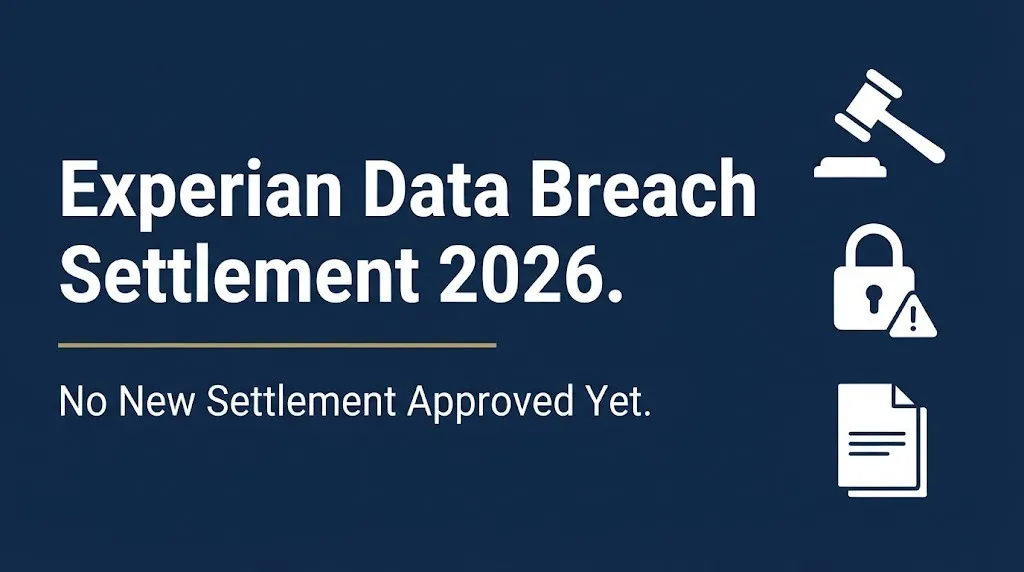
Experian has been involved in several data breach class actions. Some settled years ago. Some are still in litigation. No new Experian data breach settlement has received final approval in 2026 as of March.
This article explains which Experian settlements exist, how much they paid, how to spot a fake settlement notice, and what to do if your data was exposed. One verified fact: the largest Experian related settlement paid consumers less than twenty five dollars each, far below what most people expected.
The Facts
| Case | Multiple Experian data breach class actions |
|---|---|
| Status | No new 2026 settlement approved |
| Fund Size | Varies by case, older settlements paid out |
| Est. Per Person | Historically under 25 dollars |
| Claim Deadline | None active for new claims |
| Administrator | Varies by settled case |
| Proof Needed | Depends on specific settlement terms |
Is the Experian data breach settlement email real or a scam?
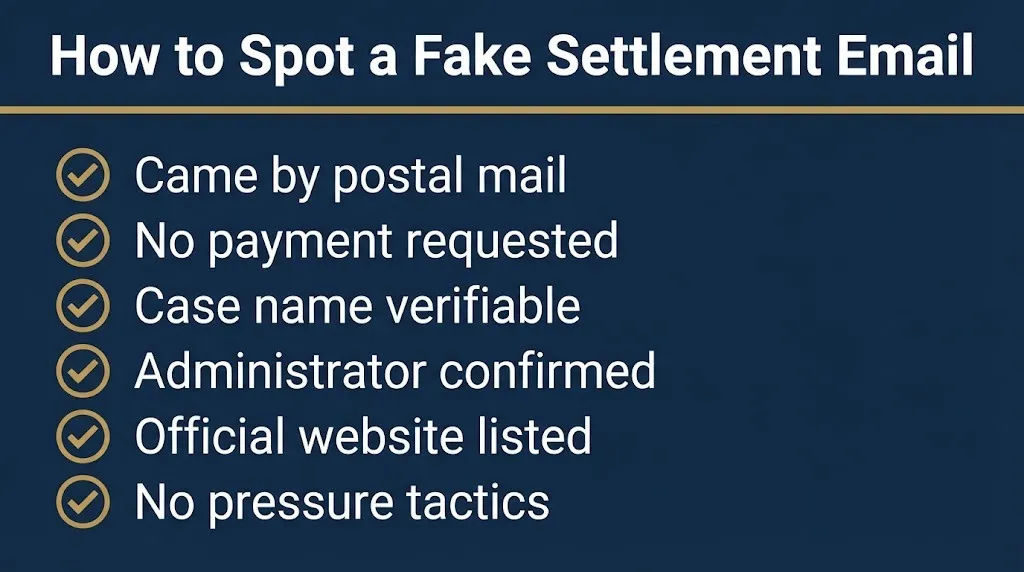
Most Experian data breach settlement emails are scams. Legitimate settlement notices come by postal mail or from the official settlement administrator, and they never ask for money or sensitive information upfront.
Scammers know that data breach settlements are confusing. They send fake emails that look official, complete with case names, docket numbers, and settlement amounts. The email tells you to click a link to claim your payment.
The link leads to a fake website that asks for your Social Security number, bank account details, or a processing fee. Legitimate settlements never charge a fee to file a claim. They never ask for your full Social Security number by email.
Here is how to tell the difference:
| Legitimate Notice | Scam |
|---|---|
| Sent by postal mail | Arrives by unsolicited email or text |
| Directs you to a .gov or court approved site | Links to a lookalike domain |
| Never asks for payment | Demands a processing fee |
| Provides a phone number you can verify | Uses pressure tactics and deadlines |
| References a real case you can look up | Vague about case details |
If you get an email, do not click anything. Open a browser and search for the official settlement website yourself. Type the web address manually.
Key Takeaway: Real settlement notices arrive by mail or from verifiable administrators, never with demands for payment or sensitive data by email.
Is the Equifax breach settlement legit?
The Equifax breach settlement is legit. It was a real class action settlement approved by a federal court in 2019, and payments have been distributed to millions of consumers.
The Equifax settlement is separate from any Experian case. Equifax and Experian are different companies. The Equifax breach, announced in 2017, exposed the personal information of approximately one hundred forty seven million people.
The settlement provided free credit monitoring, cash payments for those who already had credit monitoring, and reimbursement for time and money spent dealing with the breach. The cash payments were small. Most eligible consumers received under twenty five dollars.
The settlement also included a fund for identity theft losses. Consumers who could document actual fraud losses could claim larger amounts, up to twenty thousand dollars. Few consumers qualified for those larger payments.
If you received an Equifax settlement payment, it was legitimate. If you are still getting emails about it in 2026, be skeptical. The claim deadline passed years ago. Late emails are almost always scams.
Key Takeaway: The Equifax settlement was real and paid out, but the claim period is long closed, and current emails referencing it are likely fraudulent.
How much did the Experian data breach settlement pay?
The Experian data breach settlements paid small amounts, typically under twenty five dollars per person for basic claims. Larger payments were available only for documented identity theft losses.
Experian has been involved in several smaller data breach cases. One involved a 2015 breach of Experian’s system that exposed T-Mobile customer data. That settlement provided credit monitoring and limited cash payments.
Another involved Experian’s failure to properly investigate credit report disputes. That case was not a data breach but a consumer protection settlement.
Here is how Experian related settlement payments have broken down historically:
| Settlement Type | Typical Payment |
|---|---|
| Basic data breach claim | 10 to 25 dollars |
| Documented time spent | 20 to 100 dollars, capped |
| Identity theft losses | Up to 20,000 dollars with proof |
| Credit monitoring | 2 to 4 years of free service |
These figures come from past settlements. They do not predict any future Experian settlement. Each case has its own terms, fund size, and payment structure.
The pattern across data breach settlements is consistent. Most consumers get small checks. The people who get meaningful money are those who prove actual financial losses from identity theft.
Reality Check: Data breach settlement checks are small because the harm is hard to prove. If you expected thousands of dollars for the inconvenience of a breach, that is not how these settlements work.
How do I file an Experian data breach settlement claim?
You cannot file an Experian data breach settlement claim right now because no new Experian settlement is open for claims as of March 2026.
The claims process, when a settlement does open, follows a standard pattern. A settlement administrator is appointed. A website goes live. Notices go out by mail and email. You file a claim online or by mail before the deadline.
Here are the steps to prepare for any future settlement:
- Determine whether you were actually affected by the specific breach.
- Gather documentation showing you were a customer or had data exposed.
- Save any notification letters from Experian or the settlement administrator.
- Note the case name and court where the settlement was filed.
- Watch for the official settlement website to launch.
- File your claim before the posted deadline.
- Keep your claim confirmation number.
The documentation requirement matters. For most data breach settlements, you need to show you were affected. That might mean a notice letter, an account number, or a credit report showing the breach impact.
Do not wait until the last day. Settlement websites crash under heavy traffic. Filing early avoids technical problems.
Key Takeaway: No Experian settlement is accepting claims in March 2026, but preparation now makes filing easier if one opens.
What is the current status of Experian data breach litigation?
Experian data breach litigation remains active in multiple courts as of March 2026, but no major new settlement has been finalized this year.
Experian faces ongoing litigation over several alleged data security failures. Some cases are class actions. Others are regulatory enforcement actions brought by state attorneys general or federal agencies.
The most significant recent development is the increased regulatory scrutiny of credit reporting agencies. The Consumer Financial Protection Bureau has signaled continued oversight of data security practices at all three major credit bureaus.
No new settlement fund has been created in 2026. No claim deadline has been set. No administrator has been appointed for a new case.
If you see a headline claiming Experian just settled a massive data breach case, verify it. Check the court docket. Check the official settlement website. Check trusted legal news sources. Headlines often misstate the status of ongoing litigation.
Key Takeaway: Experian faces ongoing litigation and regulatory scrutiny, but no new settlement has been finalized in 2026.
What Experian data breaches have been settled?
Several Experian related data breach cases have been settled over the years. Each settlement covered a specific breach event and a defined class of affected consumers.
The most notable settled cases include:
| Case | Breach Date | Settlement Status |
|---|---|---|
| Experian T-Mobile breach | 2015 | Settled, paid out |
| Experian credit report dispute case | Various | Settled, paid out |
| Court Ventures data breach | 2013 | Settled, paid out |
The T-Mobile breach was the largest. Hackers accessed Experian servers containing T-Mobile customer data, including Social Security numbers and driver’s license information for approximately fifteen million people.
The settlement provided two years of free credit monitoring and cash payments for consumers who already had credit monitoring. The cash payments were modest.
The Court Ventures case involved a subsidiary that sold consumer data to identity thieves. That settlement also provided credit monitoring and limited cash payments.
Each settlement was separate. None created an ongoing claim process. If you missed the deadline for a past settlement, there is no way to file late.
Key Takeaway: Past Experian settlements covered specific breaches with defined claim periods, all of which are now closed.
What should I do if my Experian data was exposed?
If your Experian data was exposed, you should freeze your credit reports, monitor your financial accounts, and watch for official settlement notices. These steps protect you regardless of whether a settlement exists.
A credit freeze is the strongest protection against identity theft. It prevents new creditors from accessing your credit report, which stops most fraudulent account openings. Freezes are free at all three major credit bureaus.
Here is the immediate action list:
- Freeze your credit at Experian, Equifax, and TransUnion.
- Review your credit reports for unfamiliar accounts.
- Set up fraud alerts if you suspect active misuse.
- Monitor bank and credit card statements weekly.
- File an identity theft report if you find fraud.
- Save all breach notification letters for future claims.
- Check the Federal Trade Commission website for breach guidance.
A fraud alert is less restrictive than a freeze. It tells creditors to verify your identity before opening new accounts. You only need to contact one bureau to set an alert that applies to all three.
If you find fraudulent accounts, file an identity theft report with the Federal Trade Commission and your local police department. That report is essential for disputing fraudulent charges and claiming larger settlement amounts.
What are data breach compensation examples?
Data breach compensation examples show a consistent pattern: small payments for most consumers, larger payments only for documented financial losses.
The Equifax settlement is the most cited example. The total settlement fund was up to four hundred twenty five million dollars. Most consumers received under twenty five dollars. The per person payment was small because the class was enormous, approximately one hundred forty seven million people.
Other examples include:
| Case | Class Size | Typical Payment |
|---|---|---|
| Equifax | 147 million | Under 25 dollars |
| Yahoo data breach | 200 million | Free credit monitoring |
| Capital One | 98 million | Under 25 dollars |
| T-Mobile | 76 million | Under 25 dollars |
| Marriott | 300 million | Under 25 dollars |
The pattern is clear. When millions of people are affected, the per person payout shrinks. The settlement fund, however large, gets divided among all eligible claimants.
The people who receive larger payments are those with documented identity theft losses. If someone opened a credit card in your name and ran up charges, you can claim those losses. Most breach victims never experience actual identity theft.
That is why data breach settlements feel disappointing. The legal system compensates actual losses, not the anxiety of possible future harm.
Key Takeaway: Data breach settlements pay small amounts to large classes, with meaningful compensation only for documented identity theft losses.
What happens next in Experian data breach litigation?
Experian data breach litigation will continue through 2026 and beyond, with possible new settlements, regulatory actions, and court rulings. Here is the expected path.
- Ongoing 2026: Existing Experian cases proceed through discovery and pretrial motions.
- Expected 2026: Regulatory agencies may announce enforcement actions or consent orders.
- Possible 2027: New class action settlements could be filed for approval.
- Ongoing: Consumers affected by past breaches should maintain credit freezes.
These dates are estimates based on typical litigation timelines. No specific deadlines are confirmed.
The regulatory environment is tightening. The Consumer Financial Protection Bureau and the Federal Trade Commission have both signaled interest in credit reporting agency data security. New enforcement actions could come at any time.
For consumers, the practical advice is unchanged. Freeze your credit. Monitor your accounts. Watch for official notices. Do not fall for settlement scams that arrive by email or text.
The next legitimate settlement will announce itself through official channels, not through unsolicited messages.
Frequently Asked Questions
Is the Experian data breach settlement real?
There is no new Experian data breach settlement in 2026.
Past Experian settlements were real and paid out, but their claim periods are closed.
How do I know if a settlement email is legitimate?
Legitimate settlement notices arrive by postal mail or from a verifiable administrator.
Emails with links and payment demands are almost always scams.
How much did the Equifax settlement pay?
The Equifax settlement paid most consumers under twenty five dollars.
Larger payments were available only for documented identity theft losses.
Can I still file a claim for the Equifax settlement?
No, the Equifax settlement claim deadline passed years ago.
Emails claiming you can still file are fraudulent.
What should I do if I was affected by a data breach?
Freeze your credit, monitor your accounts, and save all breach notices.
These steps protect you regardless of any settlement.
How are data breach settlement amounts calculated?
Settlement amounts depend on the fund size divided by the number of valid claims.
Large classes mean small per person payments.
Will there be a new Experian settlement in 2026?
No new settlement has been announced as of March 2026.
Ongoing litigation could produce one later, but nothing is confirmed.
Do I need a lawyer for a data breach settlement?
No, data breach settlement claims are free to file without a lawyer.
Third party services charging fees are unnecessary.
The Experian data breach settlement situation in 2026 is quiet. No new settlement has been approved. No claim form exists. No deadline is approaching.
What you should do now is protect yourself. Freeze your credit. Monitor your accounts. Save your breach notices. If a legitimate settlement is announced, it will come through official channels, not through an unsolicited email asking you to click a link.