Nintendo Palworld Lawsuit 2026: Patent Infringement Claims, Latest Updates, and What It Means
Quick Answer
- Nintendo is suing Pocketpair in Japan over patents related to game capture mechanics, not over character designs or copyright.
- No settlement or payout exists. This is a corporate patent fight, not a consumer class action.
- The outcome may affect Palworld’s availability or features, but no money is available for consumers to claim.
Nintendo filed a patent infringement lawsuit against Pocketpair, the Tokyo-based studio behind the surprise hit Palworld. The case landed in the Tokyo District Court in late 2024 and has been grinding through Japan’s civil litigation process ever since. Nintendo seeks an injunction against the game and monetary damages. Pocketpair calls the patents invalid or not infringed. That is the fight in one sentence.
This is not a class action. It is not a consumer settlement. You cannot file a claim and you will not get a check. But if you play Palworld, care about gaming industry precedent, or just want to understand what is actually at stake, this article covers every verified detail. One overlooked fact: the patents Nintendo is asserting were filed after Palworld launched, a timeline that makes this case far more legally complex than most headlines suggest.
The Facts
| Case | Nintendo Co., Ltd. et al. v. Pocketpair, Inc. |
| Status | Active litigation in Tokyo District Court, no settlement |
| Fund Size | No settlement fund exists |
| Est. Per Person | Not applicable; no consumer claims |
| Claim Deadline | Not applicable; no consumer claims process |
| Administrator | Not applicable |
| Proof Needed | Not applicable |
Is the Nintendo Palworld Lawsuit Real?
Yes, the lawsuit is real. Nintendo and The Pokemon Company filed a joint patent infringement suit against Pocketpair in the Tokyo District Court on September 18, 2024. The case is not a hoax, not a rumor, and not a PR stunt.
Nintendo issued a public statement on its corporate website the same day. The company said Palworld infringes multiple patent rights held by Nintendo and The Pokemon Company. Pocketpair responded with its own public statement confirming it had received the complaint and would defend itself.
The lawsuit shocked the gaming world because most people expected a copyright claim over Palworld’s creature designs, which some players called similar to Pokemon. Nintendo did not sue over character designs. It sued over patents. That distinction is the single most misunderstood fact about the case. The court will decide whether Pocketpair’s game mechanics, not its art, crossed a legal line.
The case is being heard in Japan under Japanese patent law. That matters because Japanese patent litigation works differently than U.S. litigation. Japanese courts have a reputation for being faster and more patent-holder-friendly than U.S. courts, though the timeline is still measured in years.
Key Takeaway: The lawsuit is verified and active. It is a patent fight, not a copyright or trademark dispute. The court is in Japan, and Japanese law controls the outcome.
What Is the Palworld Nintendo Lawsuit About?
The lawsuit claims Palworld infringes multiple patents held by Nintendo and The Pokemon Company. These patents cover specific game mechanics related to capturing, riding, and interacting with creatures in a 3D open-world environment.
Nintendo has not publicly listed every patent number it is asserting. Based on Japanese patent office records and statements from both sides, the core patents appear to involve the mechanics of throwing an item to capture a creature, riding creatures across terrain, and the visual interface elements associated with these actions.
This is not a case about Palworld looking like Pokemon. The monster designs, while they sparked online debate, are not part of the complaint. Nintendo chose patents because patents are easier to enforce than copyright in some ways. A patent gives its holder an exclusive right to an invention, regardless of whether the infringer copied anything intentionally. Independent creation is not a defense to patent infringement the way it can be for copyright.
The timing of Nintendo’s patents is awkward for the company. Several of the patents asserted were applied for in Japan well after Palworld was first publicly shown in 2021 and even after it launched in early access in January 2024. Some legal experts point out that Japanese patent law allows for “divisional applications” that claim priority back to earlier filings. Nintendo argues its patents trace back to earlier Pokemon game mechanics. Pocketpair calls them after-the-fact attempts to monopolize game design concepts that have existed for years.
What Patents Did Nintendo File in the Palworld Case?
Nintendo is asserting patents related to creature-capture mechanics in a virtual world. The patents were filed with the Japan Patent Office and cover specific gameplay systems.
The key patents described in court filings and Japanese media reports include a patent for a capture mechanic where a player aims and throws an item (a ball or similar object) at a field character to capture it, a patent for riding and controlling a captured creature across open terrain, and a patent for a targeting interface that shifts between combat and capture modes.
The patent numbers have been cited in Japanese news outlets but are not centrally listed in one English-language source. The Japan Patent Office database confirms applications and grants in Nintendo’s name for mechanics matching the descriptions in the lawsuit. These patents are divisional filings that claim priority from earlier Pokemon game patents dating back to titles like Pokemon Legends: Arceus.
Divisional patents are a normal part of patent strategy in Japan. A company files a broad parent patent, then later files narrower “divisionals” that drill into specific mechanics. The later filing gets the priority date of the original parent, not its own filing date. Nintendo is relying on this priority chain to argue its Palworld-related patents were “invented” before Palworld existed. Pocketpair argues the divisionals are impermissibly broad and cover concepts Nintendo did not actually invent.
Who Are the Parties in the Nintendo Palworld Lawsuit?
The plaintiffs are Nintendo Co., Ltd. and The Pokemon Company. Nintendo is the console maker and game publisher headquartered in Kyoto, Japan. The Pokemon Company manages the Pokemon brand and handles licensing, marketing, and legal enforcement of the Pokemon intellectual property. Both are Japanese entities suing in Japanese court.
The defendant is Pocketpair, Inc., a small game studio also based in Tokyo. Pocketpair had fewer than 50 employees when Palworld launched in January 2024. The game became an instant global phenomenon, selling over 25 million copies on Steam and Xbox within months. That success made Pocketpair a target.
The size mismatch is extreme. Nintendo is one of the most litigious and well-resourced companies in the entertainment industry, with a legal department that has crushed emulators, fan games, and alleged IP infringers for decades. Pocketpair is an indie studio whose biggest prior game, Craftopia, sold modestly. The legal fees alone could threaten Pocketpair’s existence even if it wins the case.
Pocketpair has received public support from parts of the gaming community and, reportedly, from some industry allies. In July 2024, Sony Music Entertainment Japan and Aniplex announced a joint venture with Pocketpair to expand Palworld into merchandise and media. That corporate backing may help Pocketpair fund its defense, though the lawsuit is against the studio itself, not Sony.
What Damages Is Nintendo Seeking from Pocketpair?
Nintendo is seeking an injunction to stop Palworld’s sale and distribution in Japan, plus monetary damages in an unconfirmed amount.
The injunction is the bigger threat. If the Tokyo District Court grants it, Pocketpair could be forced to remove Palworld from storefronts, block downloads, or disable the allegedly infringing mechanics. An injunction in Japan would not automatically apply worldwide, but it would set a precedent other courts could follow.
The monetary damages Nintendo seeks have not been publicly disclosed in yen or dollars. Nintendo asked the court to calculate damages based on Pocketpair’s profits attributable to the infringing features. Palworld generated hundreds of millions of dollars in revenue. Even a modest royalty rate applied to that base could produce a damages figure in the tens of millions or higher.
Pocketpair has stated publicly that it intends to fight both the injunction and the damages. No settlement negotiations have been announced. No damages award has been ordered.
Reality Check: This is a company-versus-company dispute. There is no settlement fund for consumers. There is no claims process. If you see a website offering “Palworld lawsuit settlement money,” it is a scam. The only people who may see money from this case are Nintendo shareholders, if Nintendo wins, or Pocketpair, if it prevails and recovers legal fees.
What Is the Current Status of the Nintendo Palworld Lawsuit?
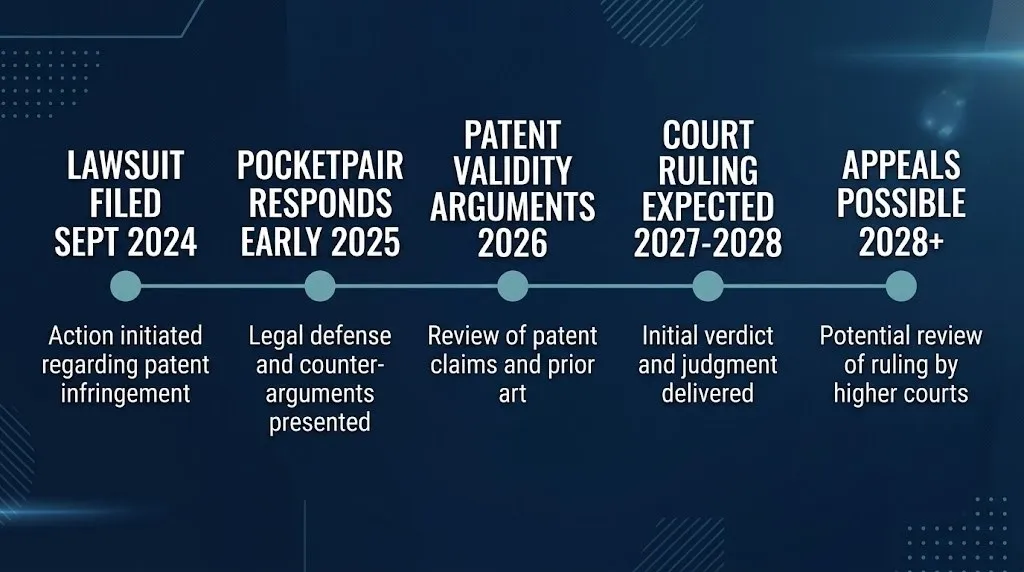
The lawsuit is in active litigation. Pocketpair filed its initial response to Nintendo’s complaint in early 2025. The Tokyo District Court is hearing arguments on patent validity, infringement, and damages.
The case is moving through Japan’s civil procedure system. This typically involves several rounds of written briefs, followed by oral hearings, followed by a court-led settlement discussion. Japanese judges often push parties toward settlement. But neither side has signaled interest.
Pocketpair’s defense strategy includes challenging the validity of Nintendo’s patents. If the court finds the patents invalid, the infringement claim collapses. Pocketpair is also arguing that its mechanics are different enough that no infringement occurred. A third argument is that the patents cover abstract game design concepts that should not have been granted in the first place.
Discovery in Japan is narrower than in the U.S. There are no massive document dumps or depositions. The court controls what evidence is produced. This tends to move cases faster, but it means less of the internal evidence becomes public.
No trial date has been set. No summary judgment motion has been reported. The case remains in the pretrial phase.
Key Takeaway: The case is in pretrial proceedings in Tokyo. No trial date exists. Both sides are filing briefs. A resolution is likely a year or more away.
How Has Pocketpair Responded to the Lawsuit?
Pocketpair has denied all infringement claims and called the patents overly broad. The company issued a public statement shortly after Nintendo filed suit.
The statement, published on Pocketpair’s website and social media, said the company would defend itself while continuing to develop and support Palworld. It apologized to fans for the concern the lawsuit caused. It also said it would not comment further on litigation strategy, a standard move to avoid giving Nintendo free information.
Behind the scenes, Pocketpair retained a Japanese patent litigation firm. The company has not identified the firm by name, but Tokyo-based IP lawyers familiar with the case have spoken to media on background. Their consensus: Pocketpair has a legitimate defense, but the resources gap is severe.
Pocketpair has not countersued. No antitrust claim, no unfair competition claim, no declaratory judgment action in another country. The company appears to be focusing all its resources on defense.
The studio has also continued updating Palworld during the litigation. Content patches, bug fixes, and new features have rolled out. This signals to the court and the public that Pocketpair does not believe the lawsuit will shut it down. It also keeps revenue flowing, which is essential when you are fighting one of the richest companies in gaming.
Will Palworld Be Shut Down Because of the Lawsuit?
An injunction is possible, but it is not guaranteed. No court has ordered Palworld removed from sale as of July 2026.
The Tokyo District Court has the power to issue a preliminary injunction before a final judgment. Nintendo likely asked for one. If the court has not granted it by now, that may suggest the judge views the patent validity question as too complex for a quick decision. That is modestly good news for Pocketpair.
Even if a Japanese injunction issues, Palworld would remain available in other countries unless courts there enforce the Japanese ruling or Nintendo files new cases. Nintendo has not sued Pocketpair in the United States, Europe, or elsewhere. A Japanese-only injunction would block sales in Japan, which matters, but the game’s largest markets are in North America and China.
Pocketpair could also remove or modify the challenged mechanics to avoid the injunction. Game patches can change capture interfaces, riding systems, or targeting modes. If the court identifies specific infringing code, Pocketpair can alter it. That would be a blow to the game’s design, but not a death sentence.
Key Takeaway: No shutdown order exists. A Japanese-only injunction is a risk, not a certainty. Pocketpair could patch around it. International sales are not currently threatened.
How Does Patent Law Apply to Video Game Mechanics?
Patent law protects inventions: new, useful, and non-obvious processes, machines, or compositions of matter. In video games, that means the underlying systems, not the artistic expression.
Game mechanics have been patented for decades. Sega patented a mechanic in Crazy Taxi. Namco patented playing a minigame during a loading screen. Nintendo itself holds patents on everything from controller shapes to menu navigation systems. The Palworld case is unusual because of the timing and the specific mechanics involved, not because patenting game concepts is new.
A patent gives its holder the right to exclude others from making, using, or selling the invention for 20 years from the filing date. Infringement does not require proof of copying. If Palworld’s mechanics fall within the scope of Nintendo’s patent claims, Pocketpair infringes even if it invented them independently. That is the power and the danger of patents.
Pocketpair’s best defense is invalidity. A patent is invalid if the invention was obvious, not new, or not properly described. If Pocketpair can show that capture mechanics existed in games before Nintendo’s priority date, the patents may fall. Games like Ark: Survival Evolved, Digimon World, and even earlier Pokemon titles themselves could serve as prior art.
The legal question is technical and narrow. It is not “did Palworld copy Pokemon.” It is “does Palworld’s throw-to-capture system fall within the specific claims of Nintendo’s divisional patent, and is that patent valid.”
What Does This Lawsuit Mean for the Gaming Industry?
The case matters because it tests the boundaries of patent enforcement in game design. If Nintendo wins, it could embolden large studios to patent common mechanics and sue smaller competitors who use similar systems.
Many game mechanics are widespread. Targeting, capturing, riding, crafting, and building appear in dozens of games. If narrow divisional patents can be asserted against those mechanics years after they became industry-standard, every indie developer who uses a throw-to-capture system is at risk.
If Pocketpair wins, it could discourage patent trolling in gaming and reinforce that game mechanics are largely unprotectable unless they are truly novel. A Pocketpair victory would not abolish game patents, but it would make them harder to enforce.
The case also highlights a cultural tension in game development. Nintendo built its empire on iterating and refining ideas that existed before. Jumping, shooting, puzzle-solving, and exploration were not invented by Nintendo. The Palworld case raises the question of whether the company that benefited from unpatented design freedom for decades should be allowed to lock down mechanics now that it is the incumbent.
Developers are watching. Some studios have reportedly audited their own capture and mount-riding systems to assess legal exposure. A handful of games with creature-capture mechanics have quietly altered their interfaces since the lawsuit was filed, though none have publicly admitted that the Nintendo case was the reason.
What Happens Next in the Nintendo Palworld Lawsuit?
Here is the expected trajectory based on Japanese civil procedure and the current posture of the case.
- Ongoing through late 2026: Written briefs and oral arguments continue. Both sides present evidence on patent validity and infringement.
- Late 2026 to early 2027: The Tokyo District Court may issue a preliminary ruling on patent validity. If patents are found invalid, the case ends quickly in Pocketpair’s favor.
- 2027: If the patents survive, the court evaluates infringement. A settlement push from the judge becomes more likely at this stage.
- Late 2027 to 2028: A trial verdict or formal settlement agreement. Appeals could extend the timeline by another one to two years.
These dates are estimates. Japanese patent cases sometimes resolve in under two years. Complex cases with high stakes can take longer. The court’s docket, the number of patents at issue, and each side’s willingness to settle all affect the pace.
Frequently Asked Questions
Can I get money from the Nintendo Palworld lawsuit?
No. This is a corporate patent dispute.
There is no class action, no settlement fund, and no claims process for consumers.
Will Palworld be taken off Steam?
Not currently. No court has ordered Palworld removed from any storefront.
A Japanese injunction is possible but would not automatically apply to international platforms.
What patents did Nintendo sue over?
Patents related to throwing an item to capture a creature and riding captured creatures.
The exact patent numbers have been cited in Japanese court filings and media.
Did Nintendo sue over Palworld’s Pokemon-like designs?
No. The lawsuit is about patents, not copyright or character designs.
Palworld’s creature appearances are not part of the legal complaint.
When will the lawsuit be resolved?
Earliest resolution is late 2027, more likely 2028 or later.
Japanese patent cases take years, and appeals can extend the timeline.
Can Pocketpair afford to fight Nintendo?
Pocketpair has Palworld revenue and a partnership with Sony Music and Aniplex.
The resources gap is still severe. Nintendo’s legal budget dwarfs most game studios.
What happens if Nintendo wins?
Pocketpair may have to pay damages and alter or remove the infringing mechanics.
A Japanese injunction could block sales in Japan. The game would likely survive in modified form.
The Nintendo Palworld lawsuit is a patent fight, not a consumer case. There is no claim to file, no settlement to join, and no check to wait for. The outcome matters because it could change what game mechanics developers feel safe using, and because it might affect Palworld’s features or availability in Japan. For everyone else, the case is a spectator event: a small studio that made a monster hit being challenged by the biggest name in monster games.
The next milestone to watch is a ruling on patent validity. If the Tokyo District Court finds Nintendo’s patents invalid, the case collapses. If the patents stand, the settlement pressure on Pocketpair rises sharply. That ruling could come within the next 12 months. Everything else flows from there.