Depo Provera Lawsuit 2026: Meningioma Claims, Settlement Status, and How to Join
Quick Answer
- Multiple lawsuits claim Depo Provera use led to meningioma brain tumors, and the manufacturer failed to warn patients.
- No settlement exists yet. Payout amounts and a claim deadline are not set. These are active injury lawsuits, not a settled class action.
- If you used the shot and were diagnosed with a meningioma, you may still have time to file your own case.
If you or someone you know used the Depo Provera contraceptive injection and later received a meningioma diagnosis, you have probably seen headlines about lawsuits against Pfizer. The core allegation is that long-term use of the drug significantly raises the risk of developing these typically non-cancerous brain tumors, and that the manufacturer knew or should have known about the risk long before updating the warning label. These are individual personal injury claims, not a single class action, which changes how you approach them.
This article covers the current status of the Depo Provera litigation, what the science says about the risk, who may qualify to file a lawsuit, what compensation might look like, and how the legal process is expected to unfold. A critical detail many people miss: time to file is limited by state law statutes of limitations, and waiting for a global settlement that may never come could cost you the right to seek compensation entirely.
The Facts
| Case | In re Depo-Provera (Medroxyprogesterone Acetate) Products Liability Litigation, MDL No. 3140 |
| Status | Active litigation in MDL, no global settlement |
| Fund Size | No settlement fund exists |
| Est. Per Person | Not yet determined, depends on individual case values |
| Claim Deadline | No deadline for a settlement. Statute of limitations deadlines apply to filing a lawsuit |
| Administrator | No settlement administrator appointed |
| Proof Needed | Medical records confirming Depo Provera use and meningioma diagnosis |
Is the Depo Provera Lawsuit Legitimate?
Yes, the Depo Provera litigation is real and ongoing. It is not a scam. As of 2026, hundreds of product liability lawsuits have been consolidated into a multidistrict litigation in the U.S. District Court for the Southern District of California.
These lawsuits are filed by women who used the contraceptive injection and were later diagnosed with meningioma, a type of tumor that forms on the membranes surrounding the brain and spinal cord. The lawsuits claim Pfizer and other defendants knew about the elevated tumor risk but did not adequately warn patients or doctors.
The litigation is not a class action where you automatically get a check if a settlement is reached. It is an MDL, which groups similar individual cases for pretrial efficiency. Each plaintiff keeps her own case. If you want compensation, you must file your own lawsuit through a lawyer. No settlement website exists to join. No administrator is collecting claims. Anyone telling you to “sign up here” for a class action payout is misleading you.
The legal and medical documents behind these claims cite epidemiological studies, including a large 2024 study published in The BMJ, which found that prolonged Depo Provera use was associated with a significantly increased risk of intracranial meningioma. That study became a central piece of evidence driving new filings.
Key Takeaway: The litigation is legitimate and active in federal court. It is individual lawsuits, not a class action. You need a lawyer to file a claim. There is no settlement website to sign up on.
What Is the Depo Provera Cancer Lawsuit About?
The lawsuits accuse Pfizer and other manufacturers of failing to warn that Depo Provera use increases the risk of developing meningioma brain tumors. The active ingredient is medroxyprogesterone acetate, a synthetic form of the hormone progestin.
The core legal claim is failure to warn. Plaintiffs argue the company knew, or should have known through available data, that the drug carried a heightened tumor risk, yet the U.S. warning label did not reflect this adequately until recently. This allowed doctors to prescribe it for years without informing patients that the risk existed.
Meningiomas are usually benign, meaning they are not cancerous. But “benign” can be misleading. These tumors grow inside the skull, pressing on the brain. They can cause severe headaches, vision loss, seizures, hearing loss, memory problems, and personality changes. Treatment often involves brain surgery, radiation, or both. Some patients suffer permanent neurological damage even after the tumor is removed.
The litigation does not claim the shot causes malignant cancer. It claims it causes meningiomas that can be life-altering and require major surgery. The difference matters. Some headlines say “cancer lawsuit,” but the medical reality is more specific. The tumor is typically non-malignant. The harm it causes is still devastating.
Does Depo Provera Cause Meningiomas?
Scientific evidence shows a strong association between long-term Depo Provera use and an increased risk of meningioma. Correlation is not legal causation, but the epidemiological data is significant enough to support the lawsuits.
A landmark study published in The BMJ in March 2024 looked at over 18,000 French women who had meningioma surgery and compared their contraceptive history to a control group. It found that women who used Depo Provera for more than one year had a 5.6-fold increased risk of developing a meningioma requiring surgery. That is a striking number in epidemiology.
The mechanism is believed to involve the high dose of progestin in the injection. Meningiomas often have progesterone receptors on their surface. When exposed to synthetic progestins like medroxyprogesterone acetate, these tumors can grow. This biological pathway makes the epidemiological findings plausible.
European regulators acted on this data earlier than U.S. regulators. The European Medicines Agency required label updates and restricted use in some countries years before the U.S. label reflected a clear meningioma warning. That regulatory gap is a central piece of the failure-to-warn argument in the lawsuits.
Not every woman who used the shot will develop a meningioma. The absolute risk remains small. But the relative risk increase is what the litigation focuses on: patients were not told the shot made them five times more likely to develop a brain tumor that might require surgery.
Who Qualifies to File a Depo Provera Lawsuit?
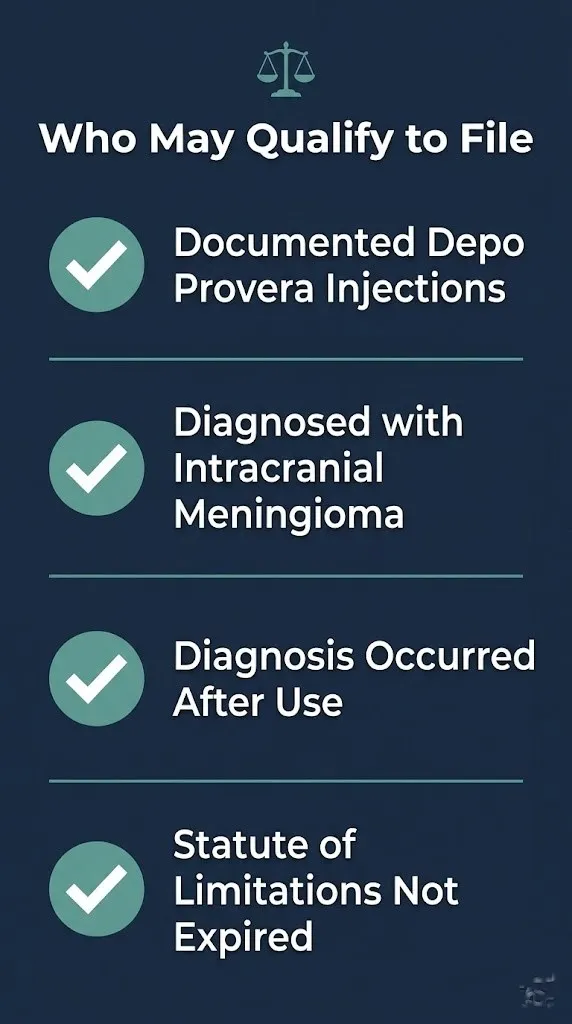
You may qualify to file a lawsuit if you used Depo Provera injections and were later diagnosed with a meningioma. The basic criteria lawyers are screening for include three elements.
First, you must have a documented history of Depo Provera use. Medical records showing the injections are essential. Self-reported use is not enough. Your pharmacy records, OB-GYN notes, or clinic records must confirm you received the shot, typically over multiple cycles.
Second, you need a confirmed diagnosis of intracranial meningioma. This usually comes from an MRI or CT scan, followed by a pathology report if surgery was performed. The tumor must have formed inside the skull, on the membranes around the brain. Spinal meningiomas may also qualify depending on the specific case and the lawyer’s evaluation.
Third, your diagnosis must have come after your Depo Provera use began. The length of use matters. The strongest cases typically involve at least one year of use, given the BMJ study’s findings. Shorter durations are not automatically excluded, but the causation argument becomes harder to prove.
There is also a time limit. Every state has a statute of limitations for personal injury claims. The clock usually starts when you knew or should have known about the injury and its possible link to the drug. This deadline can be as short as one or two years from diagnosis in some states. If you were diagnosed several years ago and have not acted, you need to speak with a lawyer immediately to see if your window is still open.
Key Takeaway: Documented Depo Provera use plus a meningioma diagnosis are the threshold requirements. The statute of limitations is your most urgent concern. Delay can bar your case permanently.
How Much Is the Depo Provera Lawsuit Worth?
No settlement values exist yet for the Depo Provera litigation. Because these are individual injury lawsuits, not a class action, every case has its own value. Any figure you see online is a guess unless it comes from a verified settlement or verdict.
In mass tort product liability cases, payouts typically depend on injury severity. A tiered system may eventually be created if a settlement is reached. Based on how other pharmaceutical MDLs have been structured, potential tiering could look like this.
Hypothetical Payout Tiers (Based on MDL Precedent, Not Confirmed)
| Injury Tier | Description | Estimated Range |
| Injury Tier 1 | Meningioma diagnosis with surgery, permanent neurological damage | Higher end of any potential matrix |
| Injury Tier 2 | Meningioma requiring surgery but no permanent major deficit | Mid-range of any potential matrix |
| Injury Tier 3 | Meningioma diagnosis, monitoring only, no surgery required | Lower end of any potential matrix |
These tiers are illustrative only. They come from patterns in other pharmaceutical mass torts, not from any Depo Provera settlement document. No settlement grid exists. The range of possible outcomes runs from zero to substantial, depending entirely on the facts of each case and whether the litigation succeeds.
Factors that increase case value: extended use of the shot, a large tumor, multiple surgeries, permanent vision or cognitive impairment, lost income, and young age at diagnosis. Factors that reduce value: short-term use, small tumors found incidentally, no treatment required, and preexisting conditions that make causation harder to prove.
Reality Check: No law firm can guarantee a payout. Any lawyer promising a specific dollar amount before reviewing your records is not being honest. This litigation is still early. Verdicts and settlements are likely years away. File because the statute of limitations is closing, not because you expect a quick check.
How to File a Depo Provera Lawsuit
You do not file a “claim” on a settlement website. You file a lawsuit in court through a licensed attorney. Here is the process step by step.
- Gather your medical records. Request all records related to your Depo Provera injections. Also gather every record related to your meningioma diagnosis, including imaging reports, surgical notes, and pathology reports.
- Research law firms handling Depo Provera cases. Look for firms with mass tort experience, specifically with pharmaceutical MDLs. Most offer free case evaluations.
- Contact one or more firms for a consultation. The consultation is free. You are not obligated to hire the first firm you talk to.
- Provide your medical records for review. The firm will have a nurse or medical expert review them to confirm the diagnosis and Depo Provera use.
- If the firm accepts your case, you sign a retainer agreement. This is a contingency fee contract. You pay nothing upfront. The lawyer gets a percentage of any recovery, typically 33 to 40 percent.
- Your lawyer drafts and files a complaint in the appropriate court. If your case fits the MDL criteria, it will eventually be transferred into the multidistrict litigation in the Southern District of California.
- You complete a plaintiff fact sheet. This is a detailed questionnaire about your medical history, Depo Provera use, and how the meningioma has affected your life. Accuracy matters. Errors here can be used against you.
- Your case proceeds through discovery and, if no settlement is reached, toward a potential bellwether trial. Most cases settle before trial, but you must be prepared for the process to take years.
The entire process is slower than people expect. MDLs often take three to five years from filing to resolution. Bellwether trials, which test a few representative cases, are used to gauge how juries react. The outcomes of those trials heavily influence whether and at what amount a global settlement is reached.
What Is the Statute of Limitations for a Depo Provera Lawsuit?
The statute of limitations is the deadline to file your lawsuit. It varies by state and is the single most urgent factor in your case.
Most states set the personal injury statute of limitations at two or three years. The clock typically starts on the date you discovered, or reasonably should have discovered, both your injury and its possible connection to the drug. This is called the discovery rule.
If you were diagnosed with a meningioma in 2023 and only learned in 2026 that studies link the tumor to Depo Provera, the clock may have started in 2026. But that is not automatic. Courts analyze when a reasonable person would have made the connection. A lawyer in your state must analyze your specific timeline.
Some states have statutes of repose, which bar claims after a set number of years from the date of the drug’s sale, regardless of when the injury was discovered. These can be harsh and cut off claims entirely. A small number of states have shorter statutes, as short as one year for medical-related personal injury claims.
Do not calculate the deadline yourself. A legal question this consequential and fact-specific requires a licensed attorney who knows your state’s laws. The wrong assumption can destroy a viable case. If you think you might qualify, call a lawyer this week, not next month.
Key Takeaway: Statutes of limitations are running. They differ by state. A lawyer must evaluate your specific timeline. Delaying contact with a law firm is the biggest mistake potential plaintiffs make.
Has There Been a Depo Provera Settlement?
No global settlement has been reached as of July 16, 2026. The litigation is still in its early to middle stages. No settlement fund exists. No settlement amounts have been established. No claims administrator has been appointed.
Pfizer has not publicly announced any intention to settle. The company has stated in court filings that it intends to defend the litigation and that Depo Provera’s labeling was adequate. That posture is typical at this stage. Most pharmaceutical MDLs do not settle before bellwether trials produce verdicts that both sides use to measure risk.
If a settlement eventually happens, it will be widely reported. Court approval is required. Notices will be sent to plaintiffs. Law firms will contact their clients. Do not trust any website, email, or social media post claiming that a “Depo Provera settlement check” is waiting for you in 2026. It is not. Those are likely scams or misleading attorney advertising.
What Is the Status of the Depo Provera MDL?
The Depo Provera cases are centralized in MDL No. 3140, pending before Judge M. James Lorenz in the U.S. District Court for the Southern District of California. MDL consolidation streamlines pretrial proceedings for cases that share common factual questions.
As of mid-2026, the MDL is in the discovery phase. Both sides are exchanging documents, taking depositions, and building their evidence. The plaintiffs’ steering committee, a group of lead lawyers appointed by the judge, is coordinating discovery on behalf of all plaintiffs.
Bellwether trial selections have not yet been announced publicly. Bellwethers are test cases chosen to go to trial first. Their verdicts provide both sides with a realistic picture of case values and juror reactions. Settlement negotiations typically intensify after bellwether outcomes.
The timeline remains uncertain. Large pharmaceutical MDLs can take four to six years from formation to resolution. The Depo Provera MDL is still in its earlier stages, so resolution is likely at least two to three years away, barring an unexpected early settlement.
What Are the Allegations Against Pfizer in the Depo Provera Cases?
The central allegation is failure to warn. Plaintiffs argue that Pfizer knew or should have known that Depo Provera significantly increased meningioma risk and did not update the U.S. warning label to reflect that risk in a timely way.
The lawsuits cite several pieces of evidence. Epidemiological data showing elevated risk existed years before the U.S. label changed. European regulators took action based on that data. France restricted Depo Provera use in some populations. The U.S. label remained relatively unchanged. Plaintiffs argue that gap represents a corporate decision to prioritize sales over safety.
Secondary allegations include negligent design (the drug is unreasonably dangerous for long-term use), breach of warranty, and in some cases, wrongful death if the plaintiff died from complications related to the meningioma or its treatment.
Pfizer acquired the Depo Provera product line through its acquisition of Pharmacia. The company denies the allegations and asserts that its labeling complied with FDA requirements at all times. The FDA’s role complicates the case. Federal law can preempt some failure-to-warn claims against drug manufacturers, a legal defense Pfizer is expected to raise vigorously.
What Happens Next in the Depo Provera Litigation?
Here is the expected trajectory based on how pharmaceutical MDLs typically progress.
- Discovery Phase (2026 through early 2027): Both sides gather evidence, depose witnesses, and build their cases. The plaintiffs’ steering committee leads this effort for the plaintiffs.
- Bellwether Trial Selection (Expected mid to late 2027): The court and both sides select a small group of representative cases for early trial.
- Bellwether Trials (Expected 2028): The first trials produce verdicts. Outcomes heavily influence settlement dynamics.
- Settlement Negotiations or Continued Litigation (Expected 2028 to 2029): If bellwether verdicts are strong for plaintiffs, settlement pressure increases. If verdicts favor the defense, cases may be dismissed or settle for less.
- Resolution (Earliest possible 2029, likely later): Global settlement, continued individual trials, or case dismissals bring the MDL to a close.
This timeline is an estimate. Pharmaceutical MDLs can move faster or slower. The pace depends on the judge’s scheduling orders and the complexity of the medical evidence.
Frequently Asked Questions
Can I still file a Depo Provera lawsuit in 2026?
Yes, if your statute of limitations has not expired.
You must contact a lawyer immediately to evaluate your specific diagnosis date and state deadline.
Do I need a lawyer to file a Depo Provera claim?
Yes. There is no settlement website or class action to join.
You must file an individual lawsuit, which requires a licensed attorney.
How much does it cost to hire a Depo Provera lawyer?
Nothing upfront.
These cases are handled on contingency. The lawyer is paid a percentage of any recovery, not before.
What side effects qualify for the lawsuit?
The litigation focuses on intracranial meningioma brain tumors.
Other side effects are not part of this MDL. Your diagnosis must be meningioma.
How long will the Depo Provera lawsuit take?
Expect at least two to three years, possibly longer.
MDL cases are complex. Resolution before 2029 would be unusually fast.
Can I join the Depo Provera class action?
There is no class action.
These are individual personal injury lawsuits. Each woman files her own case.
What if I used Depo Provera years ago?
Years-ago use may still qualify.
The key is when you were diagnosed with a meningioma and when you discovered the possible link.
What evidence do I need to file?
Medical records proving Depo Provera injections and a meningioma diagnosis.
Imaging reports, surgical notes, and pathology reports are also required.
The Depo Provera meningioma litigation is real, active, and moving forward in federal court. No settlement exists yet. There is no website to sign up on, no claim form to mail in, and no deadline to file a claim because no claims process has opened. What does exist is a narrowing window of time to file your individual lawsuit before the statute of limitations closes.
If you used the shot and have a meningioma diagnosis, your next step is a free consultation with a law firm experienced in pharmaceutical mass torts. Gather your records first. Call this week. The worst outcome is having a viable case and losing it because time ran out while you waited for a settlement announcement that never came.