Philips CPAP Lawsuit Payout Per Person: 2026 Settlement Amounts, Eligibility, and Claim Deadlines
Quick Answer
- The Philips CPAP lawsuit is a real, court-supervised settlement, not a scam, with over $1 billion in total resolution funds.
- Payout per person ranges from roughly $50 for basic device return claims to $500,000-plus for serious injury claims with strong medical documentation.
- The deadline for device return and replacement claims has passed, but personal injury claim filings continue through late 2026 or until funds deplete.
If you used a recalled Philips CPAP, BiPAP, or ventilator, you may have heard about settlement money and wondered how much you could get and when. The answer depends on which track your claim falls into. The economic loss settlement for device returns paid out modest amounts starting in 2024. The personal injury settlement track, where the real money is, is paying out now in 2026 for qualifying claims with strong medical evidence.
This article covers every verified payout figure available as of August 2026. It explains the two settlement tracks, what each pays, who qualifies, and what you need to do if you have not filed yet. One fact most coverage misses: the personal injury settlement does not use a fixed per-person formula. Payouts are individually evaluated based on injury severity, medical records, and proof of device use, so two people with the same recalled device can receive vastly different amounts.
The Facts
| Case | In re: Philips Recalled CPAP, Bi-Level PAP, and Mechanical Ventilator Products Litigation (MDL No. 3014) |
| Court | U.S. District Court, Western District of Pennsylvania |
| Status | Economic loss settlement paying out. Personal injury settlement active and paying qualifying claims. |
| Total Settlement Fund | Over $1 billion across all agreements (minimum $479 million for personal injury) |
| Device Return Payout | $50 to $500 per device, depending on model and documentation |
| Personal Injury Payout | $50,000 to $500,000-plus for documented serious injuries |
| Economic Loss Deadline | Passed (device return and replacement claims) |
| Personal Injury Deadline | Rolling. Claims being processed through 2026. Check with the settlement administrator. |
| Administrator | Philips CPAP Settlement Administrator (Epiq Class Action & Claims Solutions) |
Is the Philips CPAP Lawsuit Settlement Legitimate?
Yes. The Philips CPAP settlement is a legitimate, court-approved resolution of multidistrict litigation in the U.S. District Court for the Western District of Pennsylvania. It is not a scam. It is not an online class action you sign up for on a random website. It is a federal court-supervised settlement with a real claims administrator, Epiq, and real money being distributed.
The settlement resolves claims stemming from the June 2021 recall of Philips Respironics CPAP, BiPAP, and ventilator devices. The recall involved polyester-based polyurethane foam used for sound abatement in the devices. That foam could degrade, releasing particles and potentially toxic gases into the airway of the user. Over 15 million devices were recalled worldwide.
Philips has not admitted liability in the settlements. The company agreed to pay to resolve claims and avoid the cost and uncertainty of trial. The economic loss settlement was approved first, and payments began in 2024. The personal injury settlement received final approval and is now processing and paying qualifying claims in 2026.
Scam operators have targeted CPAP users with fake settlement offers, texts, and phone calls. The real settlement does not text you out of the blue. The real settlement does not ask for your credit card or bank password. The real settlement website is maintained by the court-appointed administrator, and filing a claim costs nothing.
Key Takeaway: The Philips CPAP settlement is real, court-approved, and paying claims. Any unsolicited text or call about it is probably a scam.
What Is the Philips CPAP Lawsuit Payout Per Person?
There is no single payout amount. What you receive depends entirely on which settlement track you fall into and, for personal injury claims, the severity and documentation of your injury.
Device Return and Economic Loss Payments
The economic loss settlement established a system of fixed payments for users who returned recalled devices or bought replacement devices. These payments are modest. They compensate for the economic loss of owning a recalled device, not for any health harm.
The standard device return payment is between $50 and $500 per device. The exact amount depends on the device model and whether you had proof of purchase. Users who bought a replacement device out of pocket could receive additional reimbursement, typically up to the cost of the replacement or a set cap amount. These payments started going out in 2024. Most economic loss claimants have already been paid.
The deadline for filing economic loss claims has passed. If you did not file an economic loss claim before the deadline, you cannot now claim a device return payment.
Personal Injury Settlement Payments
The personal injury settlement involves substantially larger payouts, but only for users who can document a qualifying injury linked to device use. Payments are not fixed. They are evaluated individually based on a set of criteria established in the settlement agreement.
Verified Personal Injury Payout Ranges
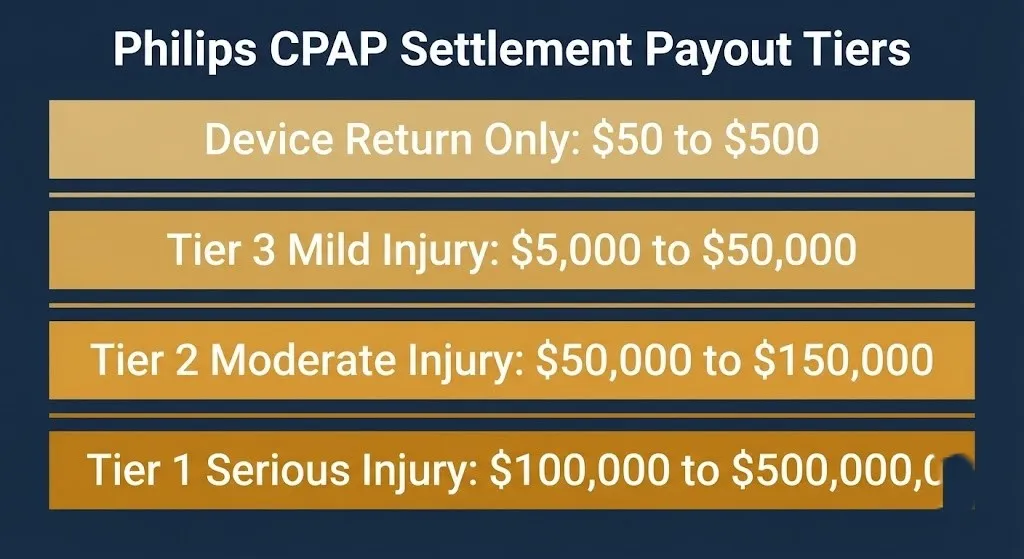
| Injury Tier | Payout Range | Documentation Required |
|---|---|---|
| Tier 1: Documented serious injury (cancer, severe respiratory illness, death) | $100,000 to $500,000+ | Medical records confirming diagnosis, proof of device use, physician certification linking injury to device |
| Tier 2: Documented moderate injury (asthma onset, chronic respiratory conditions, lung function decline) | $50,000 to $150,000 | Medical records, device use proof, physician statement |
| Tier 3: Documented mild injury or property loss only | $5,000 to $50,000 | Medical records or proof of economic loss, device registration |
| Device return only (economic loss track) | $50 to $500 | Device serial number, proof of purchase if available |
These ranges reflect what is being paid to claimants whose cases have been evaluated under the settlement’s grid system. Actual payouts vary. Two claimants with the same device model can receive different amounts based on injury severity, treatment history, age, and documentation quality.
A small number of cases with catastrophic injuries or death are settling for amounts above $500,000. Those cases typically involve lung cancer, liver cancer, kidney cancer, or severe chronic respiratory failure with clear evidence of long-term recalled device use and no other obvious cause.
Reality Check: Do not expect a large payout for simply owning a recalled device. The device return payments are small, and many users received under $100. The personal injury payments require medical proof of actual harm. If you used a recalled device but have no documented health problems, your recovery is limited to what the economic loss track provided.
Key Takeaway: Device return claims paid $50 to $500. Personal injury claims pay $50,000 to $500,000-plus, but require documented medical harm linked to device use.
How Are Personal Injury Settlement Amounts Determined?
The personal injury settlement uses a points-based evaluation system, not a fixed per-person formula. A claims administrator and a special master evaluate each claim individually based on criteria established in the settlement agreement.
The primary factors that determine your payout amount are the severity of your diagnosed injury, the strength of the medical evidence linking your injury to recalled device use, the duration of device use, whether you used a device with the PE-PUR foam that was the subject of the recall, your age and overall health, and whether you have other risk factors for the same injury.
The settlement grid assigns points for specific diagnoses, treatment received, and proof of device use. A higher point total corresponds to a higher payout. Lung cancer with pathology reports, imaging, and a physician certification of causation scores far higher than self-reported respiratory symptoms with no medical records.
This is not like filing an insurance claim where you submit a form and get a check. The process is adversarial. Defendant representatives review your medical records. They look for alternative causes. They examine gaps in device use history. Your documentation must be complete and internally consistent. Claims with weak or contradictory records are denied or receive low settlement offers.
The settlement agreement includes a minimum fund of $479 million for personal injury claims. Additional funds are available depending on claim volume and severity. The fund has not been exhausted as of mid-2026, but it is finite. Once the personal injury settlement fund is depleted, no additional payments will be made.
Key Takeaway: Your payout depends on a points-based evaluation of injury severity, medical evidence quality, and device use proof. Documentation strength drives dollar amounts.
Who Qualifies for the Philips CPAP Settlement?
Eligibility depends on which settlement track you are pursuing. The economic loss track deadline has passed. The personal injury track remains open.
Personal Injury Qualification Criteria
To qualify for a personal injury settlement payment, you must meet these conditions. Each condition must be supported by documentation. No condition is presumed.
- You used a recalled Philips Respironics CPAP, BiPAP, or ventilator device before the June 2021 recall.
- The device you used contained the polyester-based polyurethane foam identified in the recall. Not all Philips devices were recalled. Only specific models manufactured between 2009 and 2021.
- You have a documented medical injury or condition that is plausibly linked to inhaling degraded foam particles or off-gassed chemicals. Qualifying conditions include lung cancer, throat cancer, nasal cancer, liver cancer, kidney cancer, leukemia, multiple myeloma, asthma, chronic obstructive pulmonary disease, pulmonary fibrosis, and other respiratory illnesses.
- You have medical records that establish the diagnosis, treatment history, and timing relative to device use.
- You have evidence of device use, such as a device serial number, purchase receipt, prescription, or data from the device itself.
Users who registered their devices through the original Philips recall registration portal may have an easier time proving device use. If you did not register, you must find alternative documentation. Durable medical equipment suppliers, insurance records, and sleep clinic records can all serve as proof.
Who Does Not Qualify
You do not qualify for a personal injury payment if you used a recalled device but have no documented health problems, used a non-recalled Philips device, used a recalled device only after the recall was announced and were aware of the risk, or cannot produce any evidence of device use.
Key Takeaway: Qualification requires a recalled device, documented use, and a diagnosed injury linked to the recalled foam. Device ownership alone is not enough for personal injury payment.
What Is the CPAP Lawsuit Update for 2026?
The Philips CPAP litigation is in its payment phase as of August 2026. The economic loss settlement has largely concluded distributions. The personal injury settlement is actively processing and paying qualifying claims. No new global settlements have been announced, and the MDL court continues to oversee the administration of existing agreements.
The key 2026 developments are these. Personal injury claim evaluations are ongoing, with payments being issued on a rolling basis to claimants whose documentation has been reviewed and approved. The special master is resolving disputes over claim valuations. Individual lawsuits that opted out of the class settlement continue to proceed toward trial in various federal courts.
The medical monitoring settlement, a separate agreement, is funding screening programs for users who were exposed to recalled devices but have not yet developed diagnosed injuries. This settlement provides access to funded medical testing, not cash payments. It is designed to catch potential foam-related health problems early.
No new claim filing deadlines have been announced in 2026, but the personal injury settlement fund is finite. Once the fund is exhausted, claim payments stop. The settlement administrator has not published a remaining fund balance as of August 2026.
Philips has completed most of its recall remediation program. Replacement devices were distributed to the majority of registered users by late 2024. Users who still have not received a replacement should contact Philips directly rather than waiting for the settlement process to resolve the issue.
Key Takeaway: The litigation is in the payment phase. Personal injury claims are being evaluated and paid. The fund is finite. Delaying filing reduces the chance of receiving full compensation.
How to File a Philips CPAP Lawsuit Claim
Filing a personal injury claim in the Philips CPAP settlement requires specific documentation and patience. The process is not instant. Claims are evaluated individually, and processing times of 6 to 12 months are common.
Step-by-Step Filing Process
- Gather your device information. Locate the serial number, model number, and date of manufacture. Check the original device packaging, the device itself, your prescription, or your DME supplier records.
- Confirm your device is a recalled model. The official Philips recall website lists all recalled device models. Match your model number against the recall list. Keep a record of the confirmation.
- Collect your medical records. Request complete records from every healthcare provider who treated you for a potentially related condition. Include diagnostic test results, imaging, pathology reports, treatment records, and physician notes. Records must show the diagnosis, the date of diagnosis, and the treatment received.
- Obtain a physician certification if required. Some claims require a statement from a treating physician linking your condition to recalled device use. The settlement agreement specifies the form this certification must take. Your attorney will advise on whether and how to obtain this.
- Compile proof of device use. Gather insurance claims for the device, DME supplier invoices, sleep study records, CPAP data downloads, or any other documentation that establishes you used the recalled device.
- Retain an attorney experienced in the Philips CPAP litigation. Personal injury claims cannot be filed directly through the settlement administrator without legal representation. The settlement structure requires an attorney to submit and negotiate your claim.
- Complete the claim forms. Your attorney will prepare and submit the required settlement claim forms, medical records, and supporting documentation to the claims administrator.
- Respond to follow-up requests. The claims administrator or defense counsel may request additional information. Respond promptly. Delays in providing requested documentation slow the process.
Filing a personal injury claim in this settlement is more like preparing for a detailed audit than filling out an online rebate form. Every document matters. Every gap in records is questioned. Getting the documentation right the first time is faster and less frustrating than fixing it later.
Key Takeaway: Personal injury claims require an attorney and comprehensive documentation. Gather device records, medical records, and proof of use before contacting a lawyer.
Do You Need a Lawyer for the Philips CPAP Settlement?
For personal injury claims, yes. The settlement structure requires attorney representation. You cannot file a personal injury claim on your own through the claims administrator.
Attorneys handling Philips CPAP cases work on a contingency fee basis. This means the attorney is paid a percentage of your settlement, typically between 33 and 40 percent, plus reimbursement of case expenses. You do not pay upfront fees. If no recovery is made, you generally owe nothing for attorney fees, though you may be responsible for unreimbursed case expenses depending on your retainer agreement.
The contingency fee structure means your attorney’s financial interest is aligned with maximizing your payout. It also means that attorneys are selective about which cases they accept. If your documentation is weak or your injuries are minor, an attorney may decline representation because the expected recovery does not justify the cost of pursuing the claim.
Do not pay a third-party service to “file your CPAP claim” or “check your eligibility.” These services are not law firms. They cannot represent you in the settlement. They collect your information and sell it to attorneys, taking a fee for something you can do yourself by contacting a qualified attorney directly.
The economic loss claims that had fixed device return payments could be filed without an attorney. That deadline has passed. Any claim you file now is a personal injury claim that requires legal representation.
Key Takeaway: Personal injury claims require a lawyer. Legitimate CPAP attorneys work on contingency. Never pay upfront fees or use a third-party filing service.
What Medical Conditions Are Covered by the CPAP Settlement?
The Philips CPAP personal injury settlement covers a specific range of medical conditions that have been plausibly linked to inhalation of degraded PE-PUR foam particles and off-gassed chemicals. Not every health problem a CPAP user develops is covered.
Covered Medical Conditions
- Lung cancer, including non-small cell and small cell carcinoma
- Throat cancer, including pharyngeal and laryngeal cancers
- Nasal and sinus cancers
- Oral cancers
- Esophageal cancer
- Liver cancer and hepatic disease
- Kidney cancer and renal disease
- Leukemia, including acute myeloid leukemia and chronic lymphocytic leukemia
- Multiple myeloma
- Non-Hodgkin lymphoma
- Asthma, new onset or significant worsening
- Chronic obstructive pulmonary disease
- Pulmonary fibrosis
- Interstitial lung disease
- Reactive airway disease
- Chronic bronchitis
- Emphysema
- Respiratory failure
The settlement also covers death caused by any of these conditions where the deceased used a recalled device.
Conditions Not Covered
The settlement does not cover conditions with no plausible link to foam inhalation. Skin conditions, joint pain, headaches, insomnia, and general fatigue are not covered unless they are documented as secondary to a covered primary condition.
The key factor is whether medical evidence supports a causal connection between recalled device use and the diagnosed condition. Having a covered condition and using a recalled device is not automatically sufficient. The timing, the absence of alternative causes, and the medical literature on PE-PUR foam degradation all factor into the evaluation.
Key Takeaway: Cancer, serious respiratory disease, and certain blood disorders are covered. Common complaints without documented physical injury are not.
What Was the Philips CPAP Recall and Why Are They Being Sued?
In June 2021, Philips Respironics announced a voluntary recall of specific CPAP, BiPAP, and ventilator devices manufactured between 2009 and 2021. The recall was triggered by a problem with the polyester-based polyurethane foam used for sound abatement inside the devices.
The foam, known as PE-PUR, could degrade under certain conditions. High heat, high humidity, and use of certain cleaning products, including ozone-based cleaners, accelerated degradation. When the foam degraded, it could break into small particles that the user inhaled. The degraded foam could also off-gas volatile organic compounds, including chemicals of concern.
The recall affected over 15 million devices worldwide, including the DreamStation, System One, Trilogy, and other Philips Respironics product lines. Philips initially proposed repairing or replacing affected devices, but the remediation process was slow. Many users waited months or years for replacement devices. The FDA later classified the recall as a Class I recall, the most serious type, indicating a reasonable probability that use of the product could cause serious adverse health consequences or death.
Lawsuits were filed almost immediately after the recall announcement. Plaintiffs alleged that Philips knew or should have known about the foam degradation risk years before the recall. Internal company documents and FDA inspection reports revealed that Philips had received complaints about foam degradation as early as 2010 and had conducted testing that identified potential health risks. The company did not issue a recall until 2021.
The lawsuits were consolidated into multidistrict litigation in the Western District of Pennsylvania. The MDL includes economic loss claims, personal injury claims, and medical monitoring claims. The settlement agreements resolve the economic loss and personal injury claims for participating plaintiffs.
Key Takeaway: Philips is being sued because internal evidence suggests the company knew about foam degradation risks years before warning users. Over 15 million devices were affected.
How Long Will It Take to Get a Philips CPAP Settlement Payout?
Payment timing depends on your claim type and status. Economic loss payments were issued starting in 2024, with most paid by mid-2025. Personal injury payments are being issued on a rolling basis through 2026.
Typical Personal Injury Payment Timeline
Claim submission to initial review: 3 to 6 months. Your attorney submits the complete claim package. The claims administrator performs an initial review for completeness and qualifying criteria.
Initial review to valuation: 3 to 6 months. If the claim is complete and qualifying, it moves to valuation under the settlement grid. The special master or claims administrator evaluates the documentation and assigns a point score.
Valuation to settlement offer: 1 to 3 months. The valuation is converted to a dollar offer. Your attorney receives the offer and discusses it with you.
Offer acceptance to payment: 1 to 2 months. Once you accept the offer and execute the release, payment is processed. Payments are typically made by check or electronic transfer.
Total estimated time: 8 to 17 months from claim submission to payment. Complex claims with extensive medical records or disputes over valuation take longer. Claims with clear documentation and undisputed diagnoses are processed faster.
This timeline is an estimate based on reported claimant experiences. Individual timelines vary. The claims administrator does not publish average processing times, and delays occur when documentation is incomplete or when the special master is resolving a high volume of valuation disputes.
Key Takeaway: Expect 8 to 17 months from filing to payment. Complete documentation shortens the timeline. Gaps and disputes lengthen it.
Frequently Asked Questions
Can I still file a CPAP lawsuit claim in 2026?
Yes, personal injury claims are still being accepted and processed.
The economic loss deadline for device return payments has passed.
Contact a qualified attorney to evaluate whether your injury qualifies for the personal injury settlement.
How much will I get if I just return my recalled CPAP device?
If you filed before the economic loss deadline, between $50 and $500 depending on the device model.
If you did not file before the deadline, you cannot now claim a device return payment.
Device return alone does not qualify you for personal injury compensation.
What proof do I need to show I used a recalled CPAP?
A device serial number, purchase receipt, DME supplier record, insurance claim, sleep study record, or device data download.
Registration through the Philips recall portal also serves as proof.
If you have none of these, obtaining records from your DME supplier or insurance company is the best starting point.
Does the CPAP settlement cover family members who used the device?
No, the settlement covers the user of the device.
A family member who did not personally use the device is not eligible.
If the device user is deceased, their estate or surviving family members may pursue a wrongful death claim.
Can I file a CPAP claim if I already received a replacement device?
Yes, receiving a replacement device does not bar you from filing a personal injury claim.
The replacement resolves the product defect going forward but does not compensate for past harm.
Document your use of the original recalled device, not the replacement.
What if I developed cancer but also smoked cigarettes?
Your claim may still qualify, but the valuation will account for alternative causes.
The settlement evaluation considers smoking history, occupational exposures, and other risk factors.
Claims with significant alternative causes typically receive lower point scores and lower settlement offers.
Is the Philips CPAP settlement taxable?
Settlement proceeds for personal physical injuries are generally not taxable under federal law.
Interest earned on delayed payments may be taxable.
Consult a tax professional about your specific situation. This article does not provide tax advice.
How do I find a legitimate CPAP lawsuit attorney?
Contact a law firm with demonstrated experience in the Philips CPAP MDL.
Search for firms that have filed appearances in the Western District of Pennsylvania MDL.
Avoid third-party lead generators. Contact law firms directly and verify their MDL involvement.
What Happens Next
The personal injury settlement fund will continue processing and paying claims through late 2026 and likely into 2027. The fund is finite. Once it is exhausted, no further payments will be made regardless of how many additional claims are filed. If you have a documented serious injury and used a recalled device, the time to act is now.
Start by gathering your device information and medical records today. Then contact a qualified attorney for an evaluation. Do not pay for a filing service. Do not respond to unsolicited settlement texts. The real settlement costs nothing to file, requires an attorney, and pays based on documented harm, not on how quickly you click a link. The people who documented their evidence early are the ones receiving the largest payments now.