Gaming Addiction Lawsuit: 2026 Case Updates, Who Can File, and What Compensation May Be Available
Quick Answer
- Gaming addiction lawsuits are real, active civil claims filed against major video game publishers, not a scam or a settlement you join.
- No settlement fund exists yet, so no per-person payout amount has been determined by any court.
- No claim deadline is set because no settlement has been approved, but potential claimants should preserve all evidence now.
If you saw a headline about video game addiction lawsuits and wondered whether you can sign up for a settlement check, the short answer is not yet. These cases are still in active litigation. No settlement has been reached. No claims administrator has been appointed. No fund exists to distribute payments. What does exist is a growing body of civil lawsuits arguing that game publishers knowingly designed addictive mechanics that caused measurable harm to users, particularly minors.
This article covers the current state of gaming addiction litigation in 2026. It explains which companies are being sued, what the legal theories are, who might eventually qualify if a settlement is reached, and what you should do now if you believe you or your child has a potential claim. One fact worth knowing: the Judicial Panel on Multidistrict Litigation consolidated over two dozen federal cases, signaling that courts view these claims as sharing common legal questions serious enough for coordinated pre-trial proceedings.
The Facts
| Case Type | Multidistrict litigation and individual civil lawsuits |
| Status | Active litigation, no settlement reached |
| Fund Size | None established |
| Est. Per Person | Not yet determined |
| Claim Deadline | None set |
| Administrator | Not yet appointed |
| Proof Needed | Records of gaming activity, medical diagnoses, financial losses |
| Lead Defendants | Epic Games, Activision Blizzard, Roblox Corporation, Microsoft, Electronic Arts, and others |
Is the Gaming Addiction Lawsuit Legitimate?
Yes. The gaming addiction lawsuits filed in U.S. federal courts are legitimate civil claims, not a scam or a pre-existing settlement fund you can join. These are product liability and negligence cases brought by families and individuals against major video game publishers. They are being litigated in real federal courts with real judges, and the outcomes will set precedent for how addiction-based claims against technology companies are handled.
The lawsuits argue that game publishers intentionally designed their products to be addictive, using behavioral psychology techniques, variable reward systems, and algorithm-driven engagement loops that they knew or should have known would cause compulsive use. The legal theories draw from tobacco litigation, opioid lawsuits, and social media addiction cases, all of which started with individual claims that were initially dismissed before eventually resulting in large settlements.
That history matters. Early tobacco suits failed for years. Early opioid suits were dismissed. The gaming cases are at a similar early stage. The fact that no settlement exists yet does not mean the claims lack merit. It means the litigation is young. Courts are still ruling on motions to dismiss, and discovery is underway or just beginning in most of the consolidated cases.
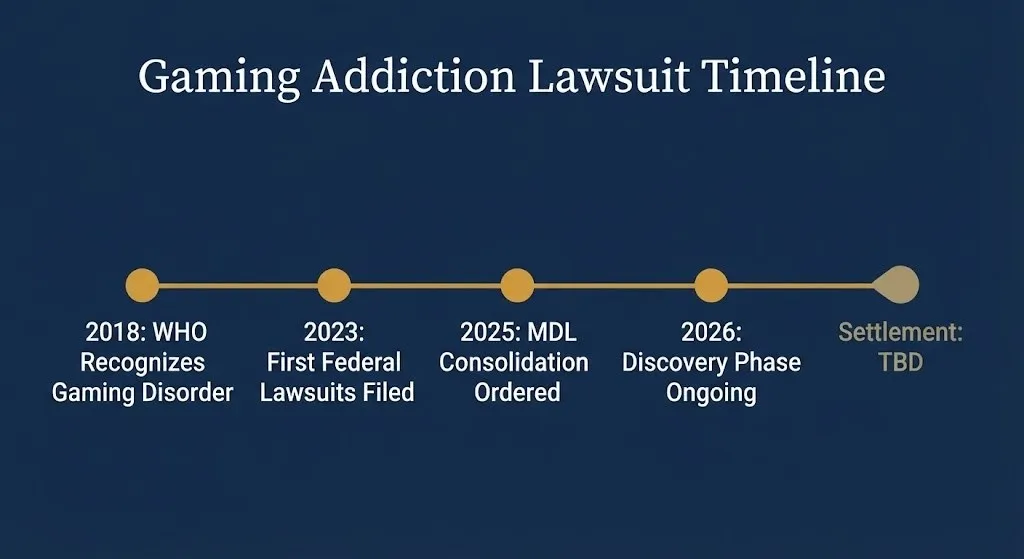
The World Health Organization added “gaming disorder” to the International Classification of Diseases in 2018. The American Psychiatric Association has identified internet gaming disorder as a condition warranting further study. These classifications provide a medical foundation that the lawsuits rely on, though no appellate court has yet recognized gaming addiction as a basis for product liability in a final ruling.
Key Takeaway: The lawsuits are real and moving through the legal process, but there is no settlement to join. Anyone offering to sign you up for a gaming addiction payout today is running a scam.
Which Video Game Companies Are Being Sued?
Multiple major game publishers and platform holders are named as defendants across the consolidated and individual lawsuits. The specific companies vary by case, but the most frequently named defendants as of mid-2026 include Epic Games (Fortnite), Activision Blizzard (Call of Duty, World of Warcraft), Roblox Corporation, Microsoft (Minecraft, Xbox platforms), Electronic Arts, and Take-Two Interactive.
The claims against each company differ in their specifics but share a common core. Plaintiffs argue that these companies designed games with features scientifically engineered to promote compulsive use. Those features include loot boxes and randomized reward mechanics, endless progression loops without natural stopping points, social pressure mechanics that penalize players for logging off, and microtransaction systems designed to exploit impulse control weaknesses.
Primary Defendant Companies and Key Games at Issue
| Company | Key Games Named in Lawsuits | Primary Allegations |
|---|---|---|
| Epic Games | Fortnite | Addictive design, manipulative monetization, targeting minors |
| Activision Blizzard | Call of Duty, World of Warcraft | Endless progression systems, loot box mechanics |
| Roblox Corporation | Roblox | Unregulated third-party developer ecosystem, child-targeted design |
| Microsoft | Minecraft | Platform-level engagement optimization |
| Electronic Arts | FIFA/EA Sports FC, Madden | Loot box mechanics, pay-to-win monetization |
| Take-Two Interactive | Grand Theft Auto Online, NBA 2K | In-game currency and gambling-adjacent mechanics |
This is not a complete list. New defendants are added as cases are filed. Some lawsuits name multiple companies in a single complaint. Others target a single publisher and a single game. The multidistrict litigation process handles these variations efficiently by grouping cases with common factual questions before one judge.
Key Takeaway: The major players in the gaming industry are all facing litigation. If your child played any popular online game in the last five years, the publisher is likely named in at least one active case.
Who Can File a Video Game Addiction Lawsuit?
Right now, no one can file a claim for compensation because no settlement exists. But understanding who the current lawsuits represent helps you assess whether you may eventually qualify if a settlement or verdict creates a compensation fund.
The plaintiffs in the existing cases fall into several categories. Parents suing on behalf of minors who developed compulsive gaming habits, sometimes resulting in academic failure, social withdrawal, or physical health problems. Young adults who began gaming heavily as minors and are now suing for the long-term effects. In some cases, adult gamers themselves are plaintiffs, arguing that the games were designed to override their autonomy and cause financial harm through microtransaction spending.
The common thread across all plaintiff categories is evidence of measurable harm. This is not about a parent being annoyed that a child plays too many video games. The lawsuits document specific injuries: diagnosed gaming disorder, mental health deterioration, significant financial losses from in-game purchases, educational decline requiring intervention, and physical conditions linked to sedentary gaming marathons.
To have standing in the current litigation, a plaintiff must show that they or their child used the defendant’s product, that the product’s design was a substantial factor in causing addiction, and that the addiction caused quantifiable damages. Courts have already dismissed some claims for failing to meet this threshold, while others have survived motions to dismiss and are proceeding to discovery.
If a settlement is eventually reached, the class definition will likely include people who played specific games during specific time periods and can document harm. Anyone who believes they may eventually qualify should start preserving records now: account statements, purchase histories, medical or therapy records related to gaming behavior, school reports showing academic decline, and any communication with the game company or platform.
Key Takeaway: Current plaintiffs are minors, former minors, and adults who can document specific harm from compulsive gaming. If settlements eventually happen, documented evidence of harm will determine eligibility and payout amounts.
How Much Compensation Could a Gaming Addiction Lawsuit Pay?
No compensation amount has been set or proposed in any gaming addiction case as of August 2026. Any dollar figure you see online is speculation, not a court-approved number. The litigation has not reached the settlement negotiation stage in any consolidated case.
That said, looking at comparable litigation provides a framework for what eventual compensation might look like, if cases succeed. The social media addiction litigation, which involves similar product liability theories against technology companies, has produced individual settlements ranging from several thousand dollars to low five-figure amounts for minor harm, with higher amounts for cases involving documented severe harm. The opioid litigation produced global settlements in the tens of billions, but individual payouts to affected families were far smaller, often a few thousand to tens of thousands of dollars depending on the severity of harm and the number of claimants.
Gaming addiction cases are likely to fall somewhere on this spectrum. The most serious claims, those involving diagnosed addiction, inpatient treatment costs, and documented financial ruin from microtransaction spending, could potentially recover more if liability is established. Claims based on excessive but not clinically diagnosed gaming are likely to recover less, if anything.
Hypothetical Payout Structure Based on Comparable Litigation
This table is illustrative only. It reflects patterns from similar mass torts, not any announced plan in the gaming cases.
| Harm Level | Comparable Cases’ Range | Key Documentation Needed |
|---|---|---|
| Documented clinical diagnosis, treatment costs, severe financial loss | Potentially $10,000 to $50,000+ | Medical records, receipts, bank statements |
| Significant academic or occupational decline, moderate financial loss | Potentially $2,500 to $10,000 | School records, employment records, purchase history |
| Excessive gaming without clinical diagnosis or major documented loss | Potentially $500 to $2,500 | Account records, time-played data |
| Minimal documented harm | Possibly excluded or token payment under $500 | Account records |
These figures are informed estimates based on comparable litigation outcomes, not predictions for these cases. The actual amounts, if any are ever approved, could be higher, lower, or zero depending on what the evidence shows and how courts rule on liability.
Reality Check: Do not make financial decisions based on a potential gaming addiction settlement. No settlement exists. No fund has been created. No payout schedule has been announced. Anyone who tells you otherwise is either misinformed or trying to sell you a “pre-filing” service that has no value. Real settlements do not text you first, and filing is always free.
Key Takeaway: Compensation amounts in comparable cases range from a few hundred dollars to tens of thousands depending on documented harm, but no amounts have been set in the gaming cases and none may ever be set.
What Evidence Do You Need for a Gaming Addiction Claim?
Even though no claims process exists yet, the evidence you preserve today will determine whether you can participate if a settlement eventually happens. This is the single most important action you can take right now. Evidence degrades over time. Game companies delete account data after inactivity periods. Banks archive old statements. Medical providers eventually purge records. Preserving evidence now costs nothing and preserves your options.
Evidence to Preserve Now
- Gaming account records. Download your or your child’s complete account data from each platform. Most major platforms allow you to request a data archive that includes play time, purchase history, and account activity. Do this now, even if you are not sure a claim will materialize.
- Financial records. Gather credit card statements, bank statements, PayPal records, and any other documentation of money spent on in-game purchases, microtransactions, or subscriptions. Go back to at least the date the gaming behavior started. Screenshots of purchase confirmations are helpful but bank records are stronger evidence.
- Medical and mental health records. If you or your child received any diagnosis related to gaming behavior, addiction, depression, anxiety, or other mental health conditions, obtain copies of those records. Include treatment records, therapy notes, medication records, and any documentation of inpatient or outpatient treatment programs.
- Academic or employment records. Report cards showing grade decline, attendance records, disciplinary reports, and any correspondence with teachers or counselors about gaming-related issues. For adults, performance reviews, attendance records, and termination documents if job loss is claimed.
- Correspondence. Save any emails or messages with game companies, customer support, or platform providers about account issues, refund requests, or complaints about addictive features.
- Personal documentation. If you have not already, write a timeline of when the problematic gaming started, what games were involved, what harm occurred, and what steps you took to address it. Memory fades. A contemporaneous written record is evidence.
Preserving evidence for a potential gaming addiction claim is like keeping receipts for a warranty claim. You hope you never need them, but if you do, having them ready is the difference between a quick resolution and a denied claim.
Key Takeaway: Download account data, save financial records, and secure medical documentation now. Data that is lost today cannot be recovered when a settlement is announced.
What Is the Current Status of Gaming Addiction Lawsuits in 2026?
The litigation is in its early to middle stages. The Judicial Panel on Multidistrict Litigation consolidated federal cases from multiple districts into a single MDL proceeding. Consolidation is a procedural step that streamlines pre-trial matters like discovery and motions to dismiss. It is not a ruling on the merits. It means the courts view these cases as sufficiently related to handle together.
As of mid-2026, the MDL court has ruled on initial motions to dismiss. Some claims have been dismissed, particularly those that failed to allege specific, identifiable harm beyond general assertions of addiction. Other claims have survived and are proceeding to discovery. Discovery in an MDL of this size typically takes 12 to 24 months. During discovery, both sides exchange documents, take depositions, and build the factual record that will support or undermine the claims.
No trial date has been set in any of the consolidated cases. No bellwether trials, test cases selected to gauge how juries respond, have been scheduled. Bellwethers are a critical milestone. In mass tort litigation, the outcomes of the first few trials often drive settlement negotiations. Until bellwether verdicts come in, defendants have little incentive to settle, and plaintiffs have limited leverage.
The Federal Trade Commission has not issued formal findings on gaming addiction as of August 2026, though the agency continues to monitor loot box and microtransaction practices. Congressional attention has been inconsistent. Several bills addressing children’s online safety and addictive design features were introduced in 2024 and 2025, but none have become law.
Key Takeaway: The cases are advancing through pre-trial procedure. Discovery is underway. No trials, no settlements, and no claims process exist yet. Expect significant developments in 2027 or 2028, not 2026.
What Are the Legal Arguments in Video Game Addiction Cases?
The legal claims in the gaming addiction lawsuits center on product liability, negligence, and consumer protection statutes. Understanding the legal theories helps you assess the strength of the cases and the likelihood of eventual compensation.
Product Liability and Design Defect
The core argument is that certain video games are defectively designed because they incorporate addictive mechanics that a reasonable designer would not include, or would include with appropriate warnings and safeguards. Plaintiffs argue that features like variable ratio reward schedules, the psychological mechanism that makes slot machines addictive, are unnecessary to the gaming experience and serve only to drive compulsive engagement.
This is a product liability theory adapted from physical products to digital ones. A car with a defective brake system is liable for resulting injuries. Plaintiffs argue a game with a deliberately addictive design should be liable for resulting addiction. The legal question is whether this theory extends to software and entertainment products.
Negligence and Failure to Warn
A separate claim is that game companies knew or should have known about the addictive potential of their products and failed to warn users or implement reasonable safeguards. Internal company documents obtained during discovery will be critical to this claim. If emails or strategy documents show that companies studied addiction mechanics and deployed them anyway, the failure-to-warn claim strengthens considerably.
Consumer Protection and Unfair Trade Practices
Some complaints include claims under state consumer protection laws, arguing that addictive game design constitutes an unfair or deceptive trade practice. These claims often focus on marketing to minors and the failure to disclose known risks. State consumer protection statutes vary, and some provide for statutory damages or attorney fee awards, making them attractive vehicles for plaintiffs.
Defenses the Companies Are Raising
The defendant companies are raising several defenses. First, they argue that gaming addiction is not a recognized legal injury and that extending product liability to entertainment products would open the door to lawsuits against any engaging media. Second, they argue that parents and users bear responsibility for managing screen time and spending. Third, they raise First Amendment concerns, arguing that game design is expressive activity protected from government regulation through tort liability.
Key Takeaway: The legal theories are novel and untested at the appellate level. The cases could establish new law, or they could be dismissed entirely. The outcome is genuinely uncertain.
Why Are Video Game Companies Being Sued for Addiction?
The lawsuits are not about whether video games are fun or whether people play them a lot. The cases target specific design features that plaintiffs argue were scientifically engineered to override user autonomy and create compulsive behavior patterns.
The Specific Design Features Under Legal Attack
- Variable ratio reward schedules. This is the same psychological mechanism that makes slot machines addictive. The player does not know when a reward will come, so they keep playing. Loot boxes are the most direct example, but many games use variable rewards in progression systems, item drops, and matchmaking outcomes.
- Infinite progression loops. Many online games are designed without natural stopping points. There is no final level, no end credits, no narrative conclusion. There is always one more objective, one more battle pass tier, one more seasonal reward. This design choice is intentional and well-documented in game design literature.
- Social obligation mechanics. Games that penalize players for not logging in, through daily rewards, guild obligations, or decaying rank systems, create a sense of obligation that plaintiffs argue is coercive. Missing a day means losing progress or letting teammates down.
- Microtransaction psychology. The use of virtual currencies that obscure real-money spending, limited-time offers that create artificial urgency, and pricing structures that encourage escalating commitment. A player who has spent $50 is more likely to spend another $50 than a new player is to spend $10.
- Algorithmic engagement optimization. Modern games use machine learning and real-time data to adjust difficulty, reward frequency, and social matching to maximize the time each individual player spends in the game. Plaintiffs argue this amounts to individualized manipulation.
The tobacco industry concealed research on nicotine addiction. The opioid industry downplayed addiction risks. The gaming industry’s internal research on player engagement and retention, and what it knew about compulsive use, will be a central focus of discovery.
Key Takeaway: The lawsuits target deliberate design choices, not the fact that games are entertaining. Internal company research on engagement and retention is likely to be the most damaging evidence if it shows knowing disregard for addiction risk.
Have There Been Any Gaming Addiction Lawsuit Settlements?
No. As of August 2026, no gaming addiction lawsuit has resulted in a settlement or verdict. Every case is still in litigation. Some individual cases have been voluntarily dismissed by plaintiffs. Some have been dismissed by courts for failure to state a claim. But no case has reached a resolution that produced compensation for plaintiffs.
The timeline for potential settlements is measured in years, not months. Comparable mass tort litigation, the opioid cases, the social media cases, the JUUL vaping litigation, all took three to seven years from initial filing to first settlement. The gaming cases are in year two or three of that timeline, depending on the specific case.
There are no settlement talks to report because settlement talks typically do not begin until after key procedural milestones: rulings on motions to dismiss that narrow the legal issues, completion of substantial discovery that reveals the strength of each side’s evidence, and bellwether trial verdicts that establish the settlement value of claims.
If history is a guide, the first meaningful settlement discussions in the gaming addiction MDL are unlikely before late 2027 or 2028. Any article or advertisement suggesting a settlement is imminent or that you can sign up now is misleading.
Key Takeaway: Zero settlements. Zero verdicts. The litigation is young, and resolution is years away.
Frequently Asked Questions
Is gaming addiction a recognized medical condition?
Yes, the World Health Organization included gaming disorder in the International Classification of Diseases in 2018.
The American Psychiatric Association identifies internet gaming disorder as a condition for further study.
Medical recognition is established, but legal recognition as a basis for liability is still being tested in court.
Can I join a class action for gaming addiction right now?
No, you cannot join a class action because no class has been certified and no settlement exists.
The cases are individual lawsuits consolidated for pre-trial purposes.
If a class is eventually certified or a settlement is reached, eligible individuals will be notified through court-approved channels.
Do I need a lawyer to file a gaming addiction lawsuit?
Yes, if you want to file an individual lawsuit, you need a lawyer experienced in product liability or mass tort litigation.
Do not pay upfront fees for a gaming addiction case evaluation.
Legitimate attorneys in this space work on contingency, meaning they are paid only if you recover money.
What should I do if I get a text or ad about a gaming addiction settlement?
Delete it or ignore it.
No settlement exists, so any message claiming you qualify for a payout is a scam or a misleading advertisement for a paid service.
Real settlement notices come through official court-approved mail or email, not random texts.
How long will the gaming addiction lawsuits take to resolve?
Expect at least two to four more years before any settlement is reached, if one is reached at all.
Comparable mass tort cases typically take five to seven years from filing to resolution.
The earliest realistic window for a global settlement is late 2027 to 2029.
What games are included in the gaming addiction lawsuits?
Fortnite, Call of Duty, Roblox, Minecraft, FIFA/EA Sports FC, and Grand Theft Auto Online are among the most commonly cited.
The cases target specific addiction mechanics, not entire game genres, so the list of games at issue may expand or narrow as litigation proceeds.
Can adults file gaming addiction claims or only parents of minors?
Both adults and parents of minors are plaintiffs in the current cases.
Adult plaintiffs must show that they themselves suffered addiction-related harm.
Parent plaintiffs sue on behalf of minor children who developed compulsive gaming habits.
Will deleting my gaming account affect my ability to file a claim later?
Possibly yes. Deleting an account can permanently destroy the data that would prove your play time, spending, and engagement.
Do not delete accounts if you believe you may have a future claim.
Download your data archive first, then decide about account deletion separately.
What Happens Next
Expected Late 2026 through 2027: Discovery continues in the MDL. Internal company documents, depositions of game designers and executives, and expert reports are exchanged.
Expected 2027: The MDL court may rule on class certification, determining whether the cases can proceed as class actions or must remain individual lawsuits.
Expected Late 2027 to 2028: If classes are certified and discovery is substantially complete, bellwether trial selections may begin. The first bellwether trials would likely occur in 2028.
Expected 2028 to 2029: If bellwether verdicts favor plaintiffs, serious settlement negotiations would likely begin. If bellwethers favor defendants, the litigation may stall or collapse.
Ongoing: Any potential settlement fund, claims administrator, and filing deadline are contingent on future court rulings and negotiations. Nothing is scheduled or guaranteed.
The gaming addiction litigation will move through discovery through late 2026 and into 2027. The next major milestone to watch is a ruling on class certification, which would determine whether the cases can proceed as class actions. Class certification decisions often drive settlement dynamics. If classes are certified, defendants face larger potential liability and more pressure to settle.
For individuals who believe they may have a claim, the action to take now is evidence preservation, not filing. Download account data. Save financial records. Secure medical documentation. Write down the timeline. Store everything in at least two places. When and if a settlement is announced, the people who preserved their evidence will be positioned to participate. The people who did not will be scrambling to reconstruct years of lost data.