Zantac Lawsuit 2026: Where the Cancer Litigation Stands After Delaware’s Dismissal
Quick Answer
- The Zantac lawsuit is real, and GSK’s $2.2 billion settlement covering roughly 80,000 claims is actively being paid out, though other manufacturers’ cases continue.
- Payout amounts vary by claim and are not publicly disclosed in most settlements; GSK’s fund covers about 93 percent of pending state court cases.
- There’s no single filing deadline left; a Delaware court dismissed over 80,000 Boehringer Ingelheim cases in April 2026, but new claims may still be accepted depending on your state’s statute of limitations.
If you’re searching “zantac lawsuit” in 2026, you’re likely someone who used ranitidine long-term and developed cancer, or you’re trying to make sense of years of conflicting headlines. This litigation has had real wins for plaintiffs and real setbacks, and both are still happening at once.
This case matters to a huge group of people. The FDA requested a full market withdrawal of ranitidine in April 2020 after independent lab testing found it could break down into NDMA, a probable human carcinogen. GSK settled roughly 80,000 claims for up to $2.2 billion, but a Delaware court dismissed a similarly sized batch of claims against a different manufacturer, Boehringer Ingelheim, just months ago.
This article separates what’s actually resolved from what’s still being fought in court. One surprising verified detail: as of early 2026, Boehringer Ingelheim had won eight consecutive defense verdicts in Illinois trials, and no jury anywhere has yet found in favor of a Zantac plaintiff.
The Facts
| Case | MDL 2924 (federal, dismissed 2022) plus separate state court litigation in Delaware, Illinois, Connecticut, and California |
| Status | GSK settlement disbursing; Boehringer Ingelheim Delaware cases dismissed April 2026; other state cases ongoing |
| Fund Size | GSK: up to $2.2 billion (covers approximately 80,000 claims); other manufacturers’ settlements confidential and case-by-case |
| Est. Per Person | Not publicly disclosed for any settlement; individual case values vary widely by cancer type and evidence |
| Claim Deadline | No universal deadline; varies by state statute of limitations, intake firms still accepting new cases |
| Administrator | Not publicly named for GSK’s settlement; distributed through participating plaintiffs’ law firms |
| Proof Needed | Medical diagnosis records, documented long-term ranitidine use, and expert causation evidence meeting your state’s evidentiary standard |
Is the Zantac Lawsuit Real or a Scam?
Yes, the Zantac litigation is a real, massive pharmaceutical mass tort, not a scam, spanning federal court and multiple state courts since 2019.
The case originated in September 2019, when the independent pharmacy testing lab Valisure filed a citizen petition with the FDA reporting extremely high levels of NDMA in ranitidine tablets. The FDA requested a full market withdrawal of ranitidine products, including brand-name Zantac, in April 2020.
Major manufacturers named across the litigation include GlaxoSmithKline (GSK), Sanofi, Pfizer, and Boehringer Ingelheim, along with numerous generic drugmakers. The federal case alone, known as MDL 2924, involved over 15,000 total actions filed.
Key facts confirming legitimacy:
- The federal case was centralized before Judge Robin L. Rosenberg in the U.S. District Court for the Southern District of Florida.
- GSK’s $2.2 billion settlement is a matter of public court record, negotiated with 10 major plaintiffs’ law firms.
- Delaware Superior Court and Cook County Circuit Court in Illinois have both hosted extensive public litigation on this case.
What Happened With the Zantac Class Action Lawsuit?
The Zantac litigation is not a single class action but a combination of a dismissed federal multidistrict litigation and separate, ongoing state court cases against different manufacturers.
Ranitidine’s core problem, according to the lawsuits, is chemical instability. The active ingredient could degrade into NDMA (N-nitrosodimethylamine), especially when exposed to heat over time, whether during shipping, storage, or even inside the human body after ingestion.
Key entities in the litigation:
| Manufacturer | Role | Status (as of mid-2026) |
|---|---|---|
| GlaxoSmithKline (GSK) | Original Zantac brand owner | Settled for up to $2.2 billion, disbursing |
| Boehringer Ingelheim | Acquired OTC Zantac rights in 2006 | Delaware cases dismissed April 2026; still fighting in Illinois, Connecticut, California |
| Pfizer | Sold OTC Zantac product line in the late 1990s | Settled multiple state cases, including Connecticut claims |
| Sanofi | Later OTC Zantac marketer | Settled roughly 4,000 claims |
Key Takeaway: Which manufacturer you’d be suing depends entirely on when you used Zantac, since ownership of the brand changed hands multiple times between the 1980s and 2017.
Zantac Cancer Lawsuit: Which Cancers Are Involved?
The Zantac cancer lawsuits allege that ranitidine’s breakdown into NDMA increased the risk of several cancers, with bladder cancer showing the strongest scientific link among plaintiffs’ claims.
Cancers named across the litigation include bladder, stomach, esophageal, liver, pancreatic, colorectal, and prostate cancer. Courts and legal observers have repeatedly noted that not all of these claims carry equal evidentiary weight.
Cancer types by relative strength in the litigation, based on court outcomes and legal analysis:
- Bladder, esophageal, and stomach cancer claims are generally viewed as having stronger scientific support.
- Prostate and colorectal cancer claims were excluded from the federal MDL due to weaker evidence linking them to Zantac specifically.
- Multiple Illinois prostate cancer trials have ended in defense verdicts for Boehringer Ingelheim.
This distinction matters if you’re trying to understand your own case. It’s a bit like a warranty claim where the specific defect you’re citing has to match documented failure patterns, a weak match makes the claim much harder to win regardless of how real your damages are.
Zantac Settlement: How Much Money Are People Getting?
There is currently no publicly confirmed per-person payout formula for any Zantac settlement, since every major agreement has been reached confidentially or without disclosed distribution tiers.
GSK’s settlement, reached around October 2024 and covering approximately 80,000 claims, was valued at up to $2.2 billion total. That figure represents the overall settlement pool negotiated with 10 major plaintiffs’ law firms, not a guaranteed amount per claimant. Individual payouts depend on cancer type, documented usage history, and each firm’s internal distribution formula.
What’s confirmed about settlement activity:
| Manufacturer | Confirmed Settlement Status |
|---|---|
| GSK | Up to $2.2 billion covering ~80,000 claims, reached October 2024, disbursing through 2026 |
| Sanofi | Settled approximately 4,000 claims, reported September 2025 |
| Pfizer | Confidential settlements in Connecticut cases (one with 6 plaintiffs, one with 10) |
| Boehringer Ingelheim | Confidential settlements in select California and Connecticut cases; continues litigating most others |
Not yet determined: exact per-person payout amounts for any settlement, since none of the manufacturers have publicly disclosed individual distribution tiers.
Reality Check
No legitimate Zantac settlement pays out through a text message link or requires you to pay an upfront fee to “unlock” your claim. If you already have an attorney handling a Zantac case, settlement funds are distributed through that law firm, not through unsolicited outreach. Anyone contacting you out of the blue promising a fast Zantac payout should be treated with real skepticism.
When Will the Zantac Lawsuit Be Settled?
There’s no single date when “the Zantac lawsuit” fully resolves, because it’s not one case, it’s dozens of separate legal battles against different manufacturers running on different timelines.
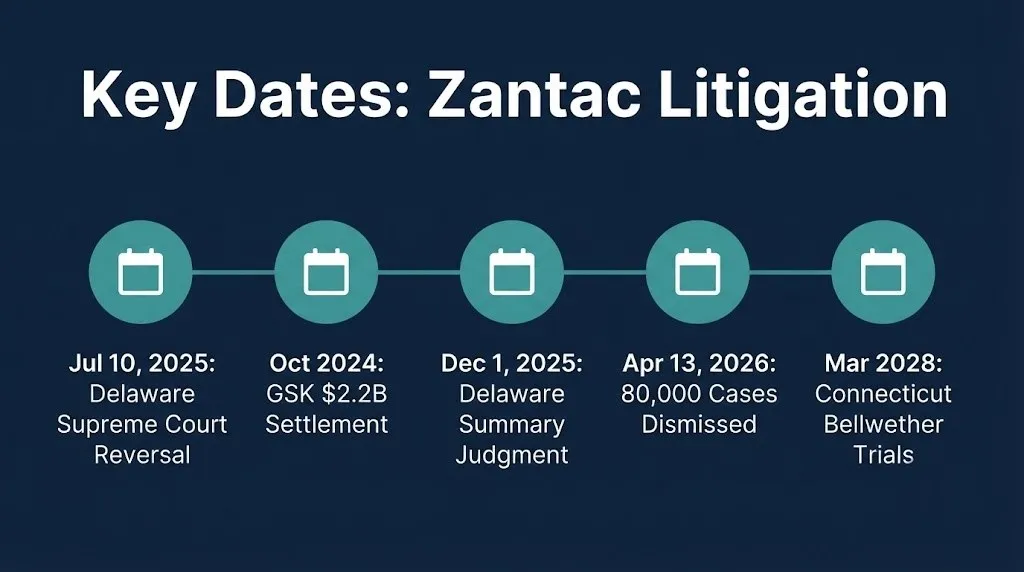
GSK’s settlement is the closest thing to a resolved chapter, and it’s actively disbursing. But claims against Boehringer Ingelheim remain contested in multiple states, with Connecticut bellwether trials not scheduled until March 14, 2028, followed by additional bellwether groups later that year and into 2029.
Realistic timeline expectations by manufacturer:
- GSK claims: largely resolved, payments processing through participating law firms now.
- Sanofi and Pfizer claims: mostly settled on a case-by-case or batch basis through 2025 and 2026.
- Boehringer Ingelheim Delaware claims filed before December 2025: dismissed April 13, 2026.
- Boehringer Ingelheim Illinois and California claims: ongoing individual trials, mixed but defense-leaning results.
- Boehringer Ingelheim Connecticut claims: bellwether trials not expected before 2028.
Key Takeaway: If your case is against GSK, you’re likely furthest along in the process; if it’s against Boehringer Ingelheim outside a settled state, expect this to take years longer.
Zantac Lawsuit Update Delaware: What the Dismissal Actually Means
The Delaware dismissal in April 2026 does not mean courts found ranitidine doesn’t cause cancer, it means the specific expert testimony plaintiffs relied on didn’t meet Delaware’s legal standard for scientific reliability.
On July 10, 2025, the Delaware Supreme Court unanimously reversed a lower court ruling that had allowed plaintiffs’ expert witnesses to testify. The Supreme Court found the trial court had wrongly applied a “liberal thrust” favoring admissibility, when the correct standard required plaintiffs to prove their experts’ reliability by a preponderance of the evidence.
That ruling sent the case back to the Superior Court for reevaluation under the corrected standard. On December 1, 2025, the Superior Court granted summary judgment for the defendants, effectively ending most of the Delaware litigation. On April 13, 2026, a Delaware court formally dismissed more than 80,000 lawsuits against Boehringer Ingelheim specifically, all filed before December 2025, with the firm King & Spalding, representing Boehringer Ingelheim, describing the dismissal as covering over 40,000 of those cases directly tied to the company.
What this ruling was and wasn’t:
- It was a ruling on expert-testimony admissibility and evidentiary standards.
- It was not a scientific finding that ranitidine doesn’t cause cancer.
- Plaintiffs may have procedural options to seek further review; as of June 2026, any appellate challenge to the April 2026 order remained unresolved publicly.
Ranitidine Lawsuit: Is New Filing Still Possible in 2026?
Yes, some law firms are still accepting new ranitidine cancer cases, though eligibility depends heavily on your state’s statute of limitations and which manufacturer’s product you used.
The Delaware dismissal specifically affected cases filed before December 2025 in that state. It doesn’t automatically bar new claims elsewhere, or claims against manufacturers who haven’t yet settled or won dismissal in your jurisdiction.
Steps if you’re considering filing a new claim:
- Confirm which brand and years of Zantac or generic ranitidine you used, since manufacturer ownership changed over time.
- Gather documented medical records showing your specific cancer diagnosis.
- Identify your state’s statute of limitations for product liability claims, since this varies significantly.
- Consult with a firm actively litigating cases against the correct manufacturer for your usage period.
- Understand that Illinois currently applies a different, historically less restrictive expert-testimony standard (Frye) than Delaware’s Daubert-based approach, which has allowed more Illinois cases to reach a jury even though none have yet resulted in a plaintiff verdict.
What Happens Next
April 13, 2026 (confirmed): Delaware court dismissed over 80,000 Boehringer Ingelheim lawsuits filed before December 2025.
Ongoing (2026): GSK’s $2.2 billion settlement continues disbursing through participating plaintiffs’ firms.
Ongoing (2026): Boehringer Ingelheim continues defending individual trials in Illinois, California, and other states, with eight consecutive defense verdicts reported by early 2026.
Unresolved as of June 2026: Status of any appellate challenge to the April 2026 Delaware dismissal remains unclear publicly.
March 14, 2028 (scheduled): Connecticut bellwether trials against Boehringer Ingelheim expected to begin, with additional bellwether groups for other cancer types following into 2029.
Frequently Asked Questions
Is the Zantac lawsuit still active in 2026?
Yes, though its status depends entirely on which manufacturer and state you’re asking about.
GSK’s settlement is actively disbursing, while Boehringer Ingelheim continues fighting cases in Illinois, Connecticut, and California after Delaware dismissed over 80,000 claims against it in April 2026.
There is no single unified “Zantac lawsuit” status, it’s a collection of separate legal battles.
How much money can I get from the Zantac lawsuit?
No publicly confirmed per-person payout amount exists for any Zantac settlement.
GSK’s fund covers up to $2.2 billion across roughly 80,000 claims, but individual amounts depend on cancer type and evidence, determined by each participating law firm.
Other manufacturers’ settlements have been reached confidentially, with terms not disclosed.
What happened with the Zantac lawsuit in Delaware?
A Delaware court dismissed over 80,000 lawsuits against Boehringer Ingelheim on April 13, 2026, for cases filed before December 2025.
This followed a July 2025 Delaware Supreme Court ruling that plaintiffs’ expert testimony didn’t meet the state’s scientific reliability standard.
The ruling was about evidentiary standards, not a scientific finding that ranitidine is safe.
Can I still file a Zantac cancer lawsuit in 2026?
Some law firms are still accepting new cases, depending on your state’s statute of limitations and which manufacturer you’d be suing.
The Delaware dismissal specifically affects cases filed there before December 2025 against Boehringer Ingelheim.
Consult an attorney litigating active cases against the correct manufacturer for your specific usage period.
How long will the Zantac lawsuit take to fully resolve?
There’s no single resolution date, since different manufacturers are on different timelines.
GSK’s settlement is the furthest along and is actively paying out claims now.
Boehringer Ingelheim’s Connecticut bellwether trials aren’t scheduled until March 2028, with other cancer-type trial groups following into 2029.
Has any jury ruled in favor of Zantac plaintiffs?
No jury has yet found in favor of a Zantac plaintiff in a trial verdict, as of the most recent public reporting.
Boehringer Ingelheim had won at least eight defense verdicts in Illinois trials by early 2026.
Settlements reached by GSK, Sanofi, and Pfizer resolved claims outside of trial, without a jury verdict either way.
What cancers are most strongly linked to Zantac in the lawsuits?
Bladder, esophageal, and stomach cancer claims are generally viewed as carrying stronger scientific support in the litigation.
Prostate and colorectal cancer claims were excluded from the federal case due to weaker evidence, and Illinois prostate cancer trials have consistently ended in defense verdicts.
The strength of your individual case depends on your specific diagnosis and documented usage history.
Is the Zantac lawsuit a class action?
Not exactly. It’s more accurately described as a mass tort, made up of individually filed lawsuits consolidated for pretrial purposes, plus separate state court cases.
This differs from a traditional class action where everyone receives a standardized payout from a single fund.
Each Zantac claimant’s case and potential compensation is evaluated somewhat individually, even within a larger settlement like GSK’s.
If you believe you may have a Zantac-related claim, the most useful next step is confirming which manufacturer’s product you used and during what years, since that single detail determines your legal options far more than any general update. From there, documented medical records matter more than anything else you can gather.
The one fact worth remembering: as of July 19, 2026, GSK’s $2.2 billion settlement continues disbursing while Boehringer Ingelheim’s Delaware cases were dismissed just months ago, and litigation against Boehringer continues elsewhere with no unified resolution date.