Listerine Lawsuit 2026: Cancer Claims, Payouts, and Who May Qualify
Quick Answer
- The Listerine lawsuit claims Cool Mint mouthwash raises cancer-linked oral bacteria without warning consumers.
- No payout has been confirmed. Mass tort attorneys project ranges based on injury severity, not verified awards.
- No claim deadline exists yet because no settlement fund has been approved by any court.
The Listerine lawsuit is a proposed class action, not a settlement with money waiting for claimants. It claims regular use of Listerine Cool Mint Antiseptic Mouthwash causes harmful bacteria to multiply in the mouth .
If you used Cool Mint Listerine daily and later received an oral, throat, or colon cancer diagnosis, you may be affected by this litigation. But there is no form to file today, no administrator collecting claims, and no confirmed payout amount.
This article separates verified court facts from attorney projections. It covers the bacteria science behind the claim, what the case actually alleges, and how mass tort payouts work when no settlement exists. One detail most coverage misses: the case names both Johnson & Johnson and Kenvue, the company spun off to hold Listerine and other consumer brands .
The Facts
| Case | Vasseur et al. v. Johnson & Johnson Consumer, Inc. and Kenvue Inc. |
|---|---|
| Status | Filed September 2024, ongoing |
| Fund Size | Not yet confirmed. No settlement approved |
| Est. Per Person | Not yet determined. No verified payout exists |
| Claim Deadline | None set. No claims process open |
| Administrator | Not yet appointed |
| Proof Needed | Check with a mass tort attorney handling this case |
Is the Listerine Lawsuit Legit or a Scam?
The Listerine lawsuit is legitimate, but it is not a settlement you can join by filling out a form. It is a proposed class action filed in federal court, and the case is still in its early stages .
The scam risk comes from anyone promising Listerine settlement money in exchange for your information or an upfront fee. No settlement fund exists, so no one can process a claim for you.
The lawsuit names Johnson & Johnson Consumer, Inc. and Kenvue Inc. as defendants . Kenvue was spun off from J&J in 2022 and holds liability for Listerine and other consumer health brands .
The lead plaintiff, Paige Vasseur, says she bought Cool Mint Listerine regularly from 2019 through February 2024. She claims she would not have used it if she had known about the cancer-linked bacteria risk .
How Much Is the Listerine Lawsuit Payout?
No Listerine lawsuit payout has been confirmed because no settlement has been reached. Any dollar figures circulating online are projections from attorneys, not verified court awards .
Mass tort attorneys handling similar cases estimate ranges based on injury severity. These are not guaranteed Listerine-specific figures:
| Injury Category | Estimated Range (Projected, Not Verified) |
|---|---|
| Early-stage cancer, minimal treatment | $50,000 to $150,000 |
| Moderate-stage cancer, surgery or radiation | $150,000 to $500,000 |
| Severe cancer, extensive treatment | $500,000 to $1,500,000+ |
| Terminal or wrongful death | $1,000,000 to $3,000,000+ |
These projections come from comparable mass tort cases and assume a settlement fund is eventually created. No such fund exists in 2026 .
Attorney fees in contingency-based mass torts typically run 33% to 40% of any gross recovery. That comes out of whatever you receive, not out of pocket upfront.
Reality Check: No one will text or email you offering Listerine settlement money. The case has not settled, no administrator has been appointed, and filing is always free if a claims process eventually opens. Anyone charging you a fee to “process” a Listerine claim before a settlement exists is not legitimate.
Who May Qualify for a Listerine Lawsuit Claim?
You may qualify for the Listerine lawsuit if you used Cool Mint Listerine regularly and were later diagnosed with a cancer linked to the bacteria the product allegedly promotes. Eligibility rules have not been finalized by any court.
The scientific claim centers on two bacteria: Streptococcus anginosus (S. anginosus) and Fusobacterium nucleatum (F. nucleatum). A study cited in the lawsuit found that daily Cool Mint Listerine use increased levels of both, and these bacteria are associated with esophageal and colon cancers .
The lawsuit also claims Listerine use decreased Actinobacteria, a type of bacteria that may help reduce inflammation and prevent cancer .
Factors that would likely matter for any future claim:
- Product used: Listerine Cool Mint Antiseptic Mouthwash specifically, not other Listerine varieties.
- Duration and frequency: Regular daily use over months or years, not occasional use.
- Diagnosis: Oral, throat, esophageal, or colon cancer diagnosed after consistent use.
- Causation questions: Tobacco use, alcohol consumption, and HPV status will be examined because they also cause these cancers.
No court has certified a class or defined eligibility rules yet. Any attorney evaluating your case will apply their own screening criteria.
Key Takeaway: The Listerine lawsuit targets Cool Mint mouthwash specifically, and any future eligibility will likely hinge on documented daily use plus a cancer diagnosis, not just product purchase.
How Do You File a Listerine Lawsuit Claim?
You cannot file a Listerine lawsuit claim today because no settlement claims process exists. The case is active litigation, not a settlement with an open claim form.
If you believe you have a claim, here is the process mass tort attorneys are using:
- Contact a mass tort attorney handling Listerine cases for a free evaluation.
- Provide your use history. Which Listerine product, how long, and how often.
- Submit medical records documenting your cancer diagnosis and treatment.
- Sign a contingency fee agreement if the attorney accepts your case.
- Wait for litigation to develop. Bellwether trials and settlement talks take years.
You do not pay anything upfront. Contingency means the attorney gets paid only if you recover money .
The Vasseur case is one proposed class action. Mass tort litigation often consolidates hundreds or thousands of individual claims into a coordinated proceeding, but that has not happened for Listerine yet.
What Is the Listerine Lawsuit About?
The Listerine lawsuit is about whether Johnson & Johnson and Kenvue failed to warn consumers that Cool Mint mouthwash promotes cancer-linked bacteria. The claim is failure to warn and consumer deception, not that Listerine directly causes cancer.
Listerine Cool Mint has long been marketed with the claim that it kills 99.9% of oral bacteria when used twice daily for 30 seconds . The lawsuit does not dispute that it kills many bacteria. The claim is that it also lets certain harmful bacteria thrive.
The research cited found that daily use raised levels of F. nucleatum and S. anginosus, both linked to colorectal and esophageal cancers. It also found a drop in Actinobacteria, which may protect against inflammation .
The plaintiff, Paige Vasseur, says she used the product as directed from 2019 to early 2024. She argues that if the warning had been on the label, she would have stopped .
The case is in the District of New Jersey, case number 25-cv-1221 .
What Bacteria Does Listerine Cool Mint Affect?
Listerine Cool Mint is alleged to increase Fusobacterium nucleatum and Streptococcus anginosus, two bacteria tied to cancer risk. It is also alleged to decrease Actinobacteria, which may help reduce inflammation.
Here is what the cited research found:
| Bacteria | Effect of Daily Cool Mint Use | Cancer Link |
|---|---|---|
| Fusobacterium nucleatum | Increased | Colorectal and esophageal |
| Streptococcus anginosus | Increased | Esophageal and colon |
| Actinobacteria | Decreased | Loss may reduce anti-inflammatory protection |
The study looked at daily use over time, matching the product’s own instructions to use twice daily .
The lawsuit does not claim Listerine causes cancer directly. It claims the product creates conditions that may raise risk, and that consumers were not told.
What Happens Next in the Listerine Lawsuit?
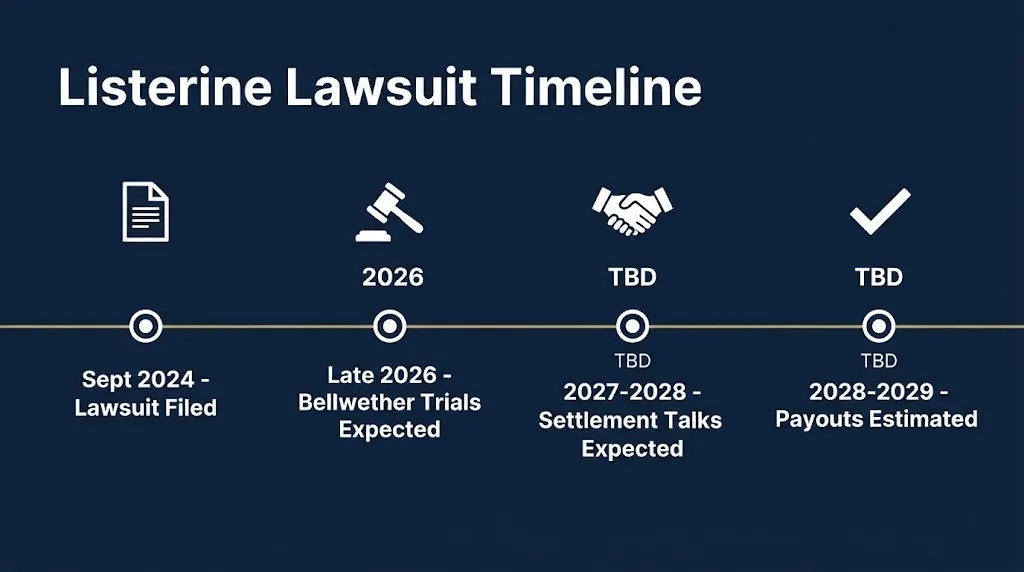
The Listerine lawsuit is in early litigation, and the next stages involve court rulings, possible consolidation, and eventually bellwether trials or settlement talks.
Expected late 2026 to early 2027: Bellwether trials test how juries react to the strongest claims. Results shape settlement negotiations .
Expected 2027 to 2028: If bellwethers produce mixed results, both sides may negotiate a global settlement fund. No timeline is guaranteed.
Expected 2028 to 2029 (estimate): If a settlement is reached and approved, a claims process would open with a published deadline and administrator .
Ongoing: The Vasseur case moves through discovery in the District of New Jersey. No trial date has been confirmed.
These timelines are projections from mass tort attorneys, not court orders. Mass torts routinely run longer than expected.
Frequently Asked Questions
Is there a Listerine lawsuit settlement in 2026?
No. No settlement has been reached, no fund exists, and no claims process is open. The case is active litigation .
How much will I get from the Listerine lawsuit?
Nothing has been determined. Any payout depends on whether a settlement is reached and how injury severity is scored. Projections exist, but no verified amount does .
What Listerine product is the lawsuit about?
The lawsuit targets Listerine Cool Mint Antiseptic Mouthwash specifically, not other Listerine varieties .
Do I need a lawyer to file a Listerine claim?
You cannot file a claim yet because no claims process exists. If one opens, mass tort claims typically require attorney representation, handled on contingency.
What cancers are linked to Listerine Cool Mint?
The lawsuit cites esophageal and colon cancers in connection with the bacteria F. nucleatum and S. anginosus .
Is the Listerine lawsuit a class action or mass tort?
It is currently a proposed class action filed in New Jersey federal court. Mass tort attorneys are also signing individual clients for potential future claims .
Who owns Listerine now, Johnson & Johnson or Kenvue?
Kenvue owns Listerine. It was spun off from Johnson & Johnson in 2022, and the lawsuit names both companies as defendants .
How long does a Listerine lawsuit take?
Mass torts typically take years. Bellwether trials are projected for late 2026 to early 2027, with any settlement distribution unlikely before 2028 or later .