Hair Straightening Lawsuit 2026: No Settlement Yet, 12,000+ Cases and the Real Deadlines
Quick Answer
- Is there a settlement? No. No global settlement exists and no plaintiff has been paid through the MDL.
- How much money? Not yet determined. Payouts depend on bellwether trial outcomes expected in 2027.
- Key deadline? The statute of limitations varies by state, typically 2 to 4 years from diagnosis.
The hair straightening lawsuit is real, active, and growing. More than 12,000 women have filed federal claims alleging that chemical hair relaxers caused uterine, ovarian, and endometrial cancer. But here’s what most websites won’t tell you plainly: there is no settlement money available right now.
If you’re searching for this lawsuit, you’re likely one of two people. Either you used these products for years and recently received a diagnosis. Or you saw a headline about a “hair straightener settlement” and want to know if you can claim money. The first group has a real legal claim worth pursuing. The second group is chasing something that doesn’t exist yet.
This article breaks down exactly where the litigation stands in 2026, who may qualify to file, what the science actually says, and why any website promising you a settlement payout today is misleading you.
The Facts
| Case | In re: Hair Relaxer Marketing, Sales Practices, and Products Liability Litigation, MDL No. 3060 |
|---|---|
| Court | U.S. District Court, Northern District of Illinois, Judge Mary M. Rowland |
| Status | Active pretrial litigation, no settlement |
| Fund Size | Not yet confirmed (no settlement fund exists) |
| Est. Per Person | Not yet determined |
| Claim Deadline | Varies by state statute of limitations |
| Administrator | Not yet appointed |
| Proof Needed | Medical diagnosis and product use documentation |
Is the Hair Straightening Lawsuit Real or a Scam?
The hair straightening lawsuit is entirely real, consolidated as MDL 3060 in the Northern District of Illinois since February 2023. Judge Mary Rowland oversees more than 12,000 individual claims .
The scam risk isn’t the lawsuit itself. It’s the websites and call centers that promise settlement money that doesn’t exist. Some sites use phrases like “file your claim now” or “get your payout” when there is no fund to claim from. Those sites are collecting your information for lead generation, not processing real claims.
Here’s how to tell the difference. A legitimate mass tort attorney will tell you that no settlement exists, that the case is in pretrial discovery, and that any payout is likely years away. A scam will promise quick money and pressure you to sign something immediately.
The defendants in this case include L’Oreal USA, Revlon, Strength of Nature, and Namaste Laboratories (Dabur). The lawsuits allege these companies knew about cancer risks and failed to warn consumers .
How Much Money Will Hair Straightening Lawsuit Claimants Get?
Not yet determined. No settlement fund exists, no payout amounts have been established, and no claims administrator has been appointed. Anyone quoting you a specific dollar figure is guessing .
That said, you can look at comparable mass torts for context. Projected ranges from legal analysts suggest potential payouts could fall between $20,000 and $200,000 or more, depending on diagnosis severity, treatment costs, and case strength . But these are projections, not promises.
Here’s what actually drives payout amounts in mass torts:
| Factor | Impact on Payout |
|---|---|
| Cancer type and stage | More severe diagnoses typically receive higher compensation |
| Age at diagnosis | Younger claimants may receive more for lost earning capacity |
| Duration of product use | Longer exposure strengthens causation arguments |
| Medical documentation | Complete records are essential |
| Bellwether trial outcomes | Jury verdicts set the baseline for settlement values |
The single biggest variable is what happens in the bellwether trials. If juries award large verdicts, settlement offers rise. If defendants win, offers shrink or disappear .
Reality Check: No one will text you a settlement check from this lawsuit. No fund exists. Filing is free through an attorney, and legitimate mass tort lawyers work on contingency, meaning they only get paid if you do. Anyone asking for upfront fees to “process” your hair relaxer claim is running a scam.
Who Qualifies to File a Hair Straightening Cancer Lawsuit?
You may qualify to file a hair straightening lawsuit if you used chemical hair relaxers regularly and were later diagnosed with uterine, endometrial, or ovarian cancer. The key is establishing both the exposure and the diagnosis .
The eligibility criteria attorneys are reviewing include:
- Product use: You used chemical hair straighteners or relaxers (not just heat tools)
- Frequency: Regular use over an extended period, often years
- Application: Products applied to the scalp as directed
- Diagnosis: Uterine, endometrial, ovarian, or another hormone-related cancer
- Timing: Diagnosis occurred after product use, with the statute of limitations still open
The Sister Study, published in October 2022, found that women who used hair straighteners more than four times per year were more than twice as likely to develop uterine cancer compared to non-users . That study triggered the wave of lawsuits now consolidated in the MDL.
Black women are disproportionately affected. The products were marketed heavily to Black communities for decades, and Black women have higher rates of aggressive uterine cancer types .
Key Takeaway: You may qualify to file if you used chemical relaxers regularly and were diagnosed with uterine, ovarian, or endometrial cancer. The statute of limitations varies by state, so timing matters.
Which Hair Relaxer Products Are Named in the Lawsuit?
The hair relaxer products named in the lawsuit include brands from L’Oreal, Revlon, Strength of Nature, and Namaste Laboratories. These are some of the most widely used chemical straighteners in the United States .
Here’s the breakdown by manufacturer:
| Manufacturer | Brands Named |
|---|---|
| L’Oreal USA / SoftSheen-Carson | Dark & Lovely, Optimum |
| Revlon | Creme of Nature, African Pride, French Perm, Fabulaxer |
| Strength of Nature Global | Just For Me, Motions, TCB |
| Namaste Laboratories / Dabur | Organic Root Stimulator (ORS Olive Oil) |
Revlon’s situation is complicated by its 2022 bankruptcy filing. The company set a claims bar date for hair straightener product claims, and that deadline has passed. However, Revlon has since emerged from bankruptcy, and some claimants may still have options .
L’Oreal is the largest defendant by market share. Its Dark & Lovely brand has been a best-seller in Black communities for decades. The company has contested the science behind the lawsuits and filed motions challenging expert testimony .
How Do You File a Hair Straightening Lawsuit?
You file a hair straightening lawsuit by consulting with a mass tort attorney who will evaluate your claim and, if qualified, file an individual complaint in the MDL. The process does not require upfront payment from you .
Here are the steps:
- Gather your medical records showing your cancer diagnosis and treatment dates.
- Document your product use including brands, years of use, and frequency.
- Consult a mass tort attorney experienced in MDL 3060 litigation.
- Complete the intake process with details about your exposure and diagnosis.
- Attorney files your complaint in the Northern District of Illinois or appropriate state court.
- Your case is consolidated into the MDL for pretrial proceedings.
- Discovery proceeds while you wait for bellwether trial outcomes.
- Settlement or trial follows if the case resolves.
The key difference between this and a class action: each plaintiff keeps their own individual claim. The MDL structure just consolidates pretrial procedures .
What Is the Deadline to File a Hair Straightening Lawsuit?
The deadline to file a hair straightening lawsuit depends on your state’s statute of limitations, which typically runs 2 to 4 years from the date of diagnosis. There is no single national deadline .
Here are examples from key states:
| State | Time Limit | Clock Starts |
|---|---|---|
| California | 2 years | Discovery of injury |
| New York | 3 years | Discovery of injury |
| Texas | 2 years | Diagnosis |
| Florida | 2 years | Diagnosis |
| Illinois | 2 years | Discovery |
| Louisiana | 1 year | Injury |
| Tennessee | 1 year | Injury |
The “discovery rule” in many states means the clock starts when you reasonably knew or should have known that your illness might be connected to product use. If you were diagnosed years ago but only learned about the hair relaxer connection recently, you may still have time .
This is the most time-sensitive part of the entire process. Missing the statute of limitations means losing the right to file permanently, regardless of how strong your case is.
Hair Straightening Lawsuit MDL 3060 Update: Where the Case Stands in 2026
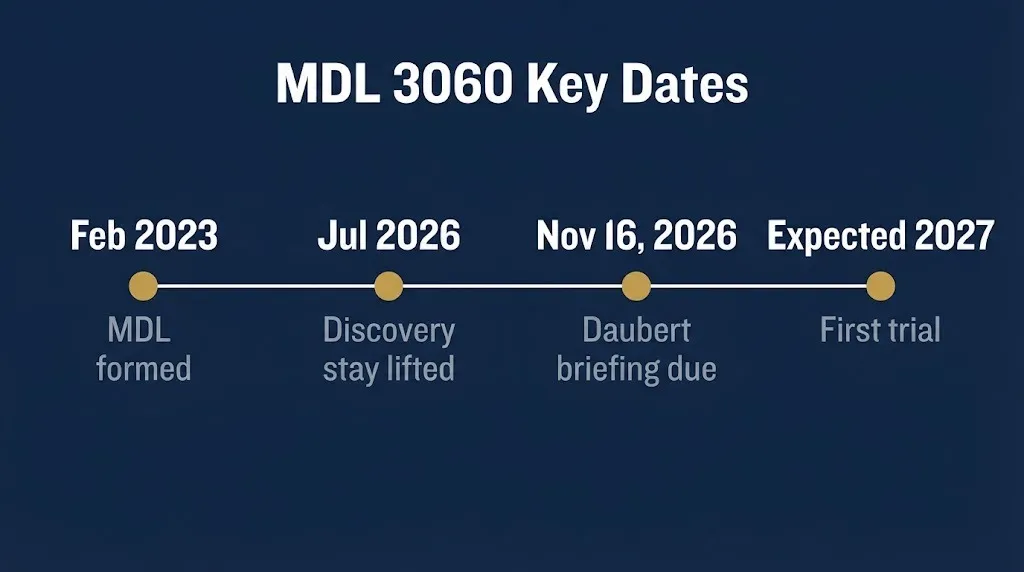
The MDL 3060 update for 2026 shows a case moving toward trial, not settlement. Judge Rowland lifted the discovery stay on second-wave defendants in July 2026 and cut the bellwether pool from ten cases to five in September 2026 .
Key developments this year:
- 12,129 cases pending as of the September 1, 2026 JPML report
- Discovery stay lifted on July 27, 2026 for second-wave defendants
- Bellwether pool narrowed from ten to five cases on September 1, 2026
- Second-wave discovery extended through July 15, 2027
- Daubert and summary judgment briefing due November 16, 2026
- First federal trial expected in 2027
The Daubert briefing is the single most important date on the calendar. This is the fight over whether plaintiffs’ expert testimony linking relaxer chemicals to cancer is admissible at all. Mass torts that clear this hurdle go on to be worth something. Mass torts that fail it collapse .
A special settlement mediator, Ellen Reisman, has been involved since 2025. But the court’s decision to lift the discovery stay signals that settlement was not close as of mid-2026 .
Key Takeaway: The MDL is moving toward trial, not settlement. Daubert briefing on November 16, 2026 will determine whether the science survives. First trial is expected in 2027.
What Does the Science Say About Hair Straighteners and Cancer?
The science says some studies link frequent hair straightener use to increased cancer risk, but causation has not been conclusively established. The evidence is strongest for uterine and ovarian cancers .
The Sister Study, published in October 2022, followed nearly 46,000 women for over a decade. Researchers found that frequent users of chemical straighteners had more than double the risk of uterine cancer compared to non-users .
Additional findings from the same study group suggest elevated risks for pancreatic and thyroid cancers, though experts caution that these results are less consistent .
The chemicals of concern include:
- Formaldehyde and formaldehyde-releasing agents (IARC-classified carcinogens)
- Phthalates (endocrine disruptors)
- Parabens (endocrine disruptors)
- Metals found in some products
The FDA has proposed a ban on formaldehyde in hair straighteners, but that rule has been paused under a Trump Administration executive order .
Defendants argue that the science is not reliable enough to support causation claims. That’s exactly what the Daubert hearing will decide .
What Happens Next With the Hair Straightening Lawsuit?
The hair straightening lawsuit will move through several key stages over the next two years, with no settlement expected before 2027 at the earliest.
Expected timeline:
- November 16, 2026: Daubert and summary judgment briefing due. This determines whether expert causation testimony survives .
- Expected 2027: First bellwether trial. Jury verdicts will set the baseline for settlement values .
- Expected 2027: Global settlement negotiations intensify following bellwether outcomes .
- Expected 2027-2028: Individual disbursements to claimants if a settlement is reached .
The case is moving faster than many mass torts. The MDL was established in February 2023 and has already reached the Daubert stage. That’s relatively quick for litigation of this size.
But “faster” doesn’t mean “fast.” Mass torts of this scale typically take three to five years from consolidation to resolution. The hair relaxer MDL is on track for that timeline, not ahead of it.
Frequently Asked Questions
Is there a hair straightening lawsuit settlement in 2026?
No, there is no hair straightening lawsuit settlement in 2026. No global settlement has been announced and no plaintiff has been paid through the MDL .
How much will hair straightener cancer lawsuit payouts be?
Payout amounts are not yet determined. No settlement fund exists, so no per-person amounts have been established. Projections range widely based on bellwether outcomes .
Can I still file a hair straightener lawsuit?
You may still file if your state’s statute of limitations has not expired. Most states allow 2 to 4 years from diagnosis or discovery of the injury .
Which hair straighteners are in the lawsuit?
The lawsuit names products from L’Oreal (Dark & Lovely), Revlon (Creme of Nature), Strength of Nature (Just For Me), and Namaste Laboratories (ORS Olive Oil), among others .
Does the hair relaxer lawsuit include breast cancer?
The lawsuit primarily focuses on uterine, ovarian, and endometrial cancers. Some claims mention breast cancer, but the strongest scientific evidence is for hormone-related reproductive cancers .
How long does a hair relaxer lawsuit take?
Mass torts of this size typically take 3 to 5 years from consolidation to resolution. The hair relaxer MDL is on track for bellwether trials in 2027, with settlement possible later .
What chemicals in hair straighteners cause cancer?
Formaldehyde is the most well-known carcinogen in these products. Phthalates and parabens are endocrine disruptors that may also contribute to cancer risk .
Is the hair straightener lawsuit a class action?
No, the hair straightener lawsuit is not a class action. It’s a multidistrict litigation (MDL) where each plaintiff keeps their individual claim. The MDL consolidates pretrial procedures, not the claims themselves .
What You Should Do Now
If you used chemical hair relaxers regularly and were diagnosed with uterine, ovarian, or endometrial cancer, the statute of limitations is your most important deadline. It varies by state and typically runs 2 to 4 years from diagnosis.
Consult a mass tort attorney experienced in MDL 3060 to evaluate your claim. The consultation is typically free, and the attorney works on contingency, meaning no upfront costs to you.
There is no settlement money to claim today. But filing preserves your right to compensation if and when a settlement is reached. The Daubert hearing on November 16, 2026 will be the next major milestone determining whether this litigation moves toward resolution.