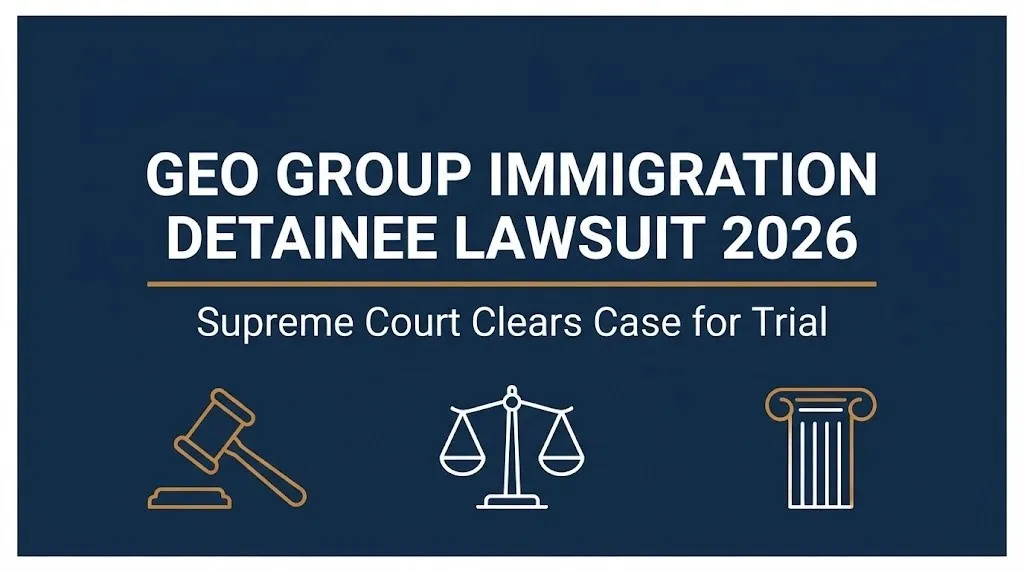
GEO Group Immigration Detainee Lawsuit 2026: Supreme Court Ruling and Case Status Explained
Quick Answer
- The GEO Group immigration detainee lawsuit is a real, ongoing federal class action, not a settled case, and no payout process currently exists.
- There is no confirmed settlement amount in the Colorado case; a related Washington case already resulted in a $23.2 million judgment against GEO.
- There is no claim deadline right now, since the Colorado case hasn’t reached a settlement or final verdict.
If you’re searching “geo group immigration detainee lawsuit” in 2026, you’re likely following news of a major Supreme Court ruling, or you may have been detained at a GEO-operated facility and are trying to understand your rights. This isn’t a case you can currently file a claim in, but it is very real and moving toward trial.
This case affects a specific, defined group. The lawsuit centers on the Aurora Immigration Processing Center in Colorado, where GEO Group required detainees to perform mandatory cleaning work and paid others just $1 a day through a “Voluntary Work Program.” On February 25, 2026, the U.S. Supreme Court unanimously rejected GEO’s bid to immediately appeal a lower court ruling, clearing the way for the case to proceed toward trial.
This article breaks down what the Supreme Court actually decided, what a related Washington state case already resulted in, and what comes next for the Colorado litigation. One detail that stands out: this same company already lost a nearly identical case in Washington state, resulting in a $23.2 million combined judgment, yet continued the same practices in Colorado for years afterward.
The Facts
| Case | Menocal v. The GEO Group, Inc., No. 1:14-cv-02887, U.S. District Court for the District of Colorado |
| Status | Active litigation heading toward trial; Supreme Court ruled against GEO on a procedural appeal February 25, 2026 |
| Fund Size | Not yet determined; no settlement has been reached |
| Est. Per Person | Not yet determined; case has not gone to trial or settled |
| Claim Deadline | Not applicable; no settlement or claims process currently exists |
| Related Case | Nwauzor v. GEO Group, Inc. (Washington state), resulted in a $23.2 million combined judgment, upheld by the Ninth Circuit in 2025 |
| Proof Needed | Not applicable at this stage; class was certified in 2017 covering detainees at the Aurora facility |
Is the GEO Group Immigration Detainee Lawsuit Real?
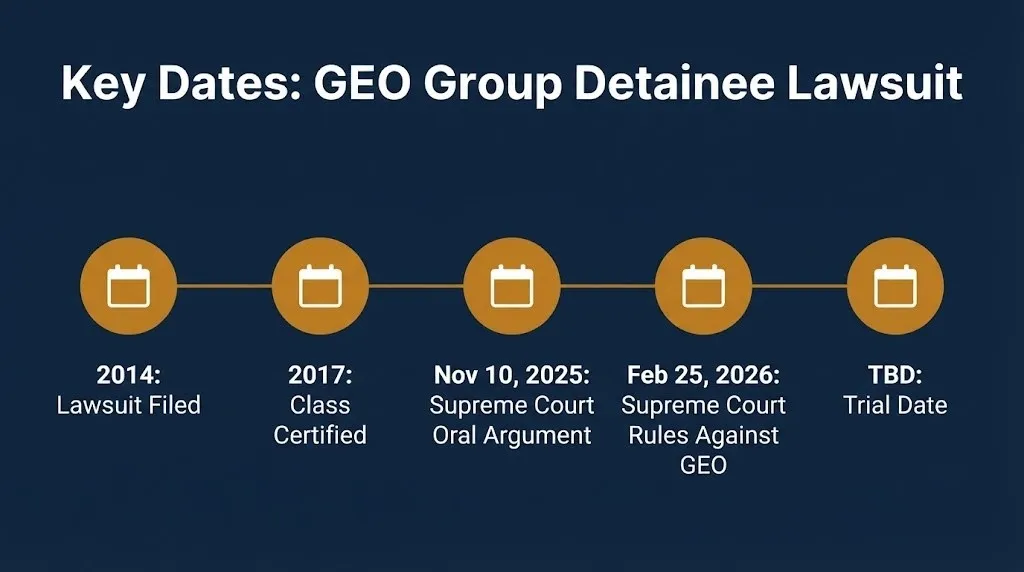
Yes, this is a real federal class action lawsuit, first filed in 2014, and it recently reached the U.S. Supreme Court.
The formal case is Menocal v. The GEO Group, Inc., filed in the U.S. District Court for the District of Colorado. Lead plaintiff Alejandro Menocal, a former detainee at the Aurora Immigration Processing Center, filed suit alleging GEO’s work policies violated the federal Trafficking Victims Protection Act and Colorado’s prohibition on unjust enrichment.
The district court certified two classes in 2017, and the U.S. Court of Appeals for the Tenth Circuit affirmed that certification in 2018. The case then reached the U.S. Supreme Court on a narrower procedural question, not the underlying merits of the allegations.
Key facts confirming legitimacy:
- The Supreme Court issued a formal written opinion, GEO Group, Inc. v. Menocal, 607 U.S. _ (2026), authored by Justice Elena Kagan.
- The ruling was unanimous, 9-0, with two justices writing separate concurring opinions.
- GEO Group is a publicly traded company (NYSE: GEO) and one of the largest private detention providers in the country, operating roughly 77,000 beds across 98 facilities.
GEO Group Lawsuit: What Did the Supreme Court Actually Rule?
The Supreme Court ruled that GEO Group cannot immediately appeal a lower court’s rejection of its immunity defense, clearing the way for the underlying case to proceed toward trial.
GEO argued it should be shielded from the lawsuit under “derivative sovereign immunity,” a legal doctrine from a 1940 case, Yearsley v. W.A. Ross Construction Co., holding that federal contractors generally can’t be held liable for conduct the government specifically authorized and directed.
The district court rejected that defense back in October 2022, finding that ICE never directed or required GEO to compel detainee labor or limit pay to $1 per day. GEO then tried to immediately appeal that rejection before the case went to trial, a legal maneuver called an interlocutory appeal.
What the Supreme Court decided, in plain terms:
- The Court held that an order denying a government contractor’s immunity claim cannot be immediately appealed.
- This was a procedural ruling about appeal timing, not a decision on whether GEO actually violated the law.
- If GEO ultimately loses at trial, it can still raise this same immunity argument on appeal at that point.
Key Takeaway: This Supreme Court ruling didn’t decide whether GEO Group is liable, it just removed one of the company’s main tools for delaying the case before trial.
GEO Group Lawsuit: What Happened at the Aurora Facility?
The lawsuit alleges GEO Group required immigration detainees to clean common areas under a mandatory “Sanitation Policy,” with punishment for those who refused, and separately paid other detainees just $1 a day through a labor program.
According to court filings, detainees who refused cleaning assignments faced escalating discipline, starting with suspension of television and phone privileges and potentially resulting in solitary confinement for up to 72 hours. Menocal himself was detained from June to September 2014 and testified to witnessing fellow detainees placed in isolation for refusing to clean.
The two core allegations in the case:
| Allegation | Legal Basis |
|---|---|
| Mandatory, unpaid cleaning under threat of discipline | Federal Trafficking Victims Protection Act |
| $1-per-day “Voluntary Work Program” pay | Colorado state law against unjust enrichment |
GEO Group has defended its labor program, arguing its pay rates align with Immigration and Customs Enforcement regulations, and describing the lawsuits more broadly as an indirect challenge to federal immigration policy rather than a genuine labor dispute.
Reality Check
No settlement currently exists in the Colorado GEO Group case, so anyone claiming you can file for compensation right now is mistaken or worse. If this case does eventually settle or result in a verdict, class members would receive formal legal notice through the court process, not an unsolicited text or email asking for personal information upfront.
GEO Group Lawsuit Washington: What the $23.2 Million Judgment Covered
A separate, related case in Washington state already resulted in a combined $23.2 million judgment against GEO Group, upheld by the Ninth Circuit Court of Appeals.
That case, formally Nwauzor v. GEO Group, Inc. and a companion suit brought by the State of Washington, centered on GEO’s Northwest ICE Processing Center in Tacoma. GEO used detainee labor for essentially all non-security functions at the facility, including cooking, cleaning, repairs, and laundry, paying detainees $1 per day between 2005 and the case’s 2021 jury verdict.
What the Washington judgment included:
- $17.3 million awarded to the detainee class for back pay under Washington’s Minimum Wage Act.
- $5.9 million awarded to the State of Washington for unjust enrichment.
- A court injunction prohibiting GEO from using detainee labor without paying at least Washington’s minimum wage going forward.
In response to that injunction, GEO chose to suspend its Voluntary Work Program at the Tacoma facility entirely, rather than comply with the minimum wage requirement.
Key Takeaway: GEO Group already lost a nearly identical labor case in Washington state, with the Ninth Circuit rejecting the same type of immunity and preemption arguments the company is now making in the separate Colorado case.
GEO Group Immigration Detainee Lawsuit: Where Does the Case Stand Right Now?
The Colorado case is actively moving toward trial, with a federal judge planning a personal visit to the Aurora Detention Facility before ruling on pending pretrial motions.
According to court docket records, a previously entered stay in the case was lifted following the Supreme Court’s February 2026 ruling. The presiding judge indicated intent to personally visit the Aurora facility before deciding a pending motion for a jury view of the site, with that visit expected within four weeks of the March 2026 order.
Recent procedural developments in the Colorado case:
- February 25, 2026: Supreme Court ruled unanimously against GEO’s immunity appeal.
- March 2026: The case’s litigation stay was formally lifted.
- The court scheduled pretrial conference dates for late April and early May 2026.
- The judge indicated plans to personally visit the Aurora Detention Facility before ruling on a pending motion for jury view.
- No trial date has been publicly confirmed as of this writing.
What Happens Next
February 25, 2026 (confirmed): Supreme Court ruled 9-0 against GEO’s immunity appeal, allowing the case to proceed.
March 2026 (confirmed): Litigation stay lifted; case moves back toward active pretrial proceedings.
April to May 2026 (confirmed scheduling): Pretrial conference dates set by the court.
Expected next step: Judge’s personal visit to the Aurora facility, followed by a ruling on the pending motion for jury view.
Unconfirmed: No public trial date has been set as of this writing; a trial, settlement, or further appeal remains possible.
Frequently Asked Questions
Is the GEO Group immigration detainee lawsuit real?
Yes, it’s a real federal class action, Menocal v. The GEO Group, Inc., first filed in 2014 in Colorado.
The case recently reached the U.S. Supreme Court, which issued a unanimous ruling against GEO Group on February 25, 2026.
The lawsuit remains active and is moving toward trial in the district court.
Can I file a claim in the GEO Group lawsuit right now?
No, there is currently no settlement, verdict, or claims process open in the Colorado case.
The lawsuit is still in active pretrial litigation, with no trial date publicly confirmed as of this writing.
If the case eventually resolves, class members would receive formal notice through the court, not an unsolicited request for information.
What did the Supreme Court rule in the GEO Group case?
The Supreme Court ruled that GEO Group cannot immediately appeal a lower court’s rejection of its government contractor immunity defense.
This is a procedural ruling about appeal timing, not a decision on whether GEO Group is actually liable.
The underlying case now proceeds toward trial in the U.S. District Court for the District of Colorado.
How much money could detainees receive from the GEO Group lawsuit?
No settlement amount or verdict figure exists yet in the Colorado case, since it hasn’t reached trial.
A related, separate case in Washington state resulted in a combined $23.2 million judgment against GEO Group in 2021, upheld by the Ninth Circuit in 2025.
Any Colorado outcome would depend on the eventual trial or settlement negotiations, none of which have occurred yet.
What facility is involved in the GEO Group lawsuit?
The Colorado case centers on the Aurora Immigration Processing Center, operated by GEO Group under an ICE contract.
The related Washington case involved GEO’s Northwest ICE Processing Center in Tacoma.
Both facilities are among GEO Group’s larger immigration detention operations in the United States.
Did GEO Group deny the allegations in the lawsuit?
Yes, GEO Group has defended its labor program, arguing its pay rates align with ICE regulations.
The company also argued it should be immune from liability as a federal government contractor carrying out authorized instructions.
Courts in both the Washington and Colorado cases have rejected GEO’s immunity arguments so far.
What happens if GEO Group loses the Colorado case?
If GEO Group loses at trial, the company could still pursue an appeal at that point, including reviving its immunity argument.
A loss could also result in a damages award to the certified class of former Aurora facility detainees.
Any such outcome would take additional time to work through further appeals before becoming final.
If you were previously detained at the Aurora facility, the case’s certified class already covers relevant time periods, so there’s nothing to actively file yet. The most useful step right now is watching for official court notices rather than acting on secondhand claims about a settlement that doesn’t currently exist.
The fact to remember: as of July 19, 2026, this case remains unresolved, with no trial date confirmed and no settlement in place.