What Is a Settlement? Legal Definition and How the Process Works in 2026
Quick answer: A settlement is a legally binding agreement between parties in a dispute, usually involving a payment, that ends a lawsuit or claim without a trial or final court judgment.
Quick Answer
- A settlement is a voluntary agreement that resolves a legal dispute, typically before or during litigation, without a trial verdict.
- Settlement amounts vary case by case, and there’s no fixed formula, they depend on damages, liability, and negotiation.
- Most settlements include a release of further claims, meaning you generally can’t sue again over the same issue once you accept.
If you’re searching “what is a settlement,” you probably received a notice, saw a headline about a lawsuit payout, or you’re trying to understand an offer sitting in front of you right now. The word gets thrown around loosely in news coverage, so it helps to know exactly what it means and what it doesn’t.
At its core, a settlement is a contract. Two sides in a dispute agree on terms, usually money changing hands, in exchange for ending the case. Courts enforce that agreement the same way they’d enforce any other binding contract.
This article covers what a settlement actually is, how it differs from a verdict or a class action payout, and what to watch for if you’re offered one. One detail people often miss: once you sign a settlement agreement, you typically give up your right to sue over that same matter again, even if you later discover your damages were worse than you thought.
The Facts
| Term | Settlement (litigation) |
| Type | Legal and contractual concept, not a specific case or lawsuit |
| Applies To | Civil lawsuits, insurance claims, class actions, employment disputes, and more |
| Governing Rule | Federal Rule of Evidence 408 (protects settlement talks from being used as evidence); state contract law governs enforcement |
| Payout Amount | Not standardized; varies entirely by case, negotiated between parties |
| Binding Effect | Enforceable as a contract; breach can result in a separate lawsuit |
| Confidentiality | Often included as a term, though not automatic in every settlement |
What Does Settlement Mean in a Legal Context?
A settlement means the parties in a legal dispute have voluntarily agreed to resolve their case, typically without a judge or jury deciding who wins.
Legally, a settlement is a contract. One party, often the defendant, agrees to provide something of value, most commonly money, and the other party agrees to drop or not pursue further legal claims related to that dispute.
Core elements of a legal settlement:
- A dispute exists, whether formally filed as a lawsuit or simply threatened.
- Both sides negotiate terms, usually including a payment amount.
- The agreement is documented in writing and signed by both parties.
- The party who was owed money or relief agrees to end their claim in exchange.
Settlements aren’t limited to civil lawsuits. The term also appears in insurance claims, employment disputes, class actions, and even estate law, where it can refer to a transfer of property into a trust. In this article, the focus is the civil dispute definition, since that’s what most people mean when searching this term.
Definition of Settlement: How Is It Different From a Judgment?
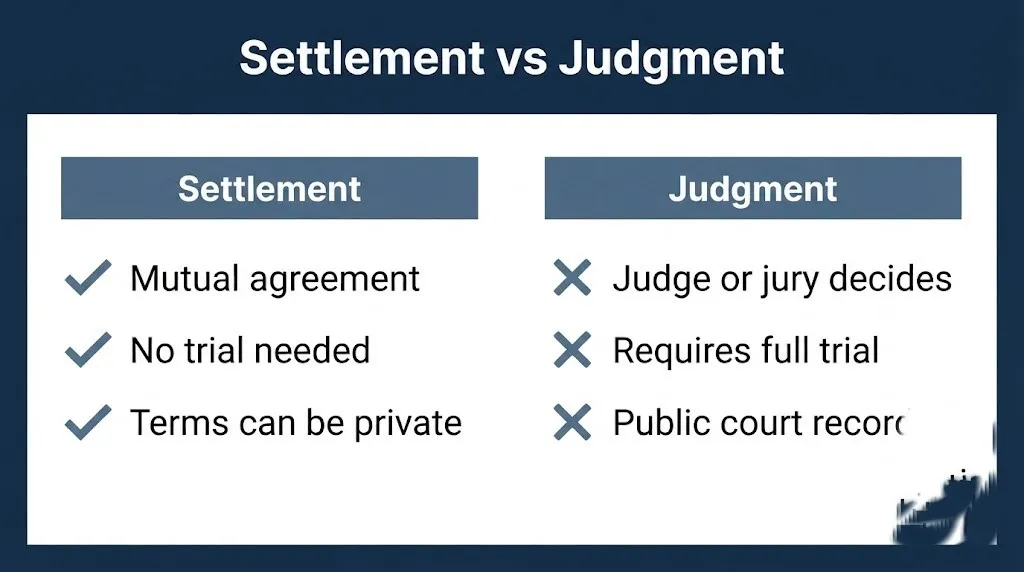
A settlement is an agreement between the parties, while a judgment is a decision made by a judge or jury after a trial.
This distinction matters more than people expect. A settlement is reached voluntarily, and neither side has to admit fault as part of the deal. A judgment, by contrast, results from a court formally ruling on the merits of the case, often stating which side was legally right.
Settlement versus judgment, side by side:
| Settlement | Judgment | |
|---|---|---|
| Who decides | Both parties, by mutual agreement | Judge or jury |
| Fault admitted | Usually not required | Often explicitly determined |
| Speed | Can happen at any stage, sometimes in days | Requires full trial process, often years |
| Appeal rights | Generally waived once signed | Either side can typically appeal |
| Privacy | Terms can be kept confidential | Public court record |
Key Takeaway: A settlement ends uncertainty by mutual agreement, while a judgment resolves the same dispute through a court’s formal ruling, and the two paths lead to very different outcomes for both sides.
What Is Settlement in a Lawsuit? When Does It Happen?
A settlement in a lawsuit can happen at nearly any point, from before a complaint is even filed to during an active trial, and even while a case is on appeal.
Most civil lawsuits in the United States never reach a jury verdict. The vast majority resolve through settlement instead, because trials are expensive, time-consuming, and carry real risk for both sides.
Common stages when settlements occur:
- Before a lawsuit is formally filed, during pre-litigation negotiation.
- After filing but before discovery, when both sides want to avoid legal costs.
- During discovery, once evidence reveals the likely strength of each side’s case.
- At a court-ordered or voluntary settlement conference.
- Mid-trial, sometimes even after a jury has been seated.
- During an appeal, if the losing side wants to avoid further risk.
Think of it like a home warranty dispute. You could fight the company through a formal complaint process for months, or you could accept a negotiated repair credit today and move on. Settlement is almost always the second option, just with legal terms attached.
Whats a Settlement Amount Based On?
There is no fixed formula for a settlement amount, and it’s not yet determined by any standard formula, since every case depends on its own facts, damages, and negotiating leverage.
Settlement amounts in comparable cases can vary wildly. Two people with similar injuries or losses might settle for very different sums, depending on the strength of the evidence, the reputation of their attorneys, and how much risk each side is willing to accept by going to trial.
Factors that typically influence settlement amounts:
- Documented financial losses, such as medical bills, lost wages, or property damage.
- The strength of the evidence proving liability.
- Whether the case involves a single plaintiff or a large class of affected people.
- Insurance policy limits, in cases involving an insurer.
- The venue and jurisdiction, since some courts and jury pools tend to award more than others.
- How close the case is to trial, since risk to both sides increases as trial approaches.
What settlements are not: guaranteed payouts based on how bad your situation feels, or a number a company owes you automatically just because a lawsuit exists. Amounts depend entirely on negotiated terms specific to each case.
Reality Check
No legitimate settlement offer arrives out of the blue asking you to pay an upfront fee to “unlock” your compensation. Real settlements are negotiated through attorneys, insurance adjusters, or a court process, and legitimate claim filing is always free. If a text or email promises a settlement check in exchange for personal or banking information first, treat it as a scam.
Meaning of Settlement in Class Action Cases
In a class action, a settlement resolves claims on behalf of an entire group of similarly situated people at once, rather than one individual case at a time.
Class action settlements work differently from individual lawsuits. A court must review and approve the settlement as fair before it becomes final, a process that includes a preliminary approval hearing, a claims period, and a final fairness hearing.
Steps typical to a class action settlement:
- A court grants preliminary approval to the proposed settlement terms.
- Class members receive notice, often by mail or email.
- A claims deadline opens, letting eligible people file for their share.
- An opt-out or exclusion deadline lets people preserve their individual right to sue instead.
- A final approval hearing lets the judge confirm the settlement is fair.
- Payments are distributed, often months after final approval, once any appeals are resolved.
This structure exists because one person can’t sign away another person’s legal rights. The court’s approval role protects absent class members who never personally negotiated the deal.
Define Settlement: Structured Settlements Explained
A structured settlement is a settlement paid out over time through periodic payments, instead of a single lump sum.
This format is common in personal injury cases involving long-term medical needs, or in cases involving minors, where a court may require payments to be spread out to protect the recipient’s long-term financial interests.
Key features of a structured settlement:
- Payments are typically funded through an annuity purchased by the paying party.
- Payment schedules can span years or even decades, depending on the agreement.
- Structured settlements often carry tax advantages compared to lump sum payments in certain injury cases.
- Selling future structured settlement payments for immediate cash is possible but usually requires court approval and often involves a discount on the total value.
Key Takeaway: Not every settlement pays out immediately, and understanding whether you’re being offered a lump sum or a structured payment plan changes how and when you’ll actually receive money.
What Is Settlement Confidentiality, and Is It Required?
Settlement confidentiality is a contract term that prevents parties from publicly discussing the terms of an agreement, but it’s not automatically part of every settlement.
Confidentiality clauses are common, especially in cases involving corporations that don’t want settlement amounts to encourage similar claims. However, they must be specifically negotiated and included in the written agreement.
What confidentiality clauses typically restrict:
- Publicly disclosing the settlement amount.
- Discussing specific terms of the agreement with media or on social media.
- Sometimes, even confirming that a settlement was reached at all.
Some jurisdictions limit confidentiality in certain case types, such as claims involving public safety or government entities, where transparency requirements can override a private confidentiality preference. If you’re negotiating a settlement and confidentiality matters to you, it needs to be explicitly requested and written into the final agreement, not assumed.
What Happens After You Accept a Settlement?
Once a settlement is signed, both sides are legally bound to its terms, and the underlying legal claim is typically dismissed or closed permanently.
Typical steps after a settlement is finalized:
- Both parties sign the written settlement agreement.
- The paying party issues payment, according to the timeline specified in the agreement.
- The case is formally dismissed with the court, if litigation had already been filed.
- The recipient generally waives the right to bring further claims on that same matter.
- If either side breaks the agreement’s terms, the other side can sue for breach of contract.
In some cases, if a settlement is breached and not simply a broken promise, the original lawsuit can be reinstated rather than requiring an entirely new breach of contract case, depending on how the agreement and dismissal were structured.
What Happens Next
When a dispute arises: Parties can negotiate informally before any lawsuit is filed.
If negotiation fails: A lawsuit may be filed, opening formal legal proceedings.
During litigation: Settlement remains possible at any point, including mid-trial.
If a settlement is reached: Terms are documented, signed, and typically result in dismissal of the case.
If no settlement is reached: The case proceeds to trial, where a judge or jury issues a binding judgment instead.
Frequently Asked Questions
What is the simple definition of a settlement?
A settlement is a voluntary agreement between parties in a legal dispute that resolves the case without a trial verdict.
It usually involves a payment from one party to the other.
Once signed, it’s legally binding, similar to any other contract.
What does settlement mean when someone gets a check in the mail?
It typically means a lawsuit or claim you were part of, often a class action, has resolved and payments are being distributed.
The amount depends on the specific settlement’s terms and how many valid claims were filed.
Always verify any settlement notice against the official case or settlement website before acting on it.
Is a settlement the same as winning a lawsuit?
Not exactly. A settlement is a negotiated agreement, while winning a lawsuit means a judge or jury ruled in your favor after trial.
Settling doesn’t require either side to admit fault or wrongdoing.
Many people settle even strong cases simply to avoid the time, cost, and risk of trial.
Can you still sue after accepting a settlement?
Generally, no, most settlements include a release of claims covering the specific dispute involved.
This means you typically give up your right to sue over that same matter again.
Exceptions can exist depending on how narrowly or broadly the settlement’s release language is written.
How long does it take to receive money after a settlement?
There’s no fixed timeline, since it depends on the settlement’s specific terms and, in class actions, whether any appeals are filed.
Individual settlements can pay out within weeks, while class action settlements often take months after final court approval.
Structured settlements are paid out over time rather than in a single payment.
What is a settlement conference?
A settlement conference is a formal meeting where parties, often with a mediator or judge’s assistance, attempt to negotiate a resolution before trial.
Many courts require or encourage a settlement conference as part of the litigation process.
It’s a common step, but reaching agreement there isn’t guaranteed.
Do you need a lawyer to negotiate a settlement?
Not always, but settlements involving significant money, insurance companies, or class actions are commonly negotiated through attorneys.
Insurance adjusters, for example, are trained to offer the lowest amount they think you’ll accept.
Complex cases especially benefit from legal guidance before signing any settlement agreement.
Understanding what a settlement actually means helps you evaluate any offer, notice, or news headline more clearly. If you’re weighing a specific settlement offer right now, read the full written agreement carefully before signing anything.
The one thing worth remembering: a settlement is a binding contract, so once you sign, that specific dispute is typically closed for good.