Trust Litigation Attorney in California: Deadlines, Costs, and How to Find One in 2026
Quick Answer
- Trust litigation attorneys handle disputes over a trust’s validity, a trustee’s conduct, or a beneficiary’s rights under California Probate Code.
- Cost varies widely: hourly rates often start at $500+ per hour, while contingency fees typically run 30% to 40% of what’s recovered.
- The most important deadline is 120 days from the date you receive formal trustee notice, or 60 days from receiving the trust document, whichever is later.
If you got a notice from a trustee, or you suspect someone is mishandling a family trust, you’re likely on a clock you didn’t know existed. California gives beneficiaries just 120 days to challenge a trust’s validity once proper notice goes out.
This mostly affects beneficiaries, heirs, and sometimes trustees themselves who need to defend their actions in court. The one number that matters most: miss that 120-day window, and a court can permanently bar your challenge, no matter how strong your case is.
This guide breaks down what a trust litigation attorney actually does, what it costs, and how the deadlines work. One detail most searches skip: contingency fee representation exists in California trust disputes, but usually only when the claim is worth $500,000 or more.
The Facts
| Topic | Trust litigation attorney representation in California |
| Governing Law | California Probate Code, primarily Sections 16061.7 through 16061.9 and Section 17200 |
| Key Deadline | 120 days from trustee notice, or 60 days from receiving the trust document, whichever is later |
| Typical Cost | Hourly rates commonly $500 or more per hour; contingency fees typically 30% to 40% of recovery |
| Fee Options | Hourly billing (most common) or contingency, usually reserved for claims of $500,000 or more |
| Who Qualifies | Beneficiaries, heirs, trustees, and other interested parties with standing under the trust |
| Where to Verify | County superior court probate division; California Courts self-help resources |
What Does a Trust Litigation Attorney Actually Handle?
A trust litigation attorney represents beneficiaries, heirs, or trustees in court disputes over how a trust is written, managed, or distributed. This isn’t the same as an estate planning attorney who drafts trusts.
Trust litigation covers a specific set of legal fights. Common matters include:
- Contesting a trust’s validity (claims of undue influence, fraud, or lack of capacity)
- Breach of fiduciary duty by a trustee
- Trustee self-dealing or mismanagement of trust assets
- Disputes over trust interpretation or ambiguous language
- Petitions to remove or replace a trustee
- Accounting demands when a trustee won’t disclose records
Trustees hire these attorneys too, not just beneficiaries. Trustees usually pay hourly, unless they’re recovering property wrongfully taken from the trust and no funds are available to finance the case. In that narrow situation, a contingency fee becomes the only workable option.
How Much Does a Trust Litigation Attorney Cost in California?
Trust litigation costs in California range from a few thousand dollars to well over $150,000, depending heavily on how contested the case becomes.
It is rare for experienced trust litigation attorneys in California to charge less than $500 per hour. That rate climbs for senior partners in complex, high-asset disputes.
| Fee Type | Typical Range | Best For |
|---|---|---|
| Hourly | $500+/hour | Most cases; standard billing structure |
| Flat fee | $5,000 to $10,000 | Simple, uncontested administration matters |
| Contingency | 30% to 40% of recovery | Claims of $500,000+, beneficiaries without upfront funds |
Litigation can range from $5,000 to more than $150,000, depending on the length, evidence, and level of expert involvement. Complex cases involving forensic accountants or handwriting experts push costs toward the higher end.
Key Takeaway: Expect hourly rates of $500 or more, with total costs shaped almost entirely by how much the other side fights back.
Hourly vs Contingency Fee Trust Litigation Lawyers: Which Fits Your Case?
Contingency fee trust litigation means you pay nothing upfront and the attorney only collects if you win. The attorney typically receives a fixed percentage, often 40%, of the total amount recovered.
Not every case qualifies. Contingency representation may be available when the potential recovery is substantial, usually at least $500,000 or more, and the facts of the case strongly support the client’s position.
Costs are handled separately from the fee itself. Costs such as filing fees, deposition expenses, and consultant fees are addressed separately in the fee agreement. Some firms advance these costs; others require the client to pay as the case proceeds.
There’s a legal wrinkle worth knowing about too. Under Probate Code Section 17211, the court may award attorney fees from the trust estate in certain circumstances, particularly when litigation benefits the trust or its beneficiaries. That means your fees aren’t always coming entirely out of your own pocket.
Think of hourly billing like paying a contractor by the hour for a home repair: predictable per session, but the total bill depends on how long the job runs. Contingency is closer to a real estate agent’s commission: no fee unless the deal closes.
How to Find a Trust Litigation Attorney Near You
Finding the right trust litigation attorney means matching the lawyer’s experience to your specific dispute, not just picking the first search result.
- Confirm the attorney’s practice focuses specifically on trust and probate litigation, not general estate planning.
- Ask whether they’ve handled cases in your county’s probate court.
- Request a consultation to review the trustee notice or trust document you received.
- Ask directly about fee structure: hourly, flat, or contingency.
- Confirm whether court costs and expert witness fees are included or billed separately.
- Check if the case timeline fits within your 120-day or 60-day deadline window.
- Get the fee agreement in writing before signing anything.
Key Takeaway: A trust litigation attorney’s county-specific court experience often matters more than firm size or advertising reach.
Steps to Start California Trust Litigation
Filing a trust contest or breach of duty claim follows a fairly consistent process across California counties.
- Gather the trustee notice, trust document, and any account records you have.
- Consult a trust litigation attorney to evaluate standing and deadline exposure.
- File the petition in the superior court probate division of the county with jurisdiction.
- Serve notice on the trustee and other interested parties.
- Participate in discovery, which may include depositions and document requests.
- Attend mediation, which many California probate courts require before trial.
- Proceed to a court hearing or trial if the matter doesn’t settle.
Not every case reaches trial. Many trust disputes resolve at mediation once both sides see the evidence laid out.
The 120-Day Deadline: California’s Most Important Trust Litigation Rule
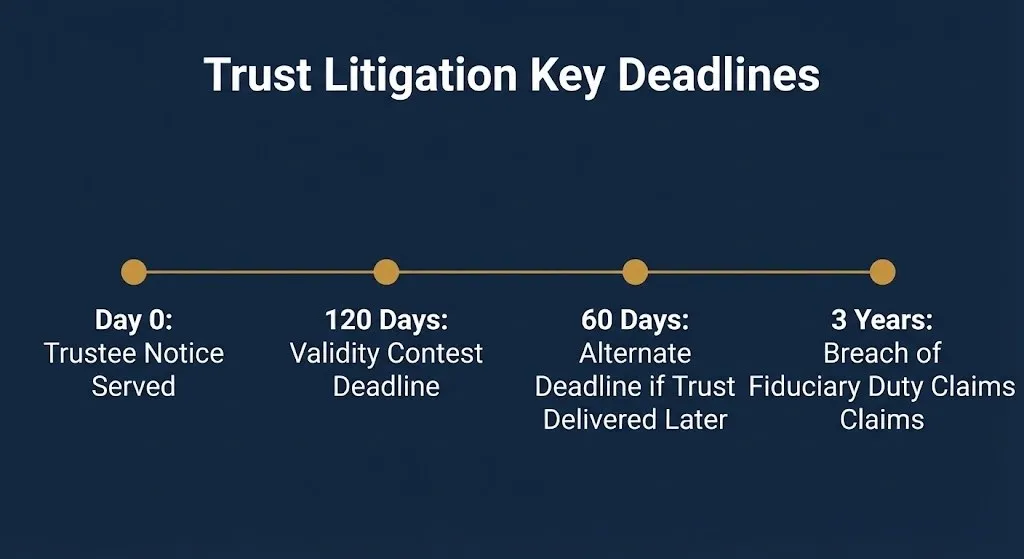
The 120-day rule is the single deadline that determines whether you can challenge a trust’s validity at all. The deadline to contest a trust is 120 days from the date the trustee notification is served, or 60 days from the date on which a copy of the terms of the trust is delivered during that 120-day period, whichever is later.
This requirement comes directly from statute. Trustees must provide this notice to beneficiaries per Probate Code Section 16061.7.
| Scenario | Deadline |
|---|---|
| Standard trustee notice received | 120 days from service date |
| Trust document delivered separately during the 120-day window | 60 days from delivery, if later than the 120-day mark |
| Breach of fiduciary duty discovered | 3 years from when you knew or should have known |
| No notice ever sent | Statute of limitations may remain open |
Reality Check: No trust litigation attorney can override a missed statutory deadline, and no online “trust dispute service” can file retroactively on your behalf. If you’re inside the 120-day window, speed matters more than finding the cheapest option.
What Happens If You Miss the Trust Contest Deadline?
Missing the 120-day window generally bars you from contesting the trust’s validity, permanently. A failure to abide by the time limit to contest a trust could cause your trust contest to be permanently barred. Only in extraordinary circumstances, such as proof that the trustee fraudulently induced you not to contest, might a court consider a late challenge.
There’s an important exception, though. If notice is never received, the statute of limitation remains open. That doesn’t mean you have unlimited time, since general limitations periods eventually apply, but it does mean improper notice can reopen your options.
Breach of fiduciary duty claims run on a different clock than validity contests. Under California law you have three years from the date you first knew or should have known that you have a claim. That distinction trips up a lot of people who assume every trust deadline is 120 days.
Estate Litigation Lawyer vs Trust Litigation Attorney: What’s the Difference?
These titles overlap heavily in practice, and most California attorneys who handle one also handle the other. Estate litigation is the broader category, covering will contests, probate disputes, and trust disputes together.
Trust litigation specifically deals with disputes arising after a trust becomes irrevocable, typically after the person who created it dies or becomes incapacitated. An estate litigation lawyer might also handle a will contest running through probate court, which follows different procedural rules than a trust dispute.
- Trust litigation: disputes over trust validity, trustee conduct, and distributions
- Estate litigation: broader term covering trusts, wills, and probate disputes together
- Probate litigation: specifically tied to court-supervised estates going through probate
If your search included both “trust litigation attorney” and “estate litigation lawyer,” you’re likely dealing with a trust dispute, since most living trusts are designed specifically to avoid probate court.
Common Reasons People Hire a Trust Litigation Lawyer
Most trust litigation cases fall into a handful of recurring categories, based on how these disputes typically arise.
- A sibling or family member believes a trust amendment was the product of undue influence
- A trustee refuses to provide an accounting of trust assets
- A beneficiary suspects the trustee is using trust funds for personal benefit
- Unequal distributions raise questions about the trust creator’s mental capacity at signing
- A trustee wants to remove a co-trustee who isn’t fulfilling their duties
- A caretaker or later relationship partner was added to a trust shortly before death
Key Takeaway: Undue influence and trustee self-dealing account for the large majority of trust litigation filings across California counties.
Who Can Legally Contest a Trust in California?
Standing to contest a trust is limited to people with a genuine legal interest in the outcome. The only persons who can do so are those who have a vested interest in the trust. This may include named beneficiaries or heirs, relatives, caretakers, or persons who were named in a previous will or trust who aren’t any longer.
That last category matters more than people expect. If you were cut out of a more recent version of a trust but named in an earlier one, you may still have standing to contest the change.
Trustees themselves have standing in a different sense, defending their own conduct rather than contesting the trust’s terms.
Trust Litigation vs Probate Litigation: How California Treats Each
Trust litigation and probate litigation run through overlapping but distinct legal tracks. Trusts generally avoid the formal probate court process entirely, which is part of why people create them.
When a dispute arises over a trust, it typically goes to the probate division of superior court, even though the trust itself never went through probate administration. Wills, by contrast, must go through probate before a contest can even be filed. The 120-day period you have to challenge a Will’s validity does not begin until it is admitted to probate.
That timing difference is significant. Trust deadlines start running from notice, while will contest deadlines wait for a court filing to happen first.
No-Contest Clauses: The Risk of Challenging a Trust in California
A no-contest clause can strip you of your entire inheritance if you challenge a trust and lose. California law typically upholds a contest clause, and therefore if a trust beneficiary brings a contest against a trust that is upheld, they stand to lose all the inheritance.
This is exactly why an experienced trust litigation attorney evaluates the strength of your claim before filing anything. Filing a weak contest against a trust with a no-contest clause can turn a partial inheritance into nothing at all.
Not every legal action against a trust triggers a no-contest clause. Petitions asking a court to interpret ambiguous trust language, for example, are often treated differently than a direct validity challenge. An attorney familiar with your specific trust’s language can tell you which category your situation falls into before you file.
What Happens Next
Within 120 days of trustee notice: File any trust validity contest before this window closes.
Within 60 days of receiving trust documents (if later): This alternate deadline applies if documents arrive separately during the 120-day period.
During active litigation: Expect discovery, possible depositions, and a court-ordered or voluntary mediation session in most California counties.
Within 3 years of discovering a breach: Fiduciary duty claims against a trustee run on this longer, separate clock.
Ongoing: Courts may award attorney fees from the trust estate under Probate Code Section 17211 in cases that benefit the trust as a whole.
Frequently Asked Questions
Do I need a trust litigation attorney or can I contest a trust myself?
You can technically file without an attorney, but the 120-day deadline and no-contest clause risks make self-representation risky.
Missing a procedural step can permanently bar your claim regardless of merit.
How much does it cost to hire a trust litigation attorney in California?
Hourly rates commonly start around $500 per hour, with total litigation costs ranging from a few thousand dollars to over $150,000.
Contingency fee arrangements, usually 30% to 40% of recovery, are available for larger claims.
What is the 120-day rule for trust litigation?
California beneficiaries generally have 120 days from receiving formal trustee notice to contest a trust’s validity.
That deadline can extend to 60 days from receiving the actual trust document, whichever comes later.
Can a trustee also need a trust litigation attorney?
Yes, trustees hire trust litigation attorneys to defend their conduct or pursue recovery of misused trust assets.
Trustees typically pay hourly rather than on contingency, unless recovering wrongfully taken property with no other funding available.
What happens if I lose a trust contest under a no-contest clause?
You could lose your entire inheritance under the trust if the clause is enforced against a failed contest.
California courts generally uphold valid no-contest clauses, making case evaluation before filing essential.
How long does trust litigation take in California?
There’s no fixed timeline confirmed in current research; duration depends heavily on complexity, discovery, and whether mediation resolves the case.
Simple disputes may resolve in months, while contested cases with experts can take well over a year.
Is trust litigation the same as probate litigation?
Not exactly. Trusts are generally designed to avoid formal probate administration, though trust disputes often still proceed through a court’s probate division.
Wills, unlike trusts, must be admitted to probate before a contest can be filed.
Can I get a contingency fee trust litigation attorney?
Contingency arrangements exist in California, but they’re typically reserved for claims worth $500,000 or more with strong supporting facts.
Most trust litigation attorneys still bill hourly as their standard structure.
If you received a trustee notice or suspect a trust is being mishandled, the 120-day clock is already running. Talk to a trust litigation attorney early, gather your documents, and confirm your specific deadline before it closes.