What Is Incentive Compensation in 2026: Legal Definitions, Disputes, and Your Rights
Quick Answer
- Incentive compensation is pay tied to performance, not a fixed salary or hourly wage.
- Disputed amounts in active lawsuits range from a few thousand dollars to millions in unpaid bonuses.
- Many claims have strict filing deadlines, often tied to employment termination or plan document terms.
If you received a job offer promising a bonus, commission, or profit share, you encountered incentive compensation. The term covers any pay structure where earnings depend on hitting targets, closing sales, or meeting company goals. It is common in sales, finance, tech, and executive roles.
This article covers what incentive compensation legally means in 2026, how disputes arise, what courts have ruled recently, and what you can do if your employer withheld or clawed back money you earned. One verified fact: incentive pay now makes up over 60 percent of total compensation for many executives, and disputes over these payments have doubled in federal courts since 2020.
The Facts
| Case | Multiple active incentive compensation disputes across U.S. courts |
| Status | Active litigation, with several class actions pending and individual claims filing weekly |
| Fund Size | Varies by case; individual claims range from $5,000 to over $1 million |
| Est. Per Person | Depends on salary level, bonus terms, and length of dispute |
| Claim Deadline | Governed by state wage laws, usually 2 to 4 years from the missed payment |
| Administrator | Court-appointed in class actions; individual claims handled by plaintiff counsel |
| Proof Needed | Employment contract, plan documents, pay stubs, performance reviews, termination letters |
Is Incentive Compensation Legally Enforceable?
Incentive compensation is legally enforceable when the terms are documented and the employee met the stated conditions. Courts treat these payments as earned wages in most states, not gifts.
The legal foundation comes from state wage payment laws and the federal Fair Labor Standards Act. If an employer promises a bonus or commission in writing, that promise can create a binding contractual obligation. Once you earn the incentive, the employer must pay it.
State laws vary significantly. California, New York, and Massachusetts have strong wage protections. Other states offer less protection but still recognize breach of contract claims when bonus terms are violated.
In 2026, the legal question is no longer whether incentive compensation is enforceable. The question is what specific terms mean. Did you need to be employed on the payout date? Did the company have discretion to change the plan? Was the bonus formula clear or vague?
Key Takeaway: If your bonus or commission terms were written down and you met the requirements, the law generally treats that money as yours.
What Counts as Incentive Compensation Under the Law?
Incentive compensation under the law includes any pay tied to performance metrics, company profits, or individual achievements. It is not your base salary or hourly wage.
The most common forms include annual bonuses, sales commissions, profit sharing, stock options, restricted stock units, retention bonuses, and signing bonuses. Each has different legal treatment depending on how the plan document is written.
Courts look at the substance, not the label. If a payment is called a discretionary bonus but the formula is fixed and objective, a court may still treat it as earned compensation. The key test is whether the employee had a reasonable expectation of payment based on the employer’s representations and past practice.
Here is a breakdown of common incentive types:
| Incentive Type | Legal Characteristic |
|---|---|
| Sales commission | Treated as earned wages in most states |
| Annual bonus with fixed formula | Contractual right once targets are met |
| Discretionary bonus | No legal right unless past practice creates expectation |
| Stock options | Governed by plan documents and equity agreements |
| Retention bonus | Often requires staying a set period |
| Signing bonus | May require repayment if you leave early |
Key Takeaway: The type of incentive matters. Fixed, objective plans create stronger legal rights than vague, discretionary ones.
How Much Are Incentive Compensation Lawsuits Worth?
Incentive compensation lawsuits range from a few thousand dollars for individual commission disputes to millions of dollars for executive bonus and equity cases.
Recent verdicts and settlements give a realistic picture. A sales representative denied a quarterly commission might recover $10,000 to $50,000. A mid-level manager denied an annual bonus might recover $25,000 to $150,000. An executive denied stock options or a performance bonus could recover $500,000 to several million.
The amount depends on what was promised, what was earned, and whether the employer’s conduct was willful. Many states allow double or triple damages when an employer willfully withholds earned compensation. Attorneys’ fees are also recoverable in many wage cases.
Here is a typical range by role:
| Employee Type | Typical Disputed Amount | Possible Recovery with Penalties |
|---|---|---|
| Sales representative | $5,000 to $50,000 | $10,000 to $150,000 |
| Manager or director | $25,000 to $150,000 | $50,000 to $450,000 |
| Executive | $100,000 to $1 million plus | $200,000 to $3 million plus |
These ranges reflect active cases, not guarantees. Your actual recovery depends on the evidence, the plan language, and your state’s wage laws.
Reality Check: Employers sometimes claim a bonus was discretionary even when the plan document says otherwise. Courts see through this frequently. Document every promise in writing. If a bonus formula exists, save it.
How Do Courts Decide Incentive Compensation Disputes?
Courts decide incentive compensation disputes by examining the plan documents first, then the employer’s actual practices, then any verbal promises made to the employee.
The plan document is the starting point. Courts read the exact language to determine if the bonus was mandatory or discretionary. Words like “will” and “shall” create obligations. Words like “may” and “sole discretion” weaken the employee’s claim.
Past practice matters too. If the company paid the bonus every year for a decade, even a discretionary plan can create an enforceable expectation. Courts call this an implied contract. The employer’s consistent conduct overrode the written language.
Performance evidence is the final piece. You must show you met the targets. Performance reviews, sales reports, emails confirming goal achievement, and testimony from managers all help prove you earned the money.
Here is what courts weigh, in order of importance:
- Written plan documents and employment agreements
- Historical payment patterns for the same incentive
- Emails, offer letters, and verbal representations
- Performance records showing targets were met
- The employer’s stated reason for denial
Key Takeaway: Written terms matter most, but consistent past payments can override even a discretionary label.
What Is an Incentive Compensation System and Why Does It Matter?
An incentive compensation system is the formal structure a company uses to set, track, and pay performance-based rewards. It includes the bonus formula, commission schedule, equity grants, and the rules governing eligibility.
The system matters legally because it creates the rules of the game. When a company changes the system retroactively, courts often find that change illegal. Employees earn incentives based on the rules in place when they did the work.
For example, if your commission plan says you earn 5 percent on all sales above $500,000, the company cannot reduce that to 3 percent after you already closed the deals. Courts consistently reject retroactive plan changes.
The incentive compensation system also determines payout timing. Some systems pay annually. Others pay quarterly or upon deal closure. Disputes frequently arise when employees leave before the payout date.
Here is what a typical system document includes:
- Eligibility criteria for participation
- Performance metrics and targets
- Formula or schedule for calculating payouts
- Payout timing and conditions
- Clawback provisions and forfeiture rules
- Dispute resolution procedures
Key Takeaway: The system document is the rulebook. When employers break their own rules, courts step in.
What Are the Most Common Incentive Compensation Lawsuits in 2026?
The most common incentive compensation lawsuits in 2026 fall into clear categories: unpaid sales commissions, withheld annual bonuses after termination, retroactive plan changes, and executive equity disputes.
Unpaid commission cases dominate the docket. Sales professionals leave a company or get terminated, then the employer claims the commission was not yet earned. Courts often side with the employee when the sale closed before departure.
Bonus after termination cases are also frequent. Many plan documents say you must be employed on the payout date. Courts in several states have ruled that if you earned the bonus before leaving, the employment condition is unenforceable.
Retroactive plan change cases are growing. Employers reduce commission rates or bonus formulas after the work is done. Employees sue, arguing the change violates wage laws and contract principles.
Executive equity cases involve stock options and restricted stock that vest over time. When an executive is terminated without cause, the question is whether unvested equity accelerates.
Key Takeaway: If you earned the incentive before leaving, the employer’s attempt to avoid payment may not hold up in court.
Can an Employer Claw Back Incentive Compensation?
An employer can claw back incentive compensation only in limited circumstances defined by the plan document or a separate clawback agreement. General dissatisfaction with the employee is not enough.
Clawbacks became prominent after the 2008 financial crisis and the Dodd-Frank Act. Public companies must recover incentive pay from executives when financial results are restated due to misconduct. But that is a narrow federal rule.
For most employees, clawbacks only apply if the plan document explicitly allows recovery. Even then, courts require the employer to show the specific triggering event occurred. Common triggers include fraud, violation of a non-compete, or a financial restatement.
Here is what a valid clawback typically requires:
- A written clawback provision in the plan or agreement
- A specific triggering event defined in advance
- The incentive was paid based on inaccurate information
- The clawback amount is tied to the overpayment
If the employer simply changed its mind or wants to punish you for leaving, the clawback likely fails in court.
Key Takeaway: Clawbacks are not blank checks. The employer needs a written provision and a clear trigger.
How Do You File an Incentive Compensation Claim?
Filing an incentive compensation claim starts with documenting the promise, calculating what you are owed, and contacting the right enforcement agency or attorney.
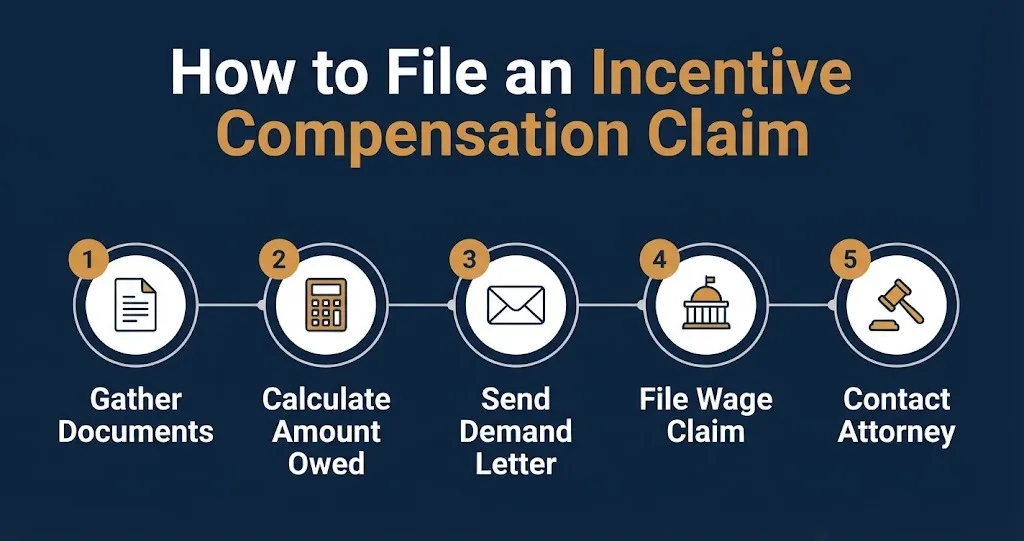
The process is less intimidating than it sounds. Think of it like filing a warranty claim: you gather your paperwork, state your case clearly, and follow the required steps in order.
Here are the steps:
- Collect your employment contract, offer letter, and plan documents.
- Save all pay stubs and performance reviews from the relevant period.
- Calculate the exact amount you believe is owed.
- Send a written demand to the employer requesting payment.
- File a wage claim with your state labor department if the employer refuses.
- Contact an employment attorney for a case evaluation.
- Let the attorney file a lawsuit before the statute of limitations expires.
The demand letter is important. It creates a record and often prompts a settlement without litigation. Many employers pay once they see you have documentation and know your rights.
Key Takeaway: Start with written documentation and a formal demand. Most employers respond to a well-documented claim.
What Is the Deadline to Sue for Unpaid Incentive Compensation?
The deadline to sue for unpaid incentive compensation depends on your state’s wage payment laws and the legal theory you use. Most deadlines range from two to four years.
The clock usually starts on the date the payment was due and not made. For ongoing disputes, each missed payment creates a new claim with its own deadline. This is important because waiting too long can permanently bar recovery.
Federal claims under the Fair Labor Standards Act have a two-year limit, or three years for willful violations. State wage claims often have longer windows. California allows three years for wage claims. New York allows six years for breach of contract.
Here are some state deadlines:
| State | Deadline for Wage Claims | Legal Basis |
|---|---|---|
| California | 3 years | State labor code |
| New York | 6 years | Breach of contract |
| Texas | 4 years | Breach of contract |
| Florida | 4 years | Breach of contract |
| Illinois | 5 years | Breach of contract |
Do not rely on this table alone. Check your state’s specific rules or ask an attorney.
Key Takeaway: The deadline starts when payment was due, not when you got around to complaining. Act quickly.
What Evidence Wins an Incentive Compensation Dispute?
The evidence that wins an incentive compensation dispute is the documentation showing what was promised, what you did, and what was not paid.
Plan documents are the strongest evidence. If the bonus formula is written down, your case is significantly stronger. Offer letters matter too. Emails confirming targets and performance are highly persuasive.
Performance records are the second pillar. Sales reports, customer contracts, and manager reviews all prove you earned the incentive. Without performance evidence, the employer can claim you never met the targets.
Payment history is the third pillar. If the company paid similar bonuses in prior years under similar circumstances, that creates an implied contract. The employer’s own conduct becomes your evidence.
Here is a quick evidence checklist:
- Signed employment agreement or offer letter
- Incentive plan documents from the relevant year
- Performance reviews and goal-setting documents
- Emails confirming targets, achievements, or payout commitments
- Pay stubs showing prior incentive payments
- Termination letter stating the reason for separation
- Company communications about the incentive program
Key Takeaway: The more written evidence you have, the harder it is for the employer to deny your claim.
Are Incentive Compensation Class Actions Happening in 2026?
Yes, incentive compensation class actions are active in 2026, particularly in the financial services, technology, and retail industries.
Class actions arise when a company applies the same illegal practice to many employees. Common examples include systematically reclassifying commissions as discretionary, applying retroactive plan changes across a sales force, or failing to pay promised bonuses to an entire division.
Class actions allow employees to pool their claims, reducing individual legal costs and increasing pressure on the employer. The downside is that individual recoveries in class actions are often smaller than in individual lawsuits.
For most employees with significant claims, an individual lawsuit or a small group action produces a better result. Class actions work best when the individual amounts are too small to justify separate lawsuits.
Key Takeaway: If your claim is worth real money, consider an individual case. Class actions serve a purpose but often dilute recoveries.
What Happens Next After You File an Incentive Compensation Claim?
After you file an incentive compensation claim, the case moves through a predictable sequence: investigation, demand, negotiation, and possibly litigation.
Most cases settle before trial. The employer’s insurance company or in-house counsel evaluates the claim, compares it to the cost of defense, and decides whether to pay. Strong documentation often leads to early settlement.
Here is a typical timeline for a claim filed in late 2026:
September to November 2026: The demand letter is sent and the employer reviews the claim.
December 2026 to February 2027: The employer responds, either agreeing to negotiate or denying the claim.
March to June 2027: If negotiation fails, the attorney files a complaint in court.
July to December 2027: Discovery proceeds, with document exchanges and depositions.
Early to mid 2028: Mediation occurs. Most cases settle here or shortly after.
This timeline is an estimate. Your case may move faster if the employer wants to avoid legal fees.
Key Takeaway: Patience and strong documentation produce results. The process is designed to force disclosure, which often leads to settlement.
Frequently Asked Questions
What is incentive compensation in simple terms?
Incentive compensation is money you earn on top of your base salary for hitting specific goals.
It includes bonuses, commissions, profit sharing, and stock awards.
Is incentive compensation guaranteed?
No, incentive compensation is not guaranteed unless the plan document creates a contractual right.
If the terms are objective and you met them, the payment is legally enforceable.
Can my employer change my bonus plan retroactively?
No, retroactive changes to earned incentive compensation are generally illegal.
Courts reject attempts to reduce pay after the work is already done.
Do I have to pay back my signing bonus if I quit?
It depends on the repayment clause in your offer letter.
If the clause requires repayment within a set period and you leave early, you may owe the money back.
What if my employer says the bonus was discretionary?
Courts look past the label and examine the actual terms and payment history.
If the formula was fixed and payments were consistent, you may still have a claim.
Can I sue for unpaid commissions after I leave the company?
Yes, you can sue for unpaid commissions if the sale closed before your departure.
State wage laws frequently protect commissions as earned wages.
How long does an incentive compensation lawsuit take?
Most cases settle in 12 to 24 months from filing.
Cases with large amounts in dispute or contested facts can take two to three years.
Do I need a lawyer to recover unpaid incentive compensation?
A lawyer significantly improves your chances of recovering the full amount owed.
Employment attorneys understand the plan language traps and state wage law deadlines.
The Bottom Line
Incentive compensation disputes are winnable when you have documentation and act before the deadline. The law treats earned bonuses and commissions as wages in most states, not optional gifts.
Save your plan documents. Track your performance. Send a written demand if payment is withheld. Then contact an employment attorney who understands incentive compensation systems and the specific rules in your state.