Class Action Settlements 2026: Which Ones Are Real, Which Pay, and How to Join
Quick Answer
- “Class action settlements” isn’t one lawsuit. It’s a category covering dozens of separate, court-approved payouts open right now, each with its own deadline.
- Payouts range widely: some no-proof claims pay under $20, others such as a Google Play antitrust settlement route up to $51 per person through PayPal, Venmo, or a prepaid card, and documented-loss tiers can reach thousands.
- Venmo and Temu both face active lawsuits in 2026, but no settlement has received final court approval for either as of this writing, so any site charging you to “sign up” for one is not the official process.
Class action settlements are real, court-supervised payments companies make to resolve lawsuits, and right now there is real money sitting in dozens of approved funds. You do not need proof of purchase for many of them. Several current settlements, including Tom’s of Maine toothpaste and LastPass, let you claim by attestation, no receipts required.
This matters most if you used a data-breach-affected company, bought a mislabeled product, or held an account with a fintech app in the last few years. One deadline worth circling: the FTC’s Amazon Prime cancellation settlement closes July 27, 2026.
This guide breaks down what counts as a legitimate settlement, how much you can realistically expect, how to file, and the real status of the Venmo and Temu cases people keep asking about. One detail that surprises most readers: you’re allowed to file for every settlement you qualify for, there’s no cap on how many you can join.
The Facts
| Topic | Class action settlements open for claims in 2026 |
| Status | Dozens active, updated weekly by settlement trackers and court dockets |
| Example fund sizes | $2.5 billion (Amazon Prime, FTC), $630 million (Google Play antitrust), $59.5 million (Flo app privacy), $87.5 million (beef price-fixing) |
| Typical no-proof payout | Roughly $7 to $420 per claim, per current tracker data |
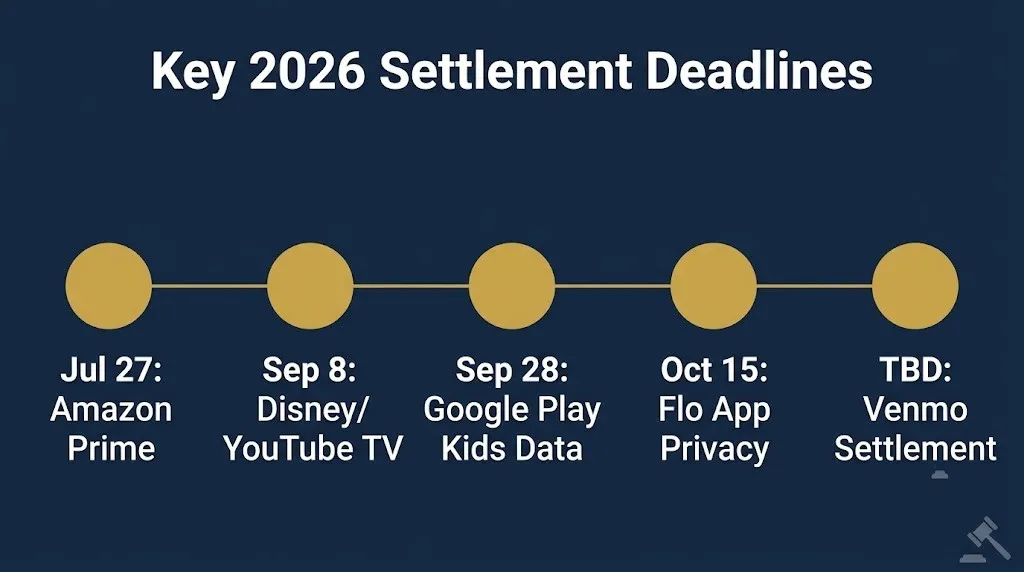
| Nearest major deadlines | July 27, 2026 (Amazon Prime); Sept 8, 2026 (Disney/YouTube TV); Sept 28, 2026 (Google Play children’s data); Oct 15, 2026 (Flo app) |
| Venmo settlement | Not yet reached, cases still in litigation |
| Temu settlement | Not yet reached, cases still in litigation |
| Filing cost | Always free through the official administrator |
Is “Class Action Settlements” Legit or a Scam?
Class action settlements themselves are a legitimate, court-supervised part of the U.S. legal system, not a scam. The confusion usually comes from lookalike sites and text messages that mimic real claim forms.
A genuine settlement traces back to an actual court case, has a named administrator, and never asks you to pay to receive money. A legitimate settlement means eligible class members may submit a claim by certifying that they purchased the product, used the service, received a breach notice, or otherwise meet the settlement criteria.
The scam version usually shows up as an unsolicited text claiming you’ve “already won” a payout, then asks for a processing fee or your bank login. Real administrators mail or email a notice, but they never front-load a cash offer before you’ve filed anything.
How Do You Know a Specific Class Action Settlement Is Real?
You verify it the same way a reporter would: check the case against a primary source, not a blog post. Look for the official settlement website tied to the case name, the court docket, or a government agency release like the FTC or a state attorney general’s office.
Aggregator sites that track dozens of open settlements cross-check each entry against a primary source, the official settlement website, the court docket, or a primary news report, and only include cases with a claim window that is open. If a site won’t name the court or the administrator, treat it as unverified.
Key Takeaway: A class action settlement is only as trustworthy as its paper trail; if you can’t find the court docket or an official administrator site, don’t submit personal or financial information.
How Much Money Can You Get From a Class Action Settlement?
Payout amounts depend entirely on the size of the fund, how many people file, and whether you’re claiming a flat cash tier or a documented-loss tier. There is no single “average” payout because every case is different.
Recent examples show the range. The Molina Healthcare robocall settlement pays an estimated $319 to $638 per person with no proof needed. A Fanatics handling-fee settlement pays a flat two $5 vouchers. The Albany Park pricing settlement gives class members a $115 store credit automatically, or $115 cash by filing a claim.
| Example settlement | Estimated payout | Proof needed |
|---|---|---|
| Google Play antitrust | Up to $51 | No, based on account records |
| Molina Healthcare robocalls | $319 to $638 | No |
| Albany Park pricing | $115 | No (automatic credit) or claim for cash |
| Flo app privacy | Pro-rata share of $59.5M | No, attestation |
| Nutricost magnesium supplement | Pro-rata share of $1.835M | No |
Documented-loss tiers pay more but take more work. The Comcast data breach settlement, for instance, offers an alternative cash payment for eligible notice recipients, or reimbursement for documented losses and time spent, depending on the claim submitted.
Class Action Settlements With No Proof of Purchase
A no-proof settlement lets you file by signing a statement under penalty of perjury that you bought the product or used the service, without uploading a receipt. This exists because requiring receipts for a $10 to $50 payout would cost the settlement fund more to verify than it pays out.
Most no-proof settlements cap the number of products you can claim, often 3 to 6 units, so claim the number you actually purchased, not the maximum allowed. Current no-proof examples circulating in mid-2026 trackers include beef products, toothpaste, magnesium supplements, and several data-breach notices.
One nuance worth flagging: “no receipt” and “no proof” aren’t always the same thing. Many data-breach claim portals still require a Notice ID, Claim ID, or PIN from your mailed or emailed notice, which functions as proof of class membership. Keep any settlement notice you receive in the mail, even if you think it’s junk.
Largest Class Action Settlements Open Right Now
Fund size and per-person payout aren’t the same thing, a billion-dollar fund split among tens of millions of claimants can still pay out modestly. That said, size signals how seriously a court took the underlying claims.
Some of the largest active or recently active funds by dollar amount:
- Amazon Prime cancellation (FTC-driven): fund size not fully public, payouts up to $51 per person, deadline July 27, 2026
- Google Play Store antitrust: $630 million, over allegations Google monopolized Android app distribution and overcharged consumers through its 30% commission
- Flo period-tracking app privacy: $59.5 million, settled by Flo, Google, and Flurry over data-sharing claims, deadline October 15, 2026
- Beef price-fixing (Tyson and Cargill): $87.5 million, covering purchases from August 2014 through December 2019
- YouTube TV / DirecTV Stream antitrust against Disney: $50 million, deadline September 8, 2026
Key Takeaway: A big headline fund number tells you the case was serious, but your actual check depends on how many other people file, not the size of the fund alone.
How to Join a Class Action Lawsuit
Joining an already-certified class action is usually passive: if you fit the class definition, you’re automatically included unless you opt out. You don’t need to hire anyone or sign a retainer to be part of the class.
For a case that’s still in the investigation or pre-settlement stage, like Venmo or Temu, “joining” typically means registering with a law firm’s intake form so you get notified if a settlement or certified class opens later. Registering at this stage creates no financial obligation.
Steps to join a class action lawsuit:
- Confirm the case fits your situation (dates, product, account, or notice you received)
- Check whether the case is still pre-settlement or has an active claims process
- If pre-settlement, register with class counsel’s intake form, if you choose to
- If a settlement is open, go straight to the official administrator site
- Save any confirmation email or settlement notice as your own record
- Watch for a claim deadline once a settlement is approved
How to File a Class Action Settlement Claim
Filing an approved claim usually takes under ten minutes and is always free. The process is the same shape across almost every case, only the fields on the form change.
Steps to file a claim:
- Find the official settlement website (search the exact case name plus “settlement”)
- Read the class definition to confirm you qualify
- Locate your Claim ID, Notice ID, or PIN if the notice you received included one
- Fill out the claim form with your name, address, and eligibility details
- Choose a payment method: check, PayPal, Venmo, Zelle, or prepaid card
- Submit before the claim deadline, courts do not accept late claims
- Save your confirmation number
Reality Check: No legitimate settlement administrator ever asks you to pay an activation fee, a release fee, a gift card, or cryptocurrency to release money you’re owed. Filing a class action claim is always free, and nobody texts you out of the blue with a payout already waiting; you have to file first.
How to Find Class Action Lawsuits You Can Join
The most reliable way to find open cases is to check official government and court sources directly, then use tracker sites as a secondary index. The FTC, CFPB, and state attorneys general post enforcement actions and refund programs directly on their sites.
For consumer product and data-breach cases, legal-news outlets that cite dockets and administrator sites, rather than just other blogs, are the more reliable secondary layer. Cross-check any case you find against the official settlement site before entering personal information.
Venmo Class Action Lawsuit: What’s Actually Open in 2026
There is no Venmo class action settlement currently paying out; several separate lawsuits are still in litigation. Venmo faces class actions over multi-day fund holds, a lack of fraud reimbursement consistent with Reg E protections, and a case tied to 1099-K threshold communication.
A separate case targets Venmo’s referral text program. Attorneys are investigating whether unsolicited Venmo referral texts violated Washington’s commercial electronic mail law, and similar cases against Robinhood and Cash App’s parent company have already settled for $9 million and $12.5 million respectively.
No settlement has received final court approval as of this writing, but the trajectory of several cases suggests settlements could be announced in the second half of 2026. If you see a site asking you to pay to “sign up” for the Venmo lawsuit, that is not how any of these cases currently work: registering with class counsel is free, and there is no claims portal open yet.
Temu Class Action Lawsuit: What’s Actually Open in 2026
Temu also has no approved consumer settlement yet, despite multiple active cases. No confirmed Temu settlement amount exists for the consumer-facing class actions as of this writing. The cases fall into three tracks: data privacy, false advertising, and product safety.
Two states have sued directly rather than waiting on private litigation. Arkansas’s attorney general filed against Temu’s parent companies, PDD Holdings and WhaleCo, alleging violations of the state’s deceptive trade practices and personal information protection laws, and Texas filed a similar suit in February 2026. Separately, the FTC reached a smaller enforcement settlement, a $2 million civil penalty over Temu’s alleged failure to meet INFORM Consumers Act disclosure requirements, though that case is about marketplace transparency, not a consumer payout fund.
The privacy track has moved furthest procedurally. Temu’s second attempt to dismiss the Illinois data privacy case was rejected by the court, keeping the largest of the pending cases alive. Until a settlement is reached, registering with a law firm’s intake form is the only free way to preserve your place in line, and no “Temu lawsuit sign up” site should be charging a fee.
Key Takeaway: Both Venmo and Temu are real, active legal fights, but neither has money to claim yet, so any “sign up now for your payout” pitch tied to either case is ahead of the facts.
Open Class Action Lawsuits and Settlements to Watch
Beyond Venmo and Temu, several cases are moving through litigation without a settlement yet, meaning there’s nothing to claim today but a payout could arrive later. Watching these means checking court dockets or legal-news trackers periodically rather than filing anything now.
Cases in active litigation reported in 2026 trackers include disputes over Kirkland Signature grain-free dog food cardiac risk claims, Kia Telluride battery drain defects, Amazon Ring facial recognition features, and Disney’s alleged biometric data collection at California theme parks. None of these has an open claims process as of this writing.
Unclaimed Money From Class Action Settlements
Unclaimed settlement money exists because most eligible people never file a claim. Industry data cited by legal-news trackers suggests data privacy settlements typically see claim rates of only 2% to 10% of the eligible class, meaning the vast majority of eligible members leave money on the table.
That’s the core reason no-proof settlements exist at all: for low-dollar claims, requiring documentation would cost more to process than the payout itself, so courts approve attestation-based filing instead. If you received a notice in the mail or an email from a settlement administrator in the past two years and didn’t act on it, check whether the claim window is still open before assuming it’s gone.
What Happens After You File a Claim
Filing is only the first step. After the claim deadline passes, the administrator validates claims, the court holds a final approval hearing, and only then does money go out.
A rough example: for cases receiving final approval in late 2026, payments could realistically arrive in early to mid-2027. That gap between filing and payment is normal, not a sign something went wrong.
Class Action Lawsuit vs. Individual Lawsuit: What’s the Difference
A class action combines many similar claims into one case so the court and the defendant deal with one proceeding instead of thousands. An individual lawsuit is yours alone, with its own timeline, cost, and risk.
Class actions trade a smaller, more predictable payout for near-zero cost and effort. Individual lawsuits can pay more if you have significant documented harm, but you take on legal fees and the case can take years. This is the same tradeoff as taking a guaranteed refund versus fighting a dispute yourself: faster and safer, but usually smaller.
Settlement Claim ID Lookup: Checking Your Claim Status
Most settlement administrators provide a status lookup on the official case website using your Claim ID or Notice ID rather than your name alone. That ID typically comes from the postcard, letter, or email you were sent when the class was certified.
If you never received a notice but believe you qualify, most claim portals also let you file without a prior ID by entering your account or purchase details directly. Administrators, not the reporting site you found the case on, are the only ones who can confirm your claim status.
Finding Class Action Lawsuits in California and Florida
Both states publish or index consumer-facing settlement and lawsuit information, but through different channels. California’s attorney general posts consumer alerts and enforcement actions, while court dockets in both states are searchable through the relevant county or federal district court’s public case system.
Because California and Florida have large populations and broad consumer protection statutes, cases originating there, like the Sprouts receipt-printing settlement or various data-breach notices, often end up covering nationwide classes rather than just residents of that state. Check the class definition in any specific case rather than assuming state residency requirements.
What Happens Next
July 2026: Multiple no-proof settlements close claim windows, including Amazon Prime (July 27) and several smaller data-breach cases. September 2026: Google Play children’s data settlement (Sept 28) and Disney/YouTube TV settlement (Sept 8) close. October 2026: Flo app privacy settlement closes (Oct 15). Expected late 2026: Illinois court expected to rule on class certification in the Temu privacy case. Expected second half of 2026: Possible first settlement announcements in Venmo-related litigation, based on current case trajectory.
Frequently Asked Questions
Is it safe to give my Social Security number for a class action claim?
Only on the official settlement administrator’s site, and only if the specific claim form requests it for payment tax reporting. Never provide it in response to an unsolicited text or email claiming you’ve already won money.
Do I need a lawyer to file a class action claim?
No, filing a claim in an already-certified class does not require a lawyer. You typically only need one if you’re pursuing individual litigation instead of joining the class.
Can I join more than one class action settlement at a time?
Yes, there is no limit on how many settlements you can file for if you qualify for each. File the ones with the nearest deadlines first.
How long does it take to get paid after filing?
It varies by case, but payment usually follows final court approval, not the date you filed. Cases approved in late 2026 could realistically pay out in early to mid-2027.
What if the Venmo or Temu lawsuit settles later, do I need to have signed up now?
Not necessarily. If a class is certified, most people who fit the class definition are included automatically. Registering early with class counsel mainly ensures you’re notified directly rather than relying on public news.
Why do some settlements not require proof of purchase?
Because verifying receipts for small claims would cost the fund more than the payouts themselves. Claims are still signed under penalty of perjury, and administrators use data analysis to flag suspicious filing patterns.
Are class action settlement texts and emails ever legitimate?
Yes, but only from the actual court-appointed administrator, and they never ask for payment to release funds. If a message asks for a fee, gift card, or cryptocurrency, it is not a legitimate settlement notice.
How much of a settlement fund actually goes to consumers versus lawyers?
This varies by case and is set by the court, with attorney fees typically approved as a percentage of the fund or a separate court-reviewed amount. Check the official settlement notice or court filing for the specific breakdown in any case you’re considering.
Start with the settlements closest to their deadline, since courts do not accept late claims once a window shuts. Bookmark the official site for any case you file, and calendar the date rather than relying on a reminder email that might land in spam.
Sources checked July 14, 2026: FTC official Amazon Prime refund announcements, Class Action Buddy settlement trackers, Top Class Actions and OpenClassActions.com case listings, ClassAction.org lawsuit database, Dapeer Law open settlements page, MoneyPilot settlement guide, and Lantern by Labaton Keller Sucharow case intake page for Temu.
This site is an independent news publisher, not a law firm. This article is information, not legal advice. Verify current details on the official settlement website before filing.