Complex Civil Litigation in 2026: What It Means, How It Works, and Why It Takes So Long
Quick Answer
- Is it legit? Yes. Complex civil litigation is a standard legal category, not a scam or a specific lawsuit.
- How much? There is no payout. This is a procedural category, not a settlement fund or claims program.
- Key deadline? None. Deadlines depend on the individual case, court, and judge.
Complex civil litigation is the legal system’s term for lawsuits that are too big, too technical, or too crowded with parties for a routine courtroom. It is a category, not a case. No one is owed money simply because a lawsuit is labeled “complex.”
That distinction matters in 2026. Search traffic for the phrase has grown as big cases dominate headlines: opioid MDLs, social media addiction claims, product liability fights over talc and hair relaxers. Readers see the term and wonder if there is a claim to file or a payout to collect.
There is not. What exists is a system. Federal courts manage thousands of related lawsuits through multidistrict litigation, state courts run their own complex programs, and judges apply special rules to keep the whole thing from collapsing under its own weight.
This article explains what complex civil litigation actually means, how cases get that label, what the process looks like, and why the timeline stretches for years instead of months.
The Facts
| Item | Detail |
|---|---|
| Case | Not a single case; a procedural category for large or technical civil lawsuits |
| Status | Ongoing across federal and state courts |
| Fund Size | Not applicable |
| Est. Per Person | Not applicable |
| Claim Deadline | None; deadlines vary by individual case |
| Administrator | Court-appointed judges and special masters in specific cases |
| Proof Needed | Not applicable |
Is complex civil litigation real or just lawyer jargon?
Complex civil litigation is a real legal category with formal rules, dedicated court programs, and its own case management procedures. It is not marketing language. Courts in California, for example, maintain specific Complex Litigation Programs with published guidelines for identifying and managing these cases .
The confusion comes from how the phrase gets used. A law firm website might say it handles “complex civil litigation” to signal sophistication. A news article might use it to describe a product liability case. Neither is wrong, but neither is a legal status you can act on.
What makes the category real is the procedural machinery behind it. When a case is designated complex, discovery may be automatically stayed, a special case management conference is scheduled, and the judge takes a more active role in moving the case forward .
How much does complex civil litigation cost or pay?
There is no payout tied to the label “complex civil litigation.” It is not a settlement program, a class action fund, or a compensation scheme. Treat any message suggesting otherwise as a red flag.
Costs, however, are real and often enormous. Complex cases involve multiple expert witnesses, extensive electronic discovery, and years of motion practice. A study of Australian litigation noted that time-based billing creates incentives for lawyers to spend more hours, and the more complex the case, the greater the potential fees .
For plaintiffs, the cost structure usually depends on the arrangement. Class actions and MDLs often run on contingency, meaning lawyers take a percentage of any recovery. Individual complex commercial disputes may bill hourly, and the bills can reach seven figures before trial even begins.
Key Takeaway: Complex civil litigation is a process, not a payout program; any “claim” tied to the phrase alone is not legitimate.
What makes a lawsuit “complex” in the legal sense?
A lawsuit becomes complex when it has one or more features that break the normal rhythm of court. The most common triggers are multiple parties, high stakes, technical evidence, and sprawling discovery.
Legal scholars identify five main causes: legal complexity, factual complexity, high stakes, multiple parties, and lawyer conduct . A case can be complex because the law is unsettled, because the facts require expert testimony, because the amount at risk could bankrupt a company, because dozens of plaintiffs are joined together, or because the lawyers fight over every procedural point.
California’s court rules take a more practical approach. Certain case types are automatically assigned to the complex track: all construction defect cases, all class actions, and all cases involving Private Attorney General Act claims . The court can also designate a case complex at an initial case management conference .
Who may qualify for complex litigation treatment?
You do not “qualify” for complex civil litigation in the way you qualify for a settlement. The question is whether your case meets the court’s criteria for special management. Judges decide that, not claims administrators.
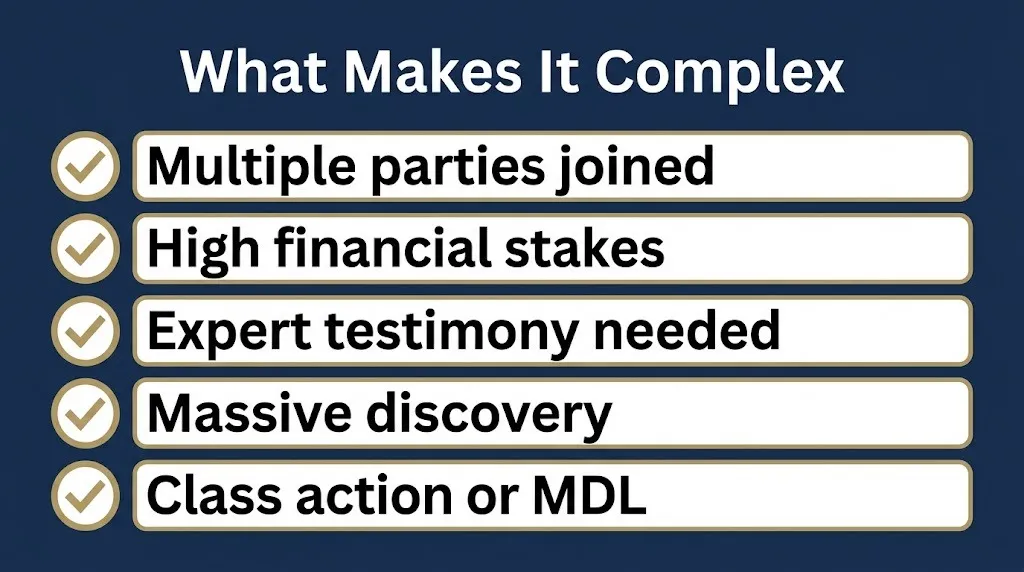
- Your case involves many parties. Joinder, consolidation, or cross-claims push a case toward complexity.
- The facts require expert testimony. Technical evidence beyond lay understanding is a common trigger.
- The stakes are existential. “Bet the company” litigation often gets heightened case management.
- The case is a class action or MDL. These are almost always treated as complex.
- Discovery will be massive. Electronically stored information and multiple jurisdictions signal complexity.
Reality Check: No one texts you money because your lawsuit is “complex.” There is no complex litigation fund. Filing fees and attorney fees are real; unsolicited offers to “register” you for a complex case payout are not.
How does multidistrict litigation fit into complex civil litigation?
Multidistrict litigation, or MDL, is the federal system’s main tool for handling complex cases that share common facts. When lawsuits pile up across different federal courts, the Judicial Panel on Multidistrict Litigation can transfer them to one judge for coordinated pretrial proceedings .
The scale is staggering. As of October 1, 2026, the federal MDL docket showed 69,340 pending actions in the Johnson & Johnson talcum powder litigation, 23,324 in the Bard hernia mesh litigation, and 15,264 in the aqueous film-forming foams litigation . The social media adolescent addiction MDL, which overlaps with the mental health cases making headlines, had 3,824 pending actions .
MDL is not a class action. Each plaintiff keeps an individual case. The MDL centralizes discovery and pretrial motions, then sends cases back for trial if they do not settle. That structure is a defining feature of modern complex civil litigation.
How do you file or participate in complex civil litigation?
You do not file a “complex civil litigation” claim. You file a lawsuit, and the court decides whether it gets complex treatment. The steps below outline the general path for someone considering civil action.
- Identify the harm and the defendant. You need a legal theory and a party to sue.
- Consult a lawyer who handles your case type. Complex cases rarely proceed without specialized counsel.
- File a complaint in the appropriate court. Jurisdiction and venue matter enormously.
- Prepare for case management. The court may schedule an initial conference to decide complexity.
- Participate in discovery. Expect document production, depositions, and expert reports.
- Consider mediation or settlement. Most complex cases resolve before trial.
What happens next in complex civil litigation generally?
There is no single next step because there is no single case. The timeline depends entirely on which litigation you are following.
Ongoing: Federal MDLs continue pretrial proceedings under their assigned judges. The talc, hernia mesh, and social media addiction MDLs remain active with thousands of pending actions .
Expected 2027: Several major MDLs will likely see bellwether trials or settlement discussions, though exact dates are not yet confirmed.
TBD: Any global settlement in a major MDL would create a claims process with its own deadlines. Watch for court-approved notices, not advertisements.
Frequently Asked Questions
What is complex civil litigation in simple terms?
Complex civil litigation is a legal category for lawsuits that are too large, technical, or crowded with parties for routine court handling.
Is complex civil litigation a type of lawsuit I can join?
No. It is a procedural label, not a claim or settlement. You join specific lawsuits, not the category.
What is the difference between complex litigation and a class action?
A class action is one type of complex litigation. Complex litigation also includes MDLs, multi-party commercial disputes, and other large cases that are not class actions.
Does complex civil litigation always go to trial?
No. Most complex cases settle before trial. The preparation for trial often drives settlement negotiations.
How long does complex civil litigation take?
It varies widely. Many complex cases take years from filing to resolution, and appeals can add more time.
Who pays for complex civil litigation?
The parties pay their own legal costs unless a statute or contract shifts fees. Plaintiffs in class actions and MDLs often work on contingency.
What is an MDL and is it the same as complex litigation?
An MDL is a federal multidistrict litigation, a specific mechanism for coordinating related cases. MDLs are a major subset of complex civil litigation but not the only type.