Compensation Psychology in 2026: What the Meta and YouTube Verdict Means for Mental Health Claims
Quick Answer
- Is it legit? Yes. A Los Angeles jury found Meta and YouTube liable for a plaintiff’s social media addiction harms in March 2026.
- How much? The plaintiff won $6 million total, but this is an individual verdict, not a class settlement fund.
- Key deadline? There is no claim deadline for the public because this was not a class action settlement.
The psychology of compensation is no longer an abstract academic question in 2026. A Los Angeles jury put a dollar figure on it: $6 million for one woman whose childhood social media use, she argued, rewired her mental health.
That verdict landed in March 2026. It is the first jury finding that Meta and Google bore legal responsibility for a user’s psychological harm from platform design. The number matters because it moves “compensation psychology” from law review footnotes into a courtroom reality.
But here is the catch you need to understand before you assume you are owed anything. This was a bellwether trial, not a class settlement. The plaintiff, identified in court as K.G.M. or Kaley, won her individual case. Thousands of similar lawsuits are still pending, and no claims administrator is accepting forms from the general public.
This article breaks down what the verdict actually says, why “compensation psychology” is now a live legal theory, and what it means for anyone wondering if their own mental health struggles with social media translate into money.
The Facts
| Item | Detail |
|---|---|
| Case | K.G.M. v. Meta Platforms and YouTube (bellwether trial) |
| Status | Jury verdict March 2026; appeals expected |
| Award | $6 million total ($3M compensatory, $3M punitive) |
| Per Person | Not applicable; individual verdict, not a class fund |
| Claim Deadline | None for public; no settlement claims process open |
| Administrator | Not appointed for public claims |
| Proof Needed | Not applicable at this stage |
Is the compensation psychology lawsuit real or a scam?
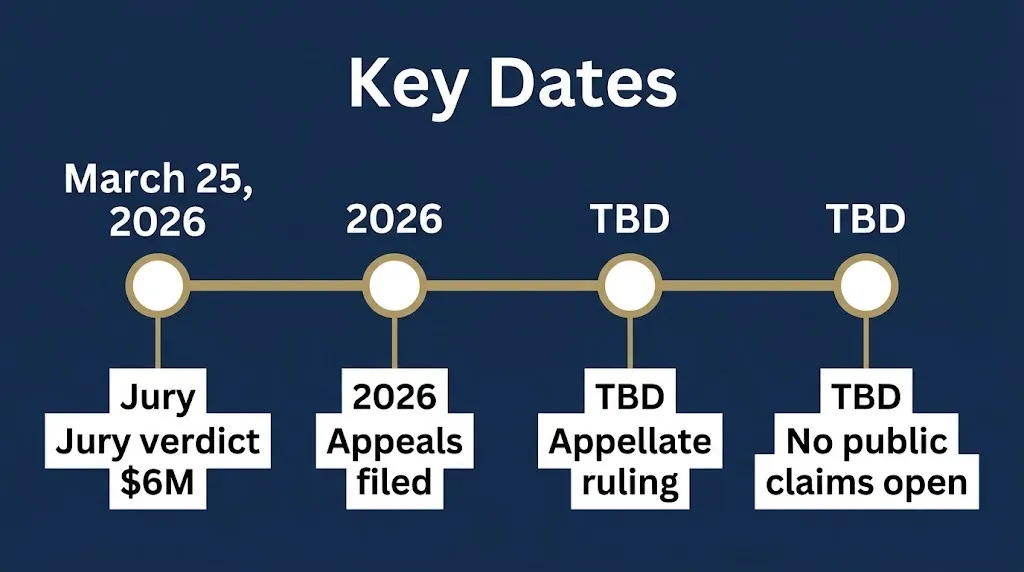
The verdict is real, but any message telling you to file a claim for a piece of a settlement is not. A Los Angeles County jury returned the verdict on March 25, 2026. Meta was assigned 70 percent of the compensatory damages and YouTube 30 percent. The punitive phase added $2.1 million against Meta and $900,000 against YouTube.
No court has approved a global settlement that would pay strangers who used Instagram or YouTube as kids. The plaintiff’s case was one of roughly 2,000 pending lawsuits consolidated for pretrial coordination. Those cases remain in various stages.
If you see an ad or text promising “compensation psychology settlement money,” treat it the way you would treat a call from someone claiming to be the IRS: hang up and verify nothing.
How much could someone get from a social media mental health claim?
There is no standard payout, no tier table, and no guaranteed amount for anyone outside the K.G.M. verdict. The $6 million figure belongs to one plaintiff in one trial. It reflects her specific evidence: her age when she started using the platforms, her diagnoses, and the jury’s findings on causation.
For the pending cases, amounts depend on factors a claims administrator would evaluate if settlements ever materialize. Those factors include the severity of the diagnosed condition, the age of first use, evidence linking platform design to the harm, and whether the person has medical records documenting treatment.
No compensation psychology settlement fund exists as of October 2026. The verdict did not create one. It established liability in a single case and set a benchmark that both sides will fight over on appeal.
What did the jury actually decide about compensation psychology?
The jury accepted a theory that psychologists and legal scholars have debated for decades: that harm to mental health can be quantified and compensated like a physical injury. Kaley testified she started using YouTube at age 6 and Instagram at age 9 or 11, depending on the account, and that she developed anxiety, depression, and body dysmorphia. The jury found Meta and Google liable for her psychological harm.
The punitive damages matter for the psychology angle. Jurors concluded the companies acted with “malice, oppression, or fraud,” according to reporting on the verdict. That finding transforms the case from a simple negligence claim into a statement about corporate conduct.
Meta’s lawyers argued that complex mental health conditions cannot be blamed on a single app. The jury disagreed. Google’s spokesperson called YouTube a streaming platform, not a social media site. The jury disagreed with that framing too, at least for this plaintiff.
Who may qualify if future settlements open?
No public eligibility rules exist yet. Any future settlement would define its own class. But based on the theories tested in this trial, the people most likely to be affected fit a profile.
- You started using Instagram or YouTube before age 13. The plaintiff’s case centered on childhood use.
- You have a diagnosed mental health condition. Anxiety, depression, and body dysmorphia were central to the verdict.
- You can connect the condition to platform use. Medical records and testimony linking usage patterns to symptoms would matter.
- You lived in California or another state with similar consumer protection laws. The trial was in Los Angeles County.
Key Takeaway: The verdict validated one person’s claim; it did not create a claims process for the public.
Why does “compensation psychology” matter in court?
Compensation psychology, in the legal context, refers to the study of how people value psychological harm and how money affects recovery. Courts have long struggled with quantifying emotional distress. The K.G.M. verdict shows a jury willing to attach a specific number to social media-related mental health damage.
The $3 million compensatory award was for past and future mental health harm. The additional $3 million in punitives was designed to punish corporate conduct. Together, they represent a jury’s judgment that the harm was severe and the conduct was blameworthy.
One older study found that litigants often feel their compensation is too low, and the litigation process itself can worsen symptoms. That tension sits at the heart of compensation psychology: money is supposed to help, but the fight for it can hurt.
How do you file a claim for social media mental health harm?
You cannot file a public claim right now. There is no open settlement. If one opens later, the process would follow the standard class action pattern.
- Watch for a court-approved notice. Official notices come from a court or a court-appointed administrator, never from a random text.
- Check the official settlement website. A real settlement has a dedicated site with claim forms and deadlines.
- Gather your records. Medical records, therapy notes, and dates of platform use would support any future claim.
- Do not pay anyone to “register” you. Filing a claim in a class action is free.
- Consider whether to opt out. If a settlement offers too little, you may have the right to exclude yourself and pursue an individual case.
What happens next in the Meta and YouTube appeals?
Both companies said they will appeal. That means the $6 million verdict could be reduced, overturned, or upheld after months or years of appellate review. No money changes hands while appeals proceed.
Reality Check: No one is texting you settlement money from a social media addiction case. Filing a claim in any legitimate class action is free. Anyone charging a fee to “reserve your payout” is running a scam.
The appeals will focus on legal questions: whether the trial judge properly instructed the jury, whether the evidence supported the causation finding, and whether the punitive damages were excessive. The outcome will shape how the remaining 2,000 cases proceed.
What happens next?
Expected late 2026 or 2027: Appellate briefs and oral arguments in the Meta and YouTube appeal. No new verdict or payout is likely before the appeal concludes.
Ongoing: The remaining bellwether cases and coordinated proceedings continue. A settlement covering a broader group of plaintiffs remains possible but not confirmed.
TBD: Any court-approved class settlement would come with a new website, claim deadline, and eligibility rules. Watch for official notices from courts, not ads.
TBD: New Mexico’s separate case against Meta, where a jury ordered $375 million in damages, also has a second phase addressing potential additional penalties.
Frequently Asked Questions
Is there a compensation psychology settlement I can claim?
No. The March 2026 verdict was an individual jury award, not a class settlement. No claims process is open to the public.
How much did the plaintiff get in the Meta YouTube trial?
The jury awarded $6 million total: $3 million in compensatory damages and $3 million in punitive damages.
Do I need a lawyer to get money from a social media lawsuit?
For a future class settlement, no. Class members file claim forms themselves. For an individual lawsuit, a lawyer would be necessary, but individual cases are expensive and slow.
What mental health conditions were at issue in the trial?
The plaintiff testified about anxiety, depression, and body dysmorphia that she said developed from childhood social media use.
Can I sue Meta or YouTube myself for mental health harm?
You can file a lawsuit, but the odds are difficult without documented harm, strong evidence, and significant legal resources. The bellwether verdict does not automatically create liability in other cases.
Is the $6 million verdict final?
No. Meta and Google said they will appeal. The verdict could be upheld, reduced, or overturned.
What is “compensation neurosis” and does it apply here?
Compensation neurosis is an older term for the idea that people exaggerate symptoms to get money. Courts and psychologists now treat it cautiously. The K.G.M. jury rejected the defense implication that her symptoms were not real.
Key Takeaway: Appeals will decide whether the verdict stands; no public money is available while that fight continues.