Talcum Powder Lawsuit in 2026: The Complete Litigation Status Report
Quick Answer
- Talcum powder lawsuits allege that Johnson & Johnson baby powder caused ovarian cancer and mesothelioma.
- No open class action settlement exists; each claimant files individually through the multidistrict litigation.
- New claimants may still file if they meet medical and exposure criteria, but deadlines vary by state.
The talcum powder lawsuit is one of the largest mass tort litigations in American history. Tens of thousands of women have sued Johnson & Johnson, claiming that decades of using talc-based baby powder caused their ovarian cancer. Thousands more have filed mesothelioma claims, alleging that talc contaminated with asbestos caused their disease.
Johnson & Johnson has repeatedly attempted to resolve these claims through bankruptcy and settlement proposals. Those efforts have faced legal setbacks and mixed court rulings. The litigation continues in 2026, with no single nationwide class action settlement open for claims.
This guide explains the current status of talc litigation, who may qualify, how much claims may be worth, and how the bankruptcy and settlement landscape has shifted.
The Facts
| Case | In re: Johnson & Johnson Talcum Powder Products Marketing, Sales Practices, and Products Liability Litigation (MDL No. 2738) |
| Status | Active; thousands of cases pending in federal and state courts |
| Fund Size | No single settlement fund; J&J proposed $8 billion to $10 billion across prior settlement efforts |
| Est. Per Person | Varies widely; ovarian cancer settlements historically ranged from $100,000 to $500,000; mesothelioma claims often higher |
| Claim Deadline | No single deadline; statute of limitations varies by state |
| Administrator | No national claims administrator for an open settlement |
| Proof Needed | Medical records, pathology reports, product usage history |
Is the Talcum Powder Lawsuit Still Active in 2026?
Yes, the talcum powder lawsuit remains active in 2026. Thousands of cases are still pending in the federal multidistrict litigation and in state courts across the country.
The multidistrict litigation, known as MDL No. 2738, is centralized in the U.S. District Court for the District of New Jersey. Judge Michael Shipp has overseen the MDL since its creation in 2016. The MDL consolidates pretrial proceedings for federal talc cases.
State court litigation continues in parallel. New Jersey, California, Missouri, and other states have significant numbers of talc cases. Some state courts have issued large verdicts against Johnson & Johnson, while others have dismissed claims.
The litigation is not over. New claimants continue to file, and existing cases move toward resolution through trials, settlements, or dismissal.
Key Takeaway: Talc litigation remains active in 2026, with thousands of cases still pending in federal and state courts.
What Is the Current Status of Johnson & Johnson’s Talc Settlement?
Johnson & Johnson’s talc settlement efforts have faced repeated legal obstacles. The company attempted to resolve talc claims through a controversial bankruptcy maneuver known as the Texas two-step. That strategy was rejected by courts.
In 2024, J&J proposed a new settlement plan through a subsidiary called Red River Talc LLC. The company offered approximately $8 billion to resolve ovarian cancer claims. A separate proposal addressed mesothelioma claims.
As of August 2026, no global settlement has received final court approval. Some claimants have accepted individual settlements, but the broad resolution J&J sought remains incomplete. The bankruptcy and settlement landscape continues to shift.
The key point for consumers: no open settlement fund exists that you can join today. Claimants must file individual cases or join any future approved settlement.
Key Takeaway: J&J’s global settlement proposals have not received final approval; no open settlement fund exists.
How Much Are Talcum Powder Lawsuit Settlements Worth?
Talcum powder settlement values vary dramatically based on the injury, the strength of evidence, and the venue. Ovarian cancer claims have historically settled in the range of $100,000 to $500,000 per claimant in some group settlements. Mesothelioma claims often settle for higher amounts, sometimes exceeding $1 million.
Jury verdicts have been higher. Some state court juries have awarded tens of millions or even billions of dollars in individual cases. Many of those verdicts were later reduced or appealed. The variability means no reliable average settlement exists.
The proposed J&J global settlement of $8 billion, if approved, would pay an average of roughly $100,000 to $200,000 per ovarian cancer claimant, depending on the number of participants. That figure is an estimate, not a confirmed payout.
| Claim Type | Settlement Range | Notes |
|---|---|---|
| Ovarian cancer | $100,000 to $500,000 | Historical group settlements |
| Mesothelioma | $500,000 to $1 million+ | Higher due to disease severity |
| Jury verdicts | $1 million to $2 billion | Often reduced on appeal |
Key Takeaway: Talc settlement values range from six figures for ovarian cancer to seven figures for mesothelioma, but no uniform amount applies.
Who Qualifies for a Talcum Powder Lawsuit?
Qualification for a talcum powder lawsuit depends on three factors: diagnosis, exposure, and timing. You may qualify if you were diagnosed with ovarian cancer or mesothelioma after using talc-based body powder for years.
The exposure requirement means you must have used Johnson & Johnson talc products, typically baby powder or Shower to Shower, for a sustained period. Many cases involve decades of regular use.
Timing matters because of statutes of limitations. Most states require claims to be filed within a certain period after diagnosis. The clock usually starts when you knew or should have known the talc caused your illness.
Medical documentation is essential. Pathology reports confirming ovarian cancer or mesothelioma, medical records showing your diagnosis, and evidence of talc use are the core proof.
- Diagnosis of ovarian cancer or mesothelioma
- History of regular talc-based powder use
- Use of Johnson & Johnson products specifically
- Diagnosis within the applicable statute of limitations
- Medical records and pathology reports available
Reality Check: No legitimate talc lawyer asks you to pay upfront fees. Talc attorneys work on contingency, meaning they collect a fee only if you recover money. Any talc claim service that demands payment is not legitimate.
Key Takeaway: You may qualify if you have an ovarian cancer or mesothelioma diagnosis, documented talc use, and file within your state’s deadline.
What Is the Difference Between Ovarian Cancer and Mesothelioma Talc Claims?
Ovarian cancer talc claims and mesothelioma talc claims are separate litigation tracks. They involve different diseases, different evidence, and different settlement values.
Ovarian cancer claims allege that talc particles traveled through the reproductive tract to the ovaries, causing inflammation and cancer. Thousands of these claims are pending. The science remains contested, with some studies showing a link and others showing none.
Mesothelioma claims allege that talc was contaminated with asbestos. Mesothelioma is a rare and aggressive cancer almost always linked to asbestos exposure. These claims often involve stronger evidence and higher settlement values.
Johnson & Johnson has maintained that its talc was never contaminated with asbestos. Internal documents and independent testing have produced conflicting findings. Juries have reached different conclusions.
Key Takeaway: Ovarian cancer claims dominate by volume, but mesothelioma claims often carry higher value due to stronger causation evidence.
How Do You File a Talcum Powder Lawsuit in 2026?
Filing a talcum powder lawsuit starts with finding an experienced mass tort attorney. Talc litigation is complex, and most firms that handle these cases work nationally with local counsel in relevant jurisdictions.
The first step is a free case evaluation. You provide your medical records, diagnosis details, and talc use history. The attorney reviews whether your case meets the criteria for filing.
If your case qualifies, the attorney files a complaint in the appropriate court. For federal cases, your case may be transferred to the MDL. For state cases, it proceeds in the state court where you or the defendant resides.
- Step 1: Gather medical records and pathology reports
- Step 2: Document your talc use history, including products and years of use
- Step 3: Contact a mass tort attorney for a free case evaluation
- Step 4: Provide all medical and exposure documentation
- Step 5: The attorney files your case in the appropriate court
- Step 6: Your case proceeds through the MDL or state court process
- Step 7: Resolution through settlement, trial, or dismissal
Key Takeaway: Filing a talc case requires medical records, documented talc use, and an experienced mass tort attorney.
What Is the Latest Talc Litigation News in 2026?
The latest talc litigation news in 2026 centers on continued settlement negotiations, ongoing trials, and the aftermath of rejected bankruptcy plans. The legal landscape remains unsettled.
Johnson & Johnson continues to pursue a global resolution. The company has set aside billions of dollars for talc liabilities. But claimant groups remain divided, with some accepting settlement terms and others holding out for trial.
Federal and state courts continue to issue rulings that shape the litigation. Some courts have excluded expert testimony linking talc to ovarian cancer, weakening certain claims. Other courts have allowed such testimony, strengthening plaintiffs’ positions.
The overall picture is one of ongoing conflict, not resolution. New claimants continue to file, and the total number of cases remains in the tens of thousands.
Key Takeaway: Talc litigation in 2026 is marked by ongoing settlement talks, divided claimant groups, and continued court rulings.
What Happened to the Johnson & Johnson Bankruptcy Plan?
Johnson & Johnson attempted to use a legal maneuver called the Texas two-step to resolve talc claims. The company created a subsidiary, assigned talc liabilities to it, and then filed that subsidiary for bankruptcy.
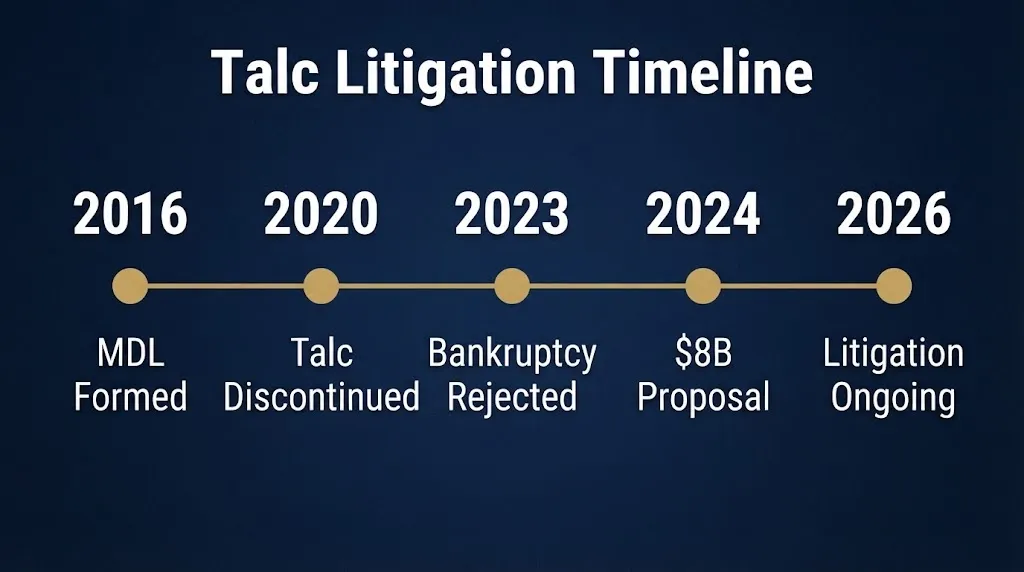
Federal courts rejected the maneuver. The Third Circuit Court of Appeals ruled that J&J’s subsidiary was not in financial distress and could not use bankruptcy to shield the parent company. A subsequent attempt using a different subsidiary also faced judicial skepticism.
In 2024 and 2025, J&J pursued a new plan through Red River Talc LLC. That plan proposed an $8 billion settlement for ovarian cancer claims. As of August 2026, final approval remains pending, and the outcome is uncertain.
The bankruptcy fight matters because it determines whether claimants receive a collective settlement or must pursue individual cases.
Key Takeaway: J&J’s bankruptcy maneuvers were largely rejected by courts, and the latest settlement plan awaits final resolution.
Can You Still Join the Talcum Powder Lawsuit in 2026?
Yes, new claimants may still file talcum powder lawsuits in 2026, provided they meet the medical and exposure criteria and file within their state’s statute of limitations.
There is no single deadline that applies nationally. Each state sets its own limitations period for personal injury and wrongful death claims. Some states allow two years from diagnosis. Others allow three years or more. Some states have discovery rules that extend the deadline.
The practical answer is that if you were recently diagnosed, you should contact a talc attorney immediately. Delay can cost your claim. Evidence becomes harder to gather, witnesses fade, and deadlines expire.
If a future global settlement is approved, it may include a claims deadline. But no such deadline exists today because no global settlement is final.
Key Takeaway: New claimants may still file in 2026, but state statutes of limitations control eligibility and timing.
What Does the Future Hold for Talc Litigation?
The future of talc litigation depends on several unresolved questions. Will J&J’s latest settlement proposal receive final approval? Will state courts continue to allow expert testimony linking talc to ovarian cancer? Will mesothelioma claims proceed on a separate track?
Late 2026: Possible rulings on the Red River Talc settlement proposal.
2027: If no global settlement, continued trials in federal and state courts.
2028 and beyond: Resolution of remaining claims through settlement or verdict.
Potential global settlement: If approved, a claims administrator would be appointed and a claims period opened.
The only certainty is continued litigation. No final resolution appears imminent.
Frequently Asked Questions
Is the talcum powder lawsuit still going on in 2026?
Yes, thousands of cases remain active in federal and state courts.
No global settlement has received final approval.
New claimants continue to file.
How much can I get from a talcum powder lawsuit?
Settlement values vary widely by case type and evidence.
Ovarian cancer claims historically ranged from $100,000 to $500,000.
Mesothelioma claims often exceed $1 million.
What is the deadline to file a talc lawsuit?
No single national deadline exists.
Each state sets its own statute of limitations.
Contact an attorney immediately if you were recently diagnosed.
Do I need to pay upfront for a talc lawyer?
No, talc attorneys work on contingency.
You pay nothing unless you recover money.
Any upfront fee request is a red flag.
What proof do I need for a talc lawsuit?
Medical records and pathology reports confirming your diagnosis.
Documentation of talc use, including products and years.
Evidence linking your illness to talc exposure.
Is Johnson & Johnson still selling talc-based baby powder?
No, Johnson & Johnson stopped selling talc-based baby powder in the United States and Canada in 2020.
The company switched to cornstarch-based powder worldwide by 2023.
Can I file a talc lawsuit for a deceased family member?
Yes, wrongful death claims may be filed by eligible family members.
Statutes of limitations for wrongful death vary by state.
Consult an attorney promptly.
Talcum powder litigation remains one of the largest mass torts in U.S. history, and it is far from over. If you have an ovarian cancer or mesothelioma diagnosis and a history of talc use, your claim may still be viable.
The most important step is to act quickly. Contact a qualified talc attorney, gather your medical records, and determine your state’s deadline. The litigation is active, and new claimants continue to join.