Zantac Lawsuit Lawyer 2026: Who Qualifies, How to Find Counsel, and What Settlements Actually Paid
Quick Answer
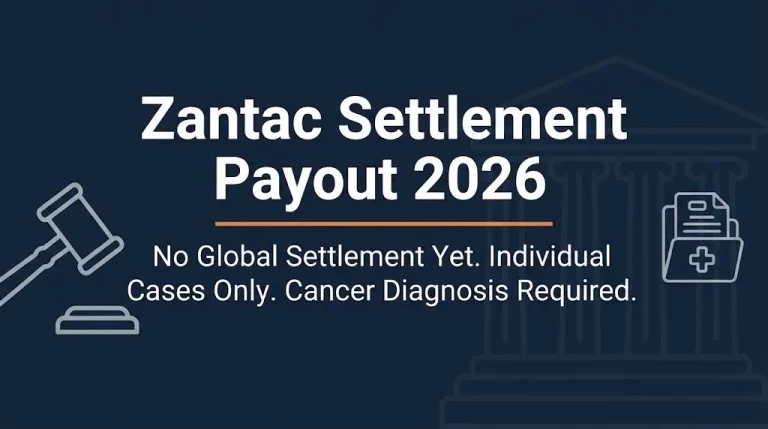
- Is there a settlement? Yes. GSK settled 80,000 cases for $2.2 billion. Pfizer and Sanofi also settled claims.
- Can you still file? Yes, but the deadline depends on your state’s statute of limitations and when you were diagnosed.
- Who qualifies? Long-term Zantac or ranitidine users diagnosed with certain cancers. You need medical records.
Do You Need a Zantac Lawsuit Lawyer in 2026?
Yes, you almost certainly need a lawyer to file a Zantac claim in 2026. These are complex pharmaceutical mass tort cases, not simple consumer claims. The scientific evidence battles alone involve expert testimony that courts have accepted and rejected on different grounds.
Filing on your own would mean navigating Daubert challenges, general causation standards, and state-specific statutes of limitations. That is not realistic without legal training.
The good news: most Zantac lawyers work on contingency. You pay nothing upfront, and the attorney takes a percentage of any recovery. That percentage typically runs 33% to 40% of the settlement amount .
This works like a home repair estimate where the contractor only gets paid if the job actually fixes the problem. You take on no financial risk to start.
How Much Did the Zantac Settlements Actually Pay?
The Zantac settlements totaled billions, but individual payouts varied enormously based on cancer type, severity, and documentation strength. GSK’s $2.2 billion deal divided among roughly 80,000 plaintiffs averaged around $27,500 per person, though actual amounts ranged from a few thousand dollars to much higher figures .
Here is what the verified settlements break down to:
| Defendant | Settlement Amount | Cases Covered | Status |
|---|---|---|---|
| GSK | $2.2 billion | ~80,000 state court cases | Announced October 2024, paying through 2026 |
| GSK (Valisure) | $70 million | Whistleblower complaint | False Claims Act, subject to DOJ approval |
| Pfizer | Not disclosed | Substantial majority of state cases | Settled per Q2 2024 filing |
| Sanofi | Not disclosed | Thousands of claims | Settled |
| Boehringer Ingelheim | No settlement | 60,000+ dismissed in Delaware | Continues litigating |
The GSK settlement used a point-based allocation system. Cancer type, duration of Zantac use, age at diagnosis, and treatment costs all factored into what each claimant received .
Key Takeaway: GSK’s $2.2 billion settlement averaged roughly $27,500 per plaintiff, but your actual payout depends on your cancer type, how long you took Zantac, and the strength of your medical records.
Who Qualifies to File a Zantac Cancer Claim?
You may qualify for a Zantac lawsuit if you took brand-name Zantac or generic ranitidine regularly for an extended period before the 2020 market recall and were later diagnosed with a qualifying cancer .
The key eligibility factors are:
- Regular use of Zantac or ranitidine for at least one year, typically between 1983 and 2020
- Cancer diagnosis after using the medication
- Medical records documenting both the usage and the diagnosis
- Filing within your state’s statute of limitations
The cancers most commonly linked to Zantac claims include bladder, stomach (gastric), liver, esophageal, pancreatic, colorectal, and prostate cancer . Some cases also involve lung cancer.
Pre-existing conditions like hepatitis B, hepatitis C, H. pylori infections, or achalasia may undermine a claim. Those conditions independently elevate cancer risk for some of the same cancer types, giving defense attorneys an alternative causation argument .
How Do You Find a Zantac Lawsuit Lawyer?
Finding a Zantac lawsuit lawyer means looking for attorneys with specific experience in pharmaceutical mass torts, not just general personal injury practices. The Zantac litigation is one of the largest drug injury cases in recent history, and the scientific and procedural complexity demands specialized knowledge.
Here is what to look for:
- Mass tort experience. The firm should have handled pharmaceutical MDLs or coordinated state court proceedings before.
- Zantac-specific involvement. Ask directly: have you filed Zantac claims? How many?
- Contingency fee structure. Most Zantac lawyers work on contingency, meaning no upfront cost to you.
- Clear communication about timeline. Zantac cases can take years. A good lawyer will be honest about that.
- Documentation support. Firms handling these cases often have intake teams that help locate medical and pharmacy records .
The firms listed as national counsel on the defense side, like King & Spalding and Dechert, represent the pharmaceutical companies, not plaintiffs . Plaintiff-side firms handling Zantac claims include Seeger Weiss and others with mass tort practices.
What Documents Do You Need for a Zantac Claim?
You need two core categories of documentation for a Zantac claim: proof you took the medication, and proof you were diagnosed with a qualifying cancer. The strength of your case depends on how well you can establish both.
Proof of Zantac use:
- Prescription records from your doctor
- Pharmacy purchase records
- Insurance claims showing ranitidine was dispensed
- If records are unavailable, a signed declaration from your prescribing physician
Proof of cancer diagnosis:
- Pathology reports
- Oncology records and treatment notes
- Imaging studies
- Biopsy results
For over-the-counter Zantac use, receipts or pharmacy records help. If you lack documentation, your doctor may be able to confirm they recommended or prescribed the medication.
The legal standard in civil litigation is preponderance of the evidence, meaning it is more likely than not that Zantac contributed to your cancer. You do not need to prove absolute causation .
What Are the Zantac Lawsuit Deadlines in 2026?
The Zantac lawsuit deadline depends on your state’s statute of limitations and when your claim accrued. There is no single national deadline.
Delaware’s two-year statute of limitations was triggered on April 1, 2020, when the FDA requested all ranitidine products be removed from the market . A Delaware judge dismissed 277 cases in January 2026 as time-barred under that rule.
Other states have different rules. Some allow two years from diagnosis, others four years. Some states apply a discovery rule, meaning the clock starts when you knew or should have known about the link between Zantac and your cancer .
The Boehringer Ingelheim dismissal in Delaware covered all cases filed on or before December 1, 2025 . That specific cutoff does not apply in other states, but it shows how aggressively defendants are pushing statute of limitations arguments.
Reality Check: No legitimate Zantac lawyer asks you to pay upfront to file a claim. Contingency fees mean the attorney gets paid only if you recover money. If someone demands a retainer, a processing fee, or payment for “medical record retrieval” before doing any work, walk away. Real mass tort firms front those costs.
Why Did Boehringer Ingelheim Win Its Zantac Cases?
Boehringer Ingelheim won dismissal of more than 60,000 Zantac cases in Delaware because the court found plaintiffs could not prove general causation. The Delaware Supreme Court excluded all of the plaintiffs’ general causation experts in July 2025, and the trial court then granted summary judgment on April 13, 2026 .
General causation is the scientific question: can this product cause this type of harm in anyone? Without admissible expert testimony on general causation, plaintiffs cannot make their case.
The Delaware ruling did not end Zantac litigation everywhere. Cases continue in California, where a hung jury in one trial showed causation can survive to deliberation . Connecticut has bellwether trials against Boehringer Ingelheim scheduled for March 2028 .
Boehringer Ingelheim has not entered any global settlement and continues to litigate. The company has an 8-0 trial record as of 2026 .
Can You Still File a Zantac Lawsuit in 2026?
Yes, you can still file a Zantac lawsuit in 2026, but the window is narrowing. State courts continue to see new filings from plaintiffs who were diagnosed with cancer after using Zantac.
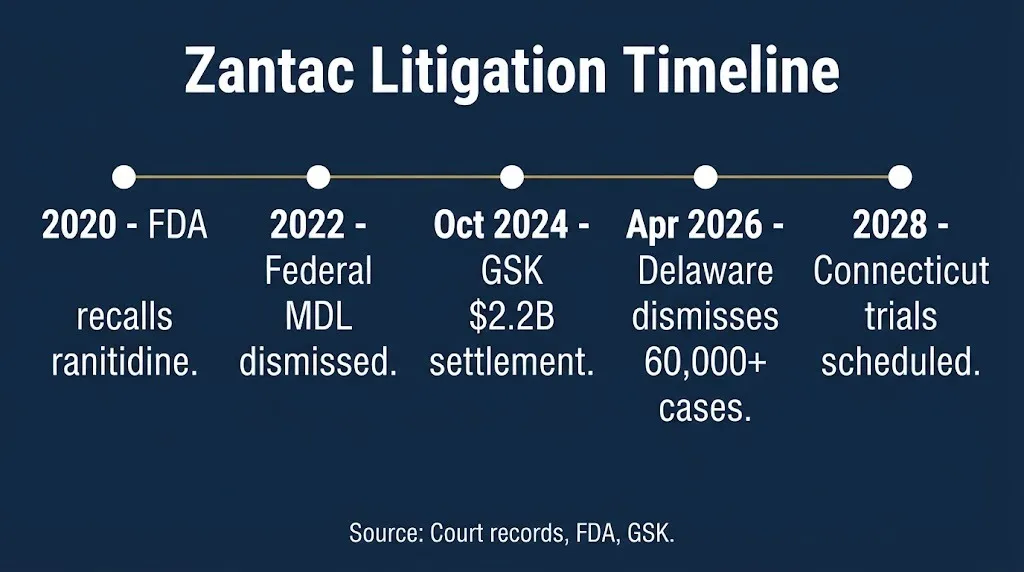
The landscape has changed dramatically since the federal MDL was dismissed in 2022. Plaintiffs lost in federal court on causation grounds, then found new life in state courts. GSK settled most of its state court cases. Boehringer Ingelheim is fighting and winning in Delaware but still faces trials elsewhere.
Whether you can file depends on three things: your state’s statute of limitations, when you were diagnosed, and which company made the Zantac you took. Some states are more favorable to plaintiffs than others.
Key Takeaway: The Zantac litigation is still active but shifting by state. Delaware is largely closed to new claims, while California and Connecticut remain viable venues.
What Happens Next in the Zantac Litigation?
The Zantac litigation is entering a phase of state-by-state battles and appellate review. Here is what to watch:
Expected late 2026: GSK settlement payments continue processing through the claims administrator. Final distributions depend on lien resolution and verification.
Expected 2027: Delaware plaintiffs may attempt to rebuild expert testimony if courts allow renewed Daubert challenges. The viability of new Delaware filings remains uncertain.
Expected March 2028: Connecticut bellwether trials against Boehringer Ingelheim are scheduled to begin .
Ongoing: The Eleventh Circuit appeal of the federal MDL dismissal could affect how causation standards apply across jurisdictions .
Ongoing: State court cases in California and other jurisdictions continue to move forward against remaining defendants.
Frequently Asked Questions
How much does a Zantac lawsuit lawyer cost?
Most work on contingency, taking 33% to 40% of any settlement. You pay nothing upfront.
How much did the Zantac settlement pay per person?
GSK’s $2.2 billion settlement averaged roughly $27,500 per plaintiff, but amounts varied widely based on cancer type and severity.
Can I still file a Zantac lawsuit in 2026?
Yes, in states where the statute of limitations has not expired. Delaware claims filed after December 1, 2025 face dismissal.
What cancers qualify for a Zantac lawsuit?
Bladder, stomach, liver, esophageal, pancreatic, colorectal, and prostate cancers are most commonly linked to Zantac claims.
Do I need medical records to file a Zantac claim?
Yes. Prescription records and pathology reports are essential to prove both drug use and diagnosis.
How long does a Zantac lawsuit take?
These are complex mass tort cases. Expect 12 to 24 months minimum, often longer if the case goes to trial.
Which companies settled Zantac lawsuits?
GSK settled 80,000 cases for $2.2 billion. Pfizer and Sanofi also settled. Boehringer Ingelheim has not settled.
Is the Zantac lawsuit still active in 2026?
Yes. State court cases continue in California, Connecticut, and other jurisdictions against remaining defendants.
If you took Zantac or generic ranitidine regularly before 2020 and were diagnosed with cancer, the clock is ticking. Statutes of limitations vary by state, and some windows have already closed. Gather your prescription records and pathology reports now, then contact a mass tort attorney for a case review. The most important deadline is your state’s filing limit.