Roundup Settlement 2026: Full Update on the $7.25 Billion Deal
Quick Answer
- The Roundup lawsuit is real. Bayer proposed a $7.25 billion settlement in February 2026, and a Missouri judge granted preliminary approval on March 4, 2026.
- Estimated payouts run roughly $10,000 to $165,000 or more per claim, based on a settlement point matrix, not a flat number for everyone.
- The opt-out and objection deadlines already passed on June 4, 2026. The final fairness hearing is now set for August 19, 2026.
If you searched “Roundup settlement” because you saw a headline, a text, or a law firm ad, here’s the direct answer. Bayer proposed a $7.25 billion nationwide settlement in February 2026 to close out current and future Roundup cancer claims, and a Missouri court gave it preliminary approval the following month.
This affects people diagnosed with non-Hodgkin lymphoma who used Roundup or another glyphosate weed killer before February 17, 2026. The single most important number right now: payouts are estimated between roughly $10,000 and $165,000 per claim, depending on how a claims matrix scores your case.
This article breaks down what’s confirmed, what’s still pending, and why a June 2026 Supreme Court ruling reshuffled the entire legal landscape. One detail most coverage buries: the opt-out window already closed in June, so most eligible people are now in the settlement by default unless they act.
The Facts
| Case | Randall King v. Monsanto (Roundup/glyphosate class settlement), Missouri Circuit Court, St. Louis |
| Status | Preliminary approval granted March 4, 2026; Final Fairness Hearing rescheduled to August 19, 2026 |
| Fund Size | $7.25 billion, proposed by Bayer in February 2026 |
| Est. Per Person | Roughly $10,000 to $165,000 or more per claim, set by a settlement point matrix |
| Claim Deadline | Subclass 1 (already diagnosed): register within 180 days of final approval. Subclass 2 (future diagnosis): within 6 years of diagnosis |
| Administrator | BrownGreer PLC |
| Proof Needed | Confirmed non-Hodgkin lymphoma diagnosis and documented Roundup exposure |
Is the Roundup Lawsuit Legitimate?
Yes. The Roundup litigation is one of the largest mass tort cases in U.S. history, and the current settlement is a real, court-supervised proceeding, not a scam.
Bayer, which bought Monsanto in 2018, has already resolved well over 100,000 Roundup lawsuits since litigation began, according to legal-news tracking through June 2026. The company has spent more than $10 billion on Roundup litigation to date.
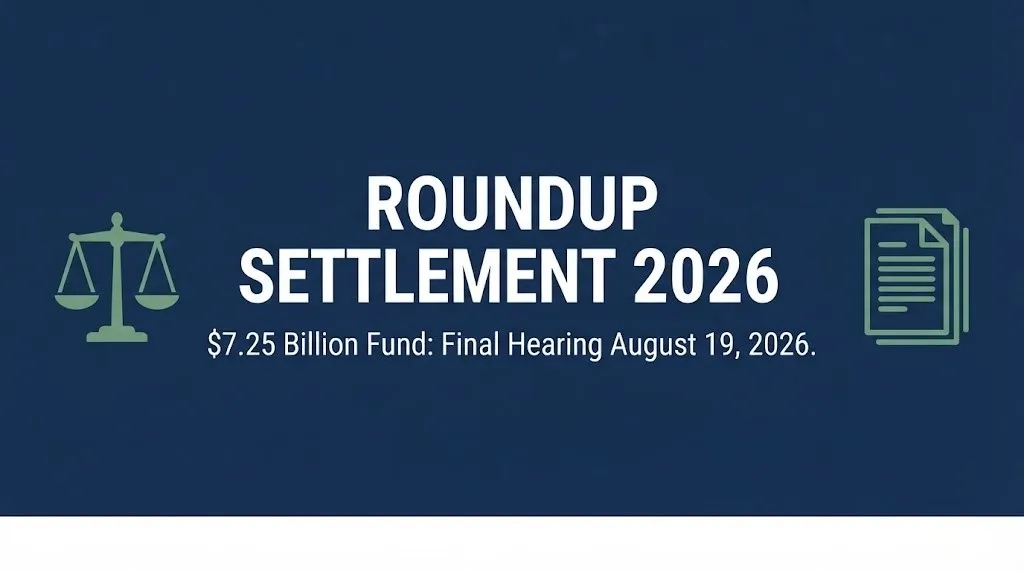
The new $7.25 billion proposal is designed to close out most of what’s left. A Missouri judge’s preliminary approval on March 4, 2026 confirmed the deal cleared its first real court test, though it still needs final approval at the rescheduled August 19, 2026 hearing.
Key Takeaway: The Roundup settlement is a genuine, court-approved process, but it hasn’t received final approval yet, so no payment is guaranteed until the judge signs off in August.
Is There an Official Roundup Settlement Website?
Yes. The official settlement website for this case is WeedKillerClass.com, and the appointed claims administrator is BrownGreer PLC.
Dozens of law firm and legal-news sites publish their own Roundup settlement summaries, and some are more accurate than others. Always cross-check specific numbers, like your deadline or your tier, against the official settlement site or your own attorney, not a random blog.
A quick way to spot a low-quality source: sites that promise a guaranteed payout amount, rather than a range, are usually oversimplifying a matrix-based settlement that hasn’t finished processing claims.
Roundup Lawsuit Settlement Amounts Per Person
Estimated payouts fall roughly between $10,000 and $165,000 or more per claim, though the exact number depends entirely on a settlement point matrix, not a flat per-person figure.
The claims administrator assigns points based on factors like the severity and subtype of your non-Hodgkin lymphoma (aggressive versus indolent), your age, your length and intensity of exposure, and whether you’re classified as an occupational or residential claimant. Higher point totals mean higher payouts.
| Claimant Type | Basic Requirement |
|---|---|
| Occupational | Exposure of 80+ hours in an agricultural, industrial, turf, or ornamental job, earning over 50% of income or more than $15,000 from that work in at least one year |
| Residential | Exposure in a home setting, not meeting the occupational threshold |
| Derivative | Spouse, parent, or dependent child of a class member pursuing a claim tied to a loved one’s exposure |
Not yet determined: exact payout for any individual claim, since the fund hasn’t reached final approval and the matrix hasn’t finished scoring pending claims as of this writing.
Reality Check
No settlement administrator or court will ever text or call you first demanding payment to “process” your Roundup claim. Filing through the official settlement process is free. Third-party sites charging a fee to “check your eligibility” are not required and should be treated as a red flag.
Monsanto Lawsuit Payout: How the $7.25 Billion Fund Works
The fund pays out over as long as 21 years, not as a single lump sum to the whole class at once. That structure lets Bayer spread the financial impact rather than paying $7.25 billion up front.
Two early payments are already scheduled and confirmed: $500 million within 10 business days of preliminary approval, and a second $500 million by August 31, 2026. These early payments are aimed at people classified as Initial Claimants.
Anyone who had already filed a Roundup lawsuit or signed a tolling agreement before February 13, 2026 qualifies as an Initial Claimant and may be eligible for a faster Quick-Pay option, ahead of the standard matrix process. Everyone else moves through the regular claims review once the settlement receives final approval.
How to File a Roundup Claim Settlement
You cannot yet submit a final claim form, because the settlement has not received final court approval, but you can prepare now. Here’s the general process based on the official settlement structure:
- Confirm your non-Hodgkin lymphoma diagnosis date and get your medical records together.
- Gather proof of Roundup exposure, such as purchase receipts, employment records, or invoices.
- Determine whether you fall under Subclass 1 (already diagnosed by February 17, 2026) or Subclass 2 (diagnosed in the future).
- Check whether you qualify as an occupational, residential, or derivative claimant.
- Watch WeedKillerClass.com for the claim form opening and registration instructions.
- If eligible as an Initial Claimant, confirm your prior lawsuit or tolling agreement filing date with your attorney.
- Submit your claim package within your applicable deadline once the portal opens.
- Keep copies of everything you submit and any confirmation you receive.
Key Takeaway: There is no live claim form to submit yet, because the case is still waiting on final court approval scheduled for August 19, 2026.
Round Up Class Action Lawsuit: Who Can Still Join or Opt Out
The window to opt out of this settlement has already closed. The exclusion (opt-out) deadline was June 4, 2026, the same date as the deadline for filing written objections.
You are automatically included in the settlement class unless you formally opted out by that date. If you did opt out, you keep the right to pursue your own individual lawsuit, but you also give up your place in the guaranteed settlement fund.
Eligibility for the class itself depends on two dates:
- You were living in the United States on March 4, 2026, regardless of citizenship.
- You had contact with Roundup, or another qualifying glyphosate product, in the U.S. before February 17, 2026.
If you’re only learning about this case now and never filed anything, you were likely automatically included as a class member, provided you meet those exposure and residency conditions.
Roundup Settlement Update: Where the Case Stands Right Now
The case moved from proposal to preliminary approval in about six weeks in early 2026, and it’s now waiting on final court sign-off. That’s the short version of where things stand.
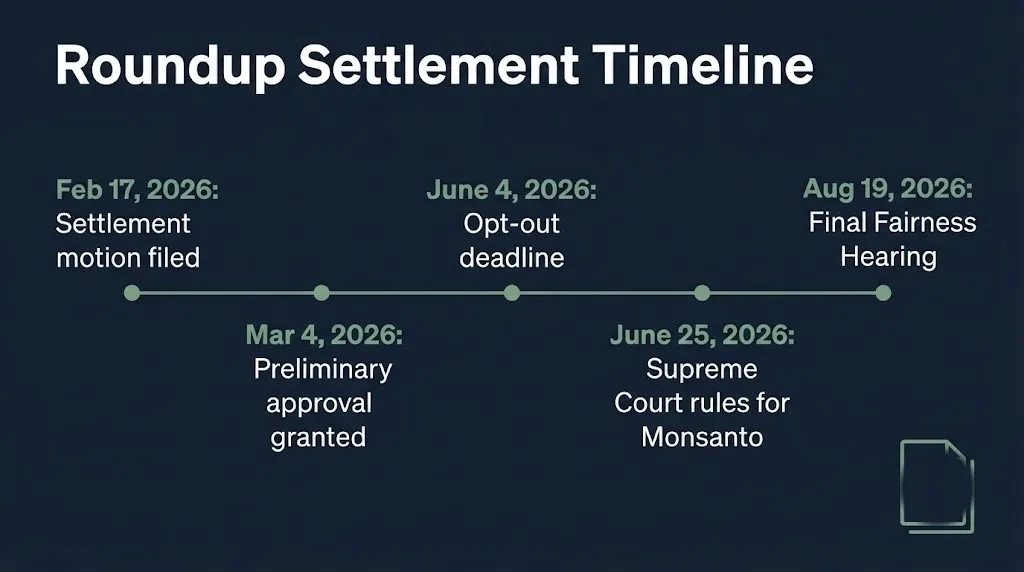
Timeline of confirmed milestones so far:
- February 17, 2026: Class counsel filed a motion for preliminary approval.
- March 4, 2026: A Missouri judge granted preliminary approval to the $7.25 billion settlement.
- June 4, 2026: Opt-out and objection deadlines passed.
- June 25, 2026: The U.S. Supreme Court ruled in a related case in Bayer’s favor (see next section).
- August 19, 2026: Final Fairness Hearing, rescheduled from its original July 9, 2026 date.
The hearing reschedule to August is confirmed by recent legal tracking as of mid-July 2026. No official reason for the delay has been independently confirmed as of this writing.
Latest Roundup Lawsuit News: Supreme Court Ruling Explained
The biggest news in this case since preliminary approval is a U.S. Supreme Court ruling that reshaped what state-level Roundup lawsuits can even argue. On June 25, 2026, the Court ruled 7-2 in Monsanto Co. v. Durnell that federal pesticide law preempts state failure-to-warn claims against EPA-approved labels.
The case involved Missouri plaintiff John Durnell, who had won a $1.25 million verdict after using Roundup for about 20 years. Justice Brett Kavanaugh wrote the majority opinion; Justice Ketanji Brown Jackson dissented, joined by Justice Gorsuch.
The ruling means plaintiffs generally cannot argue that Roundup should have carried a cancer warning label, since the EPA has repeatedly found glyphosate unlikely to cause cancer and never required one. Legal analysts note the ruling does not block every type of claim. Design defect, manufacturing defect, and advertising-based claims may still be viable in some cases.
Key Takeaway: The Supreme Court’s Durnell ruling makes the $7.25 billion settlement more attractive to remaining plaintiffs, since it weakens the argument at the center of most individual Roundup lawsuits going forward.
Round Up Litigation Update: Federal MDL vs the Missouri Settlement
The $7.25 billion settlement is separate from the ongoing federal multidistrict litigation, and mixing the two up is a common source of confusion. The federal MDL, formally called In re: Roundup Products Liability Litigation, is overseen by U.S. District Judge Vincent Chhabria in the Northern District of California.
As of July 1, 2026, there were 3,920 lawsuits consolidated in the federal MDL, an increase of 11 cases from the prior month. That federal litigation continues independently of the Missouri state court settlement covered in this article.
Bayer is reportedly using its Supreme Court win to argue the federal MDL should be significantly narrowed, since the failure-to-warn theory driving much of it is now preempted. That argument was expected to be raised at a status conference in July 2026, though no ruling on it has been confirmed as of this writing.
What Is the Roundup Weed Killer Lawsuit About?
At its core, this litigation claims that Roundup, a glyphosate-based herbicide, causes non-Hodgkin lymphoma in people with significant exposure. Monsanto developed Roundup decades ago; Bayer inherited the legal exposure when it acquired Monsanto in 2018.
Plaintiffs allege the company knew or should have known about a cancer risk and failed to warn users. Bayer and the EPA have consistently maintained that glyphosate is not likely to cause cancer when used as directed.
Comparing this to something more familiar: this is a bit like a car recall dispute, where the manufacturer insists the part meets federal safety standards while thousands of individual owners argue real-world harm occurred anyway. The disagreement over whether federal approval should shield a company from state lawsuits is exactly what the Supreme Court weighed in on this June.
Roundup Lawsuit: Non-Hodgkin Lymphoma and Glyphosate Explained
Non-Hodgkin lymphoma, or NHL, is a cancer of the lymphatic system, and it’s the specific diagnosis at the center of nearly every Roundup lawsuit. Glyphosate is the active herbicide ingredient in Roundup that plaintiffs allege causes it.
The settlement’s claims matrix separates NHL into two broad categories for compensation purposes: aggressive and indolent (slower-growing) subtypes. Aggressive subtypes generally receive higher point values, and therefore potentially higher payouts, under the official matrix.
Exposure alone, without an NHL diagnosis, does not qualify you for Subclass 1 compensation. Subclass 2 exists specifically for people exposed before the cutoff date who have not yet been diagnosed but might be in the future.
Monsanto Settlement History: How We Got Here
This isn’t Bayer’s first Roundup settlement attempt. The company has been resolving Roundup claims individually and in smaller batches since major jury verdicts began in 2018 and 2019, well before this 2026 nationwide proposal.
By June 2026, tracking from legal-news outlets put the total number of settled Roundup lawsuits at well over 100,000, with Bayer having spent more than $10 billion on the litigation overall. Separate reporting placed roughly 65,000 claims still pending or unresolved heading into this settlement, though exact figures vary by source and by month.
Earlier state-level efforts to shield Bayer from future claims, including bills considered in Idaho and Iowa, mostly failed to pass. Similar liability-shield legislation did succeed in Georgia and North Dakota, according to legal tracking through mid-2026. This new $7.25 billion settlement represents Bayer’s biggest single attempt yet to draw a line under the litigation.
Roundup Class Action Settlement vs Individual Lawsuits: What’s the Difference
Joining the class settlement means accepting a matrix-based payout without going to trial, while pursuing an individual lawsuit means keeping your right to a jury but taking on more risk and delay. That trade-off is the core decision facing anyone still weighing their options, though the window to opt out for this particular settlement already closed on June 4, 2026.
Individual lawsuits can produce far larger verdicts in rare cases, as the Durnell case’s original $1.25 million jury award shows. But the Supreme Court’s June 2026 ruling weakened one of the main legal theories individual plaintiffs relied on, making the guaranteed settlement path look more attractive to many remaining claimants and their attorneys.
Key Takeaway: With the opt-out window closed and the Supreme Court narrowing the legal path for individual trials, most remaining eligible claimants are now on track to resolve their cases through the class settlement rather than a jury trial.
What Happens Next
August 19, 2026: Final Fairness Hearing in Missouri Circuit Court to determine whether the settlement is approved as fair, reasonable, and adequate.
Expected, following final approval: Subclass 1 claimants get 180 days to register with the claims administrator, BrownGreer PLC.
Expected, following final approval: A 180-day window opens after the settlement’s effective date for Subclass 1 claim submissions.
Ongoing: Subclass 2 claimants (future NHL diagnoses) can file within 6 years of diagnosis or before the settlement’s 16th annual payment date, whichever comes first.
TBD: Whether Bayer succeeds in narrowing the separate federal MDL following its Supreme Court win, a decision still pending as of this writing.
Frequently Asked Questions
Is the Roundup lawsuit legitimate?
Yes. It’s a real, court-supervised mass tort settlement, with a Missouri judge granting preliminary approval on March 4, 2026.
The case is not a scam, though final court approval is still pending as of this writing.
How much is the Roundup settlement per person?
Estimated payouts run roughly $10,000 to $165,000 or more, based on a settlement point matrix.
Your specific amount depends on your NHL subtype, exposure history, age, and claimant classification, not a flat number.
What is the Roundup settlement deadline?
The opt-out and objection deadlines already passed on June 4, 2026.
Subclass 1 claimants get 180 days to register after final approval; Subclass 2 claimants have up to 6 years from a future diagnosis.
Can I still file a Roundup lawsuit in 2026?
New individual lawsuits face state-specific statutes of limitations, and the Supreme Court’s June 2026 ruling narrowed key legal arguments.
Most people newly learning about this case will fall into the class settlement automatically rather than filing a fresh individual suit.
Who is the Roundup settlement administrator?
The claims administrator is BrownGreer PLC.
The official settlement information website is WeedKillerClass.com.
What did the Supreme Court rule about Roundup in 2026?
On June 25, 2026, the Court ruled 7-2 in Monsanto Co. v. Durnell that federal law preempts state failure-to-warn claims against EPA-approved pesticide labels.
The ruling doesn’t block every type of Roundup claim, but it weakens the argument at the center of most individual lawsuits.
Is Roundup still being sold?
Yes. Roundup products remain on the market in the United States for agricultural and commercial use as of this writing.
What’s the difference between the Roundup settlement and the federal MDL?
The $7.25 billion settlement is a Missouri state court class action; the federal MDL is a separate case overseeing 3,920 lawsuits as of July 1, 2026 before Judge Vincent Chhabria in California.
They are related but legally distinct proceedings.
If you believe you or a family member may qualify, the most useful next step is checking WeedKillerClass.com directly and gathering your medical and exposure records now. Mark August 19, 2026 on your calendar, since that’s the date a judge decides whether this $7.25 billion settlement gets final approval.