Sterigenics Lawsuit 2026: $34M Illinois Settlement, $408M Payout History, and Who Still Has a Claim
Quick Answer
- Sterigenics has settled over 1,100 EtO exposure claims, paying $408 million in 2023, $31 million in 2025, and $34 million in July 2025.
- The largest per-claim average was roughly $464,000 from the 2023 Illinois settlement, though individual payouts varied widely by cancer type and age.
- If you lived or worked within 1.5 miles of a Sterigenics facility and developed an EtO-linked cancer, you may still have a claim, but deadlines are passing and many cases face causation challenges.
Sterigenics used ethylene oxide gas to sterilize medical equipment at facilities in Willowbrook, Illinois, and Smyrna, Georgia, for decades. Residents living near those plants later developed cancers they believe were caused by the emissions.
The company has never admitted liability. It has settled large groups of claims rather than face trials, while simultaneously winning key rulings on the science. That pattern continues in 2026.
This guide breaks down every Sterigenics settlement, what the company paid per claimant, which cases are still active, and the evidence problem that is now deciding who gets paid and who does not.
The Facts
| Item | Detail |
|---|---|
| Company | Sterigenics U.S., LLC (subsidiary of Sotera Health Company) |
| Key Facilities | Willowbrook, Illinois (closed 2019); Smyrna/Atlanta, Georgia |
| 2023 Illinois Settlement | $408 million, 879 claimants, ~$464,000 average |
| 2025 Illinois Settlements | $30.9 million (97 claims) + $34 million (129 claims) |
| Georgia Settlement | $35 million, 79 plaintiffs |
| 2026 Georgia Ruling | Summary judgment for Sterigenics, plaintiffs’ experts excluded |
| Insurance Coverage | Seventh Circuit ruled AIG has no duty to cover $150M in defense costs |
| Current Status | Additional Illinois claims pending or unfiled; Georgia claims face causation barriers |
How Much Has Sterigenics Paid in Settlements?
Sterigenics has paid more than $473 million to resolve ethylene oxide exposure claims since 2023. The company settled cases in two states through separate agreements.
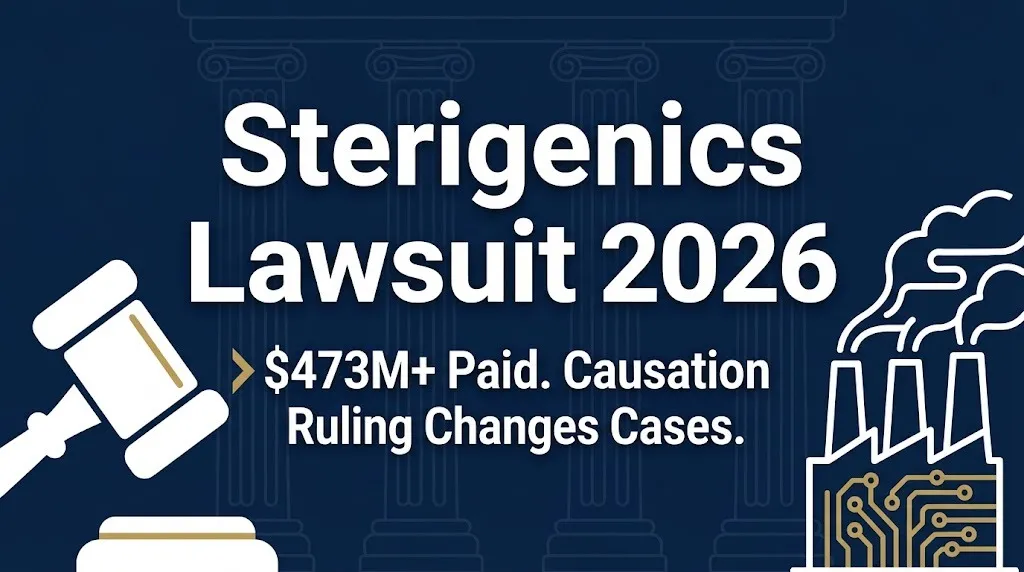
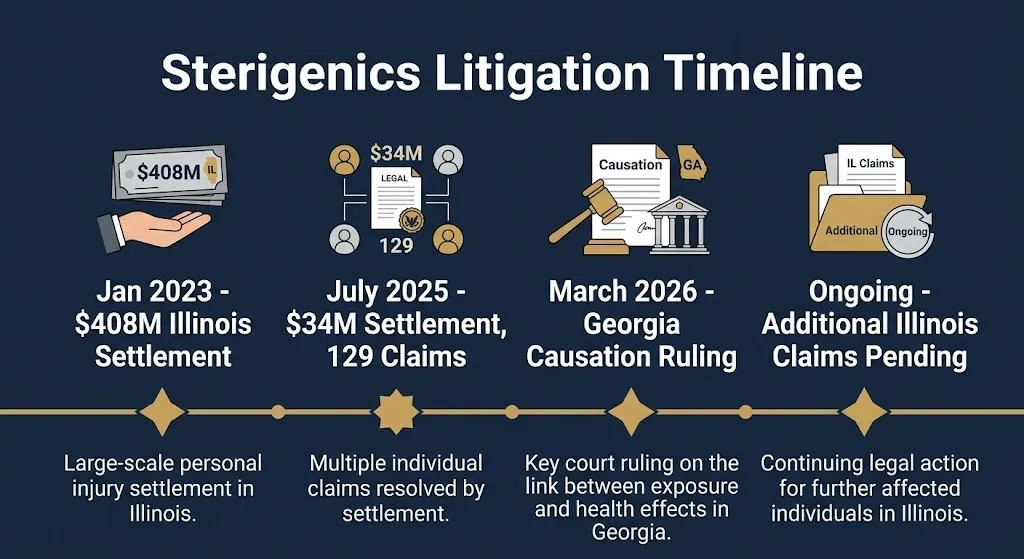
The largest single settlement was $408 million in January 2023. It resolved more than 870 claims from people who lived or worked near the Willowbrook, Illinois facility. That works out to an average of approximately $464,000 per claimant, though individual amounts varied based on cancer type, age at diagnosis, medical expenses, and severity .
In Georgia, Sterigenics paid $35 million to settle 79 claims tied to emissions from its Smyrna facility .
Two smaller Illinois settlements followed in 2025. The company paid $30,943,000 to resolve 97 claims in early 2025, and $34 million to resolve 129 claims in July 2025 .
| Settlement | Year | Fund Size | Claims Resolved | Average Per Claim |
|---|---|---|---|---|
| Illinois (Willowbrook) | 2023 | $408 million | ~879 | ~$464,000 |
| Georgia (Smyrna) | 2023 | $35 million | 79 | ~$443,000 |
| Illinois (Willowbrook) | 2025 | $30.9 million | 97 | ~$319,000 |
| Illinois (Willowbrook) | 2025 | $34 million | 129 | ~$263,500 |
The declining per-claim averages in the 2025 settlements likely reflect different case mixes, different injury severities, and the plaintiffs’ lawyers’ willingness to accept lower per-case values to clear large volumes of claims without trial.
How Much Was the Average Sterigenics Settlement Payout?
The average Sterigenics payout from the largest settlement was roughly $464,000 per claimant. That figure comes from the 2023 Illinois resolution of 879 claims for $408 million .
But averages hide enormous variation. Claimants with aggressive cancers like leukemia or lymphoma, diagnosed at younger ages with extensive treatment costs, received substantially more. Claimants with less severe diagnoses or advanced age at diagnosis received less.
Three plaintiffs opted out of the 2023 settlement and pursued individual trials. One, Susan Kamuda, won a $363 million verdict at trial. That award was later reduced on appeal, and the case ultimately settled for a confidential amount .
The 2025 settlements paid lower averages. The 97-claim settlement worked out to about $319,000 per claim, and the 129-claim settlement averaged about $263,500 per claim . These lower numbers may reflect the strength of the individual cases and Sterigenics’ improving legal position on causation.
Who Qualifies for a Sterigenics Lawsuit in 2026?
You may qualify for a Sterigenics lawsuit if you lived or worked within 1.5 miles of a Sterigenics facility for a significant period and developed a cancer linked to ethylene oxide exposure, such as breast cancer, lymphoma, leukemia, or stomach cancer .
The geographic scope matters. The Willowbrook facility operated for more than 30 years, emitting EtO into surrounding residential neighborhoods. The Smyrna, Georgia facility similarly exposed nearby residents.
Qualification also depends on your diagnosis. Ethylene oxide is classified as a human carcinogen. The cancers most commonly linked to EtO exposure include:
- Breast cancer
- Non-Hodgkin lymphoma
- Leukemia (especially lymphocytic leukemia)
- Stomach cancer
- Pancreatic cancer
Timing matters too. Statutes of limitations vary by state, and the clock typically starts when you knew or should have known about your injury and its potential cause. If you were diagnosed years ago but only recently learned about the Sterigenics connection, you may still have time in some jurisdictions, but waiting is risky.
Key Takeaway: Geographic proximity, a specific cancer diagnosis, and timely filing are the three gates to a Sterigenics claim. Missing any one of them likely bars recovery.
Can You Still File a Sterigenics Claim in 2026?
Yes, you can still file a Sterigenics claim in 2026, but the landscape has shifted. The company has resolved most of the older, stronger cases. What remains are newer diagnoses, previously unfiled claims, and cases that face a tougher causation fight.
Sterigenics disclosed in its July 2025 settlement announcement that it would still face one remaining lawsuit in Cook County after that settlement closed . But the company also warned that it “remains at risk of additional lawsuits, including by people who are diagnosed with cancer and other illnesses in the future” .
In other words, the company knows more claims are coming. The question is whether those claimants can prove causation.
The 2026 Georgia ruling changed the calculus. On March 30, 2026, the State Court of Cobb County granted summary judgment for Sterigenics in five personal injury cases after excluding the plaintiffs’ three general causation experts .
The court found that the medical community does not routinely recognize EtO as causing the alleged injuries at the exposure levels present. Plaintiffs failed to identify a reliable threshold dose. Without admissible expert testimony, the claims could not proceed .
That ruling does not bind Illinois courts. But it signals that causation is now the central battleground, and plaintiffs’ experts are facing successful challenges.
Why Did the Georgia Sterigenics Cases Get Dismissed?
The Georgia cases were dismissed on March 30, 2026 because the court excluded the plaintiffs’ causation experts. Without expert testimony linking EtO exposure to the claimed injuries, the plaintiffs could not prove their cases.
The Cobb County court’s ruling was detailed. It found four problems with the plaintiffs’ expert evidence :
- The medical community does not routinely and widely recognize ethylene oxide as causing the injuries alleged.
- Plaintiffs failed to identify a reliable threshold dose or exposure level at which EtO becomes harmful.
- Plaintiffs did not present reliable epidemiological evidence or background risk analysis.
- The alleged diseases also occur in the general population absent exposure, making causation harder to establish.
Sterigenics called the ruling a vindication. The company said it “aligns with our longstanding position that, when the science is considered fully, fairly and properly, the evidence refutes the plaintiffs’ claims” .
The ruling does not apply to Illinois cases, which proceed under Illinois law and different evidentiary standards. But it gives Sterigenics a powerful template for challenging causation experts in other jurisdictions.
What Evidence Do You Need for a Sterigenics Lawsuit?
You need three types of evidence to pursue a Sterigenics claim: proof of proximity to a facility, medical records confirming an EtO-linked diagnosis, and expert testimony on causation.
Proximity evidence establishes that you were exposed. Utility bills, lease agreements, property records, employment records, or school enrollment documents can show you lived or worked within the exposure zone.
Medical evidence establishes your diagnosis. You need pathology reports, oncology records, and treatment history. The type of cancer matters. EtO-linked cancers carry more weight.
Causation evidence is where cases now succeed or fail. Plaintiffs must present expert testimony that EtO exposure at the levels present near the facility was capable of causing the specific cancer diagnosed. Georgia courts rejected that testimony in March 2026 .
Here’s what to gather:
- Proof of residence or employment near a Sterigenics facility (utility bills, leases, employment records).
- Medical records confirming diagnosis, including pathology and oncology reports.
- Exposure duration documentation showing how long you lived or worked in the area.
- Expert causation evidence, which is now the hardest hurdle in most cases.
- Statute of limitations analysis for your jurisdiction.
What Happened to Sterigenics’ Insurance Coverage?
Sterigenics lost its bid to force its insurer to cover $150 million in legal defense costs. The Seventh Circuit ruled on March 13, 2026 that AIG has no duty to cover those costs because the pollution exclusion in the policy applies .
The ruling followed a certified question to the Illinois Supreme Court. In January 2026, the state’s high court held that “a permit or regulation authorizing emissions plays no role in assessing the application of a pollution exclusion within a standard-form commercial general liability policy” .
Translation: just because Illinois regulators allowed Sterigenics to emit EtO does not mean the pollution exclusion in its insurance policy stops applying. The emissions are still pollution under the policy language.
The Seventh Circuit’s March 13 ruling reversed an earlier district court decision that had ordered AIG to cover the defense costs. Sterigenics has also agreed to withdraw coverage claims under other historical policies .
This matters for claimants because it removes a deep pocket from the litigation funding equation. Sterigenics and its parent company, Sotera Health, are now funding settlements and defense costs from their own balance sheet.
Is the Sterigenics Securities Class Action Still Active?
No. The Sixth Circuit affirmed the dismissal of the Sotera Health securities class action on February 24, 2026. The court found the plaintiffs failed to plead material misrepresentations with the required particularity .
The Oakland County Employees Retirement System sued Sotera Health after its 2020 IPO, alleging the company misrepresented its regulatory compliance and litigation exposure related to EtO. The district court dismissed the case, and the Sixth Circuit affirmed .
The appellate court noted that Sotera “consistently provided an abundance of curative disclaimers” that negated any investor optimism. The company disclosed the EtO litigation risk in its prospectus and tempered its public statements accordingly .
This ruling does not affect personal injury claimants. It only closes off the securities fraud angle against Sotera Health.
Reality Check: No one is going to call you offering money for a Sterigenics claim you never filed. Settlements in this litigation came through attorneys representing groups of claimants. If someone contacts you claiming you’re owed a Sterigenics payout and asks for a fee or your bank details, that’s a scam. Filing a claim with a legitimate attorney is free, and these cases are handled on contingency.
What Happens Next: Sterigenics Litigation Timeline
March 13, 2026: Seventh Circuit ruled AIG has no duty to cover $150 million in Sterigenics defense costs .
March 30, 2026: Georgia court granted summary judgment for Sterigenics in five cases, excluding plaintiffs’ causation experts .
Ongoing: Additional Illinois claims remain pending or unfiled. Sterigenics continues to defend itself and warns of future lawsuits .
Expected 2027: More Illinois cases may move toward trial or settlement. Causation challenges will likely determine outcomes.
Future: New diagnoses near Sterigenics facilities may generate additional claims. Statutes of limitations control whether those claims are viable.
Frequently Asked Questions
How much did Sterigenics pay in settlements?
Sterigenics paid $408 million in 2023, $35 million in Georgia, and $64.9 million in two 2025 Illinois settlements. Total payouts exceed $473 million across more than 1,100 claims.
What was the average Sterigenics settlement payout?
The 2023 Illinois settlement averaged roughly $464,000 per claimant across 879 participants. Payouts varied widely by cancer type, age, and severity. Later settlements paid lower averages.
Can I still file a Sterigenics lawsuit in 2026?
Yes, but causation is now the biggest hurdle. Georgia courts excluded plaintiffs’ experts in March 2026. Illinois cases proceed under different rules. Consult an attorney about your specific diagnosis and exposure history.
Who qualifies for a Sterigenics claim?
You may qualify if you lived or worked within 1.5 miles of a Sterigenics facility for a significant period and developed an EtO-linked cancer like breast cancer, lymphoma, leukemia, or stomach cancer .
Why did the Georgia Sterigenics cases get dismissed?
The court excluded the plaintiffs’ causation experts on March 30, 2026, finding the medical community does not recognize EtO as causing the alleged injuries at the exposure levels present .
Did Sterigenics admit liability?
No. Every settlement explicitly states it is not an admission of liability or that emissions posed safety hazards . Sterigenics maintains its operations were safe.
What happened to the Sterigenics securities lawsuit?
The Sixth Circuit affirmed dismissal on February 24, 2026. The court found Sotera Health adequately disclosed litigation risks and did not make material misrepresentations .
What cancers are linked to ethylene oxide exposure?
Ethylene oxide is classified as a human carcinogen. Linked cancers include breast cancer, non-Hodgkin lymphoma, leukemia, stomach cancer, and pancreatic cancer .
The Bottom Line
Sterigenics has paid more than $473 million to resolve ethylene oxide exposure claims, but the litigation is not over. The company won a critical causation ruling in Georgia in March 2026, and more Illinois claims remain pending.
If you lived near a Sterigenics facility and developed an EtO-linked cancer, the window to file is narrowing. Statutes of limitations vary by state, and causation evidence is now harder to establish. Gather your medical records and proof of residence, then talk to an attorney before the deadline runs out.