Roundup Lawsuit Update 2026: Settlement Status, Eligibility, and Latest News
Quick Answer:
- The Roundup lawsuit is real, with Bayer facing tens of thousands of claims over glyphosate and cancer.
- Settlement amounts vary by case, with prior global deals exceeding $10 billion but no new fund in 2026.
- Claim deadlines depend on individual case filings, not a single class action deadline.
If you used Roundup weed killer and developed non-Hodgkin lymphoma, you are part of one of the largest product liability litigations in U.S. history. The Roundup lawsuit is real, it has produced massive settlements, and it is still active in 2026. But the status is more complicated than the headlines suggest.
The people searching this term include farmers, landscapers, and home gardeners diagnosed with cancer after years of Roundup exposure. The single most important fact is that there is no single Roundup settlement fund, no single claim form, and no universal deadline. Each case is individual, and the window to file may be closing based on your state’s statute of limitations.
This article covers the verified status of the litigation, what settlements have occurred, who may still qualify, and what the latest legal developments mean. One surprising detail: Bayer has won several recent trials, which has shifted the litigation landscape and made new settlements less certain.
| The Facts | |
|---|---|
| Defendant | Bayer, which acquired Monsanto in 2018 |
| Product | Roundup herbicide, active ingredient glyphosate |
| Alleged Injury | Non-Hodgkin lymphoma and related cancers |
| Prior Settlements | Over $10 billion announced in 2020 and 2021 |
| 2026 Status | Active, ongoing individual trials and claims |
| Claim Deadline | State-specific statutes of limitations |
| Proof Needed | Medical records, exposure history |
Is the Roundup Lawsuit Still Active in 2026?
Yes, the Roundup lawsuit is still active in 2026. Bayer continues to face thousands of unresolved claims. The litigation has not ended, and new cases are still being filed in certain circumstances.
The company announced major settlement frameworks in 2020 and 2021. Those deals resolved a large portion of the pending claims. But thousands of cases remained outside those settlements, and new claims have emerged.
| Litigation Component | 2026 Status |
|---|---|
| Prior global settlements | Completed or in distribution |
| Unresolved individual claims | Active |
| New case filings | Limited by statutes of limitations |
| Appeals | Ongoing in some jurisdictions |
| Regulatory status | EPA maintains glyphosate is safe |
The litigation is not a class action. It is a mass tort, meaning thousands of individual lawsuits with individual evidence and individual outcomes.
What Is the Latest Roundup Lawsuit News?
The latest Roundup lawsuit news in 2026 centers on trial outcomes and the shifting legal landscape. Bayer has won several recent trials, which has changed the calculus for both sides.
After early plaintiff victories produced large verdicts, Bayer’s defense strategy evolved. The company has argued that the science does not support a causal link between glyphosate and non-Hodgkin lymphoma. Recent jury decisions have been mixed.
| Development | What It Means |
|---|---|
| Recent defense verdicts | Bayer less likely to settle quickly |
| Ongoing appeals | Prior verdicts still contested |
| No new global settlement | Individual cases proceed |
| Statute of limitations rulings | Some claims time-barred |
The mixed outcomes mean new plaintiffs face a harder road than those who filed earlier. The easy settlements have already happened. What remains is harder-fought litigation.
How Much Was the Roundup Settlement Amount?
The Roundup settlement amounts have been substantial. Bayer announced a settlement framework in June 2020 valued at over $10 billion to resolve then-pending and future claims. A separate settlement in 2021 addressed future claims.
The actual per-person amounts vary widely. Some plaintiffs received significant six-figure settlements. Others received less. The amount depends on the strength of the medical evidence, the extent of exposure, and the plaintiff’s age and prognosis.
| Settlement Component | Reported Value |
|---|---|
| 2020 global settlement | $10.1 to $10.9 billion announced |
| 2021 future claims settlement | Approximately $2 billion |
| Individual trial verdicts | Ranged from defense verdicts to millions |
| Per-person payouts | Varied, often confidential |
These figures come from Bayer’s public disclosures and court filings. Individual settlement amounts are often confidential, so precise per-person averages are not publicly verifiable.
Who May Still Qualify for a Roundup Lawsuit?
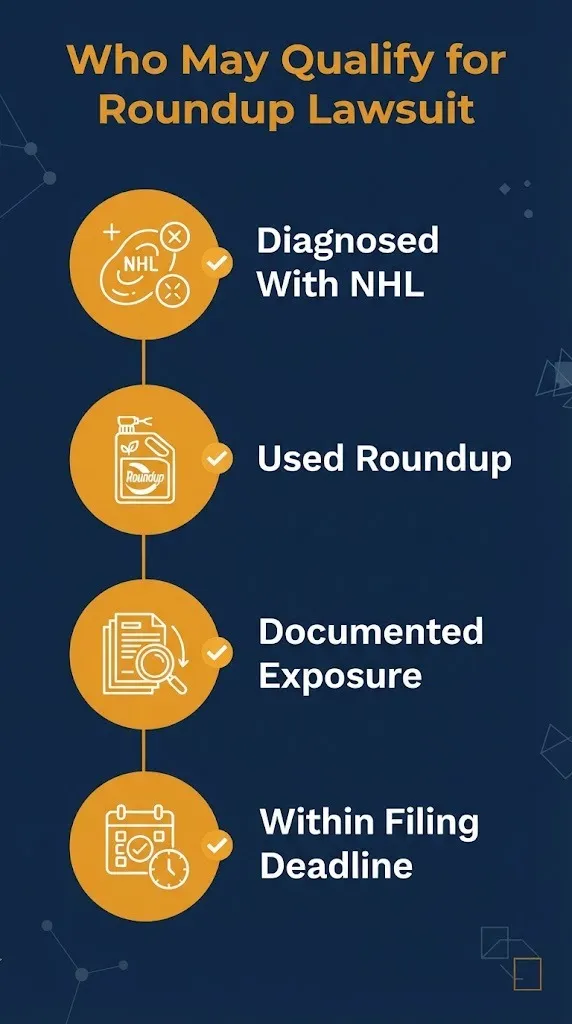
You may still qualify for a Roundup lawsuit if you used the product, developed non-Hodgkin lymphoma, and can document the exposure. Qualification depends on medical records and the statute of limitations in your state.
The strongest cases involve heavy occupational exposure over multiple years. Farmers, landscapers, and groundskeepers who sprayed Roundup regularly have the strongest exposure evidence. Home gardeners with lighter exposure can still qualify but face more scrutiny.
| Qualifying Factor | What It Means |
|---|---|
| Non-Hodgkin lymphoma diagnosis | Required medical evidence |
| Roundup exposure history | Duration and frequency matter |
| Occupational exposure | Stronger than occasional use |
| Statute of limitations | State deadline not expired |
| Medical records | Documenting diagnosis and treatment |
The statute of limitations is the critical gatekeeper. Most states allow two to three years from diagnosis or discovery. If you were diagnosed years ago and did not file, you may be time-barred.
Key Takeaway: The Roundup litigation is still active, but recent defense verdicts and statute of limitations rulings have made new claims harder, and no new global settlement has been announced in 2026.
What Is the Difference Between a Roundup Class Action and Mass Tort?
The Roundup litigation is a mass tort, not a class action. The distinction matters for how claims are resolved and how settlements are distributed.
In a class action, one plaintiff represents a group, and any settlement binds everyone who did not opt out. In a mass tort, each plaintiff files an individual lawsuit with individual evidence. Cases are grouped for pretrial efficiency but resolved individually.
| Structure | How It Works |
|---|---|
| Class action | One case, one settlement for all |
| Mass tort | Many cases, individual outcomes |
| Roundup litigation | Mass tort model |
| Settlement distribution | Individual negotiations or grid |
This means there is no single claim form for a Roundup settlement. Each plaintiff works with their own lawyer, and each settlement is individually negotiated or fits a settlement grid based on injury severity.
How Do You File a Roundup Lawsuit?
Filing a Roundup lawsuit requires hiring a lawyer and providing medical and exposure documentation. You cannot file a claim through a website or by calling a toll-free number.
Here are the verified steps to take:
- Gather your medical records showing a non-Hodgkin lymphoma diagnosis.
- Document your Roundup exposure history with dates and frequency.
- Consult a product liability lawyer with mass tort experience.
- Provide your records for a case evaluation.
- If accepted, sign a retainer agreement.
- Your lawyer files the lawsuit in the appropriate court.
- The case proceeds through discovery, negotiation, or trial.
The process is not fast. Cases can take years. The lawyer works on contingency, taking a percentage only if you recover.
What Is the Statute of Limitations for Roundup Claims?
The statute of limitations for Roundup claims varies by state. Most states allow two to three years from the date of diagnosis or discovery. The clock starts when you knew or should have known the cancer was linked to Roundup exposure.
The discovery rule can extend the deadline if you did not connect your cancer to Roundup until later. But the rule has limits. Courts have ruled against plaintiffs who waited years after the litigation became public to file.
| State Category | Typical Filing Window |
|---|---|
| Two-year states | 2 years from diagnosis |
| Three-year states | 3 years from diagnosis |
| Discovery rule states | Clock starts at discovery of link |
| Minor or deceased plaintiffs | Special rules apply |
Do not guess your deadline. A lawyer can calculate it based on your diagnosis date and your state’s law. Waiting can cost you the right to recover.
What Cancers Are Linked to Roundup?
The primary cancer linked to Roundup in the litigation is non-Hodgkin lymphoma, a cancer of the lymphatic system. Some cases involve related blood cancers, but non-Hodgkin lymphoma is the core claim.
The International Agency for Research on Cancer, a World Health Organization body, classified glyphosate as “probably carcinogenic to humans” in 2015. The EPA has maintained that glyphosate is safe when used as directed. The scientific dispute is central to the litigation.
| Cancer Type | Litigation Status |
|---|---|
| Non-Hodgkin lymphoma | Core claim, most cases |
| Multiple myeloma | Some cases |
| Leukemia | Limited cases |
| Other blood cancers | Occasional claims |
If you have a cancer other than non-Hodgkin lymphoma, your case is harder to pursue. The strongest evidence supports the non-Hodgkin lymphoma link.
Key Takeaway: The Roundup litigation is a mass tort, not a class action, so there is no single claim form, and each plaintiff must prove individual exposure and diagnosis.
What Is Bayer’s Current Position?
Bayer maintains that Roundup is safe and that glyphosate does not cause cancer. The company has won several recent trials and continues to defend the product.
Bayer inherited the litigation when it acquired Monsanto in 2018. Since then, the company has paid billions in settlements while maintaining its public position. The company has also sought regulatory and legal clarity to limit future liability.
| Bayer Action | What It Means |
|---|---|
| Settlement payments | Resolved many claims |
| Trial defense verdicts | Strengthened negotiating position |
| Appeals | Challenged adverse rulings |
| Regulatory advocacy | Supported EPA safety finding |
The company’s willingness to settle has diminished as its trial record improved. New plaintiffs face a more aggressive defense than early filers did.
How Does the EPA’s Position Affect the Litigation?
The EPA’s position complicates the litigation. The agency has consistently found that glyphosate does not pose a cancer risk when used according to label instructions. That finding supports Bayer’s defense.
Plaintiffs counter that the EPA’s analysis ignored independent studies and relied too heavily on industry data. The scientific dispute remains unresolved in court.
| Regulatory Body | Position |
|---|---|
| EPA | Glyphosate safe when used as directed |
| IARC (WHO) | Glyphosate probably carcinogenic |
| European Union | Approved with restrictions |
| State regulators | Varies |
The regulatory split does not decide the litigation. Juries weigh the evidence independently. But the EPA’s position gives Bayer a powerful argument.
Reality Check: No One Is Sending You a Roundup Settlement Check
Reality Check: If you see an ad claiming you can “sign up” for a Roundup settlement, it is a lead generator, not a settlement. No new global settlement exists in 2026. Legitimate lawyers evaluate cases individually and file lawsuits. No one is mailing checks to people who fill out an online form. If someone asks for money to process your Roundup claim, it is a scam.
What Are the Recent Trial Outcomes in Roundup Cases?
Recent trial outcomes in Roundup cases have been mixed. Bayer won several high-profile trials in 2024 and 2025. Plaintiffs won some cases as well. The pattern is less one-sided than the early litigation.
The mixed outcomes affect settlement dynamics. When Bayer wins, the company has less incentive to settle broadly. When plaintiffs win, pressure builds for resolution. The current environment favors litigation over mass settlement.
| Trial Outcome | Implication |
|---|---|
| Defense verdict | Bayer less likely to settle |
| Plaintiff verdict | Pressure for settlement |
| Hung jury | Retrial or negotiation |
| Reversed on appeal | Uncertainty for both sides |
The trial-by-trial grind is how mass torts resolve when no global settlement exists. Each verdict shapes the next negotiation.
What Happens Next in the Roundup Litigation
| Expected Timing | Milestone |
|---|---|
| Ongoing | Individual trials continue |
| Ongoing | Appeals proceed through courts |
| No confirmed date | Potential future global settlement |
| State-specific | Statutes of limitations continue to bar late claims |
| Unknown | Final resolution of remaining claims |
The litigation is in its late stages but not over. Thousands of cases remain. The resolution will come through trials, individual settlements, or a future global deal.
The most important thing you can do is check your statute of limitations. If you have a diagnosis and have not filed, the clock may already be running out.
Frequently Asked Questions
Is the Roundup lawsuit still accepting new claims?
Some new claims may still be filed if the statute of limitations has not expired.
The window is closing in many states.
A lawyer must evaluate your specific deadline.
How much money can I get from the Roundup lawsuit?
Settlement amounts vary widely.
Prior global settlements exceeded $10 billion.
Individual payouts are often confidential.
Do I need a lawyer to file a Roundup claim?
Yes, Roundup cases are individual lawsuits requiring a lawyer.
No claim form or online filing process exists.
Lawyers work on contingency.
What is the deadline to file a Roundup lawsuit?
The deadline is your state’s statute of limitations.
Most states allow two to three years from diagnosis.
Do not wait to consult a lawyer.
Can I still file if my diagnosis was years ago?
It depends on your state’s discovery rule.
Some states allow filing years after diagnosis if the link was not known.
A lawyer can evaluate your specific timeline.
Is Roundup banned in the United States?
No, Roundup remains available in the United States.
The EPA maintains glyphosate is safe.
Some local jurisdictions have restricted its use.
What did the WHO say about glyphosate?
The International Agency for Research on Cancer classified glyphosate as probably carcinogenic.
The finding was published in 2015.
The EPA disagrees with the classification.
How long will the Roundup litigation last?
The litigation could continue for years.
Thousands of cases remain unresolved.
No end date has been announced.
The Roundup litigation is a marathon, not a sprint. The easy settlements are done. What remains is harder-fought, less certain, and increasingly dependent on individual evidence and state deadlines. If you believe Roundup caused your cancer, the time to act is now. Gather your medical records. Document your exposure. Consult a lawyer. The statute of limitations does not pause while you decide. August 25, 2026 is the date this information was verified. The date that matters most to you is your filing deadline, and only a lawyer can tell you what that is.