Dexcom G6 Lawsuit 2026: Settlement Status, Payout Outlook, and Who May Qualify
Quick Answer
- Is it legit? Yes, real lawsuits are active. No settlement fund exists yet.
- How much could you get? Not yet determined. No approved payout tiers.
- Most important deadline? None set for injury claims. Investor lead plaintiff deadline passed December 26, 2025.
What Is the Dexcom G6 Lawsuit About?
The Dexcom G6 lawsuit centers on allegations that Dexcom made unauthorized design changes to its G6 and G7 continuous glucose monitoring systems, and that those changes made the devices less accurate and less reliable for people with diabetes. No settlement has been reached. These are active, contested cases.
There are two distinct tracks. The first is a securities fraud class action filed on behalf of investors who bought Dexcom stock between January 8, 2024 and September 17, 2025. That case is pending in the U.S. District Court for the Southern District of New York under case number 25-cv-08912, with Judge Katherine Polk Failla presiding.
The second track involves personal injury and consumer claims from people who used the G6 or G7 devices. The lawsuits allege that the devices failed to alert users to dangerous blood sugar levels, produced inaccurate readings, or suffered from manufacturing defects tied to unapproved materials.
If you used a Dexcom G6 or G7 and experienced a serious medical event you believe was tied to a device failure, this is the litigation that matters to you. If you are an investor who lost money on DXCM stock, the securities case is the relevant one.
The Facts
| Case | Securities: Prime v. DexCom, Inc., No. 1:25-cv-08912 (S.D.N.Y.) |
| Status | Active. Motion to dismiss filed June 9, 2026. No settlement. |
| Fund Size | Not yet confirmed |
| Est. Per Person | Not yet determined |
| Claim Deadline | None set for injury claims. Investor lead plaintiff deadline passed Dec. 26, 2025. |
| Administrator | Not yet appointed |
| Proof Needed | Check with counsel. Device data, medical records, and proof of injury are central. |
Is the Dexcom G6 Lawsuit Real or a Scam?
The Dexcom G6 lawsuit is real. Multiple law firms have filed active cases, and the FDA has issued regulatory actions against Dexcom that plaintiffs are citing. However, no settlement money is available right now, and anyone promising you a check is lying.
The FDA issued a warning letter to Dexcom in March 2025 regarding quality system and design control problems involving the G6 and G7 systems. The agency cited a design change to a component used in the sensor’s resistance layer, stating that Dexcom failed to adequately evaluate and validate the change. The FDA said the clinical study Dexcom used did not meet its primary endpoints, and some data showed worse accuracy for the changed component.
Dexcom has publicly stated it was responding to the FDA’s concerns. A warning letter is not a verdict, and it does not prove any individual injury case. But it gives plaintiffs a concrete regulatory record to argue that Dexcom had notice of design and accuracy problems.
On the investor side, the class action alleges that Dexcom made false statements about the G6 and G7’s reliability and functionality during the class period. The complaint claims the design changes rendered the devices “less reliable than their prior iterations, presenting a material health risk to users relying on those devices for accurate glucose readings”.
Key Takeaway: Real lawsuits exist and real regulatory scrutiny exists, but there is no money on the table yet. Any website or caller demanding a fee to “claim your settlement” is running a scam.
How Much Could You Get from a Dexcom Lawsuit?
Nothing is determined yet. No settlement fund exists, no payout tiers are approved, and no court has ordered compensation. Any dollar figure you see online is a projection, not a fact.
For context on how medical device settlements work, comparable cases have produced a wide range of outcomes depending on injury severity. In similar litigation, minor skin reactions tend to resolve for modest amounts, while hospitalization-level events and wrongful death claims command far more. But those are estimates from law firm marketing pages, not court-approved figures.
The only honest answer right now: not yet determined.
If you want to understand the potential value of a claim, the factors that matter are documented medical expenses, lost wages, severity of the glucose event, and whether you have device data proving the failure. An ER visit with records showing a dangerous glucose reading while your CGM showed normal is a different claim than a sensor that fell off early.
Who May Qualify for a Dexcom G6 Lawsuit Claim?
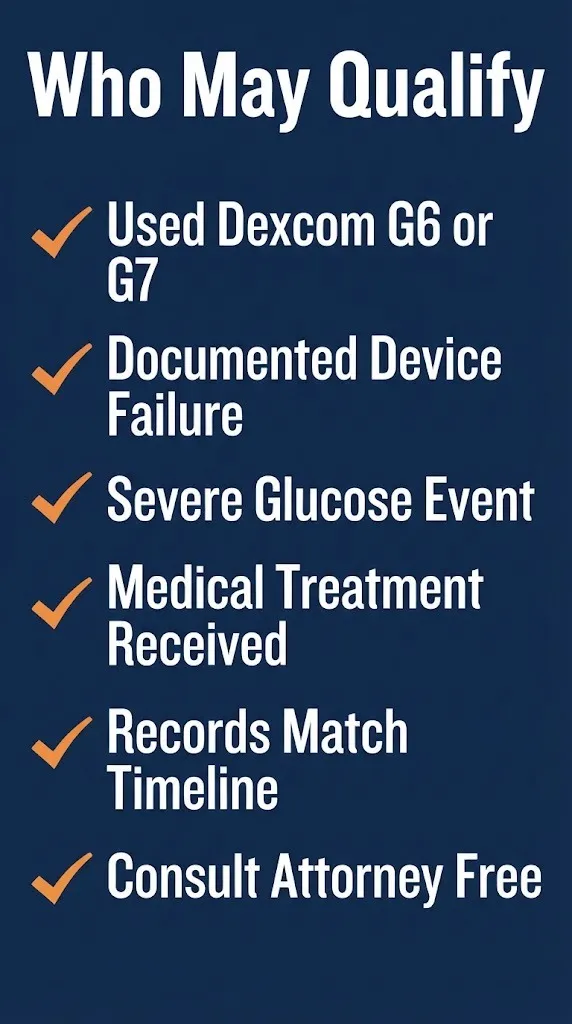
You may qualify if you used a Dexcom G6 or G7 device and suffered a documented medical event that you believe was linked to a device failure. The device alone is not enough.
Law firms handling these cases are looking for a pattern: device malfunction, reasonable reliance on the device, a severe glucose event requiring medical care, and records that connect the dots. The strongest claims involve:
- Missed alerts that led to severe hypoglycemia (seizures, loss of consciousness)
- False readings that led to wrong insulin dosing and diabetic ketoacidosis (DKA)
- App crashes or receiver failures that prevented you from getting alarms
- Hospitalization or emergency treatment for a glucose crisis
- Wrongful death linked to a CGM failure
Minor skin irritation that resolved on its own, general dissatisfaction with the device, or problems caused by user error (expired sensors, incorrect insertion) typically do not support a substantial claim. If you experienced a severe adhesive reaction with infection or permanent scarring, that is a different category with its own documentation requirements.
Key Takeaway: Injury severity and documentation drive everything. A device that beeped wrong without medical consequences is a customer service issue, not a lawsuit.
Reality Check: No One Is Sending You Settlement Money
If someone texts, calls, or emails you offering a Dexcom settlement payout, it is a scam. There is no settlement. Filing a claim in any legitimate class action or mass tort is free through official channels. Third-party “claim helpers” charging upfront fees are unnecessary. Real lawyers work on contingency in these cases, meaning they get paid only if you recover. Never pay anyone to “register” your Dexcom injury.
How Do You File a Dexcom G6 Claim?
There is no official claims process open right now because there is no settlement. If you believe you have a claim, the practical steps are:
- Document your device details. Note the model (G6 or G7), sensor lot numbers, and app version.
- Preserve your medical records. Hospital notes, glucose logs, and treatment dates are critical.
- Save device data. App screenshots, alert history, and CGM reports showing the failure.
- Record your timeline. When the device failed, when symptoms started, and when you got care.
- Consult a product liability attorney. Most offer free case reviews. No fees unless you recover.
- Avoid paying anyone upfront. Legitimate mass tort representation is contingency-based.
- Watch official court notices. If a settlement happens, a court-appointed administrator will publish claim instructions.
The investor class action has a different process. Lead plaintiff motions were due December 26, 2025. If you missed that deadline, you can still be a class member if you bought DXCM stock during the class period, but you will not serve as lead plaintiff. Class members in securities cases generally do not need to file individual claims until a settlement is reached and approved.
When Will Dexcom Lawsuit Checks Mail?
No payment timeline exists. The securities case is still fighting over whether the complaint even survives a motion to dismiss. The injury cases are in early stages, with some being dismissed on procedural grounds like personal jurisdiction.
Medical device litigation is slow. Comparable mass torts have taken years from filing to payout. A realistic timeline for any Dexcom injury settlement would be 2027 or later, and that assumes the cases survive early motions and consolidate efficiently. If you file now, you preserve your rights. Waiting until a settlement is announced often means missing deadlines or getting shut out.
What Are the Injuries Linked to Dexcom Device Failures?
The most serious injuries reported in these lawsuits involve glucose emergencies that the device failed to prevent or warn about. A CGM that stops reporting or gives false readings can lead to dangerous insulin decisions or missed treatment.
Documented injury categories include:
- Severe hypoglycemia leading to seizures, loss of consciousness, or coma
- Diabetic ketoacidosis (DKA) from undetected high blood sugar
- Hospitalization for glucose crises requiring emergency intervention
- Wrongful death in cases where a CGM failure allegedly contributed to a fatal event
- Skin and tissue injuries from adhesive reactions, including burns and scarring
At least 56 severe adverse events have been documented in connection with Dexcom device failures, including seizures and loss of consciousness. One wrongful death lawsuit alleges that a G7 device showed normal readings while the user’s actual blood sugar was 1651 mg/dL, a fatal level.
What Happens Next in the Dexcom G6 Lawsuit?
September 2026: Motion to dismiss pending in the securities class action. The court has not ruled.
Late 2026 to early 2027: Expected discovery and consolidation decisions in injury cases. Some cases may be coordinated into a multidistrict litigation (MDL).
2027: Potential bellwether trial selections if cases survive early motions. Settlement discussions typically follow bellwether outcomes.
2028 or later: If a global settlement is reached, a claims process would open. Payouts would follow months after claim submission.
TBD: No court has set a settlement deadline, claim deadline, or payment date. Watch official court dockets and the FDA’s device recall database for updates.
Key Takeaways
Key Takeaway: The Dexcom G6 lawsuit is real and active, but no settlement exists. The FDA warning letter and device recalls give plaintiffs leverage, but every case still requires proof of injury.
Key Takeaway: Investor claims have a different deadline and process than injury claims. The lead plaintiff deadline for the securities case passed in December 2025.
Key Takeaway: Filing is free. Never pay a third party to “process” a claim that does not exist yet.
Frequently Asked Questions
Is there a Dexcom G6 settlement right now?
No. No settlement has been announced for any Dexcom G6 or G7 litigation as of September 2026. The securities class action is pending a motion to dismiss, and injury cases are in early procedural stages.
How much will I get from the Dexcom lawsuit?
Nothing is determined. No settlement fund exists and no payout tiers are approved. Any specific dollar amount you see online is an estimate from a law firm, not a court-approved figure.
What is the deadline to file a Dexcom G6 claim?
There is no claim deadline because there is no settlement. For the investor securities case, the lead plaintiff deadline was December 26, 2025. Injury claims have no published deadline.
Can I still join the Dexcom lawsuit if I missed the December 2025 deadline?
That deadline only applied to investors seeking to serve as lead plaintiff in the securities class action. If you bought DXCM stock during the class period, you can still potentially be a class member. Injury claims do not have a deadline yet.
Do I need a lawyer to file a Dexcom claim?
If a settlement opens, you can typically file a claim without a lawyer for a class action refund. For personal injury claims, most people use a contingency-fee attorney because proving device causation requires medical records and expert analysis.
What injuries qualify for a Dexcom G6 lawsuit?
Serious medical events linked to device failure: severe hypoglycemia, seizures, DKA, hospitalization, coma, or wrongful death. Minor skin irritation or device dissatisfaction alone typically does not support a major claim.
Is the Dexcom G6 recall the same as the lawsuit?
No. The FDA issued a Class I recall for certain G6 receiver and app issues, and a warning letter in March 2025. A recall is a regulatory action. A lawsuit requires proof that the device failure caused a specific injury.
How long will the Dexcom lawsuit take?
Securities cases typically take two to four years to resolve. Injury mass torts can take longer. No outcome is expected before 2027 at the earliest, and settlement payouts would likely follow in 2028 or later.
What You Should Do Right Now
If you used a Dexcom G6 or G7 and had a serious glucose event, gather your medical records and device data now. Consult a product liability attorney for a free case review. There is no cost to explore your options.
If you are an investor, check whether you qualify as a class member based on the class period. No action is required to remain in the class unless you want to opt out.
The single most important fact to remember: no Dexcom G6 settlement exists as of September 2026. Anyone who tells you otherwise is either misinformed or trying to take your money.